
If you're looking for a car buying rule, let me introduce you to the 1/10th rule for car buying. The 1/10th rule will help you spend responsibly, reduce your car ownership stress, and boost your net worth over time.
If you buy an overpriced car, it is guaranteed to depreciate. If you buy an affordable car based on my 1/10th car-buying rule, on the other hand, then you can invest more cash flow into stocks, real estate, and other investments.
Over time, these investments have the potential to appreciate in value, thereby buying you the most valuable asset of all: time! Having the time and freedom to do what you want is priceless.
The 1/10th rule for car buying is the most followed and most popular car buying rule today. For those of you who want to achieve financial independence soon (FIRE), the 1/10th rule will help you get there.
Americans Spend Way Too Much Money On A Car For Their Financial Health
Back in 2009, I watched in horror as a total of 690,000 new vehicles averaging $24,000 each were sold under the Cash For Clunkers program.
The government's $4,000 rebate for trading in your car ended up hurting hundred of thousands of people's finances instead. With a median household income of only around $50,221 at the time, spending $24,000 on a new car was clearly too much.
Instead of buying a $24,000 car in 2009, you could have invested the $24,000 in the S&P 500. If you did, you would now have over $150,000 today. That's quite an opportunity cost for buying a new car!
Buying too much car is one of the easiest and biggest financial mistakes someone can make. Besides the purchase price of a car, you've got to also pay car insurance, maintenance, parking tickets, and traffic tickets.
When you add everything up, I'm pretty sure you'll be shocked at how much it really costs to own a car and hurl. After more than 10 years, the 1/10th rule for car buying has become the standard car buying rule for financial freedom seekers everywhere.
The Car Buying Rule To Follow: The 1/10th Rule
The #1 car buying rule to follow is my 1/10th Rule for car buying. The rule states that you should spend no more than 1/10th your gross annual income on the purchase price of a car. The car can be new or old. It doesn't matter so long as the car costs 10% of your annual gross income or less.
If you make the median per capita income of ~$42,000 a year, limit your vehicle purchase price to $4,200. If your family earns the median household income of $75,000 a year, then limit your car purchase price to $7,500. Absolutely do not go and spend $49,388, the absurdly high average new car price today!
If you absolutely want to buy a car that costs $49,388, then shoot to make at least $493,880 a year in household income. $493,880 is about the top 1% income threshold today.
You might scoff at the necessity to make such a high amount. However, it takes at least $300,000 a year to live a middle class lifestyle with a family today. Inflation has really made making more money necessary just to run in place.
The last thing you want to do is waste money on a car you don't need.
Minimize Your Financial Stress With A Cheaper Car
If you actually want to save for college, save for retirement, take care of your parents, buy a home, and not stress out about money when you're old, please keep your car purchase to at most 10% of your annual gross income.
Once you buy a car following my 1/10th rule, own your car for at least five years. Better yet, shoot to own it fo 10 years. Don't go selling your car every 2-3 years like most Americans do. If you do, you don't experience the full value of the car. Further, you end up paying wasteful sales taxes each time you buy a new or new used car.
Buying a car you cannot afford is the #1 way to financial mediocrity. One of the biggest benefits of buying a used car is more mental relief. And when you have less stress in your life, you will enjoy it better.
Since Financial Samurai was founded in 2009, my goal is to help readers achieve financial freedom sooner, rather than later. Ideally, I'd like every reader to achieve an above average net worth for their age.
Financial independence is worth it. A car you cannot comfortably afford is a great headwind.
Why You Shouldn't Spend More Than 10% Gross On A Car
If you want to achieve financial freedom, let's go through specific reasons why you should follow my 1/10th rule for car buying.
1) Maintenance costs
The more you drive, the more you will pay to maintain your vehicle. With thousands of parts per car, something will inevitably break or need upgrading. After 10 years of car ownership, everything from your battery to your vacuum pump will need changing.
Not only do you have to pay for maintenance costs, you've also got to pay for insurance, parking tickets, and traffic tickets. Further, the thrill of owning a new or new used car lasts for only several months. However, the pain of paying the same car payment lasts for years.
You might think getting an extended warranty will save you lots of money. But extended warranties are offered because they are more profitable for the issuer, not the car owner. Otherwise, a business wouldn't offer them.
2) Opportunity cost
When you buy a car you lose the opportunity of investing your money in assets that will likely grow and pay you dividends in the future. Everybody knows to save early and often to allow for the effects of compounding. Buying too much car is like negative compounding!
Imagine how much money you would have accumulated if you invested $300-$500 a month in the stock market since 2009 instead of paying for a car? You'd have hundreds of thousands of dollars.
You can dollar-cost average and buy a S&P 500 ETF every month instead of spending money on a car payment. Even better, you could invest just $10 a month in Fundrise, my favorite private real estate investment platform to build more wealth.
Fundrise invests in residential and industrial real estate in the Sunbelt, where valuations are lower and yields are higher. Personally, I've invested $954,000 in a couple private real estate to take advantage of the demographic long-term trend towards lower cost areas of the country. Investing in long-term trends is one of the best ways to build wealth.

3) More Stress
When you pay more than 1/10th your income for a car, you will become more stressed. You'll feel stressed whenever you get a door ding after parking your car at the local grocery store. You'll get stressed whenever you incur wheel rash after parallel parking too close to the curb.
Sometimes when you're driving in traffic, you'll feel more on edge because you don't want anybody damaging your car. If you are within 1/10th of your income, you drive and park stress free. You stop caring about door dings, bumper scrapes, even break ins. Stress kills folks.
In fact, the biggest benefit of driving a cheap old car is less stress. With less stress, your mental health will improve!
Now that my car is nine years old, I don’t care if it gets scratched, or Ding. The other day, I opened my trunk, edit, scraped along a rusty fence. No problem! The older, my car gets, the more I love it. I recommend owning cars for 10 years or more. Then change for better safety features.
4) Makes you want more
The nicer your car, the more you want to spend on other things. You start thinking stupid thoughts like: I've got to buy a matching chronometer watch, driving shoes, and outfit. You start paying $20 for valet because you want people to see you come out of your car instead of park for free.
If you think about it, only the rich or fools buy new cars today. With the average new car price at roughly $50,000, a middle-class household should buy used instead.
5) An expensive car can make you feel stupid
Deep down, you know that if you can't pay cash for your car, you can't afford the car. Each payment you make is a reminder how foolish you are with your money. Why would you want to be reminded every single month of being dumb? The thrill of owning a nice car fades after about six months. But the payment stays the same for years.
Depreciation is intense with new luxury cars especially. I would avoid them at all cost. Instead of buying a $115,000 Range Rover Sport, buy a Toyota Highlander for 1/4th the price instead. Be responsible with your money if you are still on the path to financial freedom.

If You've Already Bought Too Much Car
Look, everybody makes dumb financial moves all the time. The important thing is to recognize your mistake, stop, and fix it! Here are some things you can do if you've bought too much car already.
1) Own your car until it becomes worth 10% of your income or less.
This is the simplest solution if you've spent too much. Drive your car for as long as possible until the market value is worth less than 10% of your gross annual income.
Ideally, you want to get your House-To-Car Ratio up to at least 50 if you want to achieve financial freedom sooner. In other words, the house you own should be worth at least 50 times the value of your car. If you own a car and don't own your primary residence, then you are going to fall farther behind the general public with each passing year.

2) Bite the bullet and sell your car.
If you've spent anything more than 1/5th your gross annual income on a car, I'd sell it. It's making you poor. Even if you have to take a little bit of a hit, I think it's worth getting rid of your vehicle. Don't trade it into the dealer because you'll get railroaded. Instead, try negotiating via Craigslist.
If you have an expensive car lease, here are ways to get out of your car lease. Unfortunately, you will likely be “upside down” on your car lease where you have to pay money to get out of it. Hence, if you can afford the payments, I'd fulfill the lease agreement and swear never to lease another car again.
3) Punish yourself.
Like Silas does in The Da Vinci Code, whip yourself into submission! OK, maybe don't go to that extreme. However, if you don't punish yourself, then you will repeat your mistake and feel fine with what you have now.
For the life of your car loan, take away a food you love to eat such as chocolate. If you are a coffee addict, swear never to drink that stuff again! Save more of your income after taxes. Feel the squeeze so that you realize how ridiculous your car spending is.
If the amount of money you're saving each month doesn't hurt, you're not saving enough!
Recommended Cars By Income (Tastes May Differ)
The beauty of the 1/10th rule for car buying is that it is tethered to your income. If you want a nicer car, you must make more income! Here are some suggested cars you can buy based on my 1/10th rule.

Cars built in the 1990s and beyond are so much more reliable than those built prior. If you are serious about improving your finances, consider buying a car with less options. The less electronics, the less electrical gremlins too. The more you have loaded in your car, the more maintenance headaches you will have in the future.
Below is the chart highlighting you financial status based on your car spending as a percentage of household income. The closer you follow my 1/10th rule for car buying, the closer you will get to financial independence.
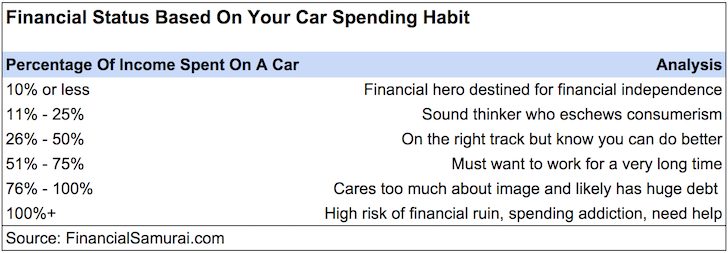
Please note that there is NO SHAME in owning a car that's worth less than $10,000. I bought a second-hand Land Rover Discovery II for $8,000. Then I drove it for 10 years until it was worth less than $2,000.
The car was great and loads of fun. With the money saved from not buying a more expensive car, I diligently invested the money. A decade later, the money grew by over 160%. But it is important to pay attention to safety.
In fact, the best time to own the nicest car you can afford is when you have kids. This way, you amortize the cost of the car across more heartbeats. Further, you have more valuable cargo which means a safer car is even more important.
But once you've found a safe enough car, put your ego aside so you can have true wealth. All the freedom in the world. Your goal should be to generate enough passive income as possible so you don't have to work. Be a time millionaire or billionaire! Freedom is the true value of wealth.
The Choice For Great Wealth Is Yours
Treat the 1/10th rule of car buying like a game. You will be surprised to find how many different type of cars you can buy with 1/10th your income if you make over $25,000 a year.
If you want a $30,000 car, get motivated by the 1/10th rule to figure out a way to make $300,000 a year. One way is to start a side hustle to generate more income on the side. We're all spending way more time at home now. Might as well try to make some side income online.
If you can't get motivated, then fine. Just don't think you can afford much more. Think about your future and the future of your family. A car is simply there to take you reliably from point A to point B.
If you're thinking about prestige and impressing others, don't be silly. Owning a nice property is way more impressive because at least you can potentially make some money from the asset!
The Worst Combo For Your Finances
One of the worst financial combos is owning a car that you purchased for much more than 1/10th your gross income and renting. You now have two of your largest expenses sucking money away from you every single month.
Think about all the wealthy people you know or the millionaires next door. Chances are high the majority of them own their homes and drive used cars. Their cars likely don't come close to 50% of their gross income.
If you want to achieve financial independence, follow my 1/10th car buying rule. Letting material things stress you out is no way to live.
If you want to detonate your finances and end up working longer than you want for the sake of a nicer ride, then go ahead and spend more than you can comfortably afford. After all, we've only got one life to live.
Buy Real Estate Instead Of An Expensive Car
Keep your car expenses to a minimum and follow my 1/10th rule for car buying. If you do, you will increase your chances of achieving financial freedom given a car is almost guaranteed to lose value over time. Instead of buying a fancy new car, use the money to invest in real estate instead.
To invest in real estate without all the hassle and unexpected costs, check out Fundrise. Fundrise offers funds that mainly invest in residential and industrial properties in the Sunbelt, where valuations are lower and yields are higher. The firm manages over $3.5 billion in assets for over 500,000 investors looking to diversify and earn more passive income. The minimum investment amount is only $10.
Another great private real estate investing platform is Crowdstreet. Crowdstreet offers accredited investors individual deals run by sponsors that have been pre-vetted for strong track records. Many of their deals are in 18-hour cities where there is potentially greater upside due to higher growth rates. You can build your own select real estate portfolio with Fundrise.
I've personally invested $954,000 in private real estate since 2016 to diversify my holdings, take advantage of demographic shifts toward lower-cost areas of the country, and earn more passive income. We're in a multi-decade trend of relocating to the Sunbelt region thanks to technology.
Both platforms are sponsors of Financial Samurai and Financial Samurai is an investor in Fundrise funds.
The 1/10th Rule For Car Buying is a Financial Samurai original post. I came up with the rule in 2009. If you want to build more wealth, join 65,000+ others and sign up for my free weekly newsletter.

Once you get over your ego, you can see that buying TWO $4k crapbox 20-year old Corollas every year would cost you less than buying a new Camry at $37,000 / 7% / 60 months. That’s assuming you just throw the first one away without selling for salvage and buy the second one, and also doesn’t even account for the differential in insurance costs (full coverage and gap insurance would be required for the brand new car).
And that’s just a Camry. It’s more than $10,000 LESS than the average new car cost in the US ($47,244 in 2024).
This concept was interesting until I did the math. It makes no sense at all based on the actual cost of cars today. Not to mention the cost of repairs, associated hassle, and loss of time getting repairs done. It is also theory and makes zero sense in practical terms.
What does your math say? Feel free to share it and some examples.
The solution isn’t to spend more on a car. It’s to spend less.
Make sure your House-To-Car Ratio is as high as possible if you want to achieve financial freedom earlier.
Pardon me if I may come across rather bluntly, but you are absolutely deluded… And I’m saying this after double checking whether there might have been a mistake and you are relating about how things were 5 or 10 years ago – yet it says clearly this was written 02/01/2024!!! Have you actually checked car prices in the past few years before saying one should only pay 10% of one’s yearly salary for car acquisition? I suppose you will also say people shouldn’t spend more than 25% of their income on housing? It begs the question: IN WHAT WORLD ARE YOU LIVING?
I am a pensioner on $20,000 (Canadian) a year and $2,000 cars are simply impossible to find. I just got offered a 2005 Camry for $6,000… My present car is a 2004 at the end of its rope (250,000 km in the rust belt is an achievement by itself) and I should spend 30% of my yearly income on a car that may perhaps last another 5 years, if I’m lucky?
I’m sorry, but advice like yours reeks of the famous “let them eat cake” remark attributed to Marie Antoinette of France before the French Revolution when people with money were like they are today, totally disconnected from the reality of the majority.
No worries. I’ve heard much harsher language before. If you are a pensioner, hopefully you have amassed a large enough net worth over the past 30 or 40+ years working to retire comfortably.
If that is the case, then you can follow my net worth rule for car buying, which used assets as a barometer.
Not everybody is as privileged to have invested and lived through the greatest bull market in history, while having a pension. Something like 14% or less of American workers are eligible for a pension.
For reference, this is the #1 car buying rule for financial freedom seekers. I introduced this rule over 10 years ago (this site started in 2009), and it has been followed by over 10 million people. I update this post every year.
For those of us that make more average incomes you have to almost completely throw out this 10% rule of you want a good car in today’s environment.
I make $66,000 a year and I’m probably going to buy a used 2022 Toyota Prius for around $23,000. Right now I own a 2007 Chevy Impala with 122,000 miles on it that’s burns oil. I live in a Rural area of the Midwest with no public transportation whatsoever, so I drive about 18,000 miles a year. Many of my coworkers drive 25-30,000 miles a year.
I was planning on keeping my Chevy impala forever. Drive your car into the ground baby! Until my mechanic got my car underneath a lift and stabbed a screwdriver straight through a rusted out structural portion of the frame. My vehicles frame could snap on the highway at any time. He told me not to take it out for any interstate driving and he is right.
Now if I follow this rule above, I’ll have to spend $6,600 on a car. You know what kind of car I can get for $6,600? Basically exactly the same car I have now (minus a bit of rust). So now I’m back to owning another late 2000s car with over 100K miles on it and probably the same engine and transmission issues my current car has. I might as well buy something newer and treat it better this time around.
But Why a Toyota Prius? Because they consistently get 50MPG on both the highway and city driving. Why do you think whenever you go to an airport all the Ubers and taxi cabs are Priuses? Because they have the lowest total cost of ownership over their lifetime. The 2022 Prius uses a single speed planetary gear style transmission, dual port injected 4-cylinder Atkinsons cycle engine, and has no drive belt or alternator that can fail. The head gasket issues and EGR clogging problems have been solved in the 4th Gen Priuses. The toyota Prius also has a bunch of plastic panels on the bottom to protect the hybrid system, but has the added side effect of protecting the undercarriage from corrosion.
I plan to drive this car into the ground as well, and I think this is the only sensible additude to have if you plan on buying a new car. If you plan to buy a newer car, plan ahead that you will own this car for the next 10+ years and purchase accordingly. This time I’ll use cosmoline on some areas known to rust.
Excellent feedback and analysis. In your situation, a reliable car is vital given you drive so much. Hence, relaxing the 1/10th rule makes sense.
I still wouldn’t pay 1/3rd of my income on a car, but that’s just be.
I’m a big fan of driving a car for 10+ years. My car is a 2015, so it will complete 9 years come July 2024. But it only has 51,000 miles.
Enjoy the Prius!
I think your car spending is reasonable as long as you can pay cash for it. You obviously need a reliable car you could drive for the next 8-10 years. For example, Dave Ramsey recommends not to spend more than 50% on annual income on ALL vehicles owned by a household. You are well within this range. The sad truth is that majority of Americans buy cars they can’t afford and that is why 85% of them are bought on credit or leased. Sam’s 10% rule I think is mostly for people with high incomes who pursue the FIRE dream. I personally try not to spend on a car more than my monthly income, which is easy to do if you make $40-50K a month, and pay cash unless I get 0% financing for 36 months. Congrats on you car choice.
The answer to everyone’s doubts/concerns below is a used Lexus ES350 or RX350. I bought my 2011 RX350 in 2015 for $20k cash and my 2014 ES350 this year for $17k cash. RX350 has been flawless and and has 138k miles on it now. The ES350 is flawless (same drivetrain as RX350) and has 66k miles. I make 160k per year and keep my cars till the tires fall off. Both cars will EASILY reach 250k miles (probably 7-8 years for RX350 and 10 years for ES350). A Lexus or Honda product will last the duration and have small maintenance bills. TBH, I would not have to think twice about buying a 2007 ES/RX350 for $5-10k as they are solid cars. I think this post is brilliant and should be followed.
Greetings,
In 2015 my wife and I bought a new Scion xB, 2015 model year, for $18,840. Our previous car had died and I really needed another one for commuting to work. True, we didn’t need a new car, but the price was acceptable considering it’s a reliable Toyota product. Our combined annual income at the time was $203,000. I still drive the same car today. It’s in very good condition, fun to drive, and we never regretted the purchase. And it has never had a mechanical failure. This 10 percent rule can be done successfully. Don’t waste your money on cars. Thank you for the good advice on this web site.
While I understand and can fundamentally agree with the principals behind this rule, it’s laughable how out of touch this is to the reality of most. I’m sure it’s easy to preach one size fits all financial advice when your individual gross income VASTLY exceeds that of whole households across society.
Why is me buying a $8,000 car when my income was over $80,000 out of touch with reality? The second hand car I bought served me well for over 10 years. Then I followed my 1/10th rule for car buying again and bought a $20,000 Honda Fit and traded in my old car for $1,500.
Just because your reality is different from another person’s reality doesn’t make another person’s reality laughable. What’s laughable is the median household of only $75,000 in America buying an average priced car of $49,500. That’s a surefire way to never achieving financial independence.
Being able to invest and watch the money compound over time for more freedom is way more valuable than buying an overpriced car that is guaranteed to depreciate in value. But, to each their own!
I bought a brand new Mazda 3 about 12 years ago that I still drive. I was probably at about 20% car price / income at the time, but I had saved quite a bit of money the previous 2 years not having a car at all. Now with the car value falling and my higher income I’m under 5% in car value / income even with today’s inflated used car prices. A car has generally been more a convenience and luxury for me since I do live in an area with good public transportation.
With current car prices, is the 1/10th salary rule a pipe dream? I think it’s impossible currently and possibly moving forward.
I just sold my 10 year old Hyundai Economy car for $10k to Carvana. It needed atkeast $2500 in maintenance. New tires, brakes, suspension… but had pretty low mileage at 55k miles. Carvana will probably turn around and sell it for $15k. I bought it NEW for $16k in 2013.
1/10th rule for someone making $50k a year is a $5k car. I would fear for my life driving a $5k car in this market.
$2500 is a lot less than a new car
If you’re earning minimum wage you probably shouldn’t even have a car. You’re sore doing more on gas, insurance, parking and repairs than you can afford. Take the bus. Ride a bike. Walk. Fiscally speaking you probably should not own a car unless your household net is more than $80k, and even then you’re throwing away more money than you can really afford.
I agree that as income goes higher the ratio would change. Probably every $50k mark ratio lowers. Nobody is making $200k and then buying a camry. Also to ppl complaining about used cars Toyota is King and Honda is probably second. It’s funny how ppl will buy an American car (ford, Lincoln) complete crap and then blame it on that it’s used.
My Goal is:
making under 50k > buy no car or motorcycle
100k > used Toyota Camry, 10 years old
200k > used Luxury 5-10 years old (Mercedes’ Lexus etc)
300k > buy any car I want: S class or Tesla P100 or rotate every year
I’m making over $250 and still drive a Rav 4 hybrid. Maybe I should scale up for more comfort, but with current economy, it seems foolhardy.
I wonder how this formula translates to EV, with the price premium associated with them (20-30% cost of equivalent class of cars). I guess 1.30/10 of salary, or do we all need to go down a class? We need to take into account the long-term fuel savings and maintenance costs. I hope this article gets updated.
I’d assume you mean 1/10 of your net sal not gross? Well that only leaves me with very high mileage car that would be more in my machanic’s garage then in mine. The cost of used cars have skyrocked due to high demand and inflation with your paycheck not keeping up.
I had an old car for years but I had to junk it because they don’t stock the parts anymore; the fuel pump went (it was replaced six months before) the car would have kept going if I could find another one but that model car was long gone to the crusher in all the junk yards.
So far I’m lucky that I can walk or bike to work but that’s gonna change too since my rent is going to skyrocket which will force me to move farther away from my job. So now I have to look for a car that is dependable/low miles/cheap to insure/good on gas for around 3,500 or less?? Not in this lifetime!
Gross. Sorry if I was not clear in the post. But I will make it more clear now.
For three years, my car was probably worth between $2000-$4000 until I finally traded it in for $1,500. It worked fine.
As I made more money, I bought a nicer car. It’s a good motivator!
does this include insurance or just the purchase price? As a new driver, my insurance premium is worth more than the cars I am looking at.
Definition of lifestyle creep
Indeed. And if done well, it’s great because it feels so good to spend more money as you get wealthier. Otherwise, we end up dying with too much. And that would be a waste.
wow just ignored my question. Great ethics you have. You have all this money but no manners
Curious. Do you think I owe you anything? If so, the entitlement mentality you have might really hurt you over the long term since you’re not paying anything and consuming this post for free. There are over 1,200 comments on this post. It’s hard to keep track of everything.
Please work on your emotional intelligence (EQ) if you want to grow your wealth, build better relationships, and live an easier life.
“does this include insurance or just the purchase price? As a new driver, my insurance premium is worth more than the cars I am looking at.”
To answer your question, just the purchase price.
At some point this rule stops making sense right? Like if you have a household income of $300k you can afford a $50k car easier than someone who makes $60k a year and buys a $6,000 car.
As you make more money your cost of living doesn’t go up unless you decide it should, but a loaf of bread costs the same regardless of your income.
Great article. My partner and I are a one-car household. We own a car that we purchased for less than 5% of our gross annual income. Pretty good, right?
However, I am starting to look at the total cost of ownership more closely. We’ve been considering getting an EV for some time now. With the higher price of gasoline and extra maintenance costs for ICE vehicles, we would actually save money on an annual basis by trading in our car for an EV that is more expensive on paper (paying cash for the balance, of course).
Hi Jesse – You might enjoy this post on the getting an electrical vehicle might finally be worth it.
Thanks for the link! The only thing holding is back is the recent spike in price of used EVs. Of course, if that gets much worse it will make ICE vehicles look good again.Had we bought a Nissan Leaf a few years ago I’d be sitting pretty right now.
My disability insurance payment is about $2300 per month. I had paid my home off early and inherited around $120k. I want to rent for a year to improve my credit score so I can buy a modest home costing around $150k. I was planning on spending $20k on a car that I intend to keep 10+ years but after reading these articles, I’m second guessing if I should limit the car purchase to under $5k. I have no problem driving a beater; 20 years ago when my terminal illness made it impossible for me to work and make the money I was used to earning I learned really fast that when that hood gets popped open, some cars still say “Toyota”. I then let my high dollar, high payment car go and spent $250 on an older car that lasted 2 years. I haven’t had bought a car via financing since that time. Just wondering what my best strategy would be right now.
Sounds like you need a really reliable car. 10% of $2,300 a month is $230. I would just pay $20,000 cash for Toyota Corolla for something really reliable with the hundred $20,000 inheritance. Keep it simple and minimize car stress.
Hi Sam.
I’m Brazilian. How can I apply and follow this rule living in my country, with a different currency?
Same concept. Spend no more than 10% of your annual gross income on a car, even if it’s in Brazilian real. This may make things even tougher to buy the car you want. But again, a car is a depreciating asset. So you want to allocate the least amount of capital possible to a depreciating asset.
Old used Camry?
One must really love money and hate oneself to do this
Birthing wrong with a used Camry for folks making under $150,000 a year. My dad used to have a 7-year-old one when I was in high school. It ran great. He retired at a regular age and is comfortable.
My wife and I tried this rule. In 2018 we picked up a 2010 Subaru Legacy for $7500 (cash), we were making around $120k at the time. Later on in 2018, we picked up a 2009 Ford Expedition EL for $5000 (cash). Our income has nearly doubled since then. We did the FS and DR approach all in one. It worked well for us to build up savings, but it was a pain in the backside.
The Expedition turned into a headache, leading to us being stranded several times. We learned that the seller disabled the engine light when we bought it, then later found out (assuming) the mileage was rolled back… A LOT. Yes, we did a Carfax on it prior to buying it but the mileage was most likely rolled back 5 years prior. We ended up putting about $8,000 in the car over the 3 years we owned it, not including oil changes. $13,000 in over 3 years, $1,500 back to us on trade-in.
The Subaru did us well for the most part, we ended up having a transmission issue that was going to cost us $6500 to replace, and we had put about $2500 into the car over the 3 years we owned it. It would have been $9,000 repairs over 3 years PLUS the $7500 we bought for it, so we declined and traded it in. We received $3,000 for the trade in for parts, it would have been $5,000 if we replaced the transmission. If we replaced it, that’s $19,000 spent over 3 years on a car that gave us 35,000 miles – it could have gone more had we replaced the transmission but that cost effectiveness just wasn’t there.
We bit the bullet and bought brand new cars.. 2 of them.. we told ourselves we were NEVER going to buy a brand new car. Our financial situation is/was in a good spot; we didn’t follow the 1/10th rule but both cars will be paid off within 36 months. The comparative cars we were looking at were $30-$40k with 100k+ miles, or we spend $40k on a brand new one.
We have 3 kids and live in rain/snow, so we wanted AWD and space. We had PTSD (jokingly) with buying the Expedition and didn’t want to take another chance – too many DIY people out there that don’t know what their doing to their cars. The car loans are sub 2.5% as well. We bought the two new cars thinking that if they last long enough, two of our kids will have them around the 10 year marks.
We paid a “premium” for space, updated safety, reliability and longevity. Even if we have some repairs that are a few grand every 5 years, and we put 200k on the cars before the kids get them, we KNOW the history of the car and we won’t have any surprises.
All that being said… I do like the 1/10th rule and understand it greatly, especially when you’re looking at sling-shotting yourself into a better financial situation. We are also fortunate enough to continue investing/saving/paying off debt with the car payments that will soon be gone.
Cheers.
Much cheaper to buy brand new cars in a long run.
I don’t know who came up with the 1/10th rule, but it was clearly someone who knows nothing about cars. Cheap cars are unreliable money pits, and your story illustrates that. I’d rather spend more for peace of mind.
But I don’t have financial security. At least I have a nice car!
Very interesting article and very informative to many (but not all) people. That being said, not everyone is in the upper 10% wage earners and can waste their hard earned money on such toys costing the majority or more of their income. Those folks that drive BMW’s & Mercedes…all the power to you if you can afford it. But not everyone lives in California, metro-NYC or similar area and has that much disposable income.
The key (as I am in my mid-60’s) after living all over the USA and parts of the world is DON’T LIVE BEYOND YOUR MEANS. Sure, everyone wants to live on the beach with palm trees and great weather year round. I know, I did it from Southern California to the Castles of Edinburgh and everywhere in between. Now I live in the country far from the big cities and related stress due primarily to financial uncertainty. Why uncertainty? Because NOTHING is guaranteed in life except taxes and death. Not your job, income level, health, stock market, vehicle, spouse, home/apartment or anything else. A simple accident or mishap can alter a persons entire life. With all the insanity in today’s “Covid Culture”, things have gone “Bat-S*IT Crazy”.
That being said, after reading many of the comments in this thread, it is interesting to say the least, hearing from both sides of the financial spectrum. What works for someone living in upscale San Francisco is not going to work for someone living in rural Columbus, Mississippi and vice versa.
Personal opinion, if anyone is living paycheck-to-paycheck and spending $60K on a new truck is either trying to impress the girls or over-the-top with testosterone injections. The older guy’s reading this know exactly what I’m talking about…we all have done it to some point. I have seen young people go without eating, live in a dump and work numerous part-time jobs just to make the monthly truck payment on the $60K PU. Insane.
I have always bought high-mileage dependable vehicles. Yes HIGH MILEAGE and if you park them side by side to a new car, you can’t tell the difference. I have read in this thread that a cheaper vehicle will cost $3000+/year in auto maintenance. Yes, if you buy garbage…evidently the guy who wrote that has no idea on how or what type of used vehicle to buy. Remember, in the 1970’s and earlier (specifically up north) cars that made it to 50,000 miles were considered unheard of. The body would rot before the engine failed. No so much today. I’ve seen vehicles past 400,000 miles on the road! You need to have an experienced individual go to the seller and inspect for anything major. The transmission and engine are the biggies. There is no reason you can not have a decent car for around $2500 if you do your homework.
Think about payments. Unless you pay cash (most do not), you can double the amount of the loan if you take it to full term. A $15,000 loan will be like $30,000 when all paid off. Then the REQUIRED FULL-COVERAGE INSURANCE until the loan is paid off in full. If you live in a big city, that is BIG BUCK INSURANCE. Yes, you might save on gas mileage over time and repairs, but, will you be paying $400+/month in auto repairs? I don’t think so.
Bottom line, do what is best for you and your situation as no 2 people have the same variables. What works for me may not work for you. Personally, I don’t have a “Status Class” vehicle to drive around trying to impress others as is unfortunately so common. I’m happy with my 10-year old Jeep Grand Cherokee that is paid off in full ($3000 at the time) that has no body damage, has over 200,000 miles on it, spent only around $300 over the past 2 years in maintenance parts (I repair my own vehicle) and was worth around $40,000+ when it was new. I’ll drive it until it drops. If I bought it new and took out a loan, I would have been a slave to the bank and insurance company for 5+ years. Less stress my way!
PS – Don’t get credit cards unless you pay it off 100% each month either. The 20% interest will eat your soul if left to pay out over time!
I do somewhat agree with the objective and reasoning of the goal, with one caveat. The rule is certainly achievable IF you can perform some car repairs yourself.
I make about average household income, and I own a 2001 Honda Civic and 1991 Toyota. By that metric, I am meeting the 1/10 rule. But for these cars have repaired them myself. The timing belts, faulty camshaft sensor, replacing brake pads. If you can do the work yourself, buying a Civic, Corolla or Camry, you can reliably get by paying very little for a functioning car.
Also, I don’t stress things like dings in parking lots, thieves targeting my cars, or any other damaging element.
I will say I agree with the author’s sentiment, but I do not think it is a make or break law. If someone does 1/5 instead, but sacrifices other areas, they can still accumulate respectable wealth. But the author already made a table for that anyways.
This post didn’t age well at all considering what’s going on with used car market. Used cars cost like new
That’s because you’re not thinking about the opportunity cost of investing in the stock market, real estate market, crypto, etc.
A poor person thinks only about the cost of the car. A rich person thinks about opportunity cost.
I will share a personal example of opportunity costs. We bought a new Tesla Model S in March of 2015 for $108k and sold Apple stock to pay cash for it. At the time, we were living in NorCal and where Teslas were common in our neighborhood. One of my buddies who ran a large body shop group that was one of the few authorized Tesla collision reapair centers and had toured the Tesla plant in Feemont. He was super impressed with Elon and their business model and was encouraging me to buy at least $100k of Tesla stock as he had just bought $150k. I didn’t buy any but if I would have taken his advice that $100k in TSLA would now be worth $2,545,000. I think about it often as I still use that 2015 Tesla with 126,000 miles on it as my daily driver. It’s worth about $32k now, lol.
How do you spell stupid? W-A-R-R-E-N… And that’s for buying a $105,000 Tesla. People like you are so obsessed with others think that you feel you have to live up their expectations, drive what they drive, go whete go etc. Living in the same neighborhood with the Filthy rich wasn’t going enough. You could of went and bought 2- used Honda’s a couple years old or even just 1 and banked the $75,000. Why Honda over other imports. Because of the reliability factor. That Honda will last you forever in some cases as long as you service it appropriately. My next choice would be a usedLexus. They have good engines and are the cheapest to maintain according to many. If you have to hide your Lexus from your neighbors view then you need to move to a different neighborhood as it seems you probably do quite often. Not listening to your friends investment advice may of cost you in terms of paper wealth but hell we all have made that mistake. If someone told me 20 years ago to put my money into bottled water as it’s going to be a huge money maker in years to come I’d a thought he list his mind. Don’t believe in the market either. Many have gone bankrupt and to jail in that corrupt thinking. Ask Martha Stewart. Playing the stock market is like horse racing. Cheat to win, cheat to lose then cheat again to recoup the losses. Life is too short. And if a Lexus isn’t good enough for ya then you might plan on working til you die. You can’t take that Tesla with ya figuratively although some might opt to be buried in theirs, but you can keep making monthly payments for it til you do die. That’s essentially what one is doing by wasting their savings or inheritance on an expensive vehicles. I’d give anything to have a new Raptor. I’m just not willing to pay $100,000 for one that will lose half its value in few years. Crazy stupid there.
Reading this now as I currently need to purchase a car…and I don’t understand FS’s response. The purchase price of a used car now seems to EXCEED the purchase price of a new one of the same model. If the new and used car both drain $30K, where’s the difference except for the lack of warranty, higher maintenance cost, existing wear/tear, and greater uncertainty in buying used? Without a lower sticker price, I fail to see the value in the current market.
I’m not sure what else to say. Feel free to buy whatever you want for whatever price.
If you are OK with forsaking any potential future investment returns, that’s probably a good thing. B/c it means you are already saving and investing enough for your future.
The YOLO economy is here!
This article seems like another hot take. While I definitely agree with the main sentiment (i.e. people spend too much money on cars), 1/10 is way too restrictive. When I didn’t earn as much, I used to drive real beaters, but it got to the point where the hassle of going to the shop all the time just wasn’t worth it. I now drive a Subaru that I bought new in 2015 for 19k. Given that I make about 170k per year, I’m not even adhering to this rule despite being what I consider to be quite frugal.
Wealth serves to fund consumption and enhance quality of life, but people need to be sufficiently conservative to plan for a lifetime of purchases and “what-ifs”. As noted in the article, it’s also important to be cognizant of opportunity costs. Thus, the article’s main point is well-taken, but (as usual) it’s taken to an extreme.
My car buying rule is actually not a hot take. I presented it to the world over 10 years ago and millions of people have take into account.
Over the past 10 years, we’ve had a incredible bull market in stocks, bonds, real estate, and many other asset classes. I really hope that a lot of people during this time Invested more than spend less money on the a car they really didn’t need.
But this is just my recommendation and guide. People are free to do whatever they want their money. Everything is rational in the end!
Yes this is absolutely a hot take. To apply a 1/10 rule you should be applying yearly. Especially in today’s market, if you go out and buy a $4000 car and it has problems on you throughout the year and then the next year or two or breaks down on you then what’s the difference between that and buying a new car which is reliable and paying $3000-$4000 on it yearly? To apply this one 10th rule you will also have to understand some thing about cars in order to buy used, which not everybody does. I find this article just an extra add to confusion, not a solution. It doesn’t add any value or understanding to the costs of buying an old car or how to even go about it. You don’t just spend 1/10 of your salary on a used car and be done with it for even one year. And under these guild lines you could be missing out on a reliable used car over an extra $1000. This article doesn’t guide you in anyway, it’s pointless. It should be revised or deleted.
Sure. If you don’t like the rule, presumably because you don’t come close to following it, do your own thing. No big deal. Nobody is judging you.
Everything is rational. If you love your car and you are happy with your financial situation, great.
Personally, I am happy to not spend so much on cars over the years so I could invest the money fully into the stock market and real estate market.
I just enjoy making more money so I don’t have to work as much to take care of my family. Earning passive income is something I enjoy more than owning my car.
But after such a massive bull market since 2009, I’m thinking of upgrading and living it up more. Once my Range Rover Sport gets to be 10 years old I’m 2025, it’ll be time to change.
I think the ideal length of time to own a car is about 10 years or until it is about 10 years old.
See: https://www.financialsamurai.com/the-ideal-length-of-time-to-own-a-car/
Wow wow wow car buying advices from a Range Rover owner. Interesting.
Pretty cool right? The 1/10 rule doesn’t discriminate between the type of car you buy. It provides a guidance for how much to spend based on income.
Would you rather read car-buying advice from a bicyclist who doesn’t need or want or can’t afford a car?
It’s really up to you whatever you want to spend. At the end of the day, it’s your money and you can live the way you wan. This article was more for people who artist friend we can arrange to help them achieve financial freedom sooner.
If you want to buy a nicer car, make more money. Making 10 times its value.
And on top of everything I said which you may or may not approve. Is that you drive half of the national average. The cost of you owning a used car which you do not let us privy to it’s cut in half for the average person. And again not sure if you do any of you own work On cars or not.
The cost of driving a used car is not that much higher than that of driving a new car, unless that new car is a hybrid. In fact, in most cases, it’s lower, if you take the cost of insurance and depreciation into consideration.
I respect your opinion but I still think this is way overkill. To get straight to the point, not everyone is sitting on a goldmine of money to pay 10% of their annual paycheck on a car and then end up racking up thousands more in repair bills. Case in point myself. My first car was a 2002 VW Passat which I picked up for $2500 but ended up spending $4000 more over two years, along with sleepless nights before I finally bit the bullet and got a certified pre owned 2017 Nissan Altima that came with an extended warranty. Fast forward to today and I just bought my second CPO vehicle, simply because of the stellar ownership experience I had. Did I lose on opportunity cost. Yes, but I could sleep well at night knowing any unforeseen expense (Like a $1200 wheel bearing replacement I did two years ago) would be covered by my warranty, but also the fact that I had a smile on my face every time I got behind the wheel of that car. Cars are my passion, and I have zero regrets spending on one. I will add that I do save/invest at least what I pay each month for my car loan, so I make up a little of what I lose in depreciation. This is also personal opinion but someone buying a 10 year old Land Rover really shouldn’t be advising others on cars. Those things are so unreliable, I wouldn’t go near one with a 10 foot pole. I did have the option of a 2016 Land Rover when I bought my latest car, but even an extended warranty couldn’t convince me to buy one knowing that parts and maintenance would make me broke, even though a vehicle like a Land Rover is perfect for my outdoor lifestyle. To put things in perspective, I’m 29, just having finished graduate school with a PhD, with near zero college debt, so I can afford to lose a little opportunity cost if it means living a little. Also, the idea of passive income doesn’t really appeal to me, simply because I’d be down to working till I’m 85 if it means doing what I love and making an impact on my field of work. This article has a target audience, like my buddy who’s investing to build passive income and follows the 10% rule to a T. But for someone like me who’s got a game plan in place for owning a nice car while at the same time saving sufficient for retirement, I think it just kills the fun out of life.
I will say though that I am not adverse to risks, so spending on a car and investing in higher risk stocks and ETF’s is my thing, and should not be a thumb rule for anyone else to follow. It’s worked well for me, but I can’t guarantee it’s going to work for you.
I think you are missing the point. The point is that the more expensive the car, the more other costs are (typically insurance). Warranties run out and parts wear out on all cars. Also, we can assume you rent and drive an expensive car.
It is fine to justify the expense. That is not the question, but it is not a smart financial choice. And I drive a 10-year-old Grand Caravan that cost just over $6 grand two years ago.
I don’t agree with the ‘not a smart financial choice’ argument. I don’t think there’s a one size fits all financial gameplan for every person. The 10% rule works well if you are already rich or have a large chunk of money in savings, that way the car you get is actually reliable and comes with a warranty in the case of the former or you have disposable cash that you could put in to fixing the car.
In my case, I bought a certified pre owned Nissan Altima for $16k in 2016. This June, my transmission started giving out and I was at 98k miles, just two shy of the end of my extended warranty, and the dealership couldn’t ‘find’ the problem because shutting off the car and starting it up again temporarily made the problem go away. Now I could bite the bullet, dip into my year old savings(I graduated with a PhD last year so I’m 29 and in my first actual job) or do the smart thing and dump the car while the used car market is skyrocketing and get almost the same amount as I put in when I bought the Altima 5 years ago. I shopped around and found a great deal on a 2018 Equinox with AWD, the premium package and the pano sunroof for $24k. With my trade in value, I’m paying just $50 more for the Equinox each month. I also invest/save around that much so it’s not like I’m living beyond my means. And this is my first transition job post a PhD, so I’m fairly confident I’ll pay off the car sooner than my loan term and still save enough for a comfortable retirement. Now I ‘could’ have saved the $$ I’m paying for the Equinox and invested it but at that point it’s money I probably won’t live to use(unless I live past 100). There’s a good saying: You never see a UHaul behind a hearse. You can’t take that extra $$$ with you when your time is up. I can both enjoy my passion for cars and save for a comfy retirement at the same time with my current trajectory.
This smacks of special pleading.
The rule is a good guideline, and yes, it means many people wouldn’t even have a car if they followed it. But if you want to be like most people, then you will end up like them – which is living paycheck-to-paycheck.
Not sure why you keep mentioning you have a PhD, as it’s irrelevant to the point and only shows that having a PhD is no certainty of financial literacy…
I think a PhD is a bigger investment than putting $500 in the stock market each year for the 6 years you’d spend to get the degree. Education is never a waste of money. I’m not talking about most people, I’m taking about peers with a PhD in my field. My professor with a PhD in my field makes about $250k a year with his wife and they own an Audi E-tron and a Chevy Traverse, they buy new cars every 3 years and are building a new house so I doubt he lives paycheck to paycheck. I also think he’s smarter than someone who makes $250k a year and drives a Toyota Camry because they feel guilty about spending more on a car when they love driving. If you can’t enjoy the money you earn, you need to question your life choices.
I think you just reinforced my point above. And your example professor (if real) is almost certainly living paycheck-to-paycheck if they live anywhere near SF or in any HCOL area.
No I haven’t. I’m saying you can enjoy spending money and save if you make enough money. Even with a temporary post doc position, I still save money despite renting and paying off a car loan. I know that once I move to a full time professor position in academia, I’d probably save even more. Assuming I work till I’m 70-75, I’d have plenty of money to enjoy retirement and then some. You’d need to be splurging on a lot more than a car to live paycheck to paycheck with a $250k salary, so it’s all relative to someone’s lifestyle.
I think this article works well for someone like my sister and brother in law who view work as a chore and want to retire early like the OP. Otherwise, you’d essentially be making money you’d never really end up spending unless you somehow live way past 100.
Well, if you’re a postdoc now, you *might* be a full professor in 10-20 years. Academia is brutal. Why you need to save now.
This has to be the stupidest take I’ve ever seen. If you make $60k/yr only buy a car that is worth 6k… wtf logic is that?!
I deserve a nicer car if I make $60K/year. Why can’t I drive a $50,000 BMW if I want to?
Just because I didn’t do well in school or go to a good college and land some high paying job, I should be able to afford the same luxuries as those who have done those things!
A $50k BMW is overkill, just like this article. You’d be better off with a much more reliable $30k car. Word of advice, don’t buy European vehicles, the maintenance cost will get you eventually. For comparison, a Camry XSE costing ~$30k will hold its own and then some against a BMW 5 series in terms of equipment and features and will give you more than 200k miles of use. You’d be lucky if that 5 series makes it to 100k miles without major mechanical issues.
I believe the person you are responding to was being sarcastic. Read the last bit again…
I can’t even get on board with the 1/10 rule. I don’t want to spend more than $2,500 period, I don’t care if other people think I’m poor because of the car I drive, I would prefer to insure I’m not poor because of the car I drive. The new car flavor wears off way too soon I could never justify paying a car note, the car serves the same function, get you from point a to point b. I’m not paying a premium for that. I’ve seen countless friends take on car notes from $300 to $500 a month, it’s a colossal waste of money. Many of them trade up every 3 to 5 years. I can’t understand that desire to be in perpetual debt, it’s like they don’t even care what the total cost is, they just say “It’s only $300 a month” I’ve never had a car note and never will, I was never able to understand why so much commitment must be given to what gets you to and from work when cheaper options were always available. A $2,000 car that is well taken care of can get you to work or the store just like a $50,000 car. The cost of a car note would have to equate to the cost of extended basic cable in the 1990s for me to justify it and I’d even have a problem with that because it’s recurrent. That was $40 a month. Of course on my income level, this guide also says I should basically be getting around on a skate board or a scooter.
I admire your aim, however at $2,500 I would be concerned about the car’s reliability. Especially nowadays with the inflated car prices. A cheap car is no good if you need it to commute to work and run the risk of not being able to get there.
Hi there! Really enjoyed this article, thank you. Before I get to my financial/car question may I suggest you put a more user friendly “Leave A Reply” / Comment area… I had to scroll an insane amount past all your 1000+ comments until I found the comment box at the very end. Why not install at the end of your article?!
Your 1/10th advice, are you suggesting 1/10th of one years costs per vehicle? So we make about 130k /year, 10% would be 13k. Would that be our budget for vehicle costs per year? Or total cost/life of the vehicle? If it’s just the budget for the year, that’d be estimated about $1083 per month or less.
We bought a car new in 2006, total costs about $25k, paid it off and still driving it today June of 2021. Definitely have gotten our value out of it! We’re keeping this but need another vehicle and want to stay under 30k, well under if we can find the smaller suv needs we are looking for. Looking at your advice, it’d make sense if you’re saying don’t spend more than 10% of your income on a car yearly… but if you’re speaking 10% total life of car, seems very extreme and not a lot of options with that?
Another question, We’ve saved up money and can buy with cash or at least part of it but don’t want to tie up cash in a vehicle IF we’re able to get a very low interest rate? What’s your take on cash vs. loans etc?
Thanks so much for your time and help!!
Hi Sam, I appreciate you writing this, I think it points a lot of people in the right direction, especially those that view cars as a utility. I assume that if someone was to view cars as a hobby and spend the money they have allocated for hobbies as well as 1/10th their income they have on a car, you’d see no problem with it?
My main gripe, however, is that a lot of the reasons you brought up for not overspending on a car (maintenance, insurance, life-style creep) are more closely tied to the make a model of a car than to its purchase price (whether new or used). For example, if someone made 120k, using the 1/10th rule, they could buy a 12-year old BMW 7-series for 12k and it would be better decision than a used 2-year old camry for 20k. The problem is that the aforementioned problems, (especially maintenance), are going to be way worse on the BMW and cost way more in the long run, making it a worse decision, despite the lower purchase price.
My point is that I think a car’s affordability has a lot more nuance to it than simply the purchase price of the vehicle. I’m interested to hear your thoughts on this. Thanks!
If income 120k, according to 1/10 rule one should get 12k Camry, which for sure less maintenance than a 12k BMW 7.. Nuance is that with same budget you still need to look for less mainenance and less insurance car, but that apply to new or used car.
If you can justify how newer 20k Camry cost less than a 12k Camry after maintenance, insurance…etc then yes 20K Camry will make more sense than 12k BMW.
How does this rule apply to households that need 2 cars? Also we already own one car flat out and will need to buy a new car later this year.
It’s the same. 1/10th rule applies to total household income for as many cars as you want to buy. $200,000 household income, perhaps buy two $10,000 cars.
The car buying rule is to encourage families to either be disciplined spenders are encourage families to try and make more money from a day job or at home.
My income is around a million, I owe 150k on my house. No other debt.
I just dropped 150k on a new Mercedes G wagon.
I understand your 1/10 rule, but i think as the income goes up, the 1/10 ratio can change.
I don’t feel guilty, irresponsible, or foolish for spending 150k on a car in my situation….I have no boats, no cabin, toys, no kids and and a conservative wife.
But I realize you are providing general advice…
Nice! I had a MB G500 before as well, when I was 25 years old and only making about $200,000. But mistake. But it was fun while it lasted! Bought a condo in 2003 soon after I got rid of it.
THANK YOU for writing this! I have been on my sister about this for a solid year. She has a couple of kids and keeps talking about needing a minivan. She and her husband are both teachers and make around $60k combined. I told her she needs to focus her search on something in the $6k range. She keeps trying to tell me that is unrealistic and she needs something reliable, which will cost at least $15k to $20k. I have told her she is absolutely crazy to even think about spending that much given their income. I completely agree with you that if she and her husband want a vehicle that costs that much, then they need to figure out a way to make $150k to $200k. As you said, they should easily be able to get a side hustle that adds $100k or so per year. Just drive an Uber or sell stuff on Etsy or something. It’s not THAT difficult!
It definitely was a great idea having a couple of kids while making $60K combined.
Agreed! And don’t have even get me started on that. From the time she was pregnant, I told her that she needs to look into adoption. Give those kids a chance. They are now 6 and 4 3 and I continue to plead with her to look out for her (and their) financial well-being and look into giving her kids up to a family that can afford to give them a good, financially stable life. I can tell that she doesn’t like me to bring it up, but I’m going to continue to do so as long as she and her husband are basically “working poor”.
Okay depending on the area, 60k is not poor, it’s middle class. I think trying to convince someone to give up their kids is horrible thing to do, unless they are mistreating the kids. As long as the kids have food, shelter, and supportive parents, they’re better off than they would be in foster care. I can almost promise you those kids, if given up, would not end up in a well off family, since well off families mainly want to adopt kids. If you really wants what’s best for your sister and her kids, sit her down and explain to her the math behind saving and her spending decisions, instead of harassing her to give up her own kids!
I never reply, but dude, you are completely nuts for this post. There are plenty of ways to raise kids on $60k/yr and “give them a chance.” I do not think $15k on a car at their income is not a fantastic choice, but it isn’t gonna ruin their lives. Of course she doesn’t like you bringing this up you sound like a complete nutter for telling her to give her kids up for adoption because you think $60k/yr is poverty. Seriously consider seeking treatment. I’m surprised your sister still talks to you if you have done the psychotic things your post claims.
Wow! Are you not familiar with the power and depth of the love between a parent and child? Are you really that superficial or are you just joking?
This post reads as sarcasm or satire. I think the posted is calling out the fact that this guidance only makes sense when presented with choices. Some people don’t have the luxury of a good choice vs a bad choice only bad choices with different degrees of consequence and risk.
Buying an old sh&*t box will save money but it comes with other risks – like that of safety. One needs to weigh the likelihood of occurrence against the impact of the risk.
I really like Financial Samurai for financial rules of thumb but come on – it is not possible to buy safe reliable transportation for 3 kids for under 15k (unless your a mechanic)
That said – I WISH I could bring myself to buy a new car. I have 0 debt (mine and wife college, grad school, 2 cars and house all paid off) off) 45 years old. $1.5MM net worth. $200K cash in emergency fund. 2 kids. 50K saved so far for college.
When is it ok for me to spend $40K on a new car without the guilt?
When household income reaches $400,000+ :)
I actually just wrote about saving for college in a 529 plan and for generational wealth transfer purposes.
$50K for two kids is not enough unless then are both under 5. I don’t think we parents should count on our kids being genius or being prudent enough to go to public school.
What if you’ve managed to build up that Net worth on only $150,000 a year at your age, that is really well done. And I would say splurge a little and shoot for a $25,000 a year car, not $15,000.
That said, I drove an $8000 car the depreciated to $3000 for 10 years and it was great. It was a Land Rover discovery 2 and could gave transported 4 no problem.
How much did you spend on repairs on a very unreliable rover?
And don’t say nothing because I’ll know your fucking full o shit.
Anything not Toyota is not reliable. The end.
Why so much anger? When I drove a Toyota FX16 hatchback, I was proud of it. Be proud of yours!
It’s a great stealth wealth car.
Since owning my RR since 2016, I’ve had to replace the big fan in front of my engine. It stopped worked in 2019. Just out of warranty so the cost was $675 I believe. Replaced a fuel sensor recently as well. That was $300.
Not bad.
You are the one that needs help, not your sister. You clearly don’t understand the bond between parent and child. If they want a reliable ride, so be it. I don’t believe anyone’s financial status is set in stone for their lifetime. For all you know, they might be making more than you in a few years, what then? And have you even considered the cost of maintaining a $6k vehicle, and all the mechanical breakdowns, not to mention the lack of safety features they would have to deal with. Cars are no longer a luxury, but rather a necessity. If they can take out a loan for a 20k vehicle, stretch it out longer for the sake of low payments now and pay it off faster when they make more money, that would be a wise choice.
I am trying to understand where they teach? Do they both have a full time assignment? $60K combined seems to be very low and unless they teach at some rural private school, most teachers in any public school make more than $30K. As far as the minivan is concerned, it is better to spend a little more and get a good van that will last a decade instead of buying a car that is going to give trouble few years down the road. I don’t consider $10K a lot for a minivan regardless of income. It’s 2021, not 1990
So basically by the logic of this ‘1%er mentality’ article, the majority of Americans can only afford very high mileage used clunkers and my experience with older clunkers is that there is hidden cost of both time and money that goes beyond just the face value sale price. Paying someone to fix your car adds up real fast. Then, the after effect would be that no dealerships will be able to sell any new vehicles and only the 5% of top wage earners will have dope rides while everyone else ride bicycles around. Way to keep the bar unattainable, but then that is the end goal of capitalism, the few get it all in the end.
Yes, the amount of money people spend on not just cars but *options* on their cars is completely f’ing insane. I understand why. Car culture is a religion and an obsession for many men. But imagine someone adding $10k in options to their $1k phone or laptop. You’d think they were completely insane. And it doesn’t matter that it’s a more expensive base price. For a given level of income/wealth the amount you spend on unneeded options on *anything* should be relative only to your wealth not to the base price of the thing. Having said that, I know the rule is simply stated for the purposes of a lowest common denominator (i assume) but where you live makes a big difference. Since cars cost the same nationally, but houses and other costs of living don’t.
It amazes me how easy people spend $5 on Starbucks latte’s and $10 on a banana split at an ice cream parlour. If you buy a new car with the desired options and you then drive the car for the next decade, so what? For a lot of people, a dependable car is a MUST. I think this 10% cut-off is very conservative and not working for a lot of people.
Just for perspective though… I’m considering going back to school for a PHD which would in no way increase my salary and I’d only be doing it for the experience (I.e. lifelong dream). The opportunity cost will be about $300k which is MORE than my annual income and it’s purely a luxury. But if I die without it I’ll deeply regret it. Life is ultimately about experiences and minimizing regret. Finances factor INTO that but if finances become the dominant factor in your life, you’re missing the point.
Exactly! I just graduated with a PhD and I’m working on my Post Doc with an annual income of ~$55k and I just got a 2018 Equinox for $25k. I have next to no student loan debt, and I’m looking at a great career moving forward. I’m not going to buy a $5000 clunker and end up paying $5000 in repairs over the next 5 years just because of a 10% rule. My first car was a $2000 VW Passat when I was making $25000 as a graduate research assistant during my grad school days and I ended up putting almost 5k down on repairs, not to mention the sleepless nights worrying about what would break next. I had enough and financed a certified pre owned Nissan Altima for $16k that put a smile on my face every time I drove it for the next couple of years and helped me sleep better at night. A sub $10k car is not worth the hassle. Not everyone can afford to wipe off their hard earned savings on repair bills.
Also on a side note, go get the PhD! It’s really going to boost your career for the future! It’s huge future investment if you ask me
I think that in 2020, 10% of your annual income is on the way too cheap side for an entire car. For one, that leaves the average consumer in the $4,000-$7,000 range which anyone who has ever shopped used cars knows that’s the “Goldilocks Zone”, as in the supply just doesn’t exist. I can also tell you that for that price you aren’t getting anything under 100,000 miles. I can also tell you as someone who has owned many cars in that price range and mileage that your WILL have expensive fixes to handle. In fact, any car over 100k miles needs to have the timing belt, water pump, serpentine belt, pulleys, fuel filter, spark plugs, and probably struts swapped out immediately to continue operating, which adds an extra $1000 at least. I’m someone who has to drive 300 miles a week commuting. That means you’re suggesting over 15,000 miles a year on a beater car for 10 straight years. Yeah, screw that buddy, I’ll spend a couple extra thousand and get a warranted car with a few lower miles. 25% of income seems more reasonable for people who aren’t Mr.Krabs. I spent that much about 4 years ago and now I make almost twice as much so it works out well. The car still hasn’t crossed 100k and it’s still worth about 10% of my yearly income. Nothing horrible happened and my car is better than yours.
I guess the problem is your concern is about the lifespan and maintenance add up the real cost and that make sense. But once it is raised to 25% people start to talk about brand and luxury car and not most economical Japanese car. Also this rule applies to new and used car. As for used car it is possible to better off spending 25% on a Japanese car than 10% on a used Range Rover.
You obviously haven’t heard of Tesla. Cheap cost to operate, very little maintenance, and with full self driving coming it is an appreciating asset.
I’ve heard of Tesla. I’ve been an investor in the company since 2018 and am very happy. I actually know a couple people who could have invested in Tesla in 2018, but bought a Tesla instead. Ouch. They’d have over $500,000 in gains today.
Exactly. Instead, they sad and poor today. If they had only thought about how much happier and better than other they could have been if they had purchased the stock instead.
I bought a Tesla. Yes. I would have been better off financially if in invested the money paid for the Tesla, in Tesla stock. However, getting to know the car and see how awesome it was made me decide to invest in Tesla too. Not so many stock but still. So, buying the Tesla was a sound investment. After three years it is still a joy to drive and I don’t regret anything. Life is too short for that.
I bought A a tesla model X and a model S and I have never had an issue with money. It might also be that I make over 500,000$ in anual household income A year. I agree that tesla’s are amazing and I still love to drive them. my other car’s were BMW and audis but I say that tesla is way better! I saw up there the cars you should buy but I say if you can afford that car and it’s what you like there is no problem buying it! So I say tesla 100% all the way.
What if my company pays for car worth 25% of my Gross annual income , and, every 4 years I am entitled for new car ? Company pays for insurance also every year.
If I don’t buy the car then amount of car is paid to me in 48 installments, after 30% tax deduction.
Will this 10% Rule will have relaxation to 25 % ?
Why are there so many replies here looking to cheat. I remember in school where teachers would discourage cheating in an exam by say, “If you cheat you only fool yourself.” That didn’t necessarily seem to be the case though.
But this is like dieting: cheating will only postpone the goal of becoming independently wealthy, and being able to retire early if desired. You can spend it now, or save and invest and have much more later.
Putting some numbers on this: we’ll assume an income of $100K. The company will pay $25K toward the cost of a car over 4-years. And I’m not really clear what Dinkar was saying, so I’m going to assume it means that he can opt to get cash of $6,250 per year, plus insurance ($750) and buy whatever car he wants, or use a bus or bike. So Dinkar’s income for the purpose of this column is $107K, and therefore he can afford a car valued at $10.7K, which he should drive for as long as he can.
So the rule gets relaxed from 10% to 10.7%!
(Note, this really all goes out of the window in the face of the pandemic, and if there is a real societal and cultural shift in how we approach work and heading to the daily office, we may change our approach and fully be on board with your 10% rule if cars become kind of useless and collect dust in our garages).
In the old days before 2020, we treated our cars almost like a sanctuary to how we treat our home, with respect and care, as it’s a place where we spend at minimum one hour a day, and at *least* 8 hours a week in. That’s around 400 hours a year in our vehicles at the very lowest range, without factoring road trips or longer drives for site visits and other business needs. I really don’t think someone making 200k a year should be schlepping it in a 10k car (if a family of two vehicles to get around) under your guidelines.
Where I live, browsing on Autotrader, that’s a really low bar unless you love working on vehicles or are best friends with a mechanic. You’re getting maybe a beat up 7 year old Corolla, a 10 year old RAV4 or 8 year old Nissan Rogue. *Generally* speaking you do not want to keep a vehicle much beyond 15 years of its life, so in the best case scenario, someone would own a 2013 Corolla and a 2012 Rogue (which by the way is way too small for a family of four, especially with car seats), in 2020! For a couple that makes *200K* a year! Frankly I think that is ridiculous and selling yourself short unless you live within minutes to rapid transit and can easily get around without a vehicle. Maybe applies if you’re in downtown Manhattan with a 5k mortgage I suppose, or right in the heart of San Francisco.
Spend 8 hours in a 2018 Acura and spend 8 hours in a 2012 Nissan and you can decide for yourself if it’s worth it, but to me it’s a no-brainer if it doesn’t significantly impact the rest of my life and my monetary allocation. The comfort, enjoyment and smile on my face – and I’m not a gearhead or a mechanic – is well worth buying a few less electronics or a marginally smaller home in my life. I’ve owned 20 year old Toyotas and have owned a 1 year old Lexus and it’s a complete world of difference when commuting.
I think a 25% rule is much more sensible and practical, and aligns better with most life stages if you have superb financial sense and management abilities. A family pulling in 120k can pick up 30k worth of car, maybe a single newish mid tier SUV like a RAV4, or CRV and a used Civic. Totally makes sense, is reasonable, fits their incomes compared to the rest of the country. 200k income – 50k of car, can go up to an almost new Honda Pilot and a lightly used Acura TLX. Again, very reasonable, great vehicles. No way this family should be driving 10 year old Corollas if they care at all about comfort and where they got to in life!
300K and you should be totally fine getting a brand new BMW 3 series and a Nissan Murano or used Lexus RX. And anyone who lives in a household with an income of 500k can pretty much own whatever Tesla, Range Rover and Jaguar models suit their fancy in their garage honestly unless they’re horrible with their money.
My spouse and I are middle-upper middle class (150-200k range of household income) and have absolutely no problems affording two cars that combined cost 1/3 of our annual gross income – a lightly used Japanese SUV and a lightly used BMW sedan. We are in excellent financial shape, including for retirement. The two key things are: we bought them used, and we paid with cash incurring no debt. Bad idea you say, at historically low interest rates? Well, we wanted to allot more of our available lending ability to acquiring more property that could be used as investable assets, and rates aren’t great for used vehicles. By going the lightly used route, we kept the warranty for major issues in the coming couple of years and have very nice and enjoyable vehicles to spend our time in, that we plan to keep for 8-10 years.
As always for most of the posts on this blog, we think the financial advice is brilliant and well worth listening to and considering, I just wanted to provide a contrarian anecdote for this point and do not feel we are completely out to lunch. Thanks for writing!
Rod, I’m a long time lurker. I had to let you know this reply was excellent!
This may be OK if you have no savings or investments. But, if you have two paid for houses and a net worth of about 2M, what is the harm in a super-clean $15K car that you are NOT going to buy every year? Especially if the purchase price is only 10-15% of your cash on hand? Unlike most people, my cash on hand exceeds my annual income. I know cash is a terrible investment, but I keep it around just for situations like this.
I bought a used low-mile Accord earlier this year and gave it to our daughter. In some ways, that car is nicer than the one we are driving!
I totally get the depreciating versus appreciating assets idea. I’m a math professor. But, does that mean no one can never eat steak, only hamburger, and only from Aldi?
They make a damn good burger now for less than $10!
If you’ve got no debt, a multi million dollar net worth, and have your expenses under control, then go for it. Feel free to buy whatever you like.
This car buying rule is for people who are still on their financial journey and who are likely under a lot of debt and trying to max out their 401(k) and build passive income.
Love it when common sense is applied.
My employer determined that government-forced wfh has been so successful that half of us are authorized to do so forever. The remaining half just moved into a building that saves the company well over $1.3 million per year.
This in turn, has reduced my family need for two daily drivers. It’s time to put my beloved 18 year old F-150 Supercrew (with original spark plugs!) out to pasture.
Many thanks for helping re-index my priorities.
What are your thoughts about Car Subscription Services like Volvo Care? These subscriptions include car payment, insurance and maintenance with little money down. Each subscription also includes 15,000 miles/year, which sounds more than reasonable to me.
IMO, this Volvo program is horrible, overpriced and designed for someone just looking for a convenient option. If you separate the three transactions, it can cost less than $700. Depending on your area, a XC can cost from $400-$550 per month. Depending on your driving situation, insurance could be cheaper than $150 and Volvo offers complimentary maintenance. They just bundling everything . The price sounds right until you do research and realize you could be saving money.
I think everyone complaining that 1/10 is too little money is missing the entire point. It means the VAST majority of people can NOT afford a new car. They also can not afford an off lease used vehicle.
This rule does not mean if you make $50,000 a year you can afford to spend $5000 a year on a 10 year loan so therefore can afford a $50,000 car, it means you can only afford a $5000 car(purchase price). While this may shock you to think someone making six figures($100k/yr can only afford a $10,000 car but if you want to grow your wealth you can’t spend that much on a depreciating asset.
While I can hear all the naysayers saying, so how are full time minimum wage folks(lets assume 20k/yr @10/hr) meant to get around if they can only afford a $2000 car? The answer is buy a $2000 used car, or ride the bus and take uber’s. They realistically can not afford a vehicle. With Insurance, registration, drivers licenses and fuel alone they can easily spend $3k+ a year where if they did the math on what it would cost for ride sharing and public transport they would come out way ahead.
Not everyone can afford a vehicle, and most people can’t afford a new vehicle. The math doesn’t lie and its one of the main reasons most people never get out of the rat race.
This advice makes no sense. If anything, you should recommend that the monthly payment not exceed 10% of the gross (or take-home) monthly income. No one purchases a new (to them) car every year, and if you hold a car for 3-4 years, the effective amount you’re spending on the car each month is in the single-digits. The purpose of your advice should not be spend the least amount of money on everything you consume/purchase – but to make smart purchasing decisions that allow you to afford a better future.
Totally agree that this is more realistic!! And when there are zero other debt liabilities…then go for what you want to pay.
This article completely misses the forest for the trees. Author actually suggests not owning a car if you only make $20k/year; really? Good luck holding a job or having any quality of life whatsoever in just about any city without robust public transit (most of them).
Why even bother with housing? You can steal a tent from a homeless person and squat in the woods for free. Think about the savings!
While you’re at it, stop throwing money away on food. Grocery stores and restaurants throw out perfectly good food every day; dig through their dumpsters every night and you have and endless supply of food completely free! Better yet, just stop eating all together you don’t even have to waste time dumpster diving. You might die eventually but think of the cost savings of not being alive!
How on earth did you afford a computer and have the time to write this based on your own advice. You are either homeless and sharing you unhelpful point of views from a library computer, or you live in a household that has everything taken care of and no concept of anything but a ton of opinions on everything.
Thanks for telling me that I shouldn’t exceed 1/10th of my gross annual income when it comes to my new car purchase. I was about to look for Honda dealership around our area when I came across your article, although I’m really glad that I did. It taught me that I should think twice about my purchases especially if it is a big investment like a car.
Cars are NOT investments! They are depreciable assets.
Tell that to the guys that bought GT Porsches and doubled their money within a year. Or the guys that bought a LaFerraro for $1M and sold it for $4M 2 years later..
Exception that proves the rule. If you have $1M to spend on a car, you are not part of FS’s target audience.
Zero debt. No mortgage. >$2m in total assets. Wife has a 7-year old Highlander XLE and I have a 3-year old VW GTI SE. We might replace the Toyota in another 7 or 8 years, or when the oldest kid is able to inherit it. The average term of ownership for a Highlander is 14-15 years anyway. The GTI might not last as long, even though it’s newer, simply because it sees more city driving and is a VW, but we’ll see. I do plan to replace it with a VW ID GTI, assuming we get one, although the Honda e looks amazing… I doubt the US ever get sit though. Maybe an electric Civic SI though? Definitely electric. I drive 50) and my office has charging stations. Once the kids are out of school and either in college or working we won’t need a Family Truckster like a Highlander and we plan to get something smaller, likely hybrid or electric, depending on infrastructure. We’ll need something with more 500 miles of range to drive to family.
ANYWAY, point being, this article is obviously directed at people who don’t have a solid grasp of their finances or are utter penny pinchers who probably also separate their double-ply toilet paper into single in order to save money. For the rest of us, just do your research and shop HARD. DOn’t get into a situation where you have to buy a car and accept the first deal that comes along. I spent months crafting the deal on my GTI – it’s a 2017, I bought it new after the ’18s had arrived for less than $25k (original sticker was $32k) out of state, pitting about 6 dealers against each other. It’s the EXACT car I wanted, I love it, and I’ll keep it until it’s no longer reliable, viable transportation. Get the car you need (meaning afford, in addition to basic practical requirements), and if you can, the car you want. Just be smart. Know your limitations. Don’t let someone take advantage of you. YOU have the high ground because YOU have the money. Take your time. Research. Shop. Negotiate. And if the deal sucks say See ya.
50, single, no kids, $125K/yr. My condo will be paid off in 10yrs. About $680K net worth not including equity in my condo. Paid $33K for my Camaro SS. I drive around 5-7K miles per year since I work remote (since 2014). I owe $13K on it, and will probably pay it off this year. I put away $ every month in savings plus a big chunk of my check to my 401K. I financed the car since I tend to trade cars too often when I pay cash (less paperwork involved). I don’t spend $ on travel, clothes..etc. Pretty frugal. Only vice is I like sports cars.
The sound, power, handling…..it feels like a supercar when I get behind the wheel but it cost nowhere near one. To me, it’s worth it. I get it if cars are just A to B to you. If not, why work your butt of everyday and not have something that is always exhilarating to you and you can afford it and still save? Instead I could driving a $12K car for cash, lose out the enjoyment, and save a little more $ potentially…… to have for what?
We share a similar story. I’m 27, earning $160K a year with no kids or debt. I have a net worth of $320K & travel about 4-5 times a year but I do not enjoy trips to the bar or expensive dinners.
I also have designated bank accounts and source of income for each initiative. Vacation is paid for by bank account bonuses and profit from my first side business. This budget resets annually and funds roll over. Investments are done from my salary. Cars are funded by straight profit from my second side business.
All said and done, I am in a comfortable financial position and make enough sacrifices to be able to afford a drive the car that I desire.
The 10% rule is great advice but it does not directly contribute to my level of happiness in life. I’m quite sure that I am just as happy or probably happier than those are solely follow the 10% rules. Congrats to those who do.
When I was 27, I was making $8/hr, lol. Only thing I don’t like about having a nice car is the “worrying” about it. The joy of driving it comes with keeping it relatively clean, not sending it through crappy car washes, avoiding curb rash, not wanting to park super close to other cars. I’ve had much cheaper cars and I don’t worry about any of that stuff. Wheel covers are easy as hell to clean too :)
Totally agree! Balance is everything in life.
How about people who see their car as a toy? I’m a “gear head” that enjoys racing and tinkering on my car. What’s an appropriate amount to spend on “hobbies and recreation” that could be lumped into the transportation category for use towards a vehicle.
Financial Samurai, I am 38 years old, my wife and I earn about 550k/yr and we are worth about 3.4mm. We have 2 cars. One was purchased new for 28k and one is worth 20k new but leased for 200/month. My wife wants to replace the leased car with an upgraded car when the lease expires. Does the 1/10 rule apply to total cars or per car? Also, do you use original cost or current cost? The most conservative application would be that our 2 cars combined should be max 55k and one was 28k, so we can spend 27k max on new car. We would lease that for 275/month but using purchase price as a barometer. I know it’s cheaper to own than lease but we feel leasing is a nice luxury and we are conservative so we are ok with this. Plus the tech improves so much every 3 years. The car my wife really wants is 60k and leases for 650/month but that’s outside the bounds of this guidance.
Total cars. So $55K maximum value of cars at purchase.
Leasing costs more than owning usually, but if you’re following the 1/10th rule, the potential extra cost doesn’t matter.
I leased a 2015 Honda fit for three years for about $215 a month. Business expense of course. It was a great little city car and I didn’t feel the lease payments one bit. It was nice to just hand over the keys to the dealer and not have to try and resell it on craigslist.
I then paid cash for a larger vehicle given we had a baby. I plan to on the vehicle for 10 years and I feel I got a good deal at the time.
Well if you want to stick with the FS, then you ought to go with his other metric for auto affordability: 5% of net worth. That would allow you to purchase $170K worth of vehicles. So with your current vehicle, she who must be obeyed can still shell out $140K and you’ll still be on the way to financial independence.
Being obsessed with material possessions is unhealthy, such as a car. On the flip side, being obsessed with building one’s net worth is also unhealthy.
In light of hyper consumerism and materialism, exhortations to be frugal, are certainly welcome, and people should listen to those voices, but people should also think critically about their own situations and apply the spirit behind the advices.
If you make $30k, spending $30k on a car is likely to be financially irresponsible. Buying a $3k used car that will likely expose you to higher risk of harm may also be irresponsible to your well being.
The ultimate goal in life isn’t to have the material possessions (or some ideal) of your dreams. It also isn’t to become financially independent by 40 either.
But who believes/cares about ultimate things anymore. Surely, only very few people.
In a city where public transport is widely available, one can wonder why even having a car. And if you consider a car a transportation tool and you don’t care for it, why bother? A car is a car, a dish washer is a dishwasher. In the midwest, public transportation is next to nothing. Where we live (in the state of Misery), you really NEED a car. In fact, since we both work, we need 2 cars. Car pooling is not an option. We make in total $60K a year so we are far from rich. Fortunately we have no revolving credit card debt and no student loans and a affordable mortgage on our small home, but other than that, things are not easy for us financially. There is no way that 10% of our gross income can take care of 2 cars AND their aggregated costs of car ownership. We always had older cars and paid for them, but one of them really gave us trouble to the point where my wife and kid got stranded in a not so kosher neighborhood. It wasn’t fun. And this was the moment where we sat around the table. The kids went from 2 hobbies to one, we squeezed some on our household budget and we replaced the lemon with a CPO Toyota Corolla (No more American). Simple but reliable and transportation Thanks to Corona we actually got a good deal, also in terms of finance. Our car payment is about $250 per month for 5 years, but a Corolla of a couple of years old should last 15 years with due maintenance. Actually, the goal is that this car will stay in the family for the kids. This is the first time that we ever took out a loan for a car, but my wife in particular wanted something more reliable after that episode. You got to understand, for a lot of people, where money is tight, cars are needed depending on locality and work distance. The 1/10 rule, as well as the “car per salary” table is ridiculous for most working class families without reliable public transport. Well, at least I got a raise, which was not expected in these weird times.
Seems to me you guys are making thoughtful and responsible decisions given your situation. Not everyone can get an MBA and score a finance job that will skyrocket you to the top 10 and likely over time top 1% of average annual income.
Your mistake is to be concerned with the price of the car compared to Total Cost of Ownership (TCO).
If you buy a complete piece of crap used economy car in order to stay under 10% – then you’ll be spending more on gas, repairs, etc.
TCO analysis is CRITICAL.
I recently bought a Tesla Model 3 for $40k – intending to keep it for more at least 5 years. Multiple studies have shown that over 5 years, TCO for the Model 3 is less than a $25,000 Acura or Corolla.
Since I don’t earn $400k/year – if I took your advice, I’d be spending MORE money on a $25k car.
Once you follow the 1/10th rule of car buying, the TCO becomes mute because you can easily afford all the costs that come your way. Nothing wrong with a $25,000 car!
I got a 2017 Corolla with 23,000 miles for $13,599. Toyota’s will last well over 150,000 miles and I financed at $205 for 48 months with about 5,500 down(from bonus from work). I MUST be at work, and I help take care of my elder mother so I can’t risk having a car that will break down even for a few days. I have bought used beaters and I will never risk being broken down on the side of the road again. I spend 13% of my monthly income pre tax on my car and my insurance combined and some may say that is too much. I am willing to pay a little extra for the peace of mind that comes from having a reliable car in my driveway. I get the lower price of the car means I can afford repairs but I would rather put that on a low monthly payment over 48 months on a very reliable car over continuously poring money into a bottomless pit on wheels.
I’m wondering your take on leasing. There are 199 leases on Toyota’s (and other comparable cars) with around 2500 down.
So you are basically renting a dependable vehicle with no maintenance costs. Does this ever make sense?
For many people, a car is a need more than a want. It should be budgeted as such like rent and food. The 10% rule works for financial freedom. Seems to make more sense to apply it to lifetime earnings. For example, someone making 50k/yr is 1.5m over 30. That’s 150k or 5k/yr over 30 in lifetime for car expenditures (insurance, gas, payments, etc). So yeah, you can buy a 50k car off 50k salary. Two or 3 of them over 30 years. Of course, you can also lower the percentage to 5% of lifetime earnings for added freedom. Wouldn’t be impossible to drive two 35k cars for 30 years. Metrics also changes if you’re not trying to work for 30 years.
lmao at the article and comments. Advice is especially useless unless in an urban setting. A good saver can easily spend 50% of their ONE YEAR earnings on a conveyance that will last them MORE THAN 10 YEARS. With everyone offering 0% APR, the average would then be 5% year, which can easily be budgeted for most. You worked in finance? Yikes!
Yeah this article is an absolute joke and doesn’t factor in the total cost of ownership along with the cost of not having a reliable car when you need it. Total farce, very surprised this guy worked in finance.
I have regretted a fairly expensive car purchase. It was paid for in cash, so it wasn’t a loan issue. More the opportunity cost of investing the money. Ultimately I decided it was a sunk cost since I’d lose so much selling it and just drive my money out of it.
This article seems odd to me, surely a 10% rule would be spread across the monthly payments? Who pays off their car in 12 months? Admittedly I only skimmed the article.
My wife earns of north of 250 and bought a 50k glc, I earn the same and have a 2013 A4 that I didn’t pay much for (25k if I recall), but If I spent 60k on my next car, it’s not a stupid amount of money. I think I read something like if you want a 30k car you should earn 300k, that’s too funny.
To the person that wants the Mustang in their 20s, crack on. You are only young once!
probably not Monthly payments, because then you can afford any cars if you divide by long enough time, just like mortgage. What author is missing is to average cost over years car driven.
Some people spend more on cars, some people spend more on clothes or food. Some people spend more on a big house (though an appreciating asset, bigger houses also cost more to maintain). One thing is for sure, you cannot take your money with you in your grave. And nobody knows when he/she is going to die. Not even FS. It can happen sooner than you think. But spending your money wisely and with due consideration is the key. Of course, having a proper retirement plan is a must. Paying off credit cards, students loans etc is key for financial success. I have a government job with a decent retirement plan. I don’t drink (alcohol), don’t care for fancy clothes (Goodwill has surprises, try it out!), I don’t smoke, have an ordinary sized home. No revolving credit card debt, no student debt and neither does my wife. So after all these years driving old sh1tty cars, 2 years ago, I bought a nice brand new $32K car that came from $40K due to years end model, at 0.9% for 5 years. Wife said, go for it!. So now we spend about 15% of our monthly income on cars (payment, insurance, gas). We can easily afford it and I enjoy every drive in my new car. You only live once, remember that!
I’m curious of the writer’s input on my situation, as I do not technically follow this 10% rule but I think of myself as financially responsible: I really enjoy driving and working on cars, and my car is a large part of my monthly entertainment.
I’m in my mid 20’s, single, make 120k a year, save 2k every month for retirement, have an emergency fund and no debt, and am saving up for a house to buy in my early 30’s. I am planning to buy a used low milage 2018 Mustang GT for around 30k in cash. I feel like I can afford it, even though it is technically more than 10% of my gross income as I am meeting all of my other savings goals, have plenty of money left over in my budget after planning for the increased gas, insurance, and maintenance. What do you think, acceptable or stupid?
I think it’s a bad move. I understand loving cars in your 20s. I loved the 5.0 Mustang GT from 1990 myself back in the mid-90s.
But don’t bank on loving what you do in 10-20 years. You’ll want options and I recommended building your taxable investment accounts to build as much passive income as possible.
At the end of the day, you want FREEDOM. And money buys freedom. And freedom is way more valuable than money or a car.
At least challenge yourself to make more than $120K for 1 year if you want to buy a $30K car.
Considering our lives basically revolve around our jobs and money, what’s the point in making money without spending it on things you enjoy? The dude is still saving 2k a month and clearly has solid financial plans for his future.
Your advice should be given to people who only want to indulge in their hobbies during retirement.
Joe, if you’re reading this I say go for it man. As long as you know you can afford it then life is way to short to not treat yourself and have some fun. I got myself a golf gti and it makes me smile every damn day. I’m sure your mustang will do the same :)
I love the FS, but I have to go with McKenzie on this one. I am a car guy also so I may be partial. The thing is that you are both right. The FS approach is like scoring %100 on a test while McKenzie’s and the original OP’s approach scores you a healthy %92. Now this is where we get into diminishing returns. 100 percent is awesome but the effort to go from 92 percent to a 100 will be way more that 8 percent. Now is 50+ present more effort, energy etc worth it to achieve the remaining 8 percent, is the ROI worth it? For me I am usually happy with my 92…but again I am not shooting for greatness
Love this article. First car after graduating professional / graduate school was a slightly used Mercedes for $42k when I was $250k in student loan debt with my wife. I sold the car after enjoying it for 2 years when I purchased my first home.
Following a rule similar to this, I delayed vehicle gratification for the next 12 years and I’m $3 Million net worth wealthier. It took time to accomplish my investment goals after seeing my household income increase from $250k to $1 Million+ per year over this period.
A large car payment would have been a barrier along the way no matter how much I tried to justify based on annual income. Now, I’ve got a growing financial nut and a 5% net worth number to work with. Unfortunately, I care less about cars, my wife gets a company car, and I get a car allowance. I drive a used Toyota and don’t care about all the Range Rovers and luxury cars dropping off kids at school in the morning. I’m content knowing that I could quit my job and survive for 20+ years based on my monthly expenses or pay cash for any of the vehicles that I typically see if I desired them that much.
Nice! What is it you do that earns you guys over $1 million a year?
Don’t knock the Range Rover. I love mine! It’s the perfect family car and also the perfect car to take up to Lake Tahoe during the winter.
But such an environmental disaster. Consider a Rivian instead: FAR more enviro-responsible, capable of anything the road to Tahoe could throw at it in any season, and priced at $75k.
On the positive side, thank goodness the coronavirus and the 2+ month long global lockdowns have done more for the environment and global warming than ever before.
Ending globalization would be a permanent solution to waste and environmental degradation. How much would a 65″ TV made in The U.S., and not in The PRC’s CCP owned, non profit manufacturing complex (search: Category: China Government Owned) cost? If The U.S. were to manufacture more of its own things, it would also be more likely that people would repair things, instead of just throwing them away, and order another from 7,000 fossil fueled miles away.
Lincoln’s economic advisor, Henry Charles Carey would be rolling in his grave at the decline of his country since the financial sector has been steering it to deindustrialization, especially since 1971.
@Marty Frazer You ignore the fact that a 65″ TV made completely in the US would cost 3x as much as what’s available now, and would still only last 5 years on the top end, because capitalism.
The US has pooped the bed pretty hard on quality items they manufacture. There’s almost nothing that the US makes that other countries don’t do as well/better, and cheaper.
Since most of the nation’s electricity is derived from natural gas and coal, The Rivian is a fossil fueled car, and a lot of CO2 is produced just to make the batteries, alone. There is a woman who’s had an old, 1950s Chevy for something like a half century. In 50 years, the average EV owner might have gone through 4 or 5 cars, even if they maintained it very well. If everyone were like that old woman, however, we could have 75% fewer factories producing cars, and most of the parts of those cars. It would be better for the environment to get a low mileage, gasoline truck and make it last a few decades.
Replacing a battery every 10 years that is charged at home via solar uses far less fossil fuel than consuming them on the regular for the same amount of years. And it is a step in the right direction and as many of us as possible must each take those steps as we can to begin turning the ship away from the iceberg so to speak. . . Of course they are not perfect – yet – but they remove at least one major portion of excessive gas and oil from our world. Plus those Rivian suv’s look like tanks – they will last.
Be on the right side of history and make an effort.
the power plants are far more efficient in terms of fossil fuel output than an individual car engine. orders of magnitude dfference
I think the point of this article is savings rate. A lot of people want to finance everything and feel like they can afford it if they can make the payments. Live life how u want.
I think a lot of other things should be taken into consideration and the rule should be adjusted to suit personal situations. If I make $100k a year by myself, I should most definitely be able to own a brand new Corolla or Camry that costs about $20k. I would put in a nice down payment, pay about $200 a month and pay off in 6 years and realistically expect to own the car for 15+years. At $100k salary, I wouldn’t just be buying a car, I will also have other expenses in my life. What if I’m someone who spends frugally in those other areas of expenses? Should I not be able to afford a better car if I cut down on other expenses? If my peers are spending $50-$100 a month at Starbucks but I’m not; if my peers are spending $200 a month eating out with coworkers for lunch but I’m not; if my peers are spending $300 a month on clothing and makeup but I’m not, should I not be able to afford a better car? These are just examples of course, but the point is we all get to choose how we want to spend our money. I think buying a nicer car that I feel good about driving and will be driving for as long as it runs is a good investment and it makes me happy.
I agree that there are really good deals out there for buying used cars and they will carry you for many more years to come but there are also bad deals out there where your car breaks down… say… 2-3 years down the road. As much care as you might take in buying that used car, sometimes you just don’t know whether or not there are hidden problems. I would rather buy a reasonably priced brand new one, have my peace of mind and drive that car for what it’s worth. Some people may disagree and that totally and completely fine. The point is we all think and behave differently! We have to make decisions that make sense for us. It’s all about balance.
I’m struggling with your advice in this article.
I gross about $350k per year and I’m leasing a Mercedes-AMG C43. The purchase price is around $65,000, however for my lease I traded in a car worth $11,000 and put $10,000 down. The monthly payment is around $600.
Using your math, the purchase price of my vehicle weighs in at about 18.5% of my gross income. That being said, the monthly payment is only about 2% of my gross monthly income. I live very frugally in all other respects, living well beneath my means when it comes to housing, food, clothing, and travel.
I suppose I could have invested that $21k instead of using it as a down payment on a lease, but I feel like I already have enough money. I’m maxing out my 401k and putting over $100k into index funds each year. I think life is more important than hoarding up as much money as possible and maximizing the return of every single dollar.
If I’m being honest, I do regret leasing my current vehicle, but not for financial reasons. I live in an area with ever-widening inequality. I feel very self-conscious driving it around when I know there are many families in my area who are struggling to pay their rent and put food on the table. My heart is in a constant battle between wanting an even fancier AMG model (because I feel like I can afford it), and wanting to break lease and drive something more frugal so I can better support my local community through giving.
I guess what I’m trying to say is that building wealth is not the only reason to spend beneath your means. Check out Luke 12:16-21.
The FS also has another metric for affording a car which is 5% of net worth. This is a better measure for wealthier individuals. So for a $65K car, you’d need to have a net worth of $1.3M. With an income of $350K it shouldn’t take long to achieve a net worth of $1.3M.
And if you don’t have that kind of wealth, then maybe you are spending less carefully than you think; and a cheaper car would be a wise choice.
Regarding wealth disparities we live in a country where a huge number of people don’t think medical care is a human right. We care more about building bigger and better bombs, than giving decent medical care to the military who get injured in our quasi-legal wars. We’re an odd country.
“I live very frugally in all other respects, living well beneath my means when it comes to housing, food, clothing, and travel”. You see? Some people spend extra on clothes, wine, cigarettes etc, and you spend a little extra on a car, perhaps you enjoy it. So that’s fine and it seems like you have plenty of opportunity to save in spite of having the car. So there is no issue. Only someone who cares ZERO about cars would say that it’s too much.
You should regret your lease bc you’re not even getting a V8 for all that $$$. C63 or go home!
This makes no calculation of what buying a car with a payment plan (typically a few years old from a dealer) would save you in light of pulling a lump sum payment from investments for an old clunker. Many dealers offer little or no money down, or 0% APR. Those years of doing monthly payments leave thousands of dollars in investments that you would’ve dropped instantly on a private sale older used car.
Moral of the story is that this shouldn’t be a “rule”, but a good use of money if you are upper/middle class. Any car above $50,000 is really a measure of style/luxury that doesn’t increase usability of a vehicle. But I guarantee that anyone who falls into the 10% rule with a $50,000 vehicle has more than enough expendable income to not worry about splitting hair. “Yes, saving money allows you to invest more and have more money later.” No shit!
Lower wage earners should not follow this rule, as a $10,000 vehicle is likely to last much longer and have lower repair costs than a $5,000 vehicle. It only takes one major repair for the lower to eclipse the higher.
A more basic word of advice is to purchase lightly used, basic transportation, and keep it for 10 years/200,000 miles. People waste the most money on loaded new vehicles that they only keep for a few years (or even worse, lease!)
As a someone that works in finance and as a car enthusiast I throughly enjoyed this article as well as the comments.
Throughout my life I’ve driven the best car for the money.
At 17 in ‘10 I was gracefully gifted a really cool fire truck red ‘91 Honda Civic Four Wheel Drive Wagon (yes they made a Subaru like Civic in the 90s) with only 79k miles. It was motorized birth control. Screw it was free and I only drove it to work, friends with daddy’s paid for Jeeps or Bimmer 335s could drive me around instead. That little red shuttle got me through senior year of high school, two degrees in college and the two years at my first job in finance. It was paid for and I love it my little red POS!
At 23, during summer ‘16 I was due to start my first real job and wanted to treat myself to a car. Spent $9.5k cash (using saving and a bit of my signing bonus) on a beautiful one-owner 382 horsepower Navy Blue CLK550 Coupe Mercedes with 123k miles. A trade-in to BMW of Sterling VA that probably only yielded $3k-$6k off the price of the new car as a trade. The CLK had a window sticker of $55k in 2007. I purchased the car for unknowingly close to the one ten % rule considering my income, it felt like a ton of money to me. I had a little money saved ($20k after tax signing bonus, $15k saving). Till this I love my V8 Merc.
Fast forward a little, received a more important role at the company by which I’m employed. A salary increase and fixed bonus came with it. Increased my take home to $154k. Unfortunately, I totaled my little red civic summer ‘18.
“That Civic is a death trap” my parents would say & I finally was scared enough to realize they were right.
So the civic was gone and I was down to the CLK550. Summer tires & rear wheel drive isn’t ideal in snow. I wanted a AWD as a daily. Figured with no debt and a net worth of $172k at 25, income of $154k take home I‘m due for a newer daily. December ‘18, I bought a one-owner real estate agent white ’14 E350 4-Matic Mercedes trade-in from a Cadillac dealership. Had 99.9k miles on the clock and I paid $16.5k cash. Mercedes wanted something like $63k just four years before I purchased it. My point is some people are good with money, others aren’t.
Let the people who aren’t finance savvy fuel the auto industry and just figure out what you can afford using the 1/10 and be FREE.
I do really want a true sports car like 911 or Corvette in my 20s and I’m running out of time. Until I increase my income substantially and have a net worth of at least $500k I know it’s no business of mine to be paying $50k cash for a used car.
For those interested, I find that if you look for cars that are trade-ins at name brand dealerships the miles do not matter as long as the Carfax shows strong maintenance pedegree. For example, say you made take home $100k and had to buy a car. Maybe you’re not like and just want a good reliable daily, I’d look for the newest V6 Lexus I can find at any name brand dealership with a Carfax that checks out. Those cars a virtually bulletproof and because prices of Toyota’s are so strong on the used market the equivalent Lexus usually is a better buy. Seriously!
Would be interested to know what others think of my choices & ideas.
Hope my car buying experiences provide perspective.
Cheers!
Just to clarify my position.
I currently drive a used car that is ~2k.
I bought it new 10 years ago for 12k.
I will replace it with new 40k car.
Moral of the story:
I can keep driving my 2k car and I am fine with it.
But I would NEVER EVER consider buying one from someone (given my current circumstances)
Why? – financial gamble and safety risk. I know my car for 2k, but I do not want to know other man’s used car for 6k.
I honestly do not care for money that much to take on the process of buying used car (Craigslist and all the nonsense associated with it) + taking on risk of wasting my time at the carshops, missing meetings, etc…
Person who will my car from me is lucky but crazy nevertheless.
I think it’s highly exaggerated to have to earn 300k a year to get a 30k car. I make 50k a year and I can comfortably afford paying $300 a month for 5 years.
FS’s other rule is you can spend up to 5% of your net assets on a car. And if your net assets aren’t above $600K with an income of $300K, you certainly shouldn’t be spending more than $30K on a car.
I too earn a good income, but the statistics are correct. A car is nothing but a depreciating asset. I purchased an older BMW X3 12K that I use primarily for work. Car is great and I didn’t pay 55K. Look at older European cars with some mileage on them. You can get incredible deals and not have to think about the 1/10th rule.
You should not treat car as an asset at all. Depreciating or not. You are not treating food, electronics, furniture as an asset, right? Have you ever thought how much your t-shirt depreciates? Will put car to shames.
Car is a consumer product. Some of that product is utility, some is luxury (same as anything else).
It just one of the most expensive things one will buy, so it gets all the attention.
Cars also hold a special place in our culture which allows people to pass judgment on each other.
“Cars also hold a special place in our culture which allows people to pass judgment on each other.”
Surge,
This is clearly true for you as you have literally obsessed over this post for FIVE+ years. Unless your family was murdered by an old car a la Steven King, this obsession you have for trolling this post is truly disturbing. Get some help.
I have read this post only 2 months ago. Thank you for tracking my commenting, but I would rather have you focus on replying/arguing to the actual points I am making.
Lol. Liam sounds so bothered! I receive notifications on this post for a very long time. It doesn’t mean that I care to judge myself and others based on another person’s rule, for 5 years.
I guess with the 10% rule, the automakers would simply go broke. Rednecks would no longer drive new pickups any more.
Not really, If everybody invested the US average car payment in good investments, they would be worth millions in a couple decades. If everyone did that, they would just be buying later in life (delaying gratification) and have no financial stress. Of course these millionaires would continue to be upgrading, passing down trucks at a lower cost to the people who made were in their shoes a decade or so before. Currently, car dealerships flog every dollar out of people making 45k a year buy letting them have the car for 600 a month.
I make drive a 3000 dollar car, less than 5 percent of my income. No, not sexy for a 20 year old to be driving. But hey, with the amount that I invest yearly, I’ll be able to afford anything and be retired withing 20 years.
LOL.
If everyone invested, consumption rate would drop and economy would stop.
Whatever your job is, how would you make your salary if everyone stopped buying (good produced by your labor) and start saving.
So stupid
This is something I strongly agree with! My dad would always tell me “Never buy a new car. Always pay cash.” The simple truth is that if you can’t afford to buy it right now, with cash, you probably can’t afford the car.
The 10% rule seems to accurately capture this reality. When I was starting out, I was making about $40k/year and I bought a $4850 Toyota Corolla. (Not quite 10%, oops, sorry Sam).
However, new cars in the same category could have easily run $25k and I CERTAINLY didn’t have the money to pay cash for one of those.
One of the fascinating things is (much like Dave Ramsey points out in Financial Peace), you can be paying that loan at 4% to the bank. OR, that money could be invested at 7% in the (S&P 500) for the same length of time EARNING you money.
I ran the numbers on this transaction and it came out to a pretty clean $13k that was saved over the course of 6 years. All for being willing to settle for a “not new” car.
I wish I had read this article 5 years ago. Should have bought a used SUV instead of a brand new fully loaded one. Those car salesman are good in persuading me to get all the upgrades wah!
Great article btw.
what you are telling us, is that you are very easily persuaded…either by car salesmen or by the author of this article.
Serge,
You’ve been trolling the comment section of this article for over FIVE years! You need to get a life. If you want to waste all your money on cars, Sam doesn’t care. But don’t complain when you struggle with money. Cars are the #1 money sink in the States, as although 1/3 of people here rent, over 90% of Americans have cars.
*Yeah, I know I’m writing this on Xmas day, but it’s a day where I have time for this. And I learned something new and strange looking for that 90% stat: the Western state with the highest percentage of car-less people is Nevada. Not what I would’ve guessed and pretty much points to the ineffectiveness of all mass transit west of the Mississippi.
Percent of carless people in nevada is still very very low compared to say that in Uk (for example).
The whole premise of rigid 1/10 rule or bike is silly.
1) Reliable car more often than not is absolute necessity for those who technically cannot afford one per 1/10 rule. Irrespective of what FS or anyone here says.
2) Car CAN be an investment as operational asset (get to work, school) to get ahead even if it causes negative cash flow in short term. Sometimes it is cheaper to live farther and pay for car
3) Cars that are less than 6k-8k are not worth buying as they bear too much risk for failure (unless you already own such car and know it). New/newer cars are incredibly cheap (and no I am not talking about bmw, you frugality fanatics). Of course, sometimes one need to purchase a junker, thats life
Surge, good luck in life with your shit attitude.
learn you will, my young apprentice
Judging from your educational history, I am positive I am much older than you. I am 50 years of age, come from a financially illiterate background in an economically challenged area of Texas. I could go on and on about the challenges I have faced in my life, but I had to laugh at the advice you provided in your article. In order to make some marginal improvements to my prospects as I near retirement, my husband (who also has a horrible financial history) and I have been making some very pointed decisions.
I face ridicule at my job in the Austin, Texas area on almost a daily basis. I drive a 2006 Town & Country van. It has peeling paint, I removed the interior headliner (with the horrid Texas heat, it started to sag) and has dings and dents all over. However, it is mechanically sound, the ac works great, it is surprisingly fuel efficient, AND in a parking space challenged area, I don’t care if someone parks too close to me.
Thanks for validating that decision for me.
Look forward to reading more of your articles,
Mr. Dogen,
Possibly the best article I’ve ever read on this topic (and I’ve read plenty of them).
I only wish more people would read it and follow it.
Thank you!
100k miles is NOT the point of failure. That’s nuts. A modern, well-maintained car should have no major issues at 100k miles unless it’s the result of a defect or damage. Most cars made in the past 12-15 years don’t even require you to change spark plugs until 100k miles.
Do some research on True Delta or even Edmunds. Most cars, if they’re going to have a problem, will develop symptoms within the first 20k miles. Direct injection engines can begin having coking problems around 30-40k miles. Turbocharged cars that were driven hard might see some turbine bearing failure before 100k. Some CVTs get “rubber bandy” around the same. But stick with relatively basic transportation, like a previous gen Corolla, with meticulous maintenance records, that passes a third-party pre-purchase inspection, and you’ll have a decade’s worth of reliable transportation. Just don’t neglect it! Get a $20 OBD scanner and manage any check engine lights. Change your oil – and use quality synthetic – every 8k miles or 9 months. Keep the engine bay clean (believe it or not, cleanliness CAN improve reliability). Don’t drive like a jerk. You’ll be fine in that $4500, 10-year old Toyota with 98k miles.
Is this suggestion to own a $4,000 to $6,000 vehicle a joke? You’re just trolling the audience, right? Do you know anything about vehicles and what you end up with if you’re getting a 10% of your salary ($4-$6k) car?
Hint: Problems. That’s what. And routine and expensive ones. Even a more reliable Japanese or Korean car in that price range is a severe financial gamble. You’d be looking at vehicles well beyond the 100k mile mark. Which, as any mechanic would tell you, is the mileage point of failures in vehicles. How does one plan to commute to and from work to keep a job when you’re storing your car or truck at the mechanic/dealership for another costly repair? Plan on using up all your vacation time? Not to mention, the constant labor and parts to fix these decade+ old vehicles (at those suggested, 10% of salary price points). Just how far is that whopping 60-90 day warranty going to take you? Oh, right, you already know.
Newer vehicles are tenfold more reliable then a decade older, 100k+ mile automobile. Another plus, a bumper to bumper warranty. I’m not saying you need to buy brand spanking new, but I think it’s far more intelligent to purchase even a $15,000–$20,000, 2 to 4 year old vehicle then a $4,000–$6,000 “beater” from 2010. In short, pretty terrible advice from you to suggest buying a rolling bucket of problems to someone based on your silly 10% salary rule. Unless, of course, you’re a shady mechanic who is looking to keep their lifts busy.
It became apparent he know nothing about cars when he said that you would need to make $350,000 to spend $35,000 ON A LUXURY car. LOL He knows nothing about cars and it would be amazing if you could buy a quality non junker car for 4k-6k
Well, Adam let me fascinate you with my last used car purchase. 2002 Lincoln Continental with 90k miles. The vehicle was driven by a retiree and maintained by her retired mechanic husband. This cars engine was very clean and had zero rust on the undercarriage, a big deal here in Minnesota, since the couple had moved back from 30 years of living in the Seattle Tacoma area. After talking the seller down because the rear driver side window did not roll down, I bought the car for…….$3,000.
Hi Zack
18year old lincoln cont. For $3k.
Great job on talking seller down! Amazing! and congrats on getting your junker.
LOL.
Seller probably is making a fortune by not having to remove grease stains from his driveway.
You are telling people to spend $3-4,500 on a used car that will no doubt tear up within a year. They will then spend another $3-4,500 on another POS which will do the same thing.
A good car is a wise investment for a LOT of people. Who cares if the value depreciates? I don’t buy a car to resell later. I bought my car to be a reliable means of transportation to and from work.
Someone could easily make a $250/$300 per month car payment if they only made $25,000 per year.
That whole “of you can’t pay cash for it, you can’t afford it” is a crock. How many of you paid cash for your house?
I 100% agree. It’s not like a person buys a new car every year. I make 40K a year, and spent 17K on a 3 year old car w/ 30K miles. I have been driving it for 3 years now. With monthly expenses of 270.00 per month for payment and insurance, I spend 3240.00 per year, less than 10% of my annual income. I am still driving my car and have only paid for oil changes and brakes for repairs. If I had spent 4K on a car, I probably would be buying a new one every year.
I have to admit, 10% seems a little extreme, especially if you make less than $50,000.
That being said, I purchased my 2005 Honda last year for only $3,000 and I would be very very surprised if the car did not last over 10 years. Even a new engine for the car is less than $1,500 installed..
You are not going to be driving a cool RWD coupe with power– but you can certainly find a reliable Honda or Toyota with higher miles easily for under $4,000, all day every day.
The author says flat out– if you are happier living in debt, go ahead and spend 100% of your income on a new car to have “peace of mind” that your car is so reliable (Hint: All cars can get flat tires, or have mechanical issues– maintain any car well and it just happens less often). The truth is you would be smarter to buy a car 10 years older, uglier, slower and without the heated seats and LED lights and invest. But, it’s your life– live it.
Congratulations that this has translated to CNBC! Still holds true after reading the original article! Will be interesting to see how spending changes with economic downturn and how many people regret the cars when things going south!
https://www.cnbc.com/2019/11/04/follow-this-simple-rule-for-car-buying-if-you-want-to-get-rich-says-millionaire-money-expert.html
It is funny to read all those comments from people trying to convince others, but mainly themselves, that funneling a 40% of their monthly income for the next five years to that BMW they just purchased is a bold move, because “used cars are unreliable, they all break and then you spend a lot of money and stuff”
I am not sure why are you so hung up on the idea that everyone is buying luxury car. Yes, someone making 40k should not buy 40k car
But for someone making 20k, it might be prudent to buy new 15k-20k car.
But maybe you personally should go out and try driving a bimmer…seems like you might have a thing going for this car
It was only an example, actually, I have driven several BMWs myself, my father had a e36, a friend of me has a 5 series… they are nice cars, but the point I try to make is, there is no point in spending the 30-40% of your income in a car. I know a lot of people that have been chaining loans for decades, when it wasn’t a new car (they really didn’t need), it was an RV, or a motorcycle or a new pool, or whatnot… then one of them suddenly loses his job and you have to listen them whine for months…
Spending 30%-40% of income on BMW is stupid.
But spending 20%-30% on reliable (non-junker) $20k new car under warranty is sometime much better decision than buying a ticking bomb for 8k-10k.
Again, you equate buying new car with buying a luxury car.
Remember, the price of car also includes a risk for maintenance expenses. This is why luxury cars drop their prices like rock after warranty period.
$6k car is really a $10k car. $6k price, $6k deferred maintenance/repairs
Right…because according to the financial Samurai, the only people who could afford a $25K Toyota Camry base model are those earning $250,000 per year. In what world does this sound reasonable, proportionate or practical? It isn’t.
The Samurai said the TOTAL one-time purchase price of the car should be no more than 10% of your income. He did not mean spend no more of your monthly income on a car payment and all associated expenses, which would be much more reasonable (i.e., if you earn $60,000 per year no more than $500 per month all in for payment, gas, insurance).
Each one can adapt the spending to his own values. For me even 10% it is too much. Bike and common transport help me to not overspend on.
Yes, I had to rent/buy a smaller aprt. and closer to my job, but in 10 years I had an aprt. and not a broken old no valuable car.
I find it humorous how aggressively some respond to this advice. I’ve spent much of my 20’s in a cheap sedan because I wanted to save money. Also, cheaper cars normally have cheaper repairs. Despite what some may believe I didn’t live at the repair shop although I did live with annoyances. My left door eventually wouldn’t open well, my A/C broke, and the car had other small gremlins. I also saved a lot of money and started investing in real estate as a teacher. The point is to live frugal and shake up many of our preconceived notions. The notion is that we don’t need expensive cars. If you’d like a nice car then that’s your call. No one is suggesting that it’s some sort of moral shortcoming. It’s just that many of us have more car than we truly need and we find great ways to justify them to ourselves.
The response is such because the advice is simply wrong. No bearing on real life. There is a difference between marginal cost of luxury and baseline cost of reliable transportation. For someone living in a modern world with busy life and optimistic outlook, it is simply more economical to buy new or near new car under warranty with very low probability of issues. That baseline would be 15k-25k.
If someone is making 20k a year, missing 1day of work or spending money on repairs – is much more expensive relatively as compared to someone making 200k.
1/10 rule advice might be ok for those who value their time at exactly $0/hr or even less
Unfortunately, for someone who makes only $20,000, it is even more imperative to not own a vehicle. They will be stuck in financial quicksand forever with car payments and maintenance issues.
Focus on making more money instead.
quicksand – maybe.
You need operating budget to get ahead. Sometimes just to operate, sometimes just to improve efficiency.
Again, completely useless advice because it is applicable to a very limited subset of reality.
So… Let me get this straight. No car? The number of places you can Bike or use mass transit to get to work is limited. Your advice works for someone in an urban area or living fairly close to work. Now take into account many urban areas removing bus routes for cost saving measures and it gets worse. If you claim a Cab/Lyft/Uber are viable options, I strongly disagree.
The long term cost is a much better number to shoot for than upfront price.
Also, ignoring safety for price is a terrible idea.
The advise on buying a $5000 car is pretty good if you can find a reliable one that the price isn’t boosted much higher. Internet car guides are fairly inaccurate in the pricing of older reliable cars. You cant touch a Civic or Corolla that is mechanically sound for under $5.5 – $6k in my area. I helped my daughter get a corolla with 120k miles on it. On paper it had a great service history and no accidents. The lot had cleaned the engine bay so you couldn’t see where seals were bad and fluids were leaking. We paid cash, which I 100% agree with. After 2 years running that car, the cost of ownership, Maintenance+Fuel Was higher than my wifes Camry purchased 2 years used. The mileage isn’t just about the engine. Its about tires, suspension, transmission, body, seals, etc… I have purchased one vehicle new in my life, and its been great base toyota 4runner which was close to the same price as buying it 2 years old. I have owned it for 10 years. The front loaded price was high, but long term cost was pretty reasonable. Yes its uses a lot of fuel but for pulling a trailer and spending a lot of miles off pavement, a fuel economy vehicle would not be capable or have survived the wear. Low cost vehicles are low cost for a reason. FYI I sold my daughters Corolla after 2 years for what I originally bought it for. So it ended up being a great value. Unfortunately that is not the case very often.
Hi Samurai! I know what it’s like to be without a car and making 20K a year. A car is the only way to get ahead when you are poor.
How can someone take on OT pay and holiday pay if the buses in your area do not run on weekends, not run after 6pm, or on holidays?
If the bus takes you 30 min to an hour to get to work, it is not feasible to get to work on time using a bike or walking, especially in bad weather.
Not owning a car is the worst and keeps people poor! It was frustrating for me to turn down better job opportunities, second jobs, and even college internships because I didn’t have a car! With a car, you can say “I can get there” instead of “How can I get there??”.
I paid $7000 for first car in cash it was a 5 yr old Suzuki, had it for 9 years. Owning a car made a HUGE difference for my career! Could find better jobs, always around 30-35% to previous base pay each switch!
That being said, used cars have short term benefit but they are a gamble. You are at the mercy of car shark repair men which I paid thousands to, and used car salesmen who are broke crooks, that close shop and I had to get the police involved to obtain my title. I decided no more used car.
Once I was more stable in career and excellent credit, I went and financed a new car!
With my first car I gave it away for free to someone who needed it.
Agree with you
People are losing their minds with their frugality delusions.
Not own a vehicle if you make 20k. You realize how unrealistic that is for most people right? Your advice is worthless because it takes place in a bubble.
People that make 20k can’t make money. That’s the whole point. The idea that someone that works 40 hours a week and brings home 20k is going to be homeless and carless is so unbelievably ridiculous.
You’re literally saying here that someone who makes 200,000 can only own a 20,000 used piece of crap toyota or something. What’s the point of making 200k? Your advice might not be “wrong”, but it’s not realistic. Get real man.
I made $20K one year and I managed with a car and insurance with gas. It was a sacrifice so not necessarily accurate to say you’d end up homeless. Having the car will open the door for more opportunities.
If someone can comfortably get around then I’d say maybe you don’t need a car now but to tell them no because they earn $20K isn’t ideal. I was able to pay $800 rent, eat , gas and everything plus save money. Having this car made me accept a job offer to become a manager and get paid more.
Absolutely horrible and unrealistic advice.
This is the problem with financial frugality blogs…while claiming to be not about money, the obsession with money is enormous.
No value of time – older car have much higher probability of breaking down. Do I want to impact my career by being late or spend my weekend time in the shop/garage?
Waste time looking for this used car on craiglist – how much do you value your time?
Car is not an asset. it is a running transportation expense. Leasing an economical car at $200/month is a great way to greatly reduce potential time wasted on car repair. 1 major repair on old car can be 2 grand, which is 1 year worth of leasing a brand new vehicle.
Try taking public transport and see how much it will cost you a month.
We live in a modern world.
How is it horrible advice to save money and not spend more than you can afford? If you like staying broke like the average American keep buying overpriced cars that you don’t work for but borrow money for if you want an expensive car start earning more money or get a real job work harder, shovel some dirt and get to work.
What are you? 12?
Your cliched madness about “frugality” is preventing you think clearly and realistically.
There is a British expression…”I am too poor to buy cheap things”. While a hyperbole, it bears a lot of truth.
There are tons and tons of people, who are making $20k/year and absolutely need a car to work. Advising them to buy $2k car (cash) is a terrible advice. And please – no anecdotal evidence about how your beater has no issue… on average – $2k car is few miles away from a major repair/maintenance. This is why it is 2k.
There’s an old American saying, “A fool and his money are soon parted.”
You seem to believe an inexpensive older vehicle is not reliable, that is just not true. Many older vehicles have a long life ahead of them, without huge costly repairs. Like another poster mentioned, you may have some squeaks, rattles, or issues, but that won’t prevent you from getting from point A to point B. If you purchase a $2-$6k vehicle, and then a year or two later have to invest $1k for repairs, that is much more affordable than a $20k+ vehicle loan.
Someone making $20-$40k has no need for a $20k vehicle. Public transport or carpooling would make more sense. Of course, this is the path of someone who wants to be financially free. If you want to be a slave to debt, please go grab a new car loan immediately. I hear they stretch them out 84 months now.
I invite you to use a public transport (or even carpooling) and be able to get ahead…
This is typical frugality trap where focus is only on savings.
Car is investment sometimes..not as an asset, but as reliable operational tool to achieve your other goals.
And please do not give me BMW example again..we are not talking about luxury car
Sorry Surge, but you are simply wrong. Samurai is right.
First of all, you have zero data showing that a new car results in being late to work less. All cars are subject to crashes, flat tires, and unexpected mechanical issues, even $250,000 Lamborghini’s. You are implying that spending 90% more on a car somehow means you are 90% more reliable, and that is false.
He clearly states in the article if you make $20,000 you have no business owning a car. The costs of owning even a cheap car mean that you are spending more than you make and you will never “get ahead” like you said.
I bought a $3,000 2005 Acura RSX last year with 160,000 miles. It is ugly and slow, but it will run just as well as your $20,000 car for the next five to ten years! And even if it didn’t, I can afford to replace the engine five times for the premium you spent on your car!
Financial Samurai gave you good advice and that is to sell your car, start taking the bus and get rid of the deficit you live in!
Taylor, I guess you have plenty of free time and money (to spend on Uber) while you engine is being replaced. And I guess you have a lot of time to go craigslist hunting to get that non-junker car for 3k.
It is utter idiocy to say that someone who makes 20k has no business to own a car. This just shows complete lack of understanding the realities and costs of public transport in 80% of the USA. Keep taking bus and you will be making that 20k forever.
That’s not his advice though. His advice is to spend 10% of what you make in ONE Year on a car. That’s ridiculous. It’s an ongoing expense. Maybe you can get away with that stuff in NY or something, but not most places. I live in Orlando and you need a car, and no one making 6 figures is driving around in a beat up honda with 200k miles.
If he said 10% of your annual income, sure. As in every check 10% goes to your car payment, but that’s not what he’s saying.
Interesting article. Cars are my hobby and yeah I have typically 3-4 at a time which probably makes you go REEEEEEEE. I’m a single man, no kids, and I make around 65k a year in my early 30s. I have several rental properties that all cash flow within the 2% rule and I have roughly half a years salary saved. None of my cars have payments as I hate payments and typically pay things off in 6-12 months ish.
Things I sacrifice for my cars.
TV and movies
Nice clothes
Fancy restaurants
Traveling/Vacationing
Shoes
Pretty much anything that isn’t car related I don’t spend any money on.
I do wish I had a couple years salary saved away but I just can’t not have my cars.
Thats my ONLY vice.
How can someone who makes 20k a year even buy a 20k worth car?
If you take a loan with bad credit, you’d end up paying 30-35k across 10 years.
Who in their right mind would choose to do that?
A person with such a low annual income cannot afford a car. It would be easier to simply switch jobs to one that doesn’t require a car in the first place.
why do you equate 20k income with poor credit?
Do about 1 minute of research and you would know. I’ll do it for you though.
The average credit score of someone making under 30k is a 590, and credit score and income have a descending correlation. Therefore, it’s clear that someone earning 20k would have a credit score average below 590. Remember credit score is directly tied to income.
590 is a very poor credit score, and we can assume most people making 20k have a lower score. It doesn’t mean you can’t have a higher one, but it’s not wrong to point out the correlation.
I have spent most of my adult life making a monthly car payment. As a young adult, I was told and believed that it’s “a part of life”, like taxes and utilities. So, being a truck guy, I consistently made payments on the newest truck, trading in religiously.
When my wife and I payed off our 2012 Prius C (50mpg, thank you very much) in August of 2018, we swore we’d never make payments again.
We bought an 02 Silverado with only 171k miles earlier this year for $4200 cash. Truck was owned by one family and meticulously maintained.
You are absolutely right that vehicles are far more reliable from the 90s and up than they were in my youth (I am 46).
Thankfully, we are in a good place financially. Though we gross lower than the US median, we are wise with our money and have a nice cushion in the bank. Plus a sub $1000 monthly mortgage payment and no credit card debt.
Much as I would love a fully loaded 2019 Ram Rebel, I refuse to pay $50k for a truck! It’s financial suicide! My 02 is just fine and by purchasing it so cheap (including much cheaper sales tax and reg fees) I was able to spend some money having fun with the truck. More aggressive BFG tires, Flowmaster exhaust, smoked lenses, etc. plus since my wife and I have clean driving records, we pay less than $70 month on insurance for two vehicles!
At the end of my long rant, let me leave the reader with something that my wife and I tell each other whenever we feel like doing something stupid…there is no car or truck that would feel better to drive than the feeling of having some financial independence provides us.
Funny that most commenters here that are against buying expensive car, have a car model in mind that they would love to own…BMW, Ram Rebel, etc….
Somehow, they chose not to own their dream, but rather comment about their prudence.
I love Lamborghini. The V12 Aventador just makes me giggle. Ferrari, McLaren, Porsche… I especially love BMW. I had an E46 M3 for my first car! It was a 333HP RWD monster, and it was a blast to drive (and fix!) and I spent every moment dreaming about it.
But, it was financial suicide for someone making $20,000 a year to own (It was only a $15,000 car, but it was a BMW lol). I had convinced myself at the time that it was a great investment and that I would own it for a lifetime and if I ever did sell it it would be worth more! I am not saying you are living in the exact same illusion as I was, but let me tell you that I was not “Owning my dream” when I was working two jobs to afford just to make ends meet.
The dream for a lot of people here is FI (Financial Independence) and that provides a whole lot more peace of mind than a new car. Samurai isn’t saying don’t buy your dreams– he is just saying wait until you make enough to afford them without being stressed out.
You were poor though. No offense, but there’s a difference between a bad decision and owning a decent car. If you only make 20k you have to do what you must. I make 70k a year in an area that individual income is ~25k and household is around ~45k. Do you really think I’m going to be driving around in a beat up junker, worrying about constant maintenance issues?
If you are searching for financial independence you aren’t going to find it by having a cheap crappy life. I’ve done that, it’s cheap and crappy. I have a nice car, own a house, have almost no debt other than student loans I’m going to pay into oblivion. I spend money when I want, on what I want, all the time. Build your skills and get a better job. I’m not rich, but I’m very very comfortable, and the idea that I’m going to have a $7000 car is ridiculous. It’s something I use everyday, the investment is worth 10% per check at least.
That truck likely wont last you long, and even if it does, you’ll always worry. It’s the guy like you that says “we can’t take the truck, I don’t know if it’ll make it!”. You don’t make enough money to really live the lifestyle you were, that’s understandable, but this isn’t good advice for people in a decent position. If you make less than the US median, you aren’t in a good place financially.
Of course buying a truck that ~110% of your annual income is suicide, but that has nothing to do with what’s being discussed here. This guy is saying you can ONLY afford a $4000 beater and that’s wrong. Sure, if you are poor it’s not a bad idea, but someone with money is going to appreciate reliability. I have financial independence already, so using some of my money now, instead of seeing it arbitrarily raise my bank account is worth it.
Excellent advice. Wish I would have seen this when I was younger. Mostly learned the hard way. Thank you.
I make $150K a year and mostly live a frugal live but it is hard to buy a decent car with your 10% rule. I am doing a lot of research and most likely will buy a 2018 Avalon XLE rental car with 37K miles for $18K from Hertz. I can’t believe this car is $35K brand new.
Why don’t you look at a 2014 or below model from a private seller instead of a late year fleet model? You certainly can find a well maintained, reliable Korean / Jap model for < $15K.
New car absolutely worth the premium to avoid smelling previous owner, dealing with previous owner, dealing with all the bullshit from private party.
Dude you’re a troll. There isn’t any bullshit if you pick the right private party to buy a car from in the first place. FB Marketplace makes this easier than it’s ever been before, as you can look for a private car in richer areas of someone who kept great maintenance of the car and are just looking to upgrade or be dumb and get a luxury car. Paying 10k to avoid smelling the previous owner is ridiculous, get over yourself.
I never said “luxury” car. I said “new” car. Most commenters have a glitch in their brain equating new car with a luxury car
I think this article is well intended, however your points are ridiculous.
Unsure why you are assuming everyone is buying their car out right.. if everyone followed the “total price of your car should be 10% of your income” the luxury car market wouldn’t exist.
You also should realize it’s beyond absurd to simply say “ figure out a way to make 300k” so you can afford a low end Lexus. I am baffled at the fact that anyone would take this article seriously.
If this holds true, then let’s consider housing costs . You should aim for 20-33% of your income to go to housing. So you would need to make 1 million a year to afford an average house.
Crazy this thing called Financing exists that allows you to buy something you wouldn’t be able to buy outright today.
This article is worthless bc it goes against what I believe in.
Mike, it sounds like you shop for things based on if you can afford the payment. Save up and pay cash. My base pay is 225k so achieving that 300k he’s doable for me. I’m in need of a car and I’m considering, coincidently, the Mustang on his recommended list. I only want to spend 12 to 15k max.
Very bad advice. We live in modern world. Not hunters/gatherers society. We trade our skills for other skills via money. We trade our time vs. assets via borrowing/lending.
You can easily brag because your base pay is almost quarter of a million. Yes you should be able to afford everything cash. Financing does not mean that I cannot afford something. I finance large purchases because of the flexibility to keep my money and possibly invest if needed. I am buying a $200K home soon and will be financing it. How does that mean I can’t afford it? I can pay cash & still have $300K liquid cash available? I like to pay cash for small purchases but I won’t knock on someone who personally can’t afford to. When I went to college, I took out interest free loans, simply placed in my cash in Long term CD accounts then repaid the principle after 5 years and pocketed the interest. Doesn’t mean I would knock on my colleagues who financed their education? I did too.
The 1/10th rule is definitely a guideline and can help some people with their achievements. I hoard so much money that I just want to live happy now & not by necessarily buying expensive cars and blings. But by worrying less about the return on every dollar and decision. I just want to relax. I look at others that are living happy without as much money and fancy cars as I do & I’m like damn, we’re both humans, they have less outside but are living contend and happy. I started adding my family members as beneficiaries to all my investment and bank accounts
Ah contraire, you may be financing but that’s because you are playing with the money to make more money. You obviously are skilled at living below your income and saving your income. Excellent job, I wish I was more like you. I wasn’t bragging but making the point with the author. I make a lot of money, comparatively, but spend a lot less on vehicles than people making a quarter of what I take in. If I think it’s a bad decision for me then I definetly think it’s bad for average Joe. You can pay off anything you finance today, so it’s not the same thing. Your money is working for you where as most people are working for their money.
Btw, my income hit 260k last year and I’m still looking while saving a little. College debt is a killer to family finances.
I watch a lot of comments on this article and find it insightful to see that many people who have well above average incomes ($150k+) tend to recognize and agree with this post, while many people who are in the $20k-80k income range have some of the strongest objections to it.
Also, it tends to be that most people who have accumulated a substantial net worth also agree to the premise this article is based on. Keeping the your liabilities as low as possible so that you can invest more until your investments bring your income high enough to afford the nicer luxuries.
The same advice this article is based on advises those finishing college to “keep living the lifestyle of a broke college student for the next 5 years”. Believing you need a separate bedroom for each child, or a car worth more than $5k for it to be dependable, or a new iPhone because yours is 2 years old… is just not factual when you look at what others have done in their lives who forwent those things.
If you want the statistically best chance to be financially average, you can borrow for liabilities and keep your payments below your income. But, most people looking for financial advice and reading blogs like this, are looking for how to be financial winners in life and looking for advice on how to not be one of the 70% of people living paycheck to paycheck. Yes, you can have a car that is 50% of your annual income and not live paycheck to paycheck, but statistically the people doing that are the anomalies and not the norm.
Your observation is correct; but you mis-construed meaning of it.
For someone making 150k+ it is much easier to maintain this fairly absurd rule. For 15k+ it is significantly easier to get decent and reliable car.
Now, someone making 40k…of course people will buy car > 4k. You tend to interpret this as lack of frugality. I argue, that in this situation, it is imperative to get a much more reliable (and expensive in absolute terms) vehicle. Assuming car is a necessity to get to work/school.
Main problem of frugality blogs: Focusing on easy thing and not understanding people and investments in general.
Main problem of this blog: Bring back x-factor discussion. Frugality brings out worst in men.
Hi Al,
Btw, I thought my $160K at 26 was comfortable but now I am aiming for that $260K. Yes, I definitely make, I won’t say smart because it may be subjective, but careful financial decisions and crazy sacrifices. In senior year I walked to school 3 miles RT to save $3 a day. I walked to work the same distance until I needed a car.
The funny thing is, the average Joe is just a comfortable and happy as me today. I totally get your point because I wonder how some people close to me could be so irresponsible with money.
I am fortunate to not have student loans. but based on your income, heck of an investment to make for education. Congrats!
“The luxury car market wouldn’t exist.” – Exactly. Just like the luxury space ship market doesn’t exist. Or the luxury private jet market is exists but is a minuscule size of the automobile market. The purpose of your life shouldn’t be to perpetuate the existence of a luxury market that sells depreciating assets to a population with sub-zero savings.
Financing exists that allows you to buy something you can’t afford – Isn’t that exactly the problem with the entire leeching financial industry. I wish most people had basic arithmetic abilities before they jump into financing things they shouldn’t buy anyway. Financial security is traded away for knick-knacks. An older generation that lived through depression would be shocked.
I notice that you did not comment on Mike’s point about financing a house. If mortgages did not exist, hardly anyone would be able to purchase a house. Your logic is so faulty it IS ridiculous. Your logic means that hardly anyone would buy a new car, because you would have to earn $300,000 in order to buy a $30,000 Honda. Absolutely totally absurd.
I am reading this and laughed at someone making 200K should buy a mazda3 hahaa, seriously.
I understand that knowing how to “wisely” spend your money and saving/investing your money is very important, but why snag a car worth 20K while making 200K is a good compromise? but accounting for parking tickets and traffic violations is fine to “budget” on? If so, your priorities are wrong and your financial management needs tweaking.
I’m not sure if this article predates another one you wrote in which you say in essence, “By all means buy a good car if you can because you have to protect your family from the war zone that are the streets.”
Still, I have to disagree with the 1/10 of gross income rule stated in this article. It’s pretty impossible for most people to do. That means you’ll have to make $250,000 just to buy a run-of-the-mill $25,000 new car. Of course, I know you’re saying to buy used (which is what I did when I bought my luxury car). Still, I about 30% of my gross income for my car because I was tired of the road noise and low crash safety rating of my old car. I was also willing to consume the cost of the 5-year loan because I know very well my return-on-investments will more than cancel out the cost of the car loan.
In the end, personal finance is personal. To say “must” does a disservice to people. They have to find the solution that is best tailored to their personal finances, wants, and needs.
It is true, everybody should do what they think is best for themselves. I don’t think it’s a disservice to share the 1/10th rule. I have gotten feedback from hundreds of people since I first introduced the rule saying how much they appreciate not spending too much on their car and investing the money in this bull market.
Nobody has to do anything if they don’t want to. It is only the people who feel the worst about their car purchase decision who will get the most offended by this post.
I think a $20,000 to $25,000 car is great. And some people want more and that’s fine as well. But when people spend big bucks on their car and wonder why they don’t have as much money as they want, that’s when things got kind of funky.
For god’s sake, stop spending 50% or more of your take home on an automobile. Why is that so impossibly hard to understand!!!!!!!!!!!! Argggggggghhhhh!!!
It sounds like simple math but everyone is incredibly worried about what their neighbors will think and incredibly insulted that they can only afford to drive a jalopy. Well, sometime the truth is hard to hear.
Anyway … I make over 200K per year and wouldn’t ever consider paying these insane car prices. It’s insane. Please stop!!!!
New or late model cars are much safer than old cars. Newer cars offer an array of safety tech that can avoid accidents and not just save you from injury or death but others as well. Following the 10% rule will mean 95% of people would not be able to benefit from technology that can save lives. So I completely disagree with the 10% rule. To the point where I think it’s patently absurd advice.
John the world is overpopulated anyway. If some buyers affordable cars lack 10 airbags theyll either drive better, slower or the population will “correct” for their shortcomings. I make around $26k, live in expensive New Jersey & drive a 280,000 mile chevy cruze. So i dont wanna hear it bro!
I think it’s reasonable.
1/10 of household incomes roughly 11k,
That covers our cars a 2011 odyssey and a 2012 Nissan Leaf.
The leaf would have been covered by someone making $35k following this rule, and the odyssey around 60k.
Neither of which I would say were unsafe or Jalopys.
I think the tone of the post is to be reasonable, in your vehicle consumption, you don’t need a 25k car when you make 27k a year.
If your worried about safety, you’d be much better served by owning a 20 year old sedan that you drive 1k miles a year than a brand new car that you drive 20k miles a year, statistically speaking.
Some food for thought:
If you live in a rural area with inclement weather, 2wd vehicles will generally not be a worthwhile option. If you have a 2wd vehicle there will be days when it is NOT safe to drive to work. What is the new plan? Are you just hoping your boss will understand? What if you work on commission or hourly? If you drive a 4wd vehicle, the cost isn’t going to be comparable at all. Show me a 4wd/AWD vehicle for $4k and I am going to show you a vehicle that HAS or WILL HAVE serious issues (I have had MULTIPLE of these vehicles, one of which was even a Toyota). And a lot of times these issues are not cheap. Twice the amount of differential work, high and low gears, overdrive, not to mention it probably has a larger engine to help push the vehicle along. Meatier tires, because if it is 4wd/Awd doughnuts likely wont cut it. What if you use your car as a part of your work? Maybe you are a traveling salesman and see 50k-60k miles a year. Maybe it is a part of your hobbies/side jobs. I am an outdoors man and contractor, and would have a really hard time loading up myself, 4 friends, and my dog with all of our gear in a Civic, not to mention it will be nearly impossible to access the locations that we need to get to. Some lumber? Nope. (Well, you could probably figure something out.)
I know that a used $8,000 Land Rover is mentioned above, but what do you really spend on maintenance? How many miles do you put on each year? In these rural areas 20k-30k is not at all uncommon. What if you are not very mechanically savvy, how much are your repair bills really costing you now? If you are mechanically savvy, how much is it worth to you to take away from recreational/family/friend time to have to work on your car? Is wifey going to be happy because your Ramen noodle dinner date was interrupted by you having to replace the fuel pump, otherwise you don’t have a way to take the kids to school tomorrow?
What happens when you find out that your alternator is shot at 7:00 a.m. as you are getting in your car to go to work and your battery is dead. Are you hoping the manager understands? Is that worth getting fired over? Would the extra money spent put a smile on your face as you drive places, or at least keep you from worrying about turning the key off cause your aren’t 100% sure it will start back up again? Is it worth saving that money to have to dry the inside of the windshield with a paper towel continuously because your A/C fan motor is blown and it is going cost 10% of the value of your car to change the motor out?
Then there is what I call “micro-stressors”. To me, small stressful items add up to a lot of stressful tension. Does the headlight being out, the dent in your passenger door, and the cracked windshield keep you from getting good sleep at night? How many dollars is this worth to you. Are you a jerk to loved ones cause you can’t get over the hole in your exhaust that wakes all of the neighbors dogs up? What if you are in a line of work where appearance really DOES matter (i.e. real estate agent, talent agent/marketer, car salesman?, politician, board member/appointed individual, etc.). Are you worried about the resale, or maybe if it will even be worth anything at all besides scrap?
I am not saying that older/used vehicles on a budget are a bad idea. I have had multiple, and I absolutely adored them all, but most of the issues listed above are actual issues that I have had with those vehicles. It needs to be understood that there IS a diminishing point of return in vehicle value and that people need to be cautious of a “One Size Fits All” budgeting approach to vehicle buying. I know it is safer to tell people to spend less and hope they follow suit, but my examples above are strictly to provide the understanding that you need to do what fits your lifestyle, and budget. You need to be very honest with yourself when asking, “What is this worth to me?” Quantify your life, your free time, and your needs. There is no guarantee that a more expensive vehicle will keep you from experiencing issues, but I will tell you again from experience, my most recent and most expensive vehicle, has had none at all. (I also really enjoy driving it.)
Globally speaking, only 80% of people even live to see the age of 65. 1 in 5 of us will not even SEE the retirement we are saving for. You are welcome to eat your Ramen, and spend your morning commute sweating through your polo, wiping the front windshield with paper towels while listening to the drone of your leaky exhaust through your duct-taped window, but I would rather make a plan with more critical thinking involved, that allows me to drive something that is reliable, comfortable, and enjoyable.
*I love Ramen.*
hi Sam,
I’m tempted to try the Personal Capital resources but part of me is quite nervous about giving some corporation access to all my finances! I know the info is out there already in a decentralized form, and I do think I could benefit from having a clearer more centralized picture… But I’m on the fence.
I notice they’re in SF. Have you talked to them in person by chance? You must feel they are pretty secure and upright. What about their system security? Am I kidding myself? How can a layman even begin to gauge corporate system security? Aaaaah!!!
A friend once said to me: Use the technology, just don’t let it use you. I love that statement but it’s a real trick figuring out how to do that in most cases.
Open to your feedback
Thanks!
Sonia
Yep, I actually consulted with them part-time from 2013-2015. I’ve met all the founders and c-level executives. The founders founded an online security firm called Passmark.
If you don’t feel comfortable using technology, don’t use them. Paper and pencil work too! Just don’t lose the paper.
For some reasons, I’ve always been comfortable using technology, credit cards, buying things online, etc. Online, there’s a record, so I trust things will be resolved.
Related: Is Personal Capital Safe To Use?
It is fascinating when an article stirred up strong emotions. It reminded me of the college years when I used up three cars in 3 and ½ years and finished my B.S in Engineering. Each one of the car was 1/30 of the income at the time.
I chose to drive $400 cars because it is the only way I attained the college degree – a dream beyond the reach of both of my parents.
The author of this article has his heart in the right place, but he may have crossed the boundary of telling others on how to exercise their hard earned resources.
Financial Independence is very simple. It is not rocket science and it based on simple math.
The following proposed money plays are based on the Trinity study.
85/15 Money Play – spend 85 cents and save 15 cents on every dollar of income. Put the saving in investments with the return between 6% to 7% for 35 years – after 35 years, the accumulated saving along with the compounded interest will give a 30 years of income with 95% or greater probability of success.
60/40 Money Play – spend 60 cents and save 40 cents on every dollar of income. Put the saving in investments with the return between 6% to 7% for 20 years – after 20 years, the accumulated saving along with the compounded interest will give a 30 years of income with 95% or greater probability of success.
50/50 Money Play – spend 50 cents and save 50 cents on every dollar of income. Put the saving in investments with the return between 6% to 7% for 15 years – after 15 years, the accumulated saving along with the compounded interest will give a 30 years of income with 95% or greater probability of success.
40/60 Money Play – spend 40 cents and save 60 cents on every dollar of income. Put the saving in investments with the return between 6% to 7% for 10 years – after 10 years, the accumulated saving along with the compounded interest will give a 30 years of income with 95% or greater probability of success.
None of these Money Plays require the specific incomes, and they do not tell you what to buy, what to eat, where to live and how to live.
You just have to pick a play and it is your creativity and resourcefulness that will make the play a success.
Good luck!
Great principle….while we are at it. Everyone needs to spend 10% max on their vehicle (vehicles to multifamily units), then spend no more than 10% on their mortgage, then spend no more than 10% on utilities/food/entertainment….that way they can save 70% of their income every month to invest.
What rock are you living under? I get the principle, but that is not the way society operates today. Great, lets all go back to the 1940’s and get our priorities aligned right?!?!
This is whimsical thinking and not something that most people will follow even a little bit.
My advice is give advice that is applicable to today’s society and social norms and you will get a whole lot more bang for your buck.
P.S. – I have a net worth of 5.2 mil. And even I don’t subscribe to the 10% of income philosophy (I make 450k yr.) and I am doing just damn fine.
The author has a parallel calculation of 5% of net worth; and one can go for the higher recommendation. So unless you are motoring around in Koenigsegg, you’re probably within his guidelines.
The “social norm” about money is to be broke because people buy things they can’t afford (poor) or go into massive debt buying things they can’t afford (middle class). I think the whole point of this website is NOT to follow social norms. But for some reason the car has became fused with most Americans’ identities, hence the constant flames on this old article. Believe it or not, you are not your car.
If you ever worry about being judged by others (especially strangers) because of the car you drive, you have problems way beyond what you pay for a car and financial freedom/security will likely always elude your grasp.
Well said. The average American is not getting ahead in their finances because they’re not saving aggressively, not investing properly, and spending too much on things that are unnecessary.
$38,000 after-tax for the average new car price in 2019 vs. a $62,000 median gross household income is completely out of whack.
Student loan debt, credit card debt, everything debt is keeping people from achieving financial freedom.
It’s what people want. I don’t want to be average with my one and only life. Time is way too precious.
38k car is around 500$/month perpetual lease.
This is new.
You can get excellent new car for $20k, which is around $250 lease.
Very very reasonable for $62k income. Because you’d rather be able to get to office on time and not waste weekends on car repair…
Why not add the Model 3 to the $250K-500K bracket?
This is not good advice.
If you only spend $4000 on a car there is a good chance that in 2-3 years you will be spending another $4000 on another car because the cost to repair it—the gear box, for example—will exceed the value of the car.
You can find well running, 8 year old Honda Civics for $4,000 – $5,000. Up to you if you want to spend more of your $40,000 on a car. It really is your choice. Don’t let me tell you otherwise.
I loved my used Civic and used Land Rover Discovery.
Can’t see where to post a new comment. Please respond to this repost:
“Yo says
May 12, 2019 at 1:24 pm
is this assuming you change your car every year? If you plan to keep your car for 5 years do you mean 10% x 5?”
The awful, horrible truth is that most Chinese (especially mainland Chinese) people who grew up or whose parents grew up under Communism are so focused on wealth, money and how to get rich that they have absolutely no clue about what it means to a) actually live and b) what it means to be truly content with what you have. I highly doubt the author’s wealth was earned merely by his intelligence and hard work; it’s virtually a certainty that he started out without much but, that his family or relatives gave him the financial power he needed to get where he is today. For example, where did his $million education at Harvard come from? His pocket money or savings? My point: don’t preach to others about things you know nothing about. Your advice won’t be worth what you think it is.
This is a great tangent. How did it come about and what does race etc have to do with not wasting money on cars?
Some related posts:
https://www.financialsamurai.com/rich-spoiled-clueless-work-minimum-wage-job-at-least-twice/
https://www.financialsamurai.com/what-if-you-go-to-harvard-and-end-up-a-nobody/
Wow!! You can sense the emotional attachment to car spending in these replies! I wonder if people felt so strongly about paying more for their wooden wagons back in the day?
Anyway, good read and mindset reality check-in. Alas…it will be difficult to overcome the big auto marketing machine. We all know undermount blue lights on hand holds are required to get from point A to point B after all.
But I digress…I actually have what is probably an inane question but will ask it it anyway because it’s applicable. In a single-earner, two person household…10% PER (assuming two vehicles)…or TOTAL??
(You have to admit…it’s kind of funny to think how yesterday’s top of the line luxury is now considered a clunker that half the replies here suggest is unacceptable to own! is there such a thing as luxury inflation? my iphone suggests so…)
10% total if you can make it happen. GL!
I have benefited from the articles on this website before, but I must join the chorus of those concluding that this article contains terrible advice. I would advise those reading this article today (June 2019) to take the principle behind this article to heart (“don’t buy too much car!”), but ignore the specifics and establish a more reasonable standard than 10% of gross annual income. There are two primary reasons for ignoring this advice:
1.) The advice is impractical for most of the country. F.S. treats vehicles as if they are pure luxury desires in the way chocolate, entertainment, or vacations might be. They aren’t. Most of this country requires a safe, dependable vehicle to get to work each day, to shop for groceries and run errands, and to raise a family.
The reason that F.S. has overlooked the impracticality of his chart is that he has spent almost his whole life in NYC and SF, two cities with extensive public transportation systems and clogged roads. These are cities, in other words, where real alternatives to cars exist and where driving a vehicle to work is often more a headache than a luxury. That situation is not the reality for most people. Dependable vehicles are necessities.
2.) The advice will likely prove costly. Does F.S. have any practical experience with what a $4,000 vehicle is actually like?
In the same breath that he complains about the associated costs of maintaining a vehicle, he recommends that someone making $40,000 a year should purchase a $4,000 junker?
Thought experiment: what should that same person do when (s)he learns, six months into spending 10% of their annual income on a vehicle, that the transmission has failed and that the cost of fixing it is $2,000? What about the next year when the brakes require total replacement for $1,200? These are not fantastic or rare examples. Anyone familiar with vehicles in the 4K to 8K range will know that such things happen often. You are guaranteed problems at that range, no matter if a mechanic checks it out beforehand or not.
With this advice, F.S. puts someone in an impossible situation. Either dump their broken vehicle for a terrible depreciation (likely less than 1K), or reinvest 50% to 75% of the vehicles worth just to make it functional again. Not even to mention the non-existent resale value a 4K vehicle will offer, no matter how much money you waste making it functional.
I suspect, once again, that this advice comes from a place of practical ignorance. F.S. is not someone who has much, if any, experience with vehicles in this range and thus unwittingly leads his readers into a terrible financial trap.
Note to readers from someone who has tried this path: don’t waste money on either a clunker or a new vehicle. Save money for a strong down payment (4-7k), take out a modest loan (again 4-7K), and purchase vehicles anywhere from 8k-14k, depending on your financial situation and auto needs. It will save you money so long as you maintain the car well.
I drove a $2,100, 1987 Toyota Corolla FX16 for 6 years up to 160,000 miles while in Virginia from 1993-1999. The car was fine.
In 2004 I drove a 1997 Honda Civic for two years and it was fine.
Then for 9 years, I bought a used Land Rover for $8,000. It was fine too.
So yes, I absolutely have experience driving economical cars.
But you were also single, and just a student. For a family (with kids), buying a car that cheap is risky, unless you are a solid mechanic by profession. As much as you are correct about the depreciating factors of cars, for a family in rural area, you have to have a solid vehicle. For those people, a 4-5 year old car has already gone through a great chunk of depreciation and yet, such a car can go easily another decade with normal maintenance. Remember, the situation is different for a young single student in his early twenties versus a family of living living off 50K a year. different situations need different advice.
I agree with you about safety. It is a must. But more importantly, be a safe and defensive driver above all else.
Plenty of non junkers for 1/10th income.
See: https://www.financialsamurai.com/the-safest-cars-to-survive-a-crash/
No, there are no non-junkers at 1/10 rule, if you income is 50k or less.
THere is are no if/buts about it.
Go on auto trader and use the filter cars with less than 75k miles. Honda and toyota newer than 2012 and you will find alot of cars with low miles in the 4500 to 7k range
Your modest loan of $7k is worth $10k over 5 years which pays for 4 transmissions, 2 brake jobs and a massage.
lol stellar reply. Sometimes we think that spending way more for something more reliable will save us money, when in fact it just means we end up spending more than our “worst case scenario repairs.” It comes down to doing your homework and researching which models are more likely to fail. They’ve been on the road for years and surely some info must be available on which gremlins each model has. Even your 8k-14k car is not guaranteed to be free from failures, especially if not well taken care of.
I’ve never owned a car worth less than $5k, but in my experience, most people who own cars cheaper than that don’t bother to fix the A/C or cosmetic damage. They just concentrate on keeping the car moving, even if it means having to wipe the inside of your windshield with a cloth when its raining because of condensation. I could add other annoyances like having everything rattle, noisy engine/transmission, rough ride, a slow car. Either way if you want a car that cheap, it’ll get you from A to B, just not very gracefully.
is this assuming you change your car every year? If you plan to keep your car for 5 years do you mean 10% x 5?
I think teaching people to be frugal is good especially given that on average Americans are spending a lot (saving rate is low compared to other countries).
But I also have to say that 10% is extreme and putting too much emphasis on saving things; do not forget that (i) life is not just defined by how much you save or how financially successful you are, and (ii) sometimes saving too much means that you have to DIY a lot (e.g., repairs) and all those hours of DIY work could be used to earn income (i.e., the so called opportunity costs).
On (ii), for example, a doctor or lawyer or consultant or alike is usually paid a couple hundreds $ an hour, and sometimes a car breaking down can cost him/her a client. Let’s say you lost 5 hours a month to doing repair or driving to repair shops after you bought a used car. 5*12*$200 is 12k annually and 5 years means 60k which can buy you a Audi A6. Well, this is not completely truth because income is taxed, etc. but you get the idea. Not to mention the business interruptions you got from car breakdowns.
And this is just purely financial aspect. There is the invaluable memory of driving a cool car.
So there are many aspects to consider… and I think the article here is bit on the extreme side and does not apply to an average American. Perhaps it worked perfectly for the author’s circumstance and the author’s values, but perhaps not for an average American.
I am a university professor in CA (not to validate my argument but just some background info.; people from different background have different perspectives).
Why are parking tickets and traffic violations used to bolster your argument? Aren’t those independent of what car you drive? What does that have to do with how much to spend on a car?
The problem with this advice, and the staunch stance of the author, is the lack of nuance. The REAL answer is “it depends”. There are many factors to consider that the author, well, didn’t. Why not? Because 10% is easy advice to give, it’s more marketable to throw out this nice round integer and be dogmatic about it then it is to consider all the myriad of situations people can be in, all the factors to consider, and actually consider the intrinsic value of driving something you like. Think of how much longer and harder to write this article would be if the author actually considered multiple perspectives. Sorry, but this is just lazy writing.
If you like nice short fluffy phrases, “Follow those who seek the truth, run away from those who claim to have found it.”
Wow… Happy new year 2019!
After a careful reading of this post, I have come to the conclusion that 10% of annual income spent on a car is a lofty goal to attain, but simply impractical for most people.
I get the need for savings and investment, and I am an almost religious user of a budget.
With that being said, penny pinching and eating noodles so you can amass a fortune after your productive years is not the way to go.
There is joy for sure in a pile of stash in the bank, but happiness is always relative – there is no state of absolute happiness for the human soul.
In lieu of the fact that misfortune may well happen to you before you are ready, and that low income earners may very well remain at that salary level for the rest of their lives through no fault of theirs and regardless of hard the work, I say it’s a bit cold-hearted to suggest they never own a car until they can manage six figures salary – which may be NEVER.
I say buy a car (used or new), just let it sit between 10% to 30% of your YEARLY INCOME, and you’ll still attain your financial goals on schedule.
Personally I’m a used car fan, buying from 100k miles to 150k miles and driving till 200k miles to 300k miles.
If you are a car enthusiast and would not mind spending really BIG on a car purchase, or you earn minimum wage and a 30% annum car is not safe in your books, I say spend up to to 50% of your annual income and draw the line there.
But have it at the back of your mind, that you have increased the time it would take to reach your goals NORMALLY.
50% annual income should be the maximum you spend on a car, so you can have enough to eat, live and change that car oil..lol
Spending above 50% is very risky and should be discouraged.
At over 50%, you would not recover quickly if your car were to immediately breakdown, also you would have lengthened the period it will take for your wealth and savings to grow.
Therefore as a general rule, I’d say try not to exceed 50% no matter what!
You see, we WANT many things in life but the reality is that we only NEED a few things in life.
Always let your car buying decision be governed by NEED and not WANT.
Satisfy some of your wants in some other ways, preferably with the lesser expenses in your budget.
And NO, you’ll never be fully able to satisfy all your wants no matter how wealthy you become
Apologies for the long sermon, I do tend to ramble at times, but I hope I have been able to assist someone, somewhere.
Full disclosure I am 30 years old with median income, 45kish per annum.
PEACE!
P. S.
The percentage values I stated above represent a single or lump sum car payment, not loan or lease.
I totally agree! While spending 10% or less on a car is probably sound advice in some situations (young person, someone with a very low salary, anyone with lots of other debt), I think it is extreme for many. I just purchased an almost new $70k vehicle and am quite happy about it. I actually own 4 autos, and one of the others is also a $70k vehicle. I am a crazy budgeting fool, love listening to Dave Ramsay, and like reading things by people like the financial samurai. However, my goal in life is not to be majorly wealthy. I like being debt free except for a car payment, having a good retirement plan, owning a nice place, eating very well, driving very nice autos, traveling, etc. In other words, while I love managing my money and controlling it, enjoying life is more important to me than being rich. I enjoy life, consider a car payment to be acceptable debt for the moment (although before long I should be able to drive very nice cars without debt – yay). I also like spending on vacations, expensive foods, etc. But, hey, why not? I make decent money, manage it well, and live well. Yes, if I was very frugal I could be very wealthy some day, but that is not my goal. For those of you who want to be rich – fine. I understand. I do. Happiness and not being enslaved to others because of debts is good enough for me. I will leave becoming billionaires while driving older, untrustworthy autos and eating beans and rice to others. And, I HAVE driven many 10yr+ autos. Two of the ones I own right now are such. They have their place for farm vehicles and sometimes local driving, but I love road trips and need reliable autos for that so that I am not stressed about breaking down everywhere I go!
Blah blah blah… I this I that. Stopped reading at the 3rd “I”
Spot on Brian
Is fun reading all the comments.
I think the article is bang on.
The purchase price of your car at 10% of income sounds perfect to me.
If you are making 40-50k you can find 100’s if not thousands of cars to choose from in the 4-5k range. You take them to a mechanic before you buy and they will tell you if is worth it.
A new car still needs tires, batteries, wipers, oil changes, fluid changes at same interval as an older car.
If making less than 50k it become more cost efficient for you to take a couple days off work if you need the time to fix your car yourself. Than pay 1000’s of dollars for a mechanic to fix in one day. I do my own repairs and have never had to take more than a weekend to repair my now 14yr old that I bought as a 9yr old used car. I’ve had people comment mistaking my car for a new one just because I redid the headlights.
At 5-10k the options open up to pretty much any make model. At 10k-20k you can get used Porsches to even some Ferrari’s.. 20-50k will get you pretty much any enthusiast car could want.
People spend 60-70k as much on a new SUV or pickup truck as some people spend on a used Lamborghini 70k that looks every bit as good as it did when had a 300k price tag a decade earlier.
You can get a new 20k-30k economy car or a used 20k-30k Porsches that most people can’t tell the difference to what year it is.
In the end is your own money to do as you wish.
Thanks for the article I reference it whenever I try to help someone with car buying budget. I can’t remember how many years ago first read it.
I know this is an old post, but I just had to add to this because I think everyone is missing the point about how much to spend on a car. I love all your articles and you have helped me with finances for sure, but this article, meh ….. I drove my last car I bought brand new for 17 years, then gave it to my son 2 years ago and he is still driving it. If you spread the cost over the time used, it averaged out to a little over $1300/year – not bad. Maybe the 1/10th rule would make sense if you looked at it on a per year basis. Don’t spend more than 1/10th of your salary A YEAR on a car, but to say 1/10th total seems unrealistic. “Regular people” new cars are around $25000. If you spread that out over 5 years with 0% fianancing, then 1/10 would be $2500 per year, which hopefully is less than 1/10th of their annual salary. But the absolute biggest reason I would not follow this advice is because you are talking about driving around in a beater and there is no way on God’s green earth I would ever drive my 4 year old grandson around in a beater. That is why I got rid of my 17 year old car that was still okay to drive – it was okay for me to be in it, but not my grandson. I bought another car that had all the safety features I could find to make sure he was as protected as possible. I would be negligent to drive him around in a rust bucket. If you would drive your kids around in a beater just to save money when you are a millionaire, that would be almost criminal. Also, a junker out on the road is a hazard to all other drivers. It’s not always just about money.
You are welcome to believe what you would like, but the believe that all vehicles that are 1/10th of someone’s salary are unsafe rust buckets would be completely inaccurate and fed by feelings and not actual data. In case you haven’t checked… there are a lot of very nice vehicles that are all newer than 10 years old that cost $4-6k (right around the average income. Just to preempt the $6k higher than 1/10th the average, try negotiating.
A quick search on craigslist shows there’s nearly 600+ for sale that meet that criteria in Nashville alone.
https://nashville.craigslist.org/search/cta?min_price=4000&max_price=6000&min_auto_year=2008
If you believe those are unsafe rust buckets that are dangerous to all other drivers, you are in the minority.
Pete, I know this is about a year later, but you have bumped your head. This article also mentions 90’s vehicles. 90s vehicles are some of the worst cars you can buy, when it comes to reliability. Even worse than the Detroit crack years. There is a reason there aren’t many on the road.
And back to bumping, private sellers are the worst way to go, unless, you have a few grand to repair and refurbish, or the private seller can produce all service records not on a Carfax.
The advice in this article is for a young person just starting out, and is evem wrong there, because with today’s new prices, used cars have gone up. I recently bought a used vehicle, and what sold me on it? 3 years old, certified, warranty, new tires, checked from top to bottom by manufacturer certified mechanics, and those small problems fixed Before I bought it. Yup, a few hoses were bad, even after just 3 yrs, and if I bought as is, or private, that was another $800 right off the bat. Just like when I did buy as is, a while back, 4 yr old car. 3 months and $600 later I had a running car for a full year, then evey 6 months I had to park it for 6 months to a year until I coild afford, or someone helped me get intake manifold fixed, computer fixed (after 1200 in other repairs that didn’t work), and after 14 yrs, I sold my 9800 used “gem” to the scrap yard for $350.
So, to you, and the OP, 10% a year should be a better buying tip in financing.
Hi,
I agree with you. It is not advisory to spend more than 10% of your income on a car. It is interesting materialism has lead to the point of cars becoming financial symbols in our society. I personally enjoy commuting to work by train. However, should I want a car it would definetly be a Lexus as this is a small dream of mine I have had since I was a small kid. In case you live in an area where a car is a must, financing services can help you out.
While I totally agree with the logic behind de 1/10th rule I also disagree with the way is transformed into buying advice, as it doesn’t provide guidance to all variables involved in the adventure of owning a car.
Let’s say I follow the rule strictly , I still can run into trouble (buying gas guzzler, buying a 10+ year old car, etc).
A better approach is to calculate the TCO (total cost of ownership over a 5 year period) and then calculate what percentage of your earnings it represents.
Let’s say you make 70,000 USD a year and drive 15,000 miles a year.
Option 1 (Buying a USD 7,000 2008 Ford explorer)
Over a 5 year period you will have the following expenses
1. Depreciation: USD 3,500 (half the price)
2. Gas: 15,000 miles a year (15 mpg @ 2.8 USD/gal) = USD 14,000
3. Repairs and maintenance: USD 6,000
4. Insurance: USD 5,000
5. Total= USD 28,500 for 5 years = 5,700 a year (8.1% of yearly salary).
Option 2 (Buying a USD 20,000 2015 Honda Accord)
1. Depreciation: USD 10,000 (half the price)
2. Gas: 15,000 miles a year (25 mpg @ 2.8 USD/gal) = USD 8,400
3. Repairs and maintenance: USD 3,000 (newer car)
4. Insurance: USD 5,000
5. Total= USD 26,400 for 5 years = 5,280 a year (7.5% of yearly salary)
In option 1 you are following the 1/10th rule while in the second option you are clearly violating it (30% of your yearly salary!!! God forgives us!). But over a 5 period time if cheaper to own the Honda than it is to own the Ford Explorer. I am already listening the cynics saying that I am comparing different types of car, but before you shoot me, the 1/10th rule also doesn’t account for this either; in fact I chose the examples on purpose.
Another advantage of this approach is that you can factor all the cars in the household and the total shouldn’t be more than 10% of the household income, ideally it should be closer to 5%.
Sounds like you enjoy your new(ish) Accord and there’s nothing wrong with that but you’re omitting significant costs from your analysis. First of all, analyze similar vehicles.
Option A:
1.$20,000 2015 Honda Accord
2. Gas: 15,000 miles a year (25 mpg @ 2.8 USD/gal) = USD 8,400
3. Repairs and maintenance: USD 3,000 (newer car)
4. Insurance: USD 5,000
5. Loan interest = $1500 (most people cannot afford $20k without auto loan)
Total cost after 5 years = -$38,000
After selling car = -$28k.
Option B:
1. $5,000 2007 Acura TSX
2. Gas: 15,000 miles a year (25 mpg @ 2.8 USD/gal) = USD 8,400
3. Repairs and maintenance: USD 4,000
4. Insurance: USD 5,000
5. Compound interest + investment savings of spending $270 per month ($15k car payment with $5k down) on low interest index fund: -$21900
Total cost after 5 years = +$1371.
After selling car: +$5371
Therefore driving a slightly older, though similar car for 5 years was completely free.
Thanks for pointing out that I didn´t include the financial cost. I normally use my savings to buy a car, and since interest rates (low risk) where around zero for a while so I didn’t find it relevant to factor that in the analysis. But you are absolutely right that doesn’t apply to everyone and I forgot to mention it in my analysis.
I compared different cars on purpose, to point out that blindly following the advice on the article is a mistake. There are other factors to consider like the ones we seemed to agree on (plus the financial cost).
Owning and driving a car is never free, is you hadn’t buy a car at all, you would have probably +26,000 USD after five years. Comparing that to your estimate of +$5,371 there is obviously a cost.
At the end of the day, financial analysis is just one factor we actually use to make a final decision (otherwise nobody will get married and have children based solely on the financial numbers). It depends on how much you drive, how much you enjoy driving, how important is reliability or having the lastest features in a car. Obviously the more you want the more you’ll end up paying.
P.D. I have never owned a Honda. Just data I found with a quick search on google.
Sounds like you’re still missing the point of the 1/10 rule. Your attempt to debunk it using TCO isn’t convincing when you look at the numbers we provided. We assume that someone making $50k a year needs to buy a car and has narrowed his options to a newish Accord or a used TSX. Sure you can fudge numbers by deliberately picking unreliable clunkers, but let’s assume a basic level of intelligence/financial acuity.
The original difference in price between the 2 options is $15k. After 5 years the net worth for the person picking option A plummets by $30k while option B remains the same. Unless the TSX requires multiple engine rebuilds, there is no way the Accord would ever be the better buy for someone making $50k since the opportunity cost of getting a $15k loan is so high. To correct your analysis you need to include opportunity cost in your total cost of ownership which includes loan interest and 5-8% return from your average mutual fund.
The reason the 1/10 rule works is because it allows you to use the markets to offset your depreciating assets. Someone making $500,000 can easily afford a $50,000 car because if he invests the same portion of his income as option B, his car will essentially be “free” as well.
Ran across this article this morning and totally agree. I’ve only owned 2 new cars in my life and after the second one regretted it completely. Since 97 I’ve been buying good used cars and investing the rest in property which is now paying off our dream home and also putting enough away for a stress free retirement. All my cars have been around the 10-15K mark and driven until they could be driven no more. Yes it is a choice but I personally know what that choice will give me now and in the future. I have employees that buy a new car every 3-4 years yet they own nothing, are drowning in debt and refuse to listen to any advice because of that so called lifestyle. Maybe they will figure it out, who knows. But I digress, thanks for the excellent article.
I agree with the author of the article. Buy used cars that have a proven reliability record. Since 1989, I have spent $47,800 on automobiles. I estimate that I have spent $4,500 on repairs. That is a total of $1800 per year. Yes, this is extreme, but I have invested the savings into my 401K with remarkable success. I do not believe in spending money trying to impress people who I don’t even know. If the people who know me don’t like me because of my car, tough! I got over peer pressure when I was in grade school. The point is that we do have an easy opportunity to accumulate wealth if we are wise about automobile purchases. Alternatively, I have travelled to 14 countries, and don’t hesitate to go out to eat. With vanity ruling, I could have easily spent $126,000 on automobiles in the 29 years, rather than the $47,800.
1. $47,800 for car over 29 years. You must not know what new automobile technology is! Try to live once!
2. You don’t need to impress anyone. It’s for your own enjoyment.
3. If you have money to afford luxury, pay for luxury! Of course, after retirement saving!
I know you are right about my ridiculously low amount of expenditure on automobiles. However, everyone cannot have high salaries or wages. I have chosen a lower stress occupation, and others legitimately don’t have too many open doors of opportunity. So, for middle class or lower middleclass, choices must be made. Perhaps it is twisted, but I enjoy seeing how far I can stretch my “automobile” dollars. I could not have spent much on automobiles and been able to travel, unless I choose a high-stress occupation. I appreciate your comments, but I do not feel at all “cheated” in life after my automobile choices. My current vehicle is a 2005 Nissan Titan, 4 door, 4 wheel drive and it doubles as my work truck. It is comfortable for a long-legged 6’2′ guy. Great sound system, quiet, and smooth ride for a truck. It really loves gas stations. Your comments are OK, but some people are so hostile to other opinions. When this author wrote the article, it was not intended to be applicable to everyone’s circumstances. Old saying- “if the shoe fits…”
This post is so wrong. Do you even know what you are talking about, Mr. Executive Director?
I agreed with Lou above. Making $200k/year and driving a Toyota Camry is miserable. Enjoy life a little before you die!
Current driving a Mercedes Benz and I am total happy, financially independent, have no issue with car payments. Plus, I also maxed out my 401k $18k/year for the rainy day plus stock trading account for annual bonus.
Knock on wood. If I crash, a MB will save my life, I don’t think a Camry would do munch. My lief is worth more than just a few thousands dollars a year.
My net worth is a bit less that Mr. Lou but I think I can afford a lifestyle of driving a luxury car which has pilot parking, 360 camera for my own safety and convenience.
Thanks but no thanks!
—————————————————————-
“Lou says
June 7, 2018 at 2:25 pm
Thank goodness I have never taken advice from someone who makes 35K a year. I am 49, working, and have a net worth of 3.8 mil. The thinking in this article is what I loath.
I spent 2 million in the last 30 years on vehicles that brough happiness and memories, otherwise id have 5.8 million and be living in remorse. At death you better have spent some of the fortune amased….otherwise it was all for not.”
If you spent $2 million on cars in the last 30 years you are missing a lot more than that from your current net worth. If you would have driven more practical cars and had invested in something like the S&P 500, your net worth would likely be double what it is now. I get it, I lived in California for the last 2 decades and many of my neighbors have the same attitude towards driving nice cars as you do. I drove company cars and my wife drove mostly used cars in the $12k – $25k range until 2008(at age 43)when we spent $45k on a new vehicle that she drove for 6 years until handing it off to our son. We paid cash for that car in 2008 and sold stock in the tech company she worked for at the time. Those shares of stock would now be worth $460,000. Maybe we should have bought a used car or something practical like a Honda Accord at the time, lol.
My point is there is a big opportunity cost, especially when you are young for driving expensive cars that depreciate 50% in 4 years or less. We were super frugal with cars when we were raising kids and it helped us become financially independent before age 50. Had we purchased all the toys and expensive cars that many of our neighbors did, we would certainly not yet have a net worth and passive income that puts us in the top 0.1%. We are now 53 and I’m retired and my wife only is working because she loves it and we still have our youngest child living with us. As soon as she is off to college my wife will retire and we will enjoy spending time at our 3 homes and traveling the world.
BTW, I have nothing against expensive vehicles, I just couldn’t bear the opportunity cost when we were in our 20′, 30’s, or 40’s. Our current vehicles are a 2015 Audi S5, 2015 Tesla, 2018 Range Rover, and a soon a new Boxter S.
I make 200k a year, base. No debt. Total comp about $250k, and I drive a 15-year old Honda Accord without a working radio. My net worth is about $1.6m (I made much less money until recently). This article has convinced me I might be able to spend more for a car than I might otherwise. Maybe I’ll splurge on a new, base Accord or Charger (if I can dicker the price down to about $24k).
AGAIN… another completely out of touch post… you’re writing posts about how everybody makes $300k a year and now all of a sudden people make $24k/year. whoever takes your advise must be incredibly gullible and inexperienced.
if you’re buying a clunker, your service cost will outweigh the cost of a new car, you put yourself and your family in danger, you put other drivers in danger. it’s true you shouldn’t spend 100% of your salary in a car, but you’ve made it clear in other posts no one earns so little… so make up your mind. either they do make money or they don’t.
used japanese cars tend to be bullet proof and these are great for college kids or people with low income jobs, once you break $60k/year move to a city where you can live comfortably and buy a normal new car.
you write about getting out of the rat race and your pushing everyone into the same generalization… not everyone is as clueless as you are.
I admit, I am clueless many times. But at least I’m free.
I did not feel bad driving an $8000 car For almost 10 years that depreciated down to about $2000 when I sold it. It actually felt incredible investing for savings in the stock market and real estate market since 2010.
How about yourself? What’s your background?
The rule does not talk about cost over time. You need another rule for that.
If you are spending 10% of your salary every year, that’s a lot more than spending 20% of your salary every 4 years. The latter has been my experience.
I have been calculating the purchase cost per mile (purchase cost plus major repairs minus disposal price divided by miles driven). I’ve had cars that I drove for $.02/mile.
I always have a fund setup for the next big car expense. I’ve never had a car loan by doing this.
I usually keep my car for a long time. I had two cars for over 13 years. Unfortunately, I had to replace them at the same time. I probably would be ok paying of these two cars. I just feel like I’m always in debt for long period of time and I guess I’m just tired of of owing money.
There are quite a few things to consider age, total asset, and your goal. Fifty eight thousand dollars in debit for all of your assets including a house is not bad, if you are young. However, if you are about to retire than it is not so good unless you have a assets that will support your retirement. Like you said should be able to pay off the 58K in a year if you cut down your spending. The problem seems like it is your family spending habit that keep you in debt.
FWIW. I don’t disagree with you on that. My wife is the one who doesn’t spend much. I’m the one that spend way too much on toys. I’ve always like the new gadget new toys. Cars has always been my love. This year, I have curbed my spending but I just free like I want sell the car and get a fresh start. Even if I sell this car, I still have one great car and a commute car. I am considering to buy an old 05 Lexus LS430 around 9k to replace this vehicle and make it as my commute car. Give me current commute car to my son when he is ready to drive in few months.
Chuck, I can understand not including minor costs of keeping a car such as oil change, or wipers, as that cost, while not a constant, probably wouldn’t vary much. But I was just wondering is there a reason why you don’t include the cost of fuel in your per mile calculation?
I wish I follow this rule sooner. I would said I enjoy my life way too much and seems to be always in debt. I have an Audi S7 which I brought used last year for 44k. I have been thinking of selling to get out of being always in debt. I will only get 35k selling to the dealer, but I also don’t want to deal with the hassle of selling it privately. I also brought my wife a lexus suv which will still owe about 25k. My wife and I have total income of 200k. I own about 15k on the Audi. I have a total debt of 58k with CC and Car and the mortgage. If I am frugal over the next year, I probably can paid off most of this debt. So my question is, should I just get rid of the S7 and just take the loss?
I had an internship on the West Coast about 5 years ago and was under 25 at the time. Was told that car rental for the two months that I was going to be there would be ~$2,200 for an average American sedan. Wound up buying a 1994 Corolla with new tires, a new clutch, and no rust, but 215,000 miles on it, for $2,200. Drove it around for a few months and took it everywhere (I did a lot of sightseeing on my weekends since I didn’t know anyone out there). Wound up driving it home (to New Hampshire, a ~3000 mile journey, with some detours) and still drive it today; it now has just under 300k miles.
Total maintenance costs during my ownership have been about $1,500 (tires, brakes, including rotors/drums/2 calipers, 4 tires, a used set of steel rims ($80) to replace a rim bent from an incident with a pothole, a new, cheap radio, a door handle, an exhaust manifold, a flex pipe, rear brake lines, a fuel filter, plugs, wires, a distributor, and some other minor stuff). The car has only stranded me once, and that was a relatively easy fix (the distributor).
Parts for cars of that vintage are incredibly cheap and readily available and I do all of my own work on my vehicles (lots of space and no fancy electronics make this relatively easy). Registration and insurance are also dirt cheap (Its around $200 a year without collision, but with comprehensive/liability). There are also very few electronics to go bad (manual locks/roll down windows) and the car is pre-obd II, so no real annual inspection since the garages don’t have the right equipment to interface with the car; visual inspection only. That Toyota is the best car I’ve ever owned and, although its underpowered, its also light (105hp/2300lbs, 5 speed manual), so reasonably peppy.
I gross ~$125k and my wife grosses about $60k (she drives a 2006 civic with 255k miles that we bought with 130k miles). I see friends who make much less drive far nicer vehicles, have issues with them, and trade them in at a loss while I still drive my same vehicle. I restore older vehicles/motorcycles on the side for fun, drive them around for a bit, and then make a (typically) small profit on them when I want something fun to drive. Would never consider buying a new vehicle and having to take the immediate depreciation hit.
I didn’t own a car until I was in my late 30s as I had lived in NYC and didn’t need one. Now I live in the burbs and bought an old Japanese car for under $2000 3 years ago. I love it, it’s reliable and I will drive it forever. I would never buy a new car, but if I need to replace it I think I would be ok sticking with the 1/10th rule which would be about a $10,000 car.
I am not sure how dead of a post this is but I was looking to see how much I should spend on my car, obviously. What math did you use to come up with this 10% number?
I make 70k, ~58k after taxes.
I am about to finance a 50k car.
With this car payment, per year it is only 18.5% of my salary.
Rent is only 16%.
Everything from groceries to electric to eating out and gym is 23%.
AND I still save(invest) 37.5% of my money every year with 5% left over in case of “emergencies.”
Obviously I could spend less on my car and save more but how can you justify that saving almost 40% of my money after taxes is not financially stable because you claim by you chart that I would be in huge debt. I am just trying to understand where this large chunk of spending is in your scenario.
Shoot for a $7,000 car and save/Invest the rest.
I agree with FS here. I now make around $200k and have been driving an $8k truck I bought a couple years ago after my $5k car sent a deer flying down the interstate. Out of full disclosure: I also bought a $5k motorcycle last year and last week bought a $6k car because the truck is a diesel f-350 and I finally grew tired of trying to parallel park it downtown. But, I got along just fine for years having vehicles in the $5k (or less) range. Now that my income has grown, I choose to have my 10% spread between multiple vehicles, each with a different purpose, instead of just one $20k vehicle.
If I was in your shoes (which I was only a few years ago) I’d spend follow FS’s advice above. Then instead of spending 18%/year of my income on a vehicle I only have to spend 2%/year in maintenance on it and I’d continue to invest the other 16.5%/year. I know that next month or next year something else will come around that I want. If I’m already spending 16.5% of my money on the car I locked myself into, then I can’t spend it on the other things. Whether that’s traveling, kayak, new mountain bike, charity, RV, etc. You’re talking about spending $800/month on something that plummets in value. You’re investing a lot already, which is great, but you’re talking about locking yourself into payments for a single thing you want now and not considering all the things you will want later as well.
Something else to consider: did you know you can take just about any vehicle and have them redo the seats with new leather and add heated AND cooled seats for about $1200? You can also have a fancy radio with touch screen, camera, wifi, etc for under $1k more? All those fancy things the new cars are selling are not that expensive to add to any other vehicle. If you find a well maintained vehicle for a good price, you can just add the actual features you want without spending anywhere near $50k.
This is a great article. The best car I gas ever owned to date was my 1992 Geo Metro 5 door. It was a 3 cylinder, 49 horsepower masterpiece. It cost me a mere 1100 dollars and got 45 miles a gallon regularly. It was dirt cheap to insure, dirt cheap to fix and downright fun To drive. I will forever miss this car. It leaked oil, it leaked gas, and the ignition key had to be perfectly aligned otherwise all the interior electronics didn’t work. It was fantastic. I’m truest bullish on cheap high mpg vehicles.
I don’t see how simply stating 1/10th income is enough of a guideline. It really needs to account for how long you keep the car and then decide what percent of you income that costs you for the life of the car. It really should be what percent of you annual income every year you should spend on your car. If you spend 10% of your income on your car but have to replace it every 5 years then that will cost you more than buying a car for 20% income and keeping it for 10 years because the purchases every 5 years will cause you to pay 2 times as many tax and transaction costs.
Paying 10% of income upfront for a car does not include all the maintenance that will come with it over the next few years so that is another reason you should be looking at the cost per year of owning a car relative to your income instead of just the 10% cost without including how long you will own it or estimated maintenance.
Again FS offers sound advice, although I disagree with Yoda FS on a ROTH account.
The 1/10th rule limits your ability to purchase depreciating assets that suck your wealth building power.
It’s insane how car payments for 60 months, then repeated for life, can impact your chances at financial independence.
Save up, pay cash, drive for 12 years. Invest that money you saved. Boom! you will have some wealth built up.
Never underestimate the power of modern marketing and the Dark Side of the Force to separate you from your wallet.
Long, spirited debate!
I think the recommendation is practicable with some caveats. As many have mentioned, the rule will put lower income people into cars that are more likely to be unreliable.
In my experience, it’s very hard to find a car that will run reliably without near constant maintenance (like feeding it a quart of oil every other week) under $3k. Cars in this range are really just stop gaps because they’re likely going to have some sort of major system failure (rust on the body that compromises safety, transmission, engine) within 18 months that will require either a significant investment or, more prudently, the purchase of another car.
Above $3k, you start to find cars that will run reliably with only routine maintenance. For 3-5k, you should be able to get 3+ years out of it. Above 6k or 7k and the car may last closer to a decade. I’ve had my Toyota Camry for over 8 years now and I originally bought it for $7500. I’ve only had to do routine maintenance and I’m sure it has another couple years before it really needs something major.
So, to get back to the 10% rule, I think those that make less than $30k should have the allowance to go up to 20% so they can get a car that can reliably support their career and salary growth. Having an unreliable car IS stressful (I’ve had a couple) and can limit someone’s career and income growth.
Above 50k though, this rule is definitely practicable and, really, if you can ignore the marketing out there and focus on function, there isn’t much actual “NEED” to spend more than 10k on a car (though I thoroughly support people with the means spending as much as they want on a car). I’ve owned more interesting cars in my life but this used and slightly abused Camry has helped make my net worth interesting.
Thanks for this important topic. New cars burn up money fast. Over the next couple of years, we need to be careful of cars with flood damage following two years of hurricanes. Those flood damaged cars could wind up being sold anywhere in the country. Rust begets rust. A talented young guy who worked on our house thought he got a terrific deal, then spent $1000’s as his truck rusted away.
Our 2004 that has been so incredibly reliable, etc. (only 90,000 miles) that we decided to repaint it, suddenly needed $2100 in repairs this month. Because we paid 0.00% over 4 years (yes, ZERO %,) the car has cost approximately $2335 per year (purchase price + major repairs, not including routine maintenance, insurance, gas, etc.) Assuming we drive it another 5 years and it needs another $2500 or so, our average yearly cost will be about $2000 per year. Our second car (1999 model) that will be donated or driven straight to the junkyard (whenever we get a super deal on our next car) was purchased 5 years old for cash, has 185,000 miles and will average approximately $1100 per year (purchase + major repairs.) The difference in average yearly cost is simply the difference between buying a new car and buying a five year old car (they are different models, of course, but the same brand and essentially the same style.) I wouldn’t buy new again. I would buy, for example, a five year old BMW (super reliability as well as comfort and driveability,) with the idea of driving it for 20 years. Other than that, I would look for a new style that people have been crazy about (remember, you are buying 5 years old) so that the car will look newer and fresher for longer. If you are in sales, especially in Real Estate or corporate sales, this is all terrible advice. You need the image of a new car (and sharp clothes.) Sales people might be best served by leasing.
Hey Guys,
I have a hard question that I’ve been trying to figure out. I drive an old beater 98 civic that only has 150k miles on it and should last at least another 100k miles, or about 10 more years. However, my dad wants to get my brother a car and he’s willing to sell me his car for prob around 13-14k plus maybe give me enough for a down payment in exchange. His is also a honda (2015 accord) with 50k miles on it so I’d be getting a good deal bc it wouldn’t be sold through a dealer (saving 2k approx) but I feel like I might miss out on opportunity costs if I invest the 200-250 per month it’s gonna cost. I’m already investing like crazy at 22 yrs old but still not sure if this would be a smart move or not. Also my current yearly is about 45k (after tax).
Thanks I could use advice on this.
Don’t spend money if you don’t have to. How much do you drive and rely on your car? Do some research and find out what the average per-repair cost is for a 20-year old Civic. How have you done with preventative maintenance? At that age things like gaskets, seals, hoses, and some fittings need to be replaced, which can be expensive and potentially catastrophic. Is it a manual or an automatic? Honda autos tended to be troublesome, and again, potentially expensive for an older car. Luckily parts are a dime a dozen and if you have a good mechanic, even a full engine/trans swap isn’t TOO terrible a prospect. But also factor your time. Say you do have major issues – can you afford to be without your car for a week?
That said, just because a car is newer doesn’t mean it can’t have problems too. It’s just far more likely that a 20 year old car, even one as remarkably well-engineered and built as that generation of Civic, is going to give you trouble. The question you have to answer is will that trouble cost you more in the long run than buying a great newish car that you could easily keep for 15-20 years.
If it were me in my early 20s, I’d sell the old Civic to a high schooler for a few grand, buy out the Accord, and keep it for a decade or two.
First off thanks for the advice. Yeah repairs are definitely something to consider I have had repairs in the past involving oil leaks and hopefully that nightmare is all over with but you never know. I think I’ll probably end up buying the newer car thanks!
Definitely consider safety as well. My previous car was a older Civic as well. It’s really an amazingly reliable car, but it’s a tin can compared to my new car. I would not want to crash that car and I’m not going to put a value on my life. So for me it’s worth it to pay a little more to be in something that meets modern safety standards.
As a father now, I am 100% for safety. I’m not willing to compromise the safety of my family to save money, or as much money anymore.
See:
https://www.financialsamurai.com/safety-first-family-car/
What would you recommend an individual do with all the extra money not spent on a car? Diversified investments? What’s the point of saving, investing, and amassing great amounts of wealth for the sake of wealth? I’d surmise that having a reasonable safety net, living comfortably, and having the means to being happy would apply to the majority of people as opposed to draconian cost reduction schemes imposed on every aspect of life. What good is a large lump sum at age 50 when it only took the past 30~ years of penny-pinching to accumulate? I can easily see young folks dedicating decades of their lives accumulating wealth only to realize later that they never got to do the things they wanted to do in life while their bodies were younger and more able.
tl;dr I’d like to know what your core values in life are and how they guide you in your financial decisions as well as the viewpoints expressed in your website.
These comments have been interesting and I would like to know what the thought is for our situation: We have a 2001 Nissan Altima – 170k miles – car needs ~$2k in repairs. We drive it less than 5k miles a year so I think we should just repair it.
Our other car, a 2013 Toyota Camry (bought new, on clearance, 0% interest) is almost paid off – 5 months left.
I would love to be w/o a car payment but my wife is concerned with the safety of the Altima.
Thanks FS community!
I like your blog a lot. I even recommended it to somebody last week :)
That out of the way, this post is less about spending money on cars and more about you advertising you are not a car guy and see no value in them. Telling a guy who makes $190k that he shouldn’t buy anything more than a new civic is only possible if you get nothing whatsoever out of cars.
A guy who makes $400k, but he shouldn’t buy more than an avalon? I drive an avalon now (I am below your avalon income bracket). I leased it with $0 out of pocket and I pay under $400/month for a brand new, safe vehicle, that’s luxurious and that I enjoy driving. Even if I bought a brand new car for $500 it would still cost me money in repairs (more than my new car), gas (more than my hybrid avalon). Meanwhile I’d hate the car, and it would be significantly less safe, as newer cars are continually releasing safety updates. I have run the numbers and the difference between driving my avalon and something cheap like a new toyota corolla is around $150-200/month.
I wear the same $30 watch I wore when my household income was 1/4th what it is now. I wear the same kind of clothes, too. I live in the same house as when my income was 1/3rd what it is now. In fact, I haven’t changed my lifestyle at all except for basically driving slightly nicer cars. I still don’t vacation, don’t spend money on gadgets, etc.
It’s possible to be a ‘car guy’ and spend less. I remember having my VW in for service and driving a loaner base-model Golf. I was pretty impressed (as a car guy) at the ‘value for money’ proposition. And that’s just a new car off the top of my head. Used? Tons of options. The hard part is breaking the mindset that you ‘deserve’ to eat $10-12k in depreciation each year.
Thanks. It’s all good and personal preference at the end of the day. I just don’t want people to regret buying something they couldn’t comfortably afford or get sick of years from now and regret having spent so much.
I absolutely know that if you spend 10% or less of your gross income on a car, you will not regret the expense because it is insignificant. And if you take my message trying to earn more to get that fence your car, you will actually feel awesome to be able to afford such a nice car and have a nice income stream.
I didn’t mind driving a Honda fit for three years, nor do I mind driving a Range Rover sport now. Both followed my rule.
I’ve always been mystified by how much our California neighbors were willing to spend on a car and I’m 100% sure that driving expensive vehicles has delayed retirement for 5+ years for almost all of them. When we bought our first new house in a nice suburb of Sacramento in 1998 for $230,000 the neighborhood was full of Mercedes, BMW’s, and luxury SUV’s. The homes were all tract homes and none of them were worth more than $350k. My wife drove a VW convertible at that time that we bought used for $12k and I had a company provided mini-van. We bought our first new car, a Buick Enclave, when we were 43 years old. We felt somewhat guilty spending $45k on a vehicle even though we were paying cash and my wife was getting reimbursed about $700 per month for mileage from her company for that Buick. We waited until age 50 to buy our first luxury car, a new Tesla Model S. At that time the Tesla was less than 1/20th of our annual income but we still had to think long and hard about it because it was exactly the same price as our first home in 1995. We are now in our early 50’s and I am retired and my wife is only working because she loves it and we still have our youngest at home with us a few more years. I’m convinced if we had spent like our neighbors the last 25 years on cars, motorcycles, boats and RV’s, I’d still be working and our retirement nest egg would be a couple million dollars smaller.
Guys (and gals) who make $190K or $400K can avail of the author’s other suggestion which is spending 5% of net worth on a car.
And if one makes $400K, and if one’s net worth is less than $800K, one definitely ought to opt for a cheaper car.
Think you’d get a kick out of the new Kia ad https://youtu.be/m7L9XRfGULo
Hah! That’s great.
I think this is a great rule. My husband and I make about $100k between the two of us. We have been on a debt crushing crusade now for the last 4 years and have paid off everything (88k) except for my school loans which will be paid off this year and then no more debt.
Now, no more debt means no car loans. During this time we have been able to save for two used vehicles (8k and 13k <– partial business expense) we were able to pay for our wedding and honeymoon (15k) in cash.
My vehicle is a little Mazda 2 that cost us 8,000 that we paid for in cash. when I bought it, it was 3 years old. I have had it for 3 years no issues. Wonderful vehicle and we also bought it from a dealership.
So not only do I think this rule is great but I also love the fact that you advocate purchasing the vehicle right out. When you do this, you get ride of the extra couple grand you would be spending on finance charges and probably the extended warranty since you are most likely purchasing a vehicle you can't afford and therefore can't afford to fix.
When you purchase a vehicle in cash you make better money decisions and what I mean by that is you weigh your wants and needs. I went from a SUV with leather heated seats and a sunroof and more perks to a Mazda 2 manual tranny that the only real feature is the electric doors and windows :) When you have a set amount to use to purchase rather than a payment (that might extend for 84 months!!!!) you really say to yourself…do I really need that. 99% of the time your answer will always be no.
Now, the plus side to saving all this money on something the depreciates so quickly is that you can invest what you would have spent into something that will actually gain you income or even pay off other debts. This helps lower the amount money that is getting flushed out of the household on unnecessary interest charges or even pay off your home early and save thousands and thousands in interest :)
It pays all around. :) :) :)
Awesome! Now this is the attitude that Gets it. Especially in this amazing bull market.
“If you want to detonate your finances and end up working longer than you want for the sake of a nicer ride, then go spend more than you can afford.”
Perfect example of the false dilemma fallacy. What you can afford is an entirely subjective term and you haven’t defined it, so you cannot possibly say what someone can afford. If you take afford to mean “having spare money to invest” then maybe, but if you take afford to mean “being able to pay bills and love comfortably”, then you might also be completely wrong.
Also, why is having a nice ride lower on the priority list than other pleasures in life – like stopping working earlier? Some people enjoy their work, and would also like a nicer car.
Here you go. https://www.financialsamurai.com/how-much-have-americans-saved-for-retirement/
And you just have to look at your own finances and see how you are. You can do whatever you want.
If by 10%, you mean 10% of your salary per year, then fair enough. If however you mean that someone on $50,000 should only buy a $5000 car then you don’t live on planet earth. Someone on that salary can easily afford to have any reasonably priced car they want. I’m on about $37,000 per year (by current exchange rates – I’m in the UK) and I wouldn’t hesitate to buy a $15,000 car – although I don’t need to as I own mine outright currently.
This is my problem with this article. Yes it’s general good advice to not splurge on a car to take you from point A to point B. The problem is when you buy a $4000 car for example you may not be getting a reliable vehicle. Of course you can pay $30,000 right out of the dealership and your car can be a lemon but at least there is some sort of warranty backing that up. Though most of the time you’re in a fresh car, you chose what you like and you’re happy with it. That’s just one example.
I think the problem lies with where people spend their money overall. Going out to eat food whether it’s fast food junk or a fancy restaurant is not wise but people do it and do enjoy it. Some people like expensive sports like skiing or snowboarding. Some people like attending sporting events that are also expensive.
If you have the budget and you do like cars, I don’t see how buying a car you like that is reasonable is a problem. I think the 1/10th rule is awful. The initial problem lies with the person and how they spend/save their money in the first place. Sure you can drive a shi*t box if that’s ok with you, but some people enjoy what they drive. While others may live in a downtown condo with no car but enjoy $200 dinners every weekend.
The Mr Samurai, think you need to commit Seppuku !! You show no connection to reality! A $4000 – $6000 used car today will have from 120,000 to 200,000 miles, and will need everything from tires to a new transmission. Not to mention the lost days from work when it leaves your ass on the side of road, or won’t crank in the morning. And forget about driving anything over 40 miles one way! (uh oh, want be taking it on vacation!) Unless you are mechanically inclined and do most of the work yourself as a “shade tree” mechanic, I would advise your readers to “get real” and go to the auto parts store and check prices.
What crack pot advise!
Bro, have you been living under a rock? Cars with 120,000-200,000 miles are barely broken in these days. If you’re car isn’t going to 200,000 miles with relatively low repairs you’re doing something wrong.
A $2,000 Civic for 150,000 miles on it will be pretty trouble free.
And tires?! You can’t count consumables as a negative on a used vehicle. ALL cars go through tires even new cars believe it or not. My Focus goes through a set of tires every 20,000 miles, I’d have to be buying a new car every 15,000 miles if I didn’t replace the tires!!
Really liked the article! I have a question as this is something I may do in the near future:
Car I want: Porsche 911 (7 year old) goes for about $70,000.
Resale Value after 5 years of ownership will be about $45,000-$50,000.
Cost of owning the car: $5,000 a year, Gas will be a little more than I currently spend, Insurance will be similar. Maintenance may average out to about $150 extra a month. Porsche are known to be reliable.
All other expenses aside, wouldn’t you agree that someone making around $100,000 a year can afford a car like this. (Your chart says $1,000,000 which would make this nearly impossible for the average Joe).
Looking forward to your thoughts!
Don’t worry man. If the car only cost $70,000, you only need to make $700,000 and not $1 million.
Goal of this article is to help younger folks especially think about the ridiculousness of buying such an expensive vehicle when public transportation is cheap, and ridesharing options for cheap and easy to use.
The people who disregarded my advice years ago are in much worse financial shape today because they could’ve use the money to invest and watch their money double or triple. And in a bear market, those who have expensive toys they don’t need will feel the weight of 1000 boulders on their shoulders because their jobs may be at risk.
By what you can afford folks! And if you need the thrill of a fancy car, just rent one for a day or two.
this is an old thread but still very interesting in 2017
i only make 32k a year while my wife makes 50k
my wife pay the house , electric/tv/internet bill and the food
i pay the car and most tools/hardware/appliances that we need for living.
i bought a fully equiped subaru 2017 at the price of 35k . (60 months payments.).
as of today i have 18 months left to pay… buying a new car means no repair and most of everything can be done under warranty.
i have not missed any payment.. it is tough, difficult and stressful.. but i have 18 months left… im sure i can do it. i have zero debt on my credit card.
i simply do not see myself taking the bus. and my needs also include my image, my pride, my ego.. drinving an old rusty car look dumb in some situations and i don’t want too look poor..
we also travels alot and driving a brand new car is qlso much more safer.
i fully agree with the article but the 10% thing does not fit my needs
“the things you own end up owning you” Tyler Durden
I read your 1/10th rule a while ago and thought how unfortunate that I didn’t have that advice when I purchased my brand new dream car, a 2008 Toyota Prius. I am now faced with the decision of buying a car because Hurricane Irma flooded my car and totaled it. I’ve had 3 weeks to decide what to do about a replacement car and as much as I want to be a devout Financial Samurai, a car costing 1/10th my income would not work for me because I’m afraid of the mechanical issues I’ll have to deal with having an older car. In the long run, it would make more sense for me to get a $15,000 Prius that’s about 3 years old. I thought long and hard about how to follow the 1/10th rule and this is what I came up with. Because I don’t want to take any money out of investments/savings for the replacement car, I’m going to ride 5 miles to and from work for the next 5 months to save on car loan payments/insurance/parking/gas. These savings in addition to the insurance payout would be 1/10th of my income, $8,300. Then I would take the $8,300 and invest it to earn enough money over the next 4 years so that the investment would pay for the car. The plan is to take out a 2.64% car loan in 5 months and have the investment income pay for the loan. The benefit to doing this is that after the car loan is paid off in 4 years, the $8,300 will still be available and earning me more money!
Since the most recent post mentioned the 1/10th rule I thought I’d return to my comment here to provide an update on my car situation. The $8,300 I invested returned $2,100 during the last 7 months so that was good but I didn’t use the earnings like I thought I would. I did ride my bike to work for a good 5 months and was loving how fit I got and the money I was saving. Unfortunately, I had to stop riding the bike when I got hit by a car on the way to work. Fortunately, I was able to fully recover after 5 weeks. I couldn’t get myself to continuing biking to work after I got better though. Although the physical benefits were great it wouldn’t have been worth it if I was ever seriously hurt or dead because of another accident. It’s funny how a person can get used to whatever becomes the norm. I got used to riding my bike so I thought I didn’t need a car. While I was healing, I was driving a beat up loaner car, a 2005 Mitsubishi Lancer. As first, I thought the car was the crappiest thing I had ever seen because this car really needs a new paint job, the glovebox hangs open due to a broken latch, the plastic part of the gear shift floats on tops of the metal part, the driver’s side window no longer rolls down, and there’s a large yellow paint stain on the back seat. However, the car has been reliable despite its looks and that’s the most important thing to me in a car. So, I’m now the owner of that $800 vehicle. Even when I got promoted with a 10% pay raise a month ago I didn’t even consider getting a new car!
Glad your accident wasn’t even more serious! Stay safe and good job saving money.
Can you create a rule-of-thumb like this for CELLPHONES!
I made this mistake in 2013. I bought a brand new car as I thought that it’d save me trouble with warranty and maintenance. I paid off my loan in 2 years instead of the required 5 so I ended up paying less. But it was still a lot of money. Even though looking back, I would have bought a used cheap car; my car has served me very nicely giving me absolutely no issues and has a great 35+MPG! I get the point though, a car is really just a liability.
This is a great article, I have always been a proponent of buying with cash, and driving your car until the increased maintenance costs out way the benefits of buying another car. Vehicles are the worst investment (although necessary) you will ever buy. Where else do you spend thousands of dollars only to have it consistently depreciate overtime.
Baced on your theory of 10% of your income on a cheap , unreliable car would be foolish if your jeopardizing getting to work on time & your livelihood. The title should be , buy the best car you can within your budget. Spending a little extra on a better quality or more reliable car is the better option in the long run as repairing an old car could cost more than you think. Pick a 3-5 year old car as most of the depreciation is within the first few years, and is still in good working order & condition with in your budget ,is my recommendation.
I had a laugh at this. 1/10th your yearly earnings buys you nothing but stress and headaches. If you have to drive that car any meaningful distance you will break down, miss appointments, etc. A car with that price tag is certainly beyond its warranty date and you are buying a mystery 100k + miles. Even for 7-10k that’s certainly the poorest investment of the poor. Many a used car salesman has a lemon for 7-10k. At least with a new car you know every mile on it because you’ve driven them!
Better advice for the financial samurais would be to sick to the urban sprawl and skip the car altogether. For everyone else who travels many miles a day back and forth to work the dependability of a warranty and a reliable ride cannot be underestimated. It’s worth more than 1/10th your yearly earnings.
There are other options, too. Carpool with coworkers or quit your long distance job for a closer job.
It’s not the end of the world if you have a long commute. Bottom line is a car is too valuable to price at 1/10th your yearly earnings. If you don’t need a car you’re probably making up the difference in your rent (urban life usually is more expensive). For example my home loan in the sticks is $400 dollars /month. This is the benefit the car loan brings me. I would have to add both my home loan and the car loan together to match the price of these urban rentals my so-called financial samurai friends rent. The difference is I wind up owning both and they own nothing. Go figure.
By the way I think you can still save 30% of your yearly earnings and afford a car and a place to live. Maybe a more practical approach to buying a car would be to not spend more than 1/10th your earnings annually on a car loan over 5 years.
I don’t follow this rule. Whether it should be applied depends on the situation. If you live in an area with poor public transportation, a vehicle is required. I do agree that you should focus on a Toyota or Honda. They run forever.
I also tend to hold my cars for 15-20 years. I have one car right now (bought new) that has 325K miles on it. I am giving it away to another family member. My other cars are 10 years and 2 years of age. If I lost the 2 year old, I would replace it with a used Toyota. Gotten comfortable with that brand.
To: all younger people reading these posts… Life is NOT a dress rehearsal, live, love and enjoy your income buy what you want when you can. For realities sake those people saying they make 250k-300k are NOT buying 25k – 30k cars. No matter what they tell you. Don’t let anyone tell you your place or what you can or can not do. Do your own thinking. Find and make your own place at your own pace.
The most recent Census Bureau data showed that median household income — what people in the exact middle of the American spectrum earn — is $53,657.
Those families who make $250,000 a year, on the other hand, belong to an elite group: Americans who earn enough to be in the highest 5 percent of the income distribution. That top stratum captures anyone who makes $206,568 or more.
Let’s keep it real a rising tide lifts all boats~
Okay I’m not sure I agree with all of your figures. But I LOVE the idea of the self-flagellation. In any case:
My current car is leased and I pay 1/10th of my take-home (after 401k, HSA, etc.) on it. It’s pretty “affordable”, but I won’t lie I think 1/10th on a lease payment is too much and I wish I hadn’t done it, but I’m sticking with it until the lease is up. It was an impulse buy and I’m too old to be doing that. Not a hugely injurious one at the end of the day, but a childish one for sure.
Anyway, my previous car I had leased a brand new Altima and the lease payment cost 1/15th of my take-home (yes that was all-in–I put no money down) and honestly it was a great price to pay. For that payment I got a car that was brand new, meaning 100% reliable and under warranty, totally stress-free, economical on gas, and it didn’t suck to drive; had satellite radio, reasonably powerful, etc. Don’t forget also, when you get any car you’re losing money as it depreciates, and a lease payment has that already built in.
Sure, i could have bought a used altima and kept it for ten years, but at some point money is meant to be spent, and driving an old junker may end up saving me money long term (not a ton, really), but it also sucks, and given my income (pretty decent) it’s just not really worth the hassle or the pain. And I can save money elsewhere; I spend little on clothes or eating out, for example.
When I run numbers, the difference between buying a new car vs an old amounts to something like $100-150/month at the most after calculating depreciation, repair costs, gas costs (newer cars tend to be better on gas), etc.
Wouldn’t financing it over 5 years lower the percentage of your income spent on the car? Instead of 95%, wouldn’t be more like 10-20% per year?
I think you are missing the point of this article Jake. You don’t get to spend 10% per year on a car. You buy a car worth 10% of your annual income. Say your are on $50K, then you buy a $5K car; not a $20K car that you pay $5K on each year.
And if you want to change car in the 2nd year; then you sell the now $4K car and get another $5K car.
I think you missed the point of how cars are paid for, and if you say that you pay for it with 95% of your salary in one year, that would be incorrect as cars are financed and paid for over a period of time at typically pretty low rates
you would need to add up the income you made over those 5 years and then divide the car into that, simple math bud
Ah, I see what you are doing; yes very simple math.
Now tell us, how you are going to pay for your retirement with no money? Using the simple math perhaps?
Bud,
The author tried to compare apples to giraffes, and I just pointed out his mistake. Mistakes happen, but since you asked:
I will pay for retirement by using the other 90% of my income, that i have saved over the 5 years (the other 10% went to paying off my new car, remember).
Then, i will drive my new car until it no longer runs while putting all of my income (other than my house payments and basic food/budgeted expenses) into long term undervalued stocks with low P/E ratios and growth potential, and most importantly not ever taking that money out of the market – even after market declines, and making sure to match the maximum that my employer contributes into my roth IRA (as that is free money I would be a fool to pass up).
More or less using the simple power of compounding returns on investments is how i plan on retiring.
Assumptions:
1) income starts at $50k and increases by 3% per year
2) used cars lose 20% of current value every year
Scenario one: buy a used car for exactly 10% of your income, drive for a year, sell and repeat for 10 total years.
In total, I spent $57319 on cars, got back $40636 when selling the first nine and I’m now driving a car worth $5219. I can sell that last car, and be car-less, and for ten years the total is -$11464
Scenario 2: buy a used car for more than 10% with the intention of driving it for 10 years. If I buy a $12843 car and it loses 20% per year I get it being worth $1379 after 10 years. If I sell it, and again now car-less, my total spent is the exact same -$11464
Lets call these the extremes, the first one by definition was exactly 10%, the second was 26% of income. How about some mid-points [should have used 12 years with more divisors :)]
Scenario 3: buy a car for 5 years, then buy another for five years, selling at end with same ~$11500 cost; 15.8% of income.
Scenario 4: buy a five cars, every other year, selling at end with same ~$11500 cost; 11.3% of income.
Using those four data points I get a less catchy, “number of expected cars per 10 years to the -0.4 power… and uhh, divide that by four percent of income” rule.
Eric, I believe you’re missing a few pieces of the equation, mainly opportunity cost and compound interest. First, selling and buying another vehicle every year will destroy wealth quickly because you’ve compounded your 20% loss by buying at X, selling at X-20% and the buying at X+3%.
Given your initial assumptions, that’s a $5k vehicle. If you sell that vehicle and buy a vehicle worth 10% of your current income(3% raise) every year. At the end of 3 years, you’ll have a $4243.60 vehicle to show for it.
Alternatively, the $5k vehicle should easily last 3 years and you could otherwise invest that 20% loss and 3% raise each year and earn 8% on it. At the end of 3 years: Your vehicle is worth $2560 but you have investments worth $3339.70. Your net result is $5899.70.
That’s a $1656.10 difference in your net worth in only 3 years.
Wish I read this sooner. Already traded in my 04 Corolla with 140k miles for a new Corolla. Nice car, especially with the standard safety features (pre collision warning braking, etc) but now got a 4 year loan to pay off. My reasoning is because of the things I would have to fix. Check engine light (bad cat or sensors), front suspension, power window motors, a/c, water pump, power steering leak, new brake master cylinder, and it was eating oil. Interior lighting wasn’t working either. I loved this car but felt it was time to move on. Love your website!
I applaud Sam for writing such a great article, but I am afraid that it tries to “chew” on a topic that is just too broad and diverse to be addressed by one universal “rule”. A car is arguably one of the most common “big” assets we buy, yet it can be used in a million different ways; there are just too many variables: how much do you drive, where do you live, what does a car mean to you, what do you use it for – the list is endless. I would say that this is a great advice for anybody who needs a daily driver that will see plenty of mileage. For everybody else a “one size fits all” advice doesn’t help much, which is why the topic is still generating so much controversy years after its release. I live in Tokyo, where even people with 200K+ incomes don’t buy cars as they are unnecessary, yet I bought a used sports car that, at the time of the purchase, set me back 50% of my annual income. It’s a 15 years old collectors item that has tripled in price over the past 10 years. The car costed me 70,000USD, I paid in cash. I roughly save 45% of my annual net income and it took me a bit over a year to get the money back. I drive once a month and I have met countless amount of people and friends thanks to my car; I have found new hobbies and even inexpensive ways to kill time as many weekends I just meet with friends over coffee at car meets and the whole Sunday costs me 5 bucks. I even booked more business at work as one of my clients is an amateur racing driver. It pushes me to do better at work, keeps me positive and motivated and is a great relaxing hobby: I could literally go on for hours listing the amount of benefits and relationships that I built over the past two years thanks to my car and, all in all, in the bigger equation of life, these where the best spent 70,000$ of my life.
Nowadays, 10% of above-average salary won’t buy you a even third-hand car. Might as well not buy a car at all!
Our family has always owned used cars, which were actually hand me downs from more well to do family members who were trading up. Over the years that has saved us quite a bit, but we also had to invest in substantial repair costs, and suffer the occasional break down. Rural living requires having a reliable means of transportation, and older cars require expensive repairs. Now we are older and don’t want to risk breaking down in the middle of the winter. For that reason, when we needed a new car at year’s end, we purchased last year’s model, new Honda Accord w 0% financing, and we plan to keep it well maintained. I’d have to be young and living in a city to be able to follow your 1/10 advice at this point.
Is leasing just a bad idea or where would it fit in this rule?
Leasing is the most expensive way to operate a vehicle, perhaps only second to renting weekly from Hertz or Enterprise. A traditional car loan on a new vehicle would be financially better than a lease, unless you tend to sell your new car every 2 years. But if you’re selling your new car every two years and are not financially independent (perhaps 1+ Million in assets?), you’re shooting yourself in your own foot right before you try to run a marathon. Sure, you might finish the marathon, but you’re intentionally making it harder on yourself.
Also, I personally don’t advocate a car loan of any kind. I own 3 vehicles, the sum of their purchase prices were 8% of my gross income. Which is also a major step up, because for 3 years I drove a vehicle that cost me only$1k while I was making just over $100k/year. Those people claiming this 10% rule can’t be done are making excuses instead of admitting they are saying “can’t” when they mean “won’t”.
You do not understand leasing at all.
Leasing a car in effectively an option contract. An option to give back the vehicle after lease is over without headache of selling it.
If you want to keep the car, you just buy it at the end AND you have a chance to renegotiate buy out price with a dealer if car prices tank.
Go ahead and do a simple math (if you are capable).
Lease: Drive off + all future lease payments + residual*sales tax = X
Buy: Price + tax + interest over loan term = Y
X is typically just a little bit less than Y. Consider this being a price of an option. Plus you have an opportunity to renegotiate the price (but buy out can never go up).
Thanks
If everyone follows this article, the entire auto industry would be done. How many jobs do you think that is? Let’s face it, 99% of people do not make over $200K a year. The people that makes less obviously have to buy a used vehicle, which at one point these vehicles were new. Let’s see here, you will have 99% of people waiting for the 1% rich people to dump their new vehicles.
If the 99% is true, then it is also true that 99% of people spend way too much on a car, and are not going to end up with an optimal financial future.
I have read several articles on this website and feel they are very helpful and accurate. This article is completely false. Spending 1/10 of your income on a vehicle is impractical. Please understand that I do not encourage people to spend 30-40k on vehicles, but reliability is key. If you spend $4k on a car, the maintenance and repairs will kill you alone. Cars do not last. Most vehicles even good Japanese cars last 150k-250k miles. Cars that are selling for that price are selling at the price for reason. They are on their last legs. You will essentially be throwing that out. I encourage new buyers or individuals on a budget to look at vehicles that are lightly used. The best bang for your buck are the cars that are 2-3 years old and under 50k miles. Usually at that point with most Toyota’s, Honda’s, and Nissan’s, you can find them for about half their original value. You can get a civic, corolla, or sentra for about 10k. You put 20-30% down and take $150 payments for 48 months on a simple interest loan. You will have a car that will last longer, be safer, and is reliable. Shop the vehicle value and speak to your local bank about rates prior to going into a dealership and you will protect yourself and make a sound financial decision
My income has been $100k plus since1997. The most I have spent on a car is $9,000. It is a 2006 Buick Bought in 2009 and still going strong. I am now shopping for a newer one in the $20,000 range.Even though my income is a little higher now,I can go to the $20k level as it only 2%of net worth. I don’t feel like I have missed any driving experience.
Tom I commend you on your fiscal restraint. And I think you made the correct decision, rather than being sucked into the keep up with the Jones’ mentality.
But having said that, you have been driving an old Buick for 8-years, so I don’t really think you are qualified to comment on “driving experience”.
(Reminds me of a friend who was hitching a ride. An old Yugo pulled over to give him a ride. He went over to the car and thanked the driver for pulling over, but rejected the offer noting that he was in a bit of a rush!)
It just comes down to freedom, doesn’t it? What if you lost your job? What if your expertise became suddenly obsolete? Think of those brilliant people who perfected the manufacture of the CRT, where are they now?
If you are in debt, you have decided to live for the moment, and to put off the day when you could survive if the merde hit the fan. When you borrow money to buy something that depreciates in value, you are sabotaging your financial position with a one-two punch.
Maybe 1/10 is a little simplistic, because the real thing is the total cost of the car, including maintenance and operation costs. But it is a great eye-opener, a way to get folks thinking about what they really need, and what they are willing to sacrifice to get it.
This site is great.
The issue of 1/10 is what if you need the car for transportation?
There a lot of individuals that have to drive a car just because other modes are not worth it. Take three hour round trip a day, no other transportation is available etc..
In general financial rules are hit and miss. Just spend less then you make, stay out of debt, get out of the debt as quickly as possible.
If you want to spend half you income on a nice car go for it. Just realize the burden (opportunity cost), and don’t go into debt. Save up and then buy the nice car.
Rolling in a $1 per pound Cadillac with 80K on it now for 5% of income and it is probably the nicest car I ever owned. Gas isn’t cheap though. It can be done, but you need to know what to look for and if you can’t maintain it I wouldn’t advise going this cheap because the little repairs can kill you.
Oh and I had my 19 year old brother follow the pre 2007 Corolla advice, which is still over 10% of his income because he works part time for minimum wage while going to trade school. At 105K, it is dead, 5K of use in his hands. 98-02 Corollas can burn oil at a tremendous rate once they hit a certain age apparently. No check engine light, good compression, ran great for those 5K miles. Wish I would have just got him a nicer car right about now.
I know friends with Civics that burn oil like crazy also. Not all Japanese cars are as bulletproof as people make them out to be.
This is, quite possibly, the dumbest post I’ve ever seen and written by someone without a very solid grasp on finances (which is why you talk about it online and are not particularly wealthy yourself).
You don’t seem to realize the benefits of owning a higher-priced vehicle that go beyond, for instance LESS maintenance costs, less downtime resulting in opportunity costs, and the innate benefits like the “appearance” of wealth.
I make over $100,000. I’d never catch myself buying a $10,000 car because I want that car to last so that I’m not buying another one in two to three years.
You should look at approximately 30% of your annual income, give or take. We have an SUV that we paid $32k for. It is not an impact on my savings and I have no debt.
Thanks for your comment and sharing your wisdom. I’m just trying to build my nut to survive in this difficult world.
Congratulations for making over $100,000. A lot of us are not as fortunate and are just trying to do our best to make more to be financially free.
You may enjoy these posts as well:
The Rise Of Stealth Wealth: How To Stay Invisible From Society’s Rage
Abolish Welfare Mentality: A Janitor Makes $271,000 A Year, Why Can’t You?
The Average Net Worth For The Above Average Person
“I’d never catch myself buying a $10,000 car because I want that car to last so that I’m not buying another one in two to three years.”
I just don’t understand comments like this.
My current car cost $9,999 and had 24,000 miles on it. It was 7 years old. I’ve already driven it for way longer than 3 years. I expect to drive it for at least 10 years.
FYI, the average age of cars on the road in the USA is 11.4 years. 11.4 years! That means that a lot of cars are way older than 11.4 years!
Clearly, cars last a lot longer than many people seem to believe. If that weren’t true the highways would have nothing but broken down cars on the side of the road each and every mile.
Here’s a great article on how to cure oneself of “Tiny Details Exaggeration Syndrome”, which is the tendency to think that small problems are way more important than they really are.
mrmoneymustache.com/2012/12/26/cure-yourself-of-tiny-details-exaggeration-syndrome/
Incidentally, that $9,999 car was sold by someone to CarMax for less than that. If I had bought that car from the person who drove it instead of CarMax, I could have gotten an even better price.
This is a great article! I think it can be extended to retirement distributions as income. Many of us will be or are tapping into traditional 401ks and IRAs. Essentially that is taxable income. So is social security. If you are only tapping Roths, social security is not taxed. In any case you essentially are paying yourself taxed or not, so it is equivalent to a salary. It might be tempting to buy an expensive luxury car if on your retirement day, say January 2017 your net worth of your retirement funds and other assets outside of real estate amounts to $2,000,000. I have just shy of that amount now, and in various asset classes, and figure with average annual gains I could be getting $150,000 per year, and that does not include social security. So one tenth of $150,000 is $15,000 and I would be fine with a Scion. I currently earn around $130,000 and am driving a 2003 Toyota. My car is used to get between point a and point b. I am in Southern California, which is a car crazy place, by I make a point of moving to where my job is so that I won’t have to drive much.
Hi Sam. I am part of a radio program on the internet. The program is in spanish and I would like to share with spanish spoken people your recommendations about buying a car. I am asking you for permmission to share this wonderful experience. Thanks a lot.
Absolutely! Share away! Everything is free on my site for people to consume. Thanks
Tank you very much!!! I Apretiate that.
Yes. You are ALL spending too much on personal transportation. I’m sorry, but it’s true. Break down the cost of your car by the amount of time you use it. Then take a hard look at whether or not you should be using it, ie could you just walk or ride a bike down the street to the drug store or to get lunch (you should be bringing lunch anyway). Once you look at the cost of the car, the depreciation, the interest, the gas, the maintenance, the insurance, the parking, you are spending MANY dollars. Do you need to? Would those dollars be better spent elsewhere? Probably.
But in all honesty, most people are either been so poorly instructed how to use money or are so stubborn to believe they for whatever reason NEED that $40,000 status symbol, and will never that get the point of this article. Which is, as I stated, YOU ARE SPENDING TOO MUCH MONEY ON YOUR PERSONAL TRANSPORTATION.
Maybe the 1/10th rule is a bit draconian, but it’s an easy rule of thumb. And weirdly, I follow it. Mostly. I drive a car that’s about 1/8th of my gross. I could have gone cheaper, but I spend most of my commute sitting in traffic and I wanted some additional comfort that simply wasn’t an available in an econobox. I also paid for it in cash. No regrets.
While I see the merit in the 1/10th rule for those making the big bucks, I question its logic for middle class folks like myself. I make around 40k and by that rule I would be limited to a $4000 car. I’ve had my share of cheap cars and have always ended up bleeding money on them with repair costs. When it’s all said and done, after adding up mechanic bills, I would have saved myself a lot of money, frustration, and time by just buying an affordable, new, warranty-protected car.
I agree
I make just under $200k/year and drive a 16 year old Grand Cherokee I bought up for $3200 and immediately put $800 into it to fix some things on it. I’ve had it for 11 months now and besides needing to replace a $20 power steering hose since then, it has not given me any problems. I’ve put around 14k miles on it in that time too. Previously (when I was making $80k/year) I had purchased a $1000, 20 year old Eagle Talon that lasted me 3 years/60k miles and only had to replace a water pump and tires during that time. I also have a ’96 Ram 1500 I bought for $1200 and put new tires, some radiator stop leak and a new fuel pump. It has been a extremely reliable over the last 3 years and I lend it out to friends constantly when their newer cars break down or if they simply need to do a trip to home depot. If you add up total purchase price and initial fixing costs of all 3 vehicles I currently own, I apparently have a 1/20th rule for myself. If you only look at the most expensive vehicle I own, it would be 1/50th rule.
Insisting all older cars are maintenance nightmares and money pits is simply untrue. Sure, some are a nightmare; my friend, who makes a bit over $100k/year had a $500 Accord. 2 1/2 months after buying it, it set itself on fire while sitting outside a friend’s house. She had a good laugh, hopefully learned that $500 might have been too cheap, and replaced it with a Saturn for $1500 as her daily driver. She has a $500k home and horse property, 3 horses and a $8k truck that gets used to tow her horse trailer.
You might have it backwards about what those with high income actually do with their money. You’re taking the advice from people who’s houses and cars are owned by the bank and ignoring the advice of those who own their homes and cars outright and have the ability to retire whenever they want.
In 1986, I was making about 28K in an Engineering job. I let my first wife talk me into buying a brand new Honda Accord for 12K. That car payment was relentless. She and I divorced shortly after the car was paid off in five years (coincidence).
From that point on, I bought well-researched used cars. I spent about $3-5k on each and drove each for 4-5 years. I think I averaged having one $1K repair a year throughout that 20-25 year period. My income was of course growing all through that period, eventually surpassing 100K. Having to fix an old car (either yourself, or paying others) requires a certain amount of emotional resilience, but I feel like I saved a ton of money overall and still drove cars that interested me. Most were older Mercedes Benzes that I purchased in the 150K mile range and drove to 300K miles.
After those “lean years”, I did finally reward myself, buying a $33K new car. I did that after my house was owned free and clear, and my retirement savings were on track for my targeted early retirement at 55.
I had not heard of a “1/10th rule”, I just stumbled into it on my own. Maybe *you* can’t stomach it. It does provoke thought on whether you’re spending way too much of your income on a car, and thinking about money is a good thing.
One point to add to the discussion: When you’re looking at used vehicles for purchase, check to see if you can hire a mechanic that has experience with the make of car you’re looking at. I just did one on a 10 year old Volkswagen GTI that had low miles (65k). The inspection was $90. He found all sorts of issues with the car and I ended up not purchasing the car. I’ve been looking to purchase a car for several months now and this old GTI checked all the boxes I was looking for. The price was great with respect to the value I placed on the vehicle. That was, until I spoke with the mechanic and he told me about all the issues ($$$) of this particular car. I use the total cost of ownership calculator and similar tools on the web to get a sense about a particular make, model, and year for a car. Each car, even within a specific category, will be different. The $90 was totally worth it even though I didn’t purchase the car.
If you want an expensive car – go for it. Treat yourself and enjoy the fruits of your labors. But be smart about it. If you get a new $50,000+ vehicle, take care of it. Don’t smoke, eat, or drink in it. Wax it every few months, and do all scheduled maintenance on the vehicle (especially oil changes). If something gets worn or breaks, have it repaired as soon as possible. Drive it with care. (You don’t have to baby it – but don’t abuse it either.)
I bought a new Toyota 4Runner Sport with every option for $36,000 way back in 2004. Because I take good care of it, it has remained very reliable. I still drive it every day, it still looks and runs like new. I paid it off in less than four years, and since then I have been saving and investing every month for the past 12 years. I could go to a car dealer today and pay cash for just about any car I want – but there’s no reason to do that because my old car is still in great shape. (I was recently offered more than $10K for it, but I wouldn’t sell because I couldn’t replace it for that price.)
Perhaps in a few years if/when I start having mechanical issues, I might buy a replacement. The next one will also be brand new and will probably cost somewhere between $45K-$60K.
I’m afraid this article is flawed on many different levels and does not make any sense for those that are
a) Hire earners (medicine, tech, whatever) or
b) Single and hire earners or
c) Married w/o kids and hire earners or
c) Already in a debt-free position (except for mortgage) and hire earners.
Catching on to a trend here?
As an example, if someone is making $500k a year gross and has no debt other than their home, spending $100 – $150k/year on a fancy sports car is not a big deal and won’t financially ruin them.
A realistic example is a married couple with 2 kids making $500k – $600k/year. No debt other than a modest house and they are responsibly paying for college and retirement accounts. Yes, it is very possible and comfortable to buy a $100k car and live their life a little bit.
I would suggest a re-hash of this article to think through various scenarios in more depth.
I guarantee you, that FAR less than 1% of owners who purchased a $100k car make $1MM or more and they are doing just fine.
I demand a re-think please !
I think you are missing a couple of things here.
Firstly the author has a companion 5% rule that allows one to purchase a car whose value is 5% of net assets. (The author should probably amend the article to mention that.)
So for the higher earners, if they are careful with their money, they could easily spend more 10% of their income. Once a doctor earning $500K has over $1M in assets, they can look to the 5% rule to get a better car. But if one is a doctor earning $500K and doesn’t have such assets, that may point to the fact one is handling money poorly, or has lots of debt or other financial obligation, and so they should stick to the 10% rule.
Secondly, the purpose of this article is to show one how to stop being a wage slave, and to work towards being independently wealthy. Therefore spending in line with transportation needs rather than desires is more likely to achieve that.
The article does have flaws in that the title is “click baity”. It also gets on board with the race to the bottom in that it is a very simplistic analysis. The more stupid we treat people the more stupid they will become. A better analysis would probably take on board ongoing costs involved in running and maintaining a car e.g. if I earn $100K, surely it is a better choice to purchase a new Nissan Versa rather than a 20-year old Hummer with over 100K miles.
But the article is what it is: a simple rule of thumb aimed at helping one save money.
(And for $50K one can certainly buy a nice BMW or Merc.)
Interesting rule. I just bought my midlife crisis car, a Chevy SS (slightly used). I was feeling guilty a little for spending so much money (I had wanted to spend half), but to my surprise and delight, I still passed the 1/10 rule! So now that I’ve found this article I can enjoy the car and still feel frugal at the same time. Ah, this is going to be the best midlife crisis ever! :)
This was an interesting article to read! Thank you for teaching us about the 1/10th rule!
Gross Income for 2015: $234,000
Purchased a Subaru Forester in 2015 for $22,900
I guess I’m on track ;)
Come on, you only live once. My Dad alway wanted to have a Bentley or a Jaguar. He now ends up in an Opel Adam. Yes, quite sensible but sad at the same time. If you can afford it and want it, go ahead and live!
Great article, but now I’m torn between guilt and motivation! I’m in the boat of needing a new minivan (5th kiddo on the way and all) and a current van with lots of problems and no shocks and struts to speak of. If we did the 1/10th rule that will only let us spend about $8000, maybe $9000 if you include a tax refund as income… I didn’t see any minivans on that list! So I have been looking for awhile and would really like somethig that can seat 8 (or 7 very comfortably) with 70,000 miles or less (I want this one to last for awhile), but I’m seeing a whole lot of nothing in that price range, I’m hoping I can spend $17,000-19,000k as I do have that stocked away for it. Does anyone have suggestions on lowering that amount realistically? I am open to suggestions but just figured I had to spend at least what I saved and maybe a little more…
An $8,000 used Honda Odyssey would be reliable, and you could easily put a couple hundred thousand miles on it without anything major going wrong. I’ve seen them approaching 300,000 miles.
The 10% rule, as it’s being described here is seriously flawed.
It’s flawed because it assumes all cars have the same operating, maintenance and repair cost… which is not reality.
For example… in the past, I bought a 2007 Ford Focus for around $5000. Over a 2 year period, a car like that might incure about $2000 in maintenance, repair and upgrade costs.
In contrast, a guy I know bought an early 2000 BMW 3 series for about the same money. Over a 2 year period, he spent about $10,000 fixing shit on it… and then the engine blew.
He would have been cheaper for him to lease or buy a new Toyota Yaris.
When you buy a car, not only do you look at the purchase/lease cost, you also call your insurance to find out the insurance rate, you look at the fuel economy ratings and estimate how much you’ll spend on fuel and also factor in other costs like registration tax, parking and other fees. There can be some very large variations and sometimes spending more can result in LOWER overall costs.
Here is a Consumer Reports Article that discusses the differences in operating/owership costs and how greatly they can differ:
https://www.consumerreports.org/cro/2012/12/what-that-car-really-costs-to-own/index.htm
It also doesn’t account for making lifestyle choices that reduce costs… like moving closer to work so the car would only be for weekend use… which cuts fuel and wear/tear costs.
Finally someone with sense, but I’m sure the author will come up with something. Probably something along the lines of how the people on this site make him more rich so the rule works for he and his doctor friends.
This world would be much better with rationally thinking people. How about changing the title and the intended users of this “rule everyone should follow”. Or, you can make the rule adaptive by phase of life cycle. Otherwise, it seems the website is being filled with BS so you can continue your passive income.
But the average person is a blind follower so I should just end it there.
I agree with Peter Stern about car buying. Keep in mind this is the Financial Samurai’s blog. FS can choose the topics. It is an open forum and readers can make their comments. I do not think the readers of this blog are blind followers. You can choose not to read or comment.
I certainly hope the readers aren’t blind followers, however, I think we know the real answer.
You are right though. I lashed out for no real reason. I’ve only read this one post so I should have limited my comments to this one posting.
Hi there, I’m new here, thanks for having me!
So, I’m used car-shopping now. I make $41k a year, and am trying to decide what amount is sensible to spend on a reliable used car. For me, reliability is a top priority since I don’t know a lot about mechanics, and have too much bad experience dropping money into constant car repairs in the past, for a vehicle with hardly any value in the end.
I recently got a gift of cash from my parents towards the car purchase, and with money I already have and the check from my insurance company, I can afford to pay for the car upfront cash, and still put over $8k more cash into savings. I’m looking at used some used Toyota Yaris, Honda Fit and Prius. Any advice on how much it really is necessary to spend to get reliability? I mean, I looked at a used 2009 Prius with 135k miles for $7,500, and even if I put aside $2k for a new hybrid battery fund in the future, it seems cheap, but the mileage makes me nervous. I would get a savings of over $900/year in gas over what my old 2008 VW hatchback got, though. Is that a better choice than a 2015 Yaris for $11k? I know older Honda Fit’s are also great buys, but the 3/5 starts on the driver’s side crash tests make me nervous, as I drive a lot of freeways. (Also, I’m only looking at hatchbacks, a I need one for transporting furniture for my side business of refinishing thrift store finds. Ps, I like your mention of how a side-hustle can be financially helpful). Thanks!
Or, like me, I just pay upfront in cash. I mean if u have to finance anything you cannot afford it. I don’t need a credit history because I never needed to finance. Pay your taxes, keep JUST a checking and savings account and you are good to go. Ask yourself: Do u need or do u want? I was drafted in 1968 and since then I have seen it all. Avoid smoking cigs, do exercise and eat reasonably well for your bodyweight. Just a little tip from my 65+ years on this world.
I think you’re spot on but I’d go even further.
Once you reach the monthly income needed, you could simply rent a nice vehicle at a low percentage of your revenue. By doing this you could literally drive a BRAND NEW sports car lease with the newest models for 10+ years for 100k (Mercedes tier vehicles for this example).
To me that makes the most sense. What are your thoughts on renting vehicles like this?
If someone hasn’t mentioned it, cars will depreciate in value over time (unless you own a coveted collectible). Why spend so much money on something that will lose value? Save that cash, invest it in something that will create wealth instead or sock it away for those rainy days.
I take home about 10k a year. Bought a sh*tbox for 1,500, 15% of my yearly income, closer to 22% with tax and the paperwork to get it on the road, plus abouf 16% of my yearly take home in insurance (if the car would’ve made it through a whole year) because I’m 19, I’m a high risk driver even though my record is spotless. It lasted 10 months before it required more then what I paid for it in repairs to pass inspection. I did not have it repaired because everything else on it is tired and doesn’t have much left to it. It is very likely that if I waited until I could afford something roughly 35% of my yearly take-home it would have lasted me much longer before needing such repairs. I live in an area with mountains, no busses, and everything is >10 miles away, mind you. If I went buy the 10% rule, I would have gotten something that would have cost me probably more than what I paid for it to get it inspection passing to begin with. So I guess it’s a would where you have to make $12+ an hour or get 2 jobs just to afford any kind of car at all. Let alone rent, electric, water, food, etc.
Looks like you are in the lower income bracket. You can take advantage of IRS’s Saver’s Credit. Check it out https://turbotax.intuit.com/tax-tools/tax-tips/Taxes-101/What-Is-The-Savers-Credit-/INF15617.html
Comment is irrelevant especially since the savers credit won’t benefit this guy. The main reason is that he only makes 10K which means that his tax liability is $0. Savers credit is non refundable.
I am going to go to college for 8 years spend 200 grand on student loans so one day I can buy a new honda civic… Said no doctor ever. Have fun paying repair bills on a car that you bought for 3-6 grand. Lets do some math. 10 percent rule. lets see. Annual salary 150,000 a year gives you a 15,000 dollar car. If you make 50,000 more a year you can spend 5,000 more on a car… even though over a 5 year span someone making 200,000 will earn 250,000 dollars more than the person making 150,000 dollars… Idk where the author got this 10% rule from.
How much are the repairs going to cost if you spend 5 grand on car? Not just the repair costs. How about rental car costs. Car breaks down, mechanic shop has to order parts takes 10 days to fix. Used cars with low miles that are cheap are cheap for a reason. Its not just the miles its the age of the car. All the rubber seals,gaskets corrosion from just being old is going to make it unreliable. Spending 5 grand on a car mine as well buy some scratch off lottery tickets or play black jack at the casino. Its a gamble.
Another scenario. I own a house 4 bedrooms. Only enough parking for 3 cars. But i want to rent out all the rooms for 500 dollar each while living there. I can park my car in my backyard but in the winter a 2wd car would get stuck. Solution buy a awd car. I go out and buy a brand new impreza and pay 350 a month for the car payment. But I only make 50,000 grand a year with my job. Which puts me in the 5,000 dollar car range according to this article. Renting the rooms out increases my income to 68000 a year. So that means I can buy a car for 6800 dollars… So by buying a awd car that will allow me to rent out one addition room which earns me 30,000 dollars over 5 years pretty much paying for the car but that doesnt matter because I am over the 10% rule. This 10% number is absurd. I just bought a transit connect new for my business. Paid 26k for it and got 0% interest financing on it for 6 years. Now if my income goes from 50,000 to 100,000 as a result of the purchase according to this articlel I spent to much money on the van. I should have spent 10k. Couple problems with this. Number 1. Older vans do not get any where near the mpg as the new ones. Second problem is if it breaks down I am paying for repairs and losing customers(income) because i was a cheap ass. Whats your rule of thumb for a house? live in a cardboard box unless your pulling in 6 figures? What about food budget? 50 bucks a month? Buy rice,beans,lard, ramen noodles and peanut butter?
My doctor friends are all making over $500,000. Not sure where you are where doctors make only $30-$60k. The doctors in America can afford $50,000+ cars and have very steady earnings.
I would like to dispel the myth that doctors make over $500,000. The average physician in primary care makes less than $200K. A resident in training probably makes $30-$60k. If you look at the average compensation in all specialities by geographic area the average MD is below $300K. The surgical subspecialists such as Orthopedic or Cardiovascular surgeons MIGHT be making close to the $500k amount. I would suggest that you read MEDSCAPE 2015 Physician Compensation Report.
Most doctors will not even tell their colleagues how much money they are making. I think your buddies are truly the exception. They also maybe generating additional income from investments. Based on salary alone, using the 1/10th car buying rule most doctors can afford a car $20-$30K.
While the 1/10th rule in this article is completely flawed (especially for doctors), I can assure you that there are doctors out there that are pulling $500k+ for their specialty and not just in under-served areas, in major city centers. :)
Can you elaborate on some of the flaws and why? Thx
I posted a comment earlier today actually, it’s the latest one posted to your blog.
I feel that it is perhaps appropriate for certain income brackets (the lower ones primarily) but as other readers have pointed out, the older and cheaper a car you buy, the higher your expenses are ultimately going to net out over the course of your ownership. So yes, your cash flow on a monthly basis won’t be impacted by a high (or any) car payment but you will most likely have some surprise expenses hit you from time to time. The likely hood increases as time and mileage go on.
As I said in my earlier comment, VERY few people who purchase a $100k car are earning $1MM/year. On the flip side, there are a lot of idiots who are probably only earning $100-$150k who buy a $100k car.
That said, your article really doesn’t account for those people who are high earners (medicine, tech, etc) and have their financial house in order. Several of your other articles do speak to high earners but not this one.
IF you have college savings for your kids and retirement savings in check and are debt free and fortunate enough to be making big bucks (e.g. $500k/year or more), then there really is no reason why you can’t purchase a toy car that is $100k – $150k in price. You state that you should ideally be earning $1MM+ a year … that’s just ridiculous, I’m sorry to say.
Like I said, your advice has merit but only for very specific households.
I would suggest (and greatly enjoy) and fresh look at this article from you with an eye towards different income thresholds and scenarios.
Deep down, you’re a car guy but you’re subsiding the beast within and you know it. :)
I consider myself a frugal person, but this advice is out of touch with the real world. This advice is for the top 5% income earners at best. Imagine setting a general savings rule of 30%. How many people do you think will be able to do that?
There is a reason that lenders use debt-to-income ratios and have for years. Debt-to-income is logical. For most people just aim for a reasonable debt to income, say 30% or less. Smart people know that leveraging debt is necessary for building wealth, even debt for cars.
Can you expound on your belief that leveraging debt for cars is a wise financial move? Thanks.
Check out: Net Worth Targets By Age, Income, And Work Experience
I didn’t care to go any further because leverage wasn’t directly related to the article.
But, if the household at the median income followed the 1/10th rule 1.) they’d end up spending more money than buying an affordable vehicle with a low interest loan because of maintenance and 2.) they’d be tying up cash into this vehicle which would possibly be as much as 1/10th or 1/20th on an annual basis meaning your first hit would be as high as 1/5th of income!
On the topic of cars, that’s where leveraging has its advantages. I’m able to get low interest loan on a reasonable priced newer (used, mechanically sound) car that allows me to keep my expenses low and spread out cash payments so that I am able to invest more and not run into cash flow issues. You can’t invest what you don’t have.
I apologize if you wanted me to speak more generally on financial leverage. I assumed you already know what it is. My point was
Why not pay cash for the car?
I understand what leverage is. But why would you want to get into debt to buy a depreciating asset? That results in an accelerated decline in your net worth.
Isn’t being financially independent and free worth it?
Why would you sink Cash into an asset that’s already depreciated with a short useful life plus the cash to truly own that almost fully depreciated car. You now have less money to invest with and grow your wealth.
I understand you want to defend your article. Again your plan only works for high income or high net worth individuals. If that’s who the article is for then admit that.
It’s true. This site is focused on those who want to achieve financial freedom sooner, rather than later. It really doesn’t matter to me how you decide to spend your money. Everything is rational, we justify our decisions, and we all do what makes us happy.
Can you tell us about yourself? What is your age, income, net worth and type of car you’re driving. I’m always interested in learning the background of my readers so I can better understand where they are coming from. I don’t want to guess.
Here’s more about the typical FS reader if you’re curious: https://www.financialsamurai.com/who-is-the-typical-financial-samurai-reader/
A lot of people are afraid of cars with over 100k miles. But most cars from the 90’s to today will run like a champion to 300,000 miles if you maintain them well. At that point the engine is done and I get rid of mine. From 100-200k there are typically no repairs needed other than brakes, batteries and tires like any new car. As in not one break down. After 200k you need to have a garage and learn to do minor repairs like alternators, starters and water pumps. Probably 2 of those type of repairs will occur in a year if you drive 20,000 miles a year.
I had a couple of new cars and I have found that it is just as exciting when you buy used ones. A 100k car seems pretty fancy when your old one is ready to be hauled off.
Rad, great comment, and I couldn’t agree with you more. It’s not the 1980s or earlier folks. Cars are MUCH more reliable nowadays. Getting them to 150,000+ is easy. My last car was a 2000 Land Rover Discover II and I drove it fine until 142,000 or so. I finally let it go in 2014 b/c I didn’t want to spend $500 – $1,000 for it to pass a smog test here in CA.
How do we feel about bicycles that cost more than 1/10th of gross annual income?
Fascinating post. Last year I spent $22,000 cash for a new midsize sedan and my annual gross income is 75K. BUT, this is only my fourth car and they’ve all last at least 10 years (my last one 12 years.) Be honest, do you still think I paid too much if I keep it 10-12 years?
I don’t mind it that many people buy expensive cars. I remember a high school economics teacher who used to say, “For the consumers buying new cars, we should give them medals.” So I agree with that teacher. Don’t discourage consumers from buying new BMWs and Mercedes even if it does stretch their budget. Give them medals.
(…but you needed to understand the sarcasm of the teacher as he would go onto to say: hey, somebody needs to drive the US economy forward so lets take advantage of their sacrifice; and, yes, give them medals for injecting their money into the economy)
Admittedly, I have not honored the 10% rule either but I do find it an interesting challenge.
Is this a joke ? 1/10th of your annual income ? Seriously? I make 130k and bought a 60K car a 2 years ago. I already paid it off and still saved a load of money over that time. Also, the car is still worth near 50K. This 1/10th rule is ridiculous. This is probably one of the most ignorant articles I’ve ever seen on the internet.
You only make $130,000, but spent around $85,000 of a gross income on a car? Are you kidding or serious? I can’t tell.
Maybe you should check out:
The Average Net Worth For The Above Average Person
A Car Is The Ultimate Status Symbol For Insecure People
85,000? Where do you make up these numbers?
Yes link more of your bias articles as sources. Because that’s solid.
I’m far from insecure. I buy things because I want them and could ln’the care less what you or anyone else thinks of me (and I really don’t).
Your one article says average net worth for someone my age (26) is 9,000. I have nearly 15 times that in the bank, and that doesn’t count all the equity I have in assets or retirement. My credit score is 762 and I have 0 debt (litterly).
I think I’m doing just fine with what I’m doing. Your advice might be valid for completely irresponsible people but is far from the only “correct” solution.
How much in gross income do you need to make to pay for a $60,000 car? Do you not pay any taxes?
Why be average? Why not be above average? I guess it is understandable that at age 26, the desire for a car is great. It’s hard to understand the importance of good financial habits earlier on. Instead, it’s natural to think we know it all.
It doesn’t matter to me or to anybody what you do with your money. We all have different priorities. When I was 26, I bought a 2/2 condo in San Francisco bc I value property and growing my wealth more.
Unfournately I have no tax deductions so I pay alot of tax. I net 94k.
I took out a loan for 47k on that car and paid it off in 2.5 years, half of the full term. With interest rates so low, you can afford to get into newer cars with full warranties that keeps maintenance low which helps alot and gives you extremely reliable transportation which for some people is really important. You can’t make money if you can’t get to work.
Car’s are a hobby of mine so of course Im gonna spend more on it. But I also bought a car that doesn’t depreciate much (Nissan GTR). I also bought it used so someone else already took alot of the depreciation for me.
I value growing my wealth more too. And I believe I’m doing it. I’m buying a new construction home here in florida that should be done in about 5 months. 5/3.5 3 car garage (no surprise there) 3200 sq/ft. I’m putting 20% down. The built in equity alone means I’m winning.
At the end of the day, growing wealth is great, but how much do you really need? As long as you’ve saving a proper amount for retirement and are responsible with what you have, you’ll be successful. I want to enjoy my life and not look back and wish I would have done something different. After all, when you die, you can’t take any of that wealth with you.
I apologize if I came off as harsh or rude before but I just don’t believe in all of this as the “proper” way for everyone.
No worries. I get called names and stuff all the time. No big deal.
I, too, bought a very expensive car in my 20s. It was a MB G500 for $72,000 pre-tax. It was fun for a year, but after a while, the enthusiasm for the car faded, but my payments stayed the same. I bit the bullet, sold it for a loss and bought my condo instead.
Now that I’m almost 40, the desire for a mid-life crisis car has returned (but still following my 1/10th rule). I’m a car enthusiast too.
Here is the key which many people don’t realize until they are much older: Your enthusiasm for work WILL fade after about 10 years. The newness will wear off and you will question what else is there in life. If you don’t properly save and invest your money before the enthusiasm fades, you will be STUCK working a job you don’t like and become unhappy. You will have wished you had more wealth so you can have more OPTIONS to do things you really want to do.
The ultimate measure of success is happiness. And even better, SUSTAINED happiness. I’m sharing my experience. Folks are free to take it in or not.
Thanks for the Article, but I would like to point out that a $4200 vehicle costs A LOT more in maintenance than a new vehicle, even though the new vehicle costs more to buy. I know from personal experience that a vehicle is going to be a depreciating asset, and sometimes a liability, no matter whether you buy used or new (unless you get lucky and buy a cheap, reliable vehicle like I did with an old farm truck). But anyways, going with your example of the 1/10th rule, once you take out predicted maintenance costs (roughly half of that $4200 per year) you are left with a meager $2100 per year for the loan payment, which means on a 5 year loan you can’t buy a vehicle worth more than about $10,500. Unfortunately, $10500 doesn’t buy much in a vehicle, especially in the new/lightly-used market. A Ford Fiesta new costs about $15000, and they are about as cheap a vehicle as you can get, and are no more reliable than any other car on the road. I guess what I’m trying to say is that the 1/10th rule worked years ago when the income/living expenses ratio was better, but cars have gotten more expensive and the average paycheck (adjusted for inflation, of course) hasn’t grown much in the last couple of decades.
I guess the good news is that many people don’t need vehicles that can last forever. What with the rebirth of public transit and the new job opportunities that are popping up in cities. But if you live in the heartland, a car is the center of your life. Without a vehicle, you’re stuck, so perhaps it is wise to say that the 1/10th rule if fine if the vehicle is not priority #1, but if you absolutely NEED a car, preferably one that will live a long life, it pays to pay a higher price for a better vehicle.
I agree that the 1/10th rule is too simplistic; but I disagree that standard maintenance on a used vehicle is going to be $2,100 per year. Unless you are the unluckiest car buyer in the world, I’d find it hard to think of $2.1K in maintenance that would occur every year; or maybe you have the most expensive mechanic.
After you change out the engine, transmission and tires, I’d hope it would run relatively trouble free for a few years.
We bought a 2007 Suzuki SX4 in 2007 with about 7K miles on it for about $13.5K; and it’s worth about $3K now. So $1.2K depreciation per year seems reasonable on most salaries. And it is still running fairly good; although it only has about 50K miles on it.
I do see some similar vehicles in the sub $15K region; and there are even some very good deals on Jeep Cherokees (I think). And going that route may be a better option than the 1/10th route to avoid the chance of a 2nd-hand lemon.
Great site. A newbie question, as it is probably more complicated of an answer than a quick two sentences but I would like a general piece of advice I can think about.
I am a 29 y/o living in the high priced Bay Area. I currently make $175ish and have a net worth of ~$450K ($200k equity in duplex, $200K in equity portfolio, $60K in cash). I love general aviation and would really like to own my airplane. Been hard to wrap my head around if/how much I should spend but would like a rule of thumb for spending on hobbies. Thanks!
Financial Samurai-san,
Could you please advise on if it’s a good idea to purchase a vehicle through Uber for the strict purpose of driving for Uber while every and all earnings from driving for Uber goes into the vehicle (payment$, insurance & maintenance).
I already have a day job and single so no financial or family obligations but to myself. Relocating from the city where i bicycled, walked, trained and bussed to the suburbs (cheaper & much closer to job) where everything is an eternity apart made me concluded that a car that would pay for itself would be most ideal with the added perks of enjoying distant suburban/nature attractions.
Domo arigato gozaimasu.
Really stupid advice. No new car can be bought for most people’s income on this ratio. If everyone followed your advice all the car manufactures would go out of business and the world would go into deep recession.
Wrong, the advice is somewhat sound, but the title is stupid. And your argument is fallacious. Individuals should not make decisions based upon how it would negatively affect an industry. Decisions are made on how they affect the one paying the bill.
I do agree that if everyone followed the rule, many current car manufacturers would be in trouble. And used car prices would go through the roof, which would be an odd irony. But people and manufacturers would adjust, and we’d probably end up with Tata type alternatives, and maybe the soon to be released Elio would become very popular. Plus Uber and Zipcar type operations might become even more popular.
Most people are driving way more vehicle than they really need.
Nope. They’d just start making cheaper cars.
Adjusting for inflation, the average cost of a new car has outpaced income by something like 3:1. The manufacturers CAN make cheaper cars. They just won’t because the profit margin for the most popular models, which in this day are luxury pickups and crossovers, represents way to much profit. Until people accept they can and should spend less, the industry will be more than happy to oblige our gluttony.
“The manufacturers CAN make cheaper cars.”
They can and do.
Median new car price in the USA is around $33,560 for 2016.
Yet perfectly good brand new cars are available in the $14,000 price range.
We had to rent a car when we were out of town for my mom’s funeral. I rented an economy car. We were so impressed I looked up what the car cost. It was less than $14,000 new.
That $20,000 difference (more if you count the interest savings) is 1/2 the purchase price of a small rental property in my market. The savings on two cars (including interest) will only be a couple of thousand dollars short of buying and fixing up a rental property. That rental property, by the way, will pay both car payments.
Think about that.
We can drive two median cars or we can drive two perfectly good cars and own a home that pays us to drive our two cars.
If you want to get wealthy, you have to stop focusing on how to appear wealthy and instead focus on how to transform expenses into revenue streams.
I am a huge fan of being sensible with cars. I average 8-10 years ownership per car. After a long time of lower car % ownership I am going to 18% on a great income. Still going to have for 8+years and I am buying used. Great advice.
A car should be looked at as a product with a lifespan. Lets say its 12 years, 12k miles a year for an entire lifespan. You can buy 6 yr old Accord with 84k miles for about half or more of a new model. So do you want an entire car or half of a car or a quarter of a car? I say buy brand new, haggle and get the subverted interest rates from the mfgr. You can start with a brand new car with the best mpg power tech ect. You have to keep it for a long time in order for this to make sense. If you replace it too soon your wasting money. This is better than paying for and driving the dirty old car on its last legs over and over.
I really enjoy this site but this particular article is a head-scratcher. I agree with you, dareo – the timespan of the purchase is an important missing variable. Am I allowed to spend 10% of my income on a car purchase every year or I am supposed to spend this 10% on a car every 15 years (that’s my average car purchase time period). I do not think I can find a $5K used car that will last another 15 years (may be a bicycle).
Perhaps, we should think about this as the maximum percentage of annual gross income you should spend on car expense a year. The car expense should include the cost of the car (car itself, sales tax, initial registration, and most importantly, opportunity cost of this “investment”) amortized, say, over 12 years. Then you add in yearly registration fee, maintenance, gas, and insurance. Setting the max at 10%, I suspect most of us cannot even afford a Honda civic.
Honda Civic = $25,000 (incl. tax and registration)
Assume 3% compounding over 12 years, $25,000 = $36,000.
$36,000 amortized over 12 years = 3000.
Registration = $150
Insurance = $900
Gas = $800
Maintenance = $250
Total = $5100
I believe the median annual income for individuals in the US is less than $51K.
(the average number is even less)
One thing I learn from this whole exercise is that a car is a very expensive item in one’s budget.
But in our society, no car = no mobility.
When can I sell the first car and use the proceeds to buy a newer cheap car?
How does one account for depreciation and residual value using the 1/10th rule?
Certainly, I’m not buying a new 1/10 income car every year. And on the other end of the spectrum, I certainly am not going to drive the 1/10th income car until the annual maintenance+insurance+gas+lost wages from missing work is so costly as to consume 1/10th of my annual salary. Where is the middle ground in your opinion?
I think the “revenue” from selling your old car should be considered a slight return on depreciation and should NOT be factored into the value of whatever you replace it with. The idea behind this 1/10th rule is VALUE, not COST. What you should do is save that “revenue” to cover maintenance and repairs. Drop it into a savings account where you can get to it if need be, but otherwise don’t touch it.
When should you sell? When it’s no longer reliable or viable. Meaning, if you can’t count on it to get you to your job and you have no alternative transportation, and repairing it would cost more than replacing it, then I think you’re “authorized” to get a new car.
Yeah… I made 12k a year when I financed my new 08 Hyundai Accent for 9700$. Paid it off within a year. But according to this list, I should’ve be making 50-75k. To be part of the higher class, to buy a low end car. Absolute fail.
Your math doesn’t add up. If we figure you paid 10% in taxes that would leave you with $1,100 that year to pay all of your living expenses. I’m not sure where you live, but out here by Chicago you couldn’t even rent an apartment in the hood for $1000 per year.
Great advice! I recently purchased a newer, one year old – fully loaded van for $17k. Household income is $180k. We’re paying it off quickly as this is the first ‘new’ car I’ve had in over 15 years and having a payment makes me nervous.
With a family of 5 in brutal Idaho winters, I feel safer in a newer car.
What a lot of these comments don’t seem to notice is that he says that anything below 50 percent of your income is decent. Consider if we didn’t have credit cards, because it is relatively recent; how many of you would have enough money to pay cash for the cars you have. I think that this rule is a decent way of making sure people don’t get buried underneath the spending power they now have.
Love this concept, especially the idea of keeping the car until it’s 1/10th your income if you already have the sunk cost. That is a new idea to me and a great one!
I agree with this rule at the average income range, but I’m not sure that a 1/10 scale makes sense for those making upwards of 125k. What is your proposed budget for other expenses, what else should you spend your money on?
I’m in my mid 20s and my wife and I (no kids now, maybe 1 in 4 years) have been very fortunate to make it to 180k/yr (I am in IT consulting and she is a resident physician and both work roughly 70hrs/week). I have always preached living below your means to make your future better, but there has to be a limit to how much you should save. If you start in your 20s and max out your retirement accounts for 2 people (47k/year) you end up with about 6.5M after 35 years at a fairly realistic 7%. How much more wealth could I possibly need?
My monthly budget is something like:
15000 gross income
– 4000 to retirement
– 4000 to Taxes
=7000 take home
– 850 to non retirement investment account
– 1600 to mortgage, taxes, insurance (300k house despite bank saying i could afford 800k)
– 300 to utilities
– 2500 to eating out, food, entertainment, vacations, any random things that come up
= 1750 which I basically call fun money that includes my car payments
I spend about 1300 a month (about 8% of gross monthly income) on cars amounting to a total purchase price of 95,000 (2010 Mazda 3 – paid off next month; 2014 Jeep Cherokee, and 2009 Porsche Boxster I bought used last year). I certainly don’t make the 1M required in the article, but I feel like I’ve bee very smart with my money. What else could I possibly need to spend my money on, if I’m on track for lofty retirement goals and I regularly contribute to my investment slush fund.
wow, now that is penny pinching. My wife and I make almost 200k a year. I’m not driving a Civic. What’s the point of saving a bunch of money if I’m going to be a cheap ass my whole life? Based on this, nobody but the insanely rich can buy a nice car. I’m already going to be a multi millionaire even with a $1,000 car payment. The point of earning money is not to hoard it until I die.
Mike, I think you are missing the author’s revision. I believe the author found he couldn’t get a nice car with a diminished income after he ‘retired’, and so now the rule is one can spend the higher of 10% of one’s income or 5% of one’s net worth.
So in your case you’d keep to a cheap car until your net worth goes over $400K. Then you can start increasing the car price; and when you are worth $1M you can get a nice new Civic for yourself and one for the missus!
It’s seems the majority on here are saying wait till your 65+ retired and worth a few million before you buy a nice new car to drive to and from the doctors office! Sounds like quite the life! Live within your means but ultimately its your money and if rippen around in a new car tickles your fancy by all means go for it. And if kicking the bucket with a few million in the bank is how you wanna go then by all means do it. Your tombstone will either read “Here’s lies so and so who died from a heart attack doing donuts driving a Hellcat in a McDonald’s parking lot” or “Here lies so and so who died while sitting in their $1,000,000 plus house with lots of money in the bank with a great looking portfolio who was always finacially responsible and drives a 1995 Honda Civic”. Another quick point no it’s not smart to purchase so POS car for 2k only to continue to dump money into it, buy something reliable and newer, maintain it like you do your personal hygiene and it will take care of you for years.
I agree that we should smell the roses as we go along. I think that saving money for retirement is a good idea but everyone does not live to retire. Money is to provide some security and enjoy. If there is any joy in riding in a new car — buy a new car.
Why not just make more? I wanted to own a sweet new Honda Fit for $20,000, so I decided to make more than $200,000.
Check out the post: Are You Too Proud To Be Rich?
Not everyone can just make more. At any rate the goal in life is to enjoy yourself, be happy, and die penny less.
As long as your saving enough to retire when you want to retire spend however much you want in whatever categories you want!
And that’s the scary part. If not everybody can make more, then why should everybody be able to easily spend more? The AH-HA moment of this entire comment thread!
Related: How To Retire Early And Never Have to Work Again
Well, you don’t spend more in total. You should spend more or less in whichever areas bring you the most happiness, no? I’m sure there’s things that you enjoy a lot and that’s where you should spend your money.
I mean, I’m sure some people spend what I would think is entirely too much on refrigerators, clothing, electronics, etc. Other people spend too much money going on vacations, other people save too much, etc etc.
Especially if you could kick the bucket tomorrow or maybe something happens to you physically and now you can’t do what you enjoy (again live within your means and be somewhat responsible) and the reason you held off on something you wanted that in all reality was within reach but you were almost being to conservative to a fault and now you don’t get that chance. And I’m sorry but I think retirement in someways is a detriment to society. Who says you have to stop working? I’ve seen what retirement looks like and it doesn’t look very enjoyable to me. Even if you have hobbies and some things to keep you busy, humans are built to work and thrive when they work hard ect ect, look at how many billionaires and millionaires are still workings when they don’t need to. I think the idea of “retirement” has been idolized for so long as part of the “American Dream” when in reality there is nothing wrong with working all your life. Again have a balance of work and play and enjoy life! And if you enjoying life is stopping work at 40 and drinking the finest champagne then go for it!
What’s wrong with the Civic? I think they are pretty nice. Maybe I’m just easily impressed ;)
The problem with really cheap old cars ($4K and under) is the repair costs cannot be estimated.
If you make $40,000 and buy a $4000 car, you will also be paying rent, mortgage, food, Obama care, utilities, insurance, clothing, gas, etc. After all those, what is left for the car repair? Seriously, let’s say your old car died and you only got $900 for the junker. You make $40K, so your take home is about $2800 per month. After expenses, are you able to save enough money to buy a $4,000 car? Imagine at $200 a month, would take 2 years. How are you going to get to work during those 2 years? This is a big issue. Same problem with buying a house, you never can get the 20% down payment, so you rent for the rest of life.
On the other hand, you could buy a very respected low mileage (under 15K miles) car 1-2 years old at a 1/3rd discount and expect to drive for 5 years without much expenses, except for tires and brakes after 2-4 years. Then you drive this car for 12-15 years, and the annual cost is about the same as the old used car, which probably will have to be junked and replaced every 5 years conservatively. You have nice, clean reliable transportation, albeit costs about $1000 per year more than the junker, but you have peace of mind.
So we are stuck between a $150-300 per month loan payment vs. unknown repair costs for a car with $150K miles, which I estimate to average about $1500 per year, which means the old car with 150k miles is cheaper to operate, be it less reliable, until a major repair comes up, and the whole formula is off whack. Expect to continue to buy old musty smelly cars, constantly have to be repaired, and the nightmare of a major repair you cant afford just around the corner.
So the key is therefore to purchase a car with low repair costs and excellent repair records, no matter which car or price. In the long run, these two items are the most important for you.
Great financial rule #24 – Always pay cash for your car.
In theory, I think that the 10 % rule can apply only on car purchases if you are doing short distance driving. If you are doing long distance highway driving, a newer reliable car is a better idea. I have always bought new cars and drove them at least 200,000 miles. I have saved some money because my husband did some repairs and not going to the dealer for major repairs. I also paid for AAA membership which would tow 200 miles. If the car breaks down, it is easily towed. Car rental for long distance driving is also an option. I have found that a one week car rental can cost as much as a one month car note. If your old cheap car stops working on the highway in 10 above zero temperature, I guarantee you will never buy a cheap car again.
I have seen similar comments from others about buying a new car and keeping it for 200K miles. If the goal is to spend as little as possible on a vehicle, why not buy a used car that has 70K miles on it, and drive it for 130K miles? Over time, rather than buying two new cars, one would buy three older cars. I imagine the savings would be significant.
The comparison with car rental prices is interesting. The only thing to note is that $500 to a rental company is $500 gone. But $500 on a loan produces some equity.
The correct answer is it depends.
Certain makes and models hold their resale value better than others.
You really need to estimate the expected life of the vehicle. Then factor in any required maintenance (timing belts, suspension components, tires, etc.). At 75,000 miles the vehicle likely needs new shocks and some other bits. With a new vehicle you still have to replace this stuff, but you get a lot of miles out of the vehicle before replacement.
Anyways, after you come up with the total cost of the vehicle you can come up with a cents per mile figure. At this point you can actually compare the costs of two vehicles with different mileages.
Also remember, mileage isn’t the only cause of vehicle wear. A car that’s low miles but is relatively old could be in need of just as many repairs as a car of the same age with double the mileage! Certain components wear out with time rather than mileage (anything made of rubber).
In some cases a car with 45,000 miles on the clock will cost more per mile than the same car brand new. In other cases the exact opposite is true. It just really depends on what the used market is. Subarus and Hondas are two examples of cars that usually cost less per mile new than used. American makes are almost always better bought used.
never buy a car in the 70-90k mileage area. if you do, you need to negotiate a huge discount, because this is the mileage area where major repairs are going to pop up at any moment. it is better to buy a car with 150k for 20% what you paid for the 70k, and by 150k, most of the expensive things are already replaced.
my recommendation is either buy a 1-2 year old very good repair record used car (must be under 15,000 miles), and drive it into the ground.
or, as the author suggests, a $4,000 car with 150,000 miles on it, and also drive this into the ground. Anything between 15k and 150k are going to cost more.
But it’s not that simple, it really depends on how much the particular car depreciates. The mileage you should buy a car at REALLY depends.
That’s why simply saying spend 1/10th doesn’t work. There’s a huge difference between a 100,000 mile + car that cost 1/10th and a 10,000 mile car that cost 1/10th.
This rule should really be based on how much to budget for transportation expenses on a monthly basis.
I don’t understand where 10% comes from or how it is a good number. If you only make 40k a year you are only supposed to spend 4k on a car? If you can find a good one then great, but good luck. A cheap old car from the 1990s is more likely to fall apart in a few years than not. Everyone keeps presenting anecdotal evidence that their specific car was 20 years old and they drove it for a million miles and it never had a problem. Well that is definitely the exception, not the rule. I have an older car, I bought it for 4k and I’ve driven it for four years and now I certainly need a new one. Things wear out, it doesn’t matter how you maintain your car. Your suspension, brakes, engine components, all pumps and motors wear out with age and miles. I’ve maintained my car perfectly well and I’m lucky I’ve had no engine trouble, but I’ve had to replace my brakes, calipers, struts, exhaust, starter, and more. That stuff is not cheap at all, and I’ve done all the work myself. If I took it to a shop it would have probably been more than what I paid for it to fix it.
It’s definitely good to be frugal with a car. Don’t buy something fancy, just buy something that drives. However, sometimes you do get what you pay for.
Looking at Autotrader there are 199 cars costing between $3K and $5K within 200 miles of my zip code, all built after 2005. Of those 32 have mileage less than 100K.
If you bought your car for 4k and drove it 4 years(48 months) it costed you $83.33 to own the car. Even if you paid another $1,500 a year for repairs for 4 years which is 6K your total cost would be 10k or $208.33. I think you had a bargain if the car is still running. The car also still has some trade-in value even if you sell it to the junk man.
If the repairs are going to be $1.5K per year, wouldn’t one just be better off getting a new or newish $10K car which wouldn’t have any repairs? It would have a much higher resale value after 4-years.
There is always a debate. Just flip a coin and buy what ever comes and don’t regret it(you can also do best of three while flipping the coin). In the end I am going to buy what makes me happy. #YOLO#YouCantBuyHappiness.
I make just about $500,000 a year. If I buy a $50,000 car every year, where do I put the old ones?
Author meant to say that 1/10th in GENERAL audience, not to take it literally for EVERYBODY.
Say if your take home is $60k, you well deserve a nice Camry LE, that’s well 35%. That’s it, do not push it for more.
This is how you put yourself in to future trouble.
If your take home is $3000 a month, that doesn’t mean you can easily cover $600/month for a car. Working for a private company, even as a permanent status, taking many loans is risky. When the company goes down, so do you.
Depending on your employment situation, say government employees are less likely to get laid off. They have better chance to take a financial risk, especially buying a car, or long term loan because the income/retirement is assured.
Two decades ago, a friend back in high school, working at the gas station for minimum wage, part time, bought a Brand new Civic for $14000. After decent amount of down, from his parents, he can afford $200/month. In his case, he paid almost 100% on a car.
The case above is not the same as, a coworker, takes home $70k. A 535i is also 100%. $1000/month may be manageable. Look for the long term. To me, it’s $12000 a year. You get a very nice car with it. In this case, the money she paid $10000 down, can be a car and done deal.
Saving money never been so easy. If you save 50% of your income, do it. Even if 80%.
Buy a house with that money you save in 5-10 years, after that rent it and buy another one and live in it. Your living expense will pay itself. Go home and relax.
Going back to the Chart, ask yourself, DO YOU WANT TO WORK FOREVER?
Do you want to work forever <-- EXACTLY right. When I was in my 20s, I was very enthusiastic about working. How could I not be after going to school for so long? 10 years later, not so much. If you have massive debt and depreciating assets, you will never be able to escape. Here is my passive income for financial freedom update for 2016. It took sacrifice, but nothing good comes free, especially trying to get to $200,000 a year. Hint: It doesn’t involve spending more than 1/10th of my income on a car. It involves trying to build assets and grow my income as much as possible so my money can work FOR me, not the other way around.
All you’re really saying is do you want to do the same job forever? The obvious answer there is no. Nobody does.
Sitting around doing nothing in retirement is toxic. Similarly sitting around in a dead end job you’ve grown to despise is also toxic.
The best life to live is one that entertains you and challenges you until you stop breathing. For most of us that means finding an occupation that you enjoy. It also means keeping your skillsets up-to-date and branching out whenever you start to get bored.
Retirement savings are great if you are in a high-risk fleeting occupation such as sports. If you can do the job at 70 then I honestly see no reason why retirement is important. Work until you croak and enjoy yourself the entire time. I say this as someone who has worked for 25 years already.
GOV employee here, most of us take home around $70k after tax
those whine about how broke they are, spend between $35 to $60k on their car, some of them have more than one for himself/herself.
lack of education? indeed, i am not talking about not having at least a Bachelor degree, but common sense.
their mentality goes, when I retired, I still have the same income, so spending it all now it’s okay.
it isn’t, unless you have short term mortgage which will be paid off before retiring.
retirement is not 100% grantee, many reasons could void your retirement, if so, then what are you going to do? you have no money, no retirement, no savings.
In the article and comments there is very little attention paid to safety features. Having front collision avoidance and lane change warning are expensive and are worth paying the extra money for. How much is that saved cash really worth when you spend 6 months in a rehab facility/home or live without half your cranium for the rest of your life, or graduate off the mortal coil permanently? Current safety features and new, functional airbags are worth money and buying a 10 year old car will not get you those. If you live where driving a car is completely mandatory, e.g., anywhere in Texas, then riding a bike or a horse are not options, and you are forced to buy a car to live. Paying more for it to have current safety features is a significant investment in future quality of life and makes no sense to not factor into the price and value of a car. Financial independence is a lovely dream but loses some of it’s shimmer if it means it got you smashed up.
Airbags, anti lock breaks, anti-swerve features have been around for well over 10 years.
In the old days, cars used to be built even tougher due to the amount of steel they used versus bodies today.
Speed is the #1 killer. Slow down.
When you bought Rhino even you valued *current* safety standards that did not exist in older cars. You wrote, “I was happy to research that Honda skipped the 2014 model and went straight to 2015 because they wanted to comply with all crash test metrics. The 2009-2013 models didn’t pass Insurance Institute for Highway Safety’s front overlap crash test. Based on the latest IIHS test, the 2015 Fit overcame the failure and received the IIHS TOP SAFETY PICK award. Awesome!”. (https://www.financialsamurai.com/deciding-on-leasing-or-purchasing-a-new-car/)
Good highlight. My old car was 14 years old when I finally switched and had 6 warning dashboard lights on. It was time to switch as I couldn’t pass smog. It was time for me to change as I took the love of my car too far, especially based on my income.
the author of this a idiot, not a damn person that makes 200,000 a year is going to pay for a 20,000 car. everyone that knows me know that im cheap and conservative but 10% is way to over conservative and unnecessary. i say it should be 50% there is alot people who make 60,000 and and have a 35,000 car make make their payments perfectly fine with no struggle. this article is insulting. im guessing he’s mad he cant buy a nice car, so he tells people that makes alot to buy a crap car.
You say this because you make over $200,000 and can’t get yourself to pay only $20,000? Or, are you saying this out of speculation? What’s wrong with a Honda Fit, Toyota Corolla, etc?
I’ve made way over $200,000 for over a decade and drove an awesome Land Rover Discover II 2000 for 9 years that I bought for $8,000.
Check out: How Much Should My Net Worth Or Savings Be By Age. If you’re on track, then good. If you’re not, then just accept the fact you’ll be working for the rest of your life. No need to call people idiots.
The rule is 1/10 of your salary on car expenses per year. Not 1/10 your salary on the entire principle of the car. That’s absolutely ludicrous. The 1/10 rule is a great rule to follow when you follow it correctly
No – he’s right. The figures here listed are egregious.
You can always make the argument that a cheaper car is better; it’s a depreciating asset. Financially speaking, we should ALL be driving $5,000 clunkers. Please don’t be one of those people who state ‘but I need an SUV for my wife and kids’. You don’t NEED one, you WANT one, the same way an enthusiast WANTS a performance vehicle.
At the end of the day, as with anything – there’s something to be said for desire factor. If you are in the ‘don’t care’ category (as are most of the people whom are posting here), then by all means – buy a used econobox and put an air freshener in it.
But stating people who make $100,000 a year should drive a $10,000 car, or are making a ‘bad’ decision, is the type of financial advice which is simply out of touch with the market.
What’s next, stomping on grapes to save on wine?
If you want a more expensive car than $10,000, why not just try to make more money? No wealthy person I know in the top 1% spends more than 1/10th their income on a car. Perhaps this is why they are in the top 1%?
See: The Top 1% Net Worth Amounts By Age
I know this is your website and all, but telling people to simply make more money is incredibly off putting. For most people it’s simply not that easy. You can’t just wake up one morning and decide your going to make more money. Some people can do it, but most can’t.
On a serious note and you may have an article about this, but I’m curious.
What kind of budget do you run for yourself, as in I’d like to see a break down off what you do with 100% of your income. You don’t need to include dollar values, but rather I’m interested in percentages. What percent do you save for retirement, what percent do you spend on housing, what percent do you spend on food, what percent on vacation, what percent on recreation, etc.
If you already have an article on this, point me to the link, if you don’t have an article on this I think it would make a very interesting reading. Certainly seeing the entire picture would be very helpful rather than you saying you only spend 10% of your income on a car.
I get bummed out if I have to work more to try and make more or get more as well. So I understand. Everybody wants the easy way. Everybody would rather justify their spending than actually control their spending. What I’ve noticed is that a lot of people DON’T BELIEVE there is a way to make more, so they don’t try. Here are some articles to help:
Income Profiles Of Financially Free People
Easy Ways To Boost Your Savings And Control Your Spending
Spoiled Or Clueless? Try Working A Minimum Wage Job
Blogging For A Living? How Much can You Really Make
Why You Need To Start Your Website Today
How To Make $200,000 A Year And Not Feel Rich
Let me know your thoughts after you’ve read these articles.
Thanks,
Sam
Well, I’m pretty young yet. Only 25 and have not got to the point in my career where I’m anywhere near topping out my earnings. So I haven’t and don’t plan on trading valuable free time to be able to make extra money.
What I’m really more interested in, is what you think an ideal monthly budget would be. I’d like to see 100% of gross or net pay budgeted by percentages. A quick google search already gives plenty of examples, but I’m curious to hear your take.
Let me know your thoughts on my posts I sent you.
One way to learn at 25 is to just do whatever you think is best and learn from any mistakes and get better. There’s no better way to really learn than trial and error, compared to listening to someone who’s already gone through what you’ll experience.
It’s all about enjoying the journey. My ideal is for you to max out your 401k and then save at least 20% after 401k and after tax earnings. The rest, you can do whatever you want with it. You can also check out How Much Should I Have Saved By Age too.
Sam,
There is where we are out of touch. I do know individuals who are in the top 1% of income earners who spend more than 10% of their annual income on automotive, and I know many ~100k income who have spent more than 10k on their vehicle, and are on solid financial footing.
I agree with the principle of what you are saying, but a new Corolla starts at around 18k, and to tell yourself you need to make $180,000 to buy a new Corolla, is not an effective way to motivate yourself to make more money.
Ravi
It is for me. And I guess everybody has a different way to motivate themselves.
There are GREAT Corollas that are 6-8 years old for under $10,000. I drove a $8,800 Land Rover Discovery II, know for having a bad maintenance rep for 10 years until 2014 and didn’t have any crazy problems.
I think you are missing something here.
The reason why the 1% spend proportionately less on their vehicles is due to the law of diminishing returns. Once you reach the luxury price point of 30-50k you simply don’t get much more for additional dollars spent, so the rich tend to either stop at this point or go a little higher to the 5 or 8 series BMW range. Their percentage of income/assets spent is lower b/c of this “soft cap” on the price spent. This is the same reasoning why you don’t see many 1% people with gold plated iphones…
I think your 1/10th of income rule is ridiculous. The reality is that households earning 100-200k are being very reasonable buying a 30k automobile.
I think the thing you are missing is that the author has a back-up position: you can spend the greater of 10% of income or 5% of net assets. The result of this is that wealthier people can afford expensive cars even if their income would not justify such expenditures.
It is clearly a better rule than his 10% rule. It directly rewards those who don’t flitter away money frivolously. For someone earning $200K, who invests wisely, and doesn’t waste money on a car, once their net worth goes over $400K they would apply the 5% rule. And when they have a million in net worth they can spend $50K on a car.
Obviously for anyone whose net worth is double their income, the 5% rule is better. And buying a cheaper car early on will help that in two ways: less spending and more investing.
My parents are frugal jerks who would stomp on their neighbor’s fruits to make juice, and they wouldn’t even limit their car spending to 10%.
It’s just dumb to buy a cheap car < $10K. Those cars tend to be either 1) old clunkers, 2) crappy cars, or 3) tiny cars. A decent, multi-purpose sedan that will last you 20+ years starts at $20K. And if you need a minivan or large trunk for transportation, those start at $30K.
Used cars also often have plenty of problems you won't be aware of until after you've owned it for months. You'll end up spending a lot more replacing parts and/or the car itself if you spend too little. There's a limit to how cheap you can go.
I usually the articles here, even the crazy-savings ones. However, this one is just out of touch with reality. According to this article, if I made $150K a year and saved $5000K, I shouldn't waste money on a tiny Fiat.
It's more realistic to change the requirements to 10% of your wealth instead of 10% of your income.
Actually the author has another article where he advises us to spend either 10% of income or 5% of wealth.
The one thing I note in your comment is that you say that a $20K car will last 20-years. Well if that is the case why does one have to buy it new. Why not buy it when it is 5-years old and only $10K; or 10-years old and only $5K? It would still have many good years left in it.
See this article: https://www.financialsamurai.com/net-worth-rule-for-car-buying-guideline/
Well, if you made $150k/year in your job and had saved/invested $5000K (aka $5M), even if that $5M was only making a 5% APR, your income would actually be $150k+$250k = $400k. So by all means, go by a brand new $40k car or truck. Personally, I shy towards real estate, which gives closer to an 8% return when only calculating rent and ignoring appreciation, so that would be closer to $550k/year income, or a $55k new car/truck.
Pete: per the author’s 5% of assets rule, with $5M in assets one could spend $250K on a car.
Bud, yes based on the net worth rule. But the point was that even based on income, someone with $5M in assets *should* not have only an earned income of $150k, but should really have far more income coming from investments.
Very untrue you can buy 3year old Volkswagens and and Honda accords for under 10k that are still decent cars. I personally have a 2008 GMC Acadia that I got under 10k that is a large suv that has been reliable for years
“It’s just dumb to buy a cheap car $10,000.
I bought a low mileage 2002 used sedan (24,000 miles) in 2009 for $9,999. It’s still running strong 7 years and 90,000 miles later.
I liked that car so much that I bought it twice! Yep, bought the same car twice, it’s that good.
It was totaled by hail damage about 4 years ago. Nothing functionally wrong with it but it had a lot of dents. The insurance company totaled it, paid me for the loss, and then sold it back to me for pennies on the dollar. I made about $5,000 on that deal. (And another $5,000 on a similar car my wife drives, also bought for $9,999 a couple of years earlier. She drove that one until last spring.)
I figure I’ll be driving it at least another 5 years, at least 4 years into my early retirement.
Sure. We can agree to disagree on calculation you have chosen.
I’m an early 30’s professional with a love of cars, and what we can totally agree, is that using our ‘wants’ to motivate us to increase earning potential is a powerful tool.
Feel free to share other articles with me which you think will help.
Keep up the great work!
Ravi
You are right. My 2015 tax return will say $1,255,000 in income and I drive a perfectly fine 15 year old Toyota worth about $4k. I currently am deciding not to spend even $20k on a new to me car because I can use that money to help build another business. That use is more fun and better financially. So you are right on – even earning well over $200k I won’t spend $20k on a car.
What is the purpose of money? I think to give an individual life style options and to help others. I also think it is wonderful that you are happy with your $4k Toyota. Possibly you are spending your money on other expensive non-business related items or charitable donations.
I have been in an older car in a Midwest winter with the temperature at zero degrees. My well maintained car did not start. I am willing to spend more than 1/10 of my income on a car to buy a reliable car.
In 2000 I got my first job out of college and then proceeded to spend about 35% on my first new car. Shame on me. I thought I was being frugal buying a new honda accord v6. They got me for something like 7% interest at the time. I refinanced it later to lower the payments and eventually I owned it. The car was wonderful and I put a ton of miles on it, but the WHOLE ORDEAL COST ALOT OF MONEY.
It is a misnomer to only say used cars require maintenance. I religiously took my car into the dealer for tune-ups at regular intervals for the first 3 or so years! Each visit cost around $100-150 bucks (if memory serves me). Give or take a bit on my numbers here — my point is that new cars require maintenance too if you want to get your full value out of them!
My current car I picked up for <10% of my income. No loan. 4 years in it is still going strong … one of the better car decisions I ever made. NO CAR PAYMENT, NO LOAN.
Freedom from debt is hard to express until one experiences it. Most of us take paying a monthly chunk of our check towards a car for granted, but why? We don't have to. The car I have is safe, dependable, and it suits me and my family just fine.
I’ve read many of the of the posts here and skimmed all the others. I don’t get it ???
1. Where did 10% come from ? Its just a completely arbitrary quantity based on no known financial model ever published. Its meaningless.
2. Over what time period are you going to own the car? One year, 10 years, forever ? Without a time basis, the 10% is once again meaningless.
3. Factoring in trafic tickets and excessive insurance charges for being a high risk driver only makes sense if you get trafic tickets and pay excessive insurance rates.
4. Cherry picking the bottom of the stock market and saying you would have made 300% compound growth is grossly biased! Its more likely that you bought stocks long before the most recent market bottom and you may have just got back to even or possibly even lost a substantial portion of your average investments.
There is no simple or useful “one size fits all” solution for everyone. Practical budgeting is a must for anyone who wants financial security and spending over your ability is always a mistake. Car ownership is as much a necessity for many people as is food. For others its a useless expense. You simply can not put these two classes of people into the same group, toss out “10%”, and make it sound reasonable.
Until you factor in TIME OF OWNERSHIP, no arbitrary percent of income has any significance. If you buy a different car annually, 10% is way too high! You are throwing your money away! On the other hand if you keep that same car for 10 years or longer, at 10% you are probably living well below your means! Accumulating cash wealth with enjoying its benefits is a sad life indeed.
Seriously, I bought a shinny NEW and fully loaded GMC Jimmy for about 42% of my income at the time. I’m still driving it 17 years later! Yes, by choice not necessity! Averaged over time and factoring in about a 50% higher income now puts this purchase at about 2% annually. My average cost for a luxury SUV (at the time anyway) has been less than most people spend on their phone bill.
I’m just now considering a new car and stumbled upon this site. With a practical buy and hold philosophy, I’m looking at the BMW-X4 or Lexus-NX. Both of these cost well above the silly 10% rule being discussed here but would look much nicer in front if my $500,000 home. Which by the way was fully paid off years ago even with my excessively over-reaching 42% GMC purchase 17 years ago.
My point is simple: common sense and patience in your budgetting will help you develop financial security faster than meaningless spending “rules” that probably don’t apply to your exact situation.
There is no one size fit all car buying guide. But I’ve found through my experience of buying / selling over 10 cars and making minimum wage to multiple six figures a year is that the 1/10th rule works great for those who want to achieve financial freedom sooner, rather than later and be bitter at their jobs.
If you want the X4 or NX, why not work on some side hustles to try and make $400,000 – $500,000? Use your wants as motivation to make more!
Read:
Spoiled or Clueless? Try Working Minimum Wage Jobs At Least Twice In Your Adult Life
The Average Net Worth For The Above Average Person
I’m glad there are other people who also feel the same way as i read through this article. For a while i thought i was the only one thinking how ludicrous this sounded to me. I just got my first career Job as Software Engineer and making…well let just say it’s far exceedingly well above the national average. I currently have a 2010 Mazda Mazda3; Prior to this, i owned a 2002 Toyota Camry which i bought in high school and paid off. I drove the camry through the better part of college; The Camry after aging quite a bit, if it was not for my parents would have been damn near impossible to maintain working for $12/hour through highschool and most of college. I find it somewhat absurd that it would be suggested that someone spend only 10% of their income on a car if they make 40-50K/year. This is dangerous advice. My camry cost in maintenance after reaching old age, about 12years old, became EXTREMELY expensive. I calculate spending somewhere around $1000 to $1500 every 8-10 months at the dealership because of just major maintenance in old age. And just to clarify, no i do not drive recklessly or were bad at maintaining the car. I took the car to the dealer every 3-4months and spent $70-$100 and that was just regular maintenance. So to say the least, buying a car at 10% of their income is a BAD investment. This is true for a few reasons if you buy a car at 10% of your gross income assuming its the national average of 42K, you can buy a car that is with about $4.2k. That’s great, but here are the problems…generally unless that car is a motorcycle the car will be at least 10 years old which means maintenance is already an issue. Considering that i was spending $1000-$1500 on my camry every 8-10 months you would be in a lot of trouble just on maintenance. You also pay more money in your insurance policy for having an older car (In general). This seems counterintuitive to me…why would i buy a bucket that will cost me money just to keep it running??? Is that not just as bad as buying a car over your means? Secondly, older cars with this “less” technology that can cost more on maintenance as the author claims in the article is as someone else mentioned…heavily biased. The argument could be made that older cars can also be stolen more easily because they don’t have the technology that newer cars have. This is all speculation though there isn’t really any concrete evidence being presented that would make this useful. Finally, if i can buy a car at 17 that cost $16K pay it off while working a part time job making $12/hour in highschool some working full time in a career job making 40K-100K+ per year can afford a $20K-$30K car. It’s absurd to say that this is not the case. Otherwise you are probably living in substandard conditions. Being smart with money, yes; im all for it, but being cheap to save a few bucks and living in subpar conditions seems way too much this 1/10th rule is definitely living in subpar conditions.
Rex,
The biggest unknown is how your 10 year older self will feel after working all those years. I can promise you that enthusiasm and energy fades for work the older you get. You start dreaming of escaping the rat race.
The key is to save and invest now so that when you really want to get the hell out, you have the financial means to do so. Financial freedom is all about having optionality, if you spend a Ton of money out on your car then you lose that optionality.
Better method is to just make more. What is wrong with making more money if you want a nicer car? Have you seen my post entitled, income profiles of financially free people?
https://www.financialsamurai.com/income-profiles-of-financially-free-people/
I would say not everyone can just make more though. That being said, while i have a car payment now , I’m starting to think I won’t have one when this one is up. I might start subscribing to the cash purchase only car shopping method.
The problem with car payments is this: your enthusiasm for your car will start off high and slowly go down, but the car payments stay the same. A car buyer’s goal is to keep that enthusiasm line HIGHER than their car payment line, otherwise, they’ll feel like they are wasting money, which they are, and start feeling the car is like an anchor on their financial life.
Everyone can make more. This is 2016 where the internet reigns supreme.
There’s the gig economy, like driving for Uber, where my friend made $1,000 in two days due to a sign up promotion then quit.
There’s starting your own website, like this one, where the demand curve is unlimited. This website allowed me to leave my finance job of 11 years to be free. It’s been 4 years now and I thank my lucky starts I spend the time to write posts and respond to comments every day.
Then there’s the number of hours you are willing to work a day or a week. There are actually people in this world who COMPLAIN why they can’t get ahead financially, while only working one job for 40 hours a week or less. Can you believe it? Why not work 60 hours a week, and make 50% more through a side job or side hustle?
The Income Profiles Of Financially Free People are all real people who are willing to do more. Saving money on a car, clothing, food, is the EASY first thing to do. The harder, but much more rewarding thing to do is make more money.
I agree this 10% philosophy is ridiculously low. It is not like you have to pay off the car in a year. If most adhered to this, they could not afford a more reliable low miles, low age car. Then they would buy cars that ate up more in repairs and have them for less periods of time before catastrophic issues would come up. There is something to be said of buying a car that ensures issues are covered under warranty for a while.
Rather than focusing on a dollar amount that is too small (someone making $100,000 a year certainly can buy a car north of $10,000 without any problem), the bigger thing is avoiding overpaying for things that are unnecessary (like a specific brand name or extraneous features). I have an ex that HAD to have the $50,000+ Lincoln MKX… I got a Kia Sportage at well under half price. Yeah, I lack in the bells and whistles… but I generally do not miss or need the majority of them. I do not need heated or cooled seats, nav systems, backup cameras, folding size mirrors, etc.
The way I see it, if you have a lifestyle that needs transportation to commute or enjoy life, then you are going to be buying some decent cars. Of course, buying more used cars is one good option to save money. But even new vehicle purchases can be ok if done reasonably and at least then you always know the real vehicle history.
Sam – w an 11k loan on a VW beetle 2010 30000miles — 60 mo loan 48 months remaining 6% interest do you recommend:selling at a loss – or using 0% credit card for partial repayment ? And pay down the rate
I have no other debt escort $1000 visa and some medical bills I pay whom I can— goal is to buy a home after divorce …. Car payment only $279 but they make it sound like a big deal when I apply for mortgage – so they want it paid in full — I don’t want to take $ out of savings – however family member will pay it. At that poi,tmi feel it’s better to put that gift $ toward downpayment on home
Please — need a plan — love Yor blog
Correction : typo pay down the remainder
If you can’t buy a house with a $279 car loan something else is likely wrong. I just recently purchased a $200,000 home with 20% down. 30 year fixed at 4%. I have a car note that’s $417/month and my fiancé has one that’s about $390/month.
$300/month shouldn’t make or break a mortgage is what I’m getting at. Especially if it’s in an asset.
the numbers are low, which means you are playing safe, but what is your Net Income? it could change the whole game.
I have been trying for over a year, since before last September, to buy a vehicle that will work for our needs, a family of 5, with 2 extra seats, for the kids friends, I’m often expected to assist with transporting. We make less than the median income, but I can’t find anything used, in good condition, with less miles than the fifteen year old van I’m driving. I would be so glad to keep on driving it, but we are typically spending more than $300month, sometimes much more even double to keep it going, and the engine block has a crack,the transmission is also needing to be replaced. I keep on checking “Craig’s List”, and local news sales, but even 5k, more than this rule allows won’t net me a vehicle that I’m not scared to waste my money on. ive also actively shared our search with friends & family. I feel that the leasing market has destroyed the quality used vehicle market. I do have the 5kcash if anyone has any other resources or ideas for me to find a mini van that will function for our family. please excuse the mistskes, my old phone isn’t doing well either.
Hi Sam,
I’m a reader of your site from Malaysia. Stumbled upon this article when looking for guidelines on how much to spend on a car. Ended up buying a used one according to the 1/10th rule.
Recently wrote an article about the experience and linked back to you too.
Just wanted to say thanks, and all the best ahead for your upcoming product!
Best,
Aaron
Hi Aaron!
Good to hear from you and thanks for linking back. I was just in KL and Pulau Redang this past May/June! Wonderful food. Hadn’t been back in over 10 yers.
Cheers
Damn… how did I miss your reply? Just got back here and saw you replied.
Hope you enjoyed your trip last year, and do come by again. Have you been to Pulau Perhentian yet? Not as widely known as Redang, but less commercialized.
Do let me know if you’re ever in KL. Drinks on me!
No prob. Was deciding between Redang and Perhentian and chose the former as I wasn’t the driver :)
OK, next time!
I’ll be waiting!
Pingback: My SUV Will Beat Up Your Hybrid & Save The World! | Financial Samurai
Pingback: Deciding On Leasing Or Purchasing A New Car | Financial Samurai
I just have to ask here, im new to the financial mastery side of Life. I turned 25 two months ago, I have a job, ive been studying currency trading for quite some time now and aspire to become a stockbroker. I come from a working class family. Currently I make $16 an hour for a position that I know is worth much more (mortgage industry) but took it to get my foot in the door. Anyways, being from the working class, surrounded by people also in the working class, my “$16 an hour” is an “ooo ahhh” amongst my friends. I’ve been wanting to surround myself with people who A) Already make good money to teach me the art of making and spending money, or B) Someone who is as ambitious as I am to push eachother to make good money.
Im just reading your comments, and how you guys throw around “i make $100k, $250k $300k a year” like it’s nothing, almost as if you’re disappointed in making that! lol My point is, I cant even fathom making that kind of income. What do you guys do? how did you get started? what tips do you have? Do you guys have degrees? are you self starters? are you guys on salary or business owners, if salary, how the hell did you land such a high paying job and what kind of responsibilities do you have?
My youngest brother and I, (he’s 18) are the only ones in my entire family with ‘starry eyes’, we dream big, we work hard, we want it, and we want it bad.
I however, have been going through financial issues with a stupid BMW lemon that I bought a year ago ($4,000 bought.. I’ve spent $4,000 worth of parts into it within this 1 year) .. cant sell it because it wont pass smog, and now im stuck with a late registration because it just wont pass, still afraid its going to shut down on me at a red light at any given moment despite repairs.. yea.. . Anyways, as soon as I get that out of the way, im going to finance a vehicle (about $10,-$12,000) simply because I’ve spent the money on an “about 10% of your income car” and repairs have killed me since day 1, i’d rather put up with financing, maybe even purchase extended warranty, because I tell you.. I know for a fact, there’s nothing like that peace of mind, that your car wont leave you stranded anywhere.
I’m glad to be on this website, and I hope to reach the tax brackets of all of you before I reach 30!
Buying a BMW for $4000 is not something anyone but a decent mechanic or experienced, motivated DIYer should be doing. Not a lemon–you just made a poor decision.
These people are likely all educated or highly skilled. Of my friends who make 6 figures, one is a dentist, the other a pharmacist, and the last a lawyer. All require doctorates and i believe they are all making about 150k. Get educated or pick up a skill!
Actually while all those positions do require quite a bit of education, none require a doctorate.
A JD means juris doctorate (lawyer)
A DMD is doctorate of dentistry
A pharmacist has a doctorate in, well, pharmacy.
The Google is really helpful to,see that all of these careers require doctorates.
None of these are real PhD-type doctorates.
A doctorate in law is an LL.D. A JD is the US equivalent of an LL.B. i.e. a Bachelor of Laws. It certainly doesn’t qualify one to go around saying one is Dr. Smith the attorney.
For medical professionals who do get to be called Dr. Smith, it is not correct to say they have a doctorate in the sense of a higher degree in dentistry or medicine or whatever i.e. it is not a PhD type higher degree.
And yes, The Google is really helpful if you know something about what you are looking for.
BTW you can reply to things on the internet without being a smart alec (per Wikipedia: sarcastic, wisecracking, or humorous manner … delivered in an offensive, obnoxious, or cocky way).
I have an MD, a medical doctorate. I had 9 years of formal education after my undergraduate degree. You are saying I don’t have a real doctorate because it isn’t a PhD? I’m not sure what underlying insecurity you are trying to protect here, but yes lawyers doctors and dentists have terminal doctoral degrees. Maybe you couldn’t get into one of those programs so you went the PhD route and now feel like you are better than others because you do research or something? The things you are saying are incorrect.
M.D. does not stand for Medical Doctorate; it stands for Doctor of Medicine. You may be a doctor, but you don’t have a doctorate i.e. in the sense that a doctorate is a PhD. When people are talking about doctorates, they are talking about PhDs.
But as a medical professional you are obviously perfectly correct in referring to yourself as Dr. X. The only other group who can correctly do that, are those with a Ph.D.
A J.D. was a made up degree to make lawyers seem like they are on par with medical doctors, and an attempt to be recognized as doctors. Historically a law degree was an LL.B. i.e. a Bachelor of Laws. There is no difference between a US J.D. and an English/Irish/Australian/South African/New Zealand/Indian/Pakistani/etc LL.B.
I would laugh if I heard an attorney, who didn’t have a Ph.D., was referring to themself as Dr. Smith, J.D. The proper title for an attorney is John Smith, Esq.
Also it seems odd to say that the attorney “Dr.” Smith, J.D. after completing a higher degree would be going from a doctorate to a Masters of Laws (LL.M.).
BTW it is not necessary to be insulting when having a disagreement. You may have years of education in medicine; but perhaps a class on how to interact in a positive and sincere fashion wouldn’t have gone amiss.
I know four people who make six figures a year. One is a coal miner who runs a long wall machine. He has a high school diploma. Another is a small business owner. He has a high school diploma. Another owns some hotels and a factory space that he rents out to a manufacturing company. He didn’t finish high school. The last one is me. I did about 2 weeks of university. I’ve averaged just over 100,000 a year for the last three years from my own website. I basically got lucky.
I also know a doctor who is just recently out of 6 years of school and more months of residency. She makes 72,000 a year but lives in New York so spends about half of her income on rent.
Diplomas aren’t everything.
Diplomas aren’t everything, but they sure help.
You know four people who make six figures a year.
All of my colleagues do.
I’m a doctor.
Most people are paid what they are worth. Usually.
Some jobs are underpaid for the value they add to the world like social work imho.
What is your educational background? $16 an hr is not bad if you don’t have a college degree.
Engineering is a very rigorous 4 yr degree and I know some young engineers only making $27-30 an hr. Others make $50 an hr right out of college. Opportunity cost of not making money is 4 yrs for a college degree plus about $40,000 in tuition loans. Living costs would be present regardless so I don’t mention them.
Medicine (I’m a doc) pays from $100-200 an hr. Most docs make about $100 an hr. Sounds great right? Not really. 4 yrs college gettinf very very good grades, rocking the mcat, 4 yrs medical school which is *very* demanding. Then 3-7 yrs residency working 60-100 hrs a week.
Then you’re taxed a ton as an attending physician. The professional careers pay well but have heavy opportunity cost, loss of your youth, and loans.
Anybody *can* become a doctor with at least average smarts and a LOT of studying. Everybody (save for some friends that have super rich parents giving them 500,000) takes loans to study medicine.
Hit me up if you have questions about making money. I’m self-employed, in the trades, make pretty good money. My adjusted gross income hovers around $70k (69, 72, 68 the last few years), but I only work about half the year. I make as much as some of the doctors and lawyers whose homes I work on, without the overhead of graduate school. It’s pretty satisfying watching their egos deflate as they see me make the same money they do without the formal education. A self-employed tradesman doesn’t have the same status in society as a doctor or lawyer, but he can make the same money.
In earn $185k/yr after 41 years of work in high tech. I’ve worked since I was 14 with no gaps in employment since 17 when I joined the USAF. I am now right at 59 1/2 and can see the light at the end of the tunnel with a decent 7 figure nest egg. Still employed but not for long – I hope. It’s a tough decision due to health care costs, and I’m healthy, so is my wife of 34yrs.
I started working at 12yrs old getting paid under the table – sort of speak – due to my young age. I provided dumb labor as it was all I had to offer at that age.
The USAF (6yrs) gave me a good foundation for the rest of my adult life and I was able to leverage the training I received into an entry level high tech computer job making $11.5k a year. My salary quickly grew to match my skill level over the years. The years were constant learning and working long hours, sometimes non-stop over 24hrs or more. It was and is a results oriented kind of work. In other words, if you have the skills to do the job, prove it with results – everyday.
My advice to anyone starting out is to get in the work force as soon as possible.
Never quit.
Change jobs once you have some skills and a resume that your industry needs. It’s a good way to bump up your salary instead of relying exclusively on annual increases. I belive it’s the best way to get paid what you’re worth.
Never quit.
The Military is a viable option if you join correctly. The USAF is by far the better option for really good technical training, safer too. Study for the entrance exam as it will determine the career field you will be placed into. Score high enough and you can choose your career field and the type of training you will receive. Save your money while you’re in, I did not, you don’t need much since food, clothing (uniform), and shelter is provided.
I’m in IT, one of those “$200k” people you speak of. I am definitely not disappointed in that number, so hope it doesn’t come off that way. But, perhaps what you pick up on with a lot of people in the >$100k crowd is that ambition (that you also have) to always be striving to better ourselves and those around us.
On the topic of getting to that kind of earnings… I took an entry level job at a company doing tech support after college in 2004, earning $33k/year. After about a year and a half I got promoted over to development and had to move to Santa Barbara for that department… they gave me a $2k raise… both incomes would be considered poverty level in those places. As I changed companies after gaining experience, I met more people and networked more.
Those who work hard want to work with other people of that caliber. I try to hire those I know work hard and they do the same. I try to get “Joe” and “Bob” to join me at my new company because they are hard working and enjoyable to be around. I tell my boss they are worth the money and talk highly of them and they get a raise by coming over to the new company. Maybe 3 or 5 years later they are doing the same for me. Sometimes it’s 10 years later after we’ve each gone to a few different companies.
The old saying of: “It’s who you know” is true, but if you’re not a good worker, it also work against you. If I am interviewing someone and I see they were at a company a friend of mine worked at, I will ask my friend about them. An previous boss or company may be required not say much more than whether they would rehire you, but your old coworkers don’t have that requirement. You will never know I talked to them though. If they tell me how they always had to do extra work because of you, that you were lazy, that you have an attitude, etc and I trust them because I know their caliber of work…you might not even be called in to interview. It’s the other saying of: “Your reputation precedes you”.
So, get your foot in the door, work hard, be ambitious but humble, help others through your career, and stay in touch with old coworkers you liked working with.
Carlitos –
There are a number of great responses to your question, but I’d like to add a couple pieces of perspective.
Everything is relative. I grew up in nowhere, Midwest thinking if I ever made $100K+ I’d be the luckiest SOB. Now, I live in a coastal city, and my peer group is all <30 y/o and all earn $200K+. I relate to how your family responds to your current earning and ambition. It's been a mind shift as newcomers joined my peer group from age 10 (hometown) to 20 (college) to 25 (early career).
The single, most important piece of advice I'd give you is something that is already on your radar: surround yourself with ambitious (I'd add kind-hearted) friends and mentors who will push and teach you. I feel most optimistic about my career when I look around and I'm not the smartest person in the room (happens a lot :)). Secondly, I've learned how I learn new things, so I know I'm well positioned to continue to learn and benefit from others' experience as long as I listen, ask ?s, and apply effort. Additionally, choosing a partner who has similar values goes a long way. Mine is a frugal midwesterner too, and she keeps me grounded when I suggest a luxury-type purchase. "That's inconsistent with your values" or "What would your grandpa think of that?" comments have helped me reset my thinking and maintain level living costs as my income grows.
I will echo others in that education (Bachelor's degree from public school for me) has unlocked a ton of opportunities that my family members simply never had. That doesn't mean you can't make it without that, but I do believe it requires extra hustle and creativity. I'm not in much of a position to advise on specifics to side hustle (but I think there are posts on that topic) as I followed a boring/predictable path much like Sam's early career.
Best of luck to you and your brother!
Sam,
First of all, great website.
30y/o, I earn 120-130K and have 100k saved. I live in Japan and I need 4500$ to go through a month. This includes everything. I save 1/3 of my income.
I love cars, I mean I am REALLY passionate about them: your article and most of the comments make perfect sense to me as most of you look at cars as a mean to go from A to B. I have the same approach for clothes (10 bucks v-necks and Chuck Taylor’s) and many other things.
In short, I have very little expenses, cook all my meals, don’t go out for dinners or drinks and just go on a couple holidays a year, but I love cars and I am planning to buy…a 65000$ one, in cash.
It’s a used Nissan GT R from 2000, these cars are actually getting even more expensive as the time goes by, but I’m not planning to sell it as I’ve been chasing it since I was 20 years old and I can’t actually believe that I am in a position to buy one.
It will add great value to my life and it’s the only passion I have, but I’m not happy to see 2/3 of my savings go as it will take sometime to get them back.
What’s your advice for somebody in my position?
Thanks in advance and keep up the great work!
I am in the same boat as you.
I am looking to spend 50 of my 100 on a 1M, limited production vecichle only around 800 ever made.
I am scared too but I do not want car payments and I intend on keeping this car forever.
I think you should go for it.
You are good with your money, you will save it up again in a couple of years.
And just think all the joy your car will bring you.
I am a gear head too, I feel your pain.
Good Luck!
Melissa,
Thanks!
I wake up every morning wishing I had the fever for motorbikes instead, that would be much cheaper!
I have been following Sam for a while and I know that he is a bit of a car but too, but I think I am on a different level. I mean, spend my weekends tracking down old Motorsport magazines and DVDs for 3 bucks on the web. I go trackside to watch live racing and I just spent the weekend with very little sleep as I was following the live streaming of the 24 Hours of SPA. I bought a scale model of that car in 2003 and I have been looking at it ever since.
The car is not new, is not fancy and, for most people, not even pretty. I’m paying the money not for possessing it, but for the experiences that I am planning to have with it. Still, it’s a big, though world and I’d like to hear Sam’s thoughts.
On a financial standpoint, the car is definitely appreciating as they are getting more and more rare. Here in Japan is an icon and I’m 100% sure that, should the worst happen, I will be able to sell it. My salary is also going up and I work in sales with the possibility to earn large commission chunks. My plan is to save an additional 15-20K and pull the trigger.
But if you buy this very expensive car, you will also need expensive insurance, and even that will not truly repair the car if something damages it. Buy a cheap ugly truck and trailer, that you can park anywhere, and later, if you buy the fancy car, trailer it to events, and charge sponsors gobs of money to showcase it and sell their wares with it, or charge people massive amounts of money to drive it gently on closed courses at well publicized events. After you have made enough off it to cover your original purchase of it, drive it like you stole it and don’t give 2 shats about what anyone thinks of your blasphemy. If you get tired of it somehow or wreck it, still sell it for some insane price due to all the publicity.
I have a friend just like you, a total car nut. Spending 2/3 of your savings is a big decision though. Only you know if the opportunity cost is worth it.
If it’s your passion, your dream car, and if that car will appreciate in value, I think this may be an exception to the 1/10 rule. I believe what Sam frown upon is the idea of “keeping up with the jones” or driving a nice car for your own ego.
So nobody is going to ask this guy how his advice is even possible to follow let alone smart?
The cheapest new cars are around $13,000. So how much would you have to be making to buy the bargain basement new car? (Hint: think, $130,000). Good luck finding people on that salary that will buy a car that probably doesn’t have air conditioning standard and that might have to roll the windows down to cool down (hehehe “roll”, fun times huh). And these people tend buy much more expensive cars than $13,000. Don’t believe me? Who the heck is keeping BMW, Mercedes, Audi, etc in business? You don’t buy those cars for under $4,200 unless it’s on victory lap.
Next, if the medium income as you say is $42,000 that means half the working class can only buy up to a $4,200. But that’s not even the worst part. What percent of people actually make enough to buy a new car within 10% of their income??? 11% dude. 11. ELEVEN! 89% have to buy used cars.
BUT WAIT THERE’S MORE!!! How are used cars made???? New car drivers make them!!! How on Earth is 11 percent of employed people going to buy enough cars and then drive them enough them enough miles/years to artificially create the supply to go with the EIGHTY NINE PERCENT of the employed’s demand???
$4,200 cars exist soley BECAUSE the majority of people DON’T follow your, ummm, are we still calling it advice? What would the country be like if they even COULD follow your… uh…. words? The used car market wouldn’t exist! We would be back to square one: Only the rich could afford those “people movers” which means very few cars needed, no competition from just a couple car manufactures. Let’s say these people were nice enough to want to single handedly change things (LOL, this is rich…. get it? hahah)? That means for every rich new car buyer, (s)he would have to buy 9 cars each (11:89 ratio roughly), put lots of kms on ALL of them and then be willing to sell them to desperate middle class people (and people making “only” $100k to $129k) who need to get around, for a fair price. The public transit system can’t immediately accomodate that many people. I don’t even think the New York system could handle 89% of working new yorkers that’s the best the USA has to offer.
Sucks to be anyone in a city with no real public transit making under $25000 in your world. Gotta find a horse I guess, YYEEEEEHHHAAAAAAWWWW!!!
How about you give a % for house price now? 30% maybe? So median worker buys a $12,600 house? Too much huh. We are after all trying to get rich or die trying. Excessive frost bite from being homeless up north in January will surely do that from the parking spot we were able to buy.
Let’s go ALL OUT. 100% on housing!!! (in my most evil laugh and pinky to the lip.) Who needs food and transport anyways. Find me that $42,000 home. Does it come with pet roaches?
Recheck the math. Have a good one.
Wow, that was definitely a huge rant.
You seem to be trolling, but just in case, here’s how you do it.
Buy a used $4200 car instead of the $25k car. Instead of having a $20k loan with $358.93/month payments (based on 5 years @ 2.95% interest… you know most people don’t get that low of a rate right?). If you drive that $4200 car for 5 years and instead invest that $358.93/month into an S&P index fund… which has averaged 11.8% year over year for the last 72+ years… but we’ll base our calculations on just 8% to be fare so people don’t freak out about 12% interest. You’ll have $26,350.48 in that account.
Lets say your $4200 car explodes… as in, it literally blows up into a giant fireball and you didn’t even have insurance. You manage to get NPR to come pick it up for free, just so you don’t have to pay someone to remove it and you get your $5 tax deduction for burnt scrap metal…
Now, assume you’re a loser and in 5 years you’ve never gotten a raise, so you’re still making $42k, but your $26k is making 8% also, so you’re actually making $42k+2,100 = $45,100. If you just restrain yourself one more time… and buy a $4,500 car and keep investing that $358.93/month… your investment account has $26k-4,500 (were else did the money come from to buy that car right?) = $21,850…. plus your $358.93/month… in another 5 years… is worth $58,455.
Now, lets say you’re like F’ this! it’s been 10 years I’m buying a new car with cash for $30k out of that $58k. Because that other $4500 car got vaporized by little green men and you still didn’t have insurance on it, so you get $0 from it. Lets assume you started later too.. so you started all this when you were 30, so now you’re 40 and have a $30k car paid in cash. You leave that other $28k in the account and keep adding that $358.93/month… when you’re 65…
You’ll have $523k… again, still invested, so still earning 8%… and you’re still a loser, so you’re still making $42k… but you’re actually making $42k + $41,840… and you won’t be a burden on society when you retire because you actually have money. Oh yeah, and you’ve been able to buy new cars for a while now too.
If you look beyond right now and can grasp what happens over time when you actually invest money, you’ll see it clearly. But if you manage to justify making the decision to remain broke on the basis of “If people don’t buy new cars there will be no used cars”, then I doubt you’re going to comprehend what compounding interest does in my example above. Because in reality, there’s plenty of used cars in existence in this country and if people actually followed basic financial wealth building principles like this, there will be plenty of us buying new cars and selling used cars.
By the way: I have two vehicles, total value of both combined is under $5k. My house was less than 100% of my yearly income. I bought a house well within my means so I could invest more, no cockroaches either! 7 years later it’s 2x the value, I haven’t been a loser and managed to get raises, so the mortgage is now only 8% of my take home pay, which means more gets invested each month.
Whether you say you can or say you can’t do it, you’re right. But, it’s doable if you choose to. So I suggest you ‘recheck the math’. Because the math isn’t wrong, you’re inability to restrain your spending is.
So Pete, tell me where can I find a car that costs 4200$ on purchase and nothing on maintenance to keep it mobile and reliable?
Seriously, I want one!
I may be inclined to go overboard on reliability, just because I don’t want to look for a new job after I don’t show up when my car dies 500 miles away from home (i.e. weekend trip). And I’m not interested in paying 800$ for towing.
Repairs are not free, and 500$ can be easily twice a year, particularly on an older car … for some trivial matter (intermittent short killing the battery, power steering leaking, cooler leaking).
I couldn’t agree more. I’ve unknowingly always followed this rule because I refuse to finance a depreciating asset, but it has caused heartache over the years. The major flaw of this article is ignoring the reality that fully depreciated cars are not free to operate. Here on Earth, they require more maintenance than when new, and yes I’m talking about more than tires/oil changes/brakes.
If it was 10%*(Gross Income) purchase price, and lets say no more than 5%*(Gross Income) in maintenance, wouldn’t you be in the same spot financially after 5 years if you bought a newer/nicer model for 25%*(Gross Income) and half the maintenance cost. For every success story of buying a beater and driving it for years with minimal maintenance, I’m sure there are 10x as many money pits that aren’t worth the time, money or grief people put into them every month.
And just so I have my facts straight, I would like to know where $42K/year median per capita income was derived from? That may be average, but not median. Google says $52K/year/household and $27K/year/person. Now our $4200 example is really more like 15%, or 50% more car. As a car guy in general, I’m telling you buying a $6750 car (25% of Google’s per capita income) is WORLDs ahead of buying and maintaining $2700 money “saver”. Oh and let’s not forget all the people who may be reading this (eh hem half) that cannot pull down $27K/year who may be interested in improving their financial situation as well
I understand the objective of this article, but please let’s all be adults about the true mathematics/economics of driving a beater.
Ah, but I have taken into account the cost of ongoing maintenance with my 1/10th rule.
In the 1980s and earlier, cars broke down all the time. Today, cars are so much more reliable. So even if you get a 10 year old car from 2005, the ongoing maintenance expense is much better than a 10 year old car from 1985 or 1995.
I drove a “beater” worth $2,500 – $10,000 from 2004 – 2014 (it was a 2000 Land Rover Discovery, famous for its problems). I didn’t have anything out of the ordinary in terms of maintenance expenses, and this car is at the top of perceived problems. Now think about a 2004 Honda Civic or Corolla driver. The maintenance expenses are not as much as people think.
The lemons get blown out of proportion.
Well, I actually own two of them and drive 30k miles/year. One I bought for $4k and average about $200 in maintenance on it and spend about $400 on tires every 3 years, so ~$130/year more.. total right around $330/year in maintenance. The other one I bought for $1200, put $600 tires on it when I bought it and had to replaced the fuel pump for $120. I’ve had that for over 2 years now and have put about 15k miles on it. Besides changing the oil and that pump, nothing else has been needed.
You’re forgetting that they are ‘disposable’ cars for the most part, so you don’t fix every little thing that breaks. The one I had prior I bought for $1k and it cost about $300/year in maintenance/tires. I drove it for over 60k miles in 3 years before the engine finally just seized up. I know $1k is a bit extreme, but under $4200 is completely doable. I’ve personally have done it 3 times, 4 if you include the $850 motorcycle I used to commute on for 2 years (which I actually sold for $1k after those two years)
You can make excuses but in reality, a $4k car is reliable if you buy things based on mechanical condition as opposed to what “looks good”. The $1k cars left me on the side of the road about once every 2 years waiting for my $75/year AAA membership to get used, but my $4k vehicles haven’t done that yet. But you’re entire assumption is based on new cars not breaking down, which, if you stalk a repair shop for even a day, you’ll learn that they actually do as well. Besides, if you’re actually saving/investing that money you didn’t spend on the car, you can easily rent a car for the one week every 2 years for what you would have been paying monthly.
Realize also that I also do 30k miles/year, which is double the average. So my 2-3 years is most people’s 4-6 year span in terms of maintenance, cost and wear and tear on cars.
Are horses less than $4,200? Think of all the maintenance. Giddyup!
At 1.9% interest the board on my horse would get me a 30,000 car with a 60 month loan. That’s not including any of the other expenses.
I’d say you could roll around in a pretty nice off lease BMW for what a horse would cost.
Btw, I’m pretty cheap with the horse. Could spend a lot more.
My husband and I bought our 1995 Ford Explorer for $1800 three years ago (less than 2% of our yearly income). When we put our kayak on top, it more than doubles the worth of the car! The “Proud Vietnam Veteran” bumper sticker that we haven’t bothered to take off really adds to our street cred.
Sam,
How would you apply this rule to a married couple driving two vehicles? 5% of combined gross income per car? Or 10% per car? Or, since 20% total seems high, yet couples generally enjoy more efficient living expenses overall, perhaps call it 15% of combined gross income total for both cars?
My wife and I drive two vehicles currently worth about 7-8% of our CGI combined. We are 26 and our gross is around 175k. We own both free and clear and I don’t intend to change that ever. No more car payments for me.
I bet we will make it another 5-6 years before my wife’s needs replacement, and mine will hopefully last 10-12 years. The thought of how much money I will save/invest in that time makes me salivate! If I were purchasing a car for one of us tomorrow for some reason, I would probably aim for about 8% of our CGI in cash.
Hi Michael,
Since a marriage equals one unit, it’s simply 10% of a couple’s total combined income.
Check out: The Average Net Worth For The Above Average Married Couple!
Man… what do you do?! My wife and I make about 110k combined. I’m 25 and she’s 24, there’s no way we could hit 175k in two years!! I’m a bit jealous. Although it could be a geographical difference.
I am an engineer and she works in marketing for an international corporation. We live in the expensive Northeast. The interesting thing about personal finance is that your income level is only part of the story. With a relatively high rate of saving and no expensive debt, you can fairly quickly eclipse people who earn much more than you, but overspend like crazy. According to Personal Capital, our NW is $283.5k as of today. If you had told me that 4 years ago when I was dead broke after a trip to Europe, I would have laughed at you.
Save your money if that is what you want to do. I work hard, I play hard. I also invested a lot. not in the stock market, but in oil and gas. Now I am able to invest in real estate. I am 32 years old make almost 7 figures a year and have millions in the bank. If you want it? go get it!!!!! I was given nothing in my life by anyone, but an opportunity to work hard. I started off making 10.00 an hour 14 years ago working for the man.
Is it smart to have 4 soon to be five cars when you are making 400k a yr with 2 million net worth. 2015 jeep 40k. 2014 truck 25k van 10k car 14k another car 10k =100k
Doesn’t seem very efficient or green. But I guess it all depends on your debt levels and need for cars. Do you have 3-4 concurrent drivers?
Yes going to be four drivers and the truck is necessary for buisness
Sam, where do you live? I am in Northeast Ohio. This will become pertinent in a minute.
I drive a 2000 Celica GTS that I bought new. I drive very carefully and do not abuse the car, and have only 100,000 miles on it. This year it has taken $1800 in repairs so far (It is only June). Last year it took $2500. Note I have an independent mechanic who is excellent and charges 50-60% of dealer costs.
Most of the repairs are not items that have worn out due to use but rust is the problem. I just broke a strut: It rusted through. The resonator pipe: Rusted through. Brakes including calipers get major corrosion after only one winter, so I just replaced rotors that were at 60% but were destroyed by rust. The parking brake cables ($340 or so for that repair) corroded completely apart. This is an item which takes very little stress over its life. I replaced sway bars and I cannot be sure, but our pot holes from the winter act like Freddie Krueger on car suspensions.
This vehicle is worth < $4000 on the open market but these last five years' worth of repairs would have put a MAJOR chunk down on the median $24k car that you warn sternly against.
I suspect the repair curve will plummet for a few years now, but I do not really know, it could continue! To mitigate risk I could take your advice and buy a $6,000 or $7,000 vehicle and sell my current vehicle, only to replace a large number of items very soon for the same reasons.
Lamenting the repairs to my mechanic he responded: "I bet you did not do much to this car for a long time, right?" "Yes for 7 or 8 years I did absolutely nothing, and little for 10 years." "Well, I am doing similar repairs to yours on Fords and Chevys that have only 30,000 miles on them. Our weather is a big cause of this." So the Toyota is still king, but remains a patsy to salt and snow.
If you are in the Sunbelt, you may have different problems like the dashboard drying out and not looking so great, and faded seats, but not tens of components just falling apart before their time. (?)
I am thinking of an SUV to replace this vehicle. The industry leading depreciation of say a new or certified Honda CRV or Toyota Tacoma is looking darn good about now. If my calculations are correct (?) I see about $1600 per year average depreciation for these leading vehicles over a ten year span. It is anyone's guess; will my car average above or below that for its second decade? I am tired of guessing and a well-defined $1600 figure is more attractive than the rust lottery.
My mechanic recommended a BMW X3 at $8,000 that he has been servicing. He likes the German vehicles because they are all stainless steel underneath, including the fasteners. That sounds great however the owner is a divorcee who is selling because the X3 is nickel and diming her to death.
I am not looking for a reason to get a shiny new vehicle. My wife and I are debt free. We eat out <5 times per year and do not have cable TV. We live more simply than any other educated professionals that we know. Gurus like you are correct, it has become addictive to save money and have emergency money, and not live paycheck to paycheck to feed a material lifestyle.
Thus, if I could be one of those people who bought a $3,000 car and drove it for 3 years with $200 in repairs, I would be the first to line up. I cannot find the line for the free lunch though. Where is it?
What is your income though? $8,000 for a car seems reasonable with a $80,000 income.
I live in San Francisco, the cheapest international city in the world right now IMO.
I totally hear you on being the Rust Belt or living near the corrosive ocean and having to spend more money maintaining a car. Something to consider when buying a vehicle… where you live, where the vehicle has lived before you buy!
For everyone getting worked up about the 1/10th rule, just relax. Not hard to tell which posters have already wasted the money, but there’s still hope for the rest of you.
It’s not a hard and fast rule, the basic advice is don’t buy a new or expensive car that you can’t afford. No matter how much you try to convince yourself, you don’t need it.
Forget those on $500k per year, they can buy a Ferrari if they want one, it doesn’t really apply.
For people with a regular income, just try and keep the purchase price under $10k (ideally closer to $5k), very manageable figures. Also think about the price of repairs and parts, second hand transmissions, diffs, struts, engines etc. You’d be amazed at how cheaply a wrecking mechanic will source and fit these things for more common vehicles, normally with 3-6 month warranties, enough time to put it through it’s paces and “test” it ;).
The reliability argument. Non-factor. If it’s post 2000 and not huge on miles, and from a reliable manufacturer, it will work out cheaper on maintenance than a new or more expensive car 95% of the time, and if you choose wisely, all major repairs are relatively cheap anyway (see above).
Think about it, a $30k car vs a $5k car… That’s 6 x $5k cars you could buy for 1 x $30k car. Even with the worst luck ever, choosing famously unreliable cars from shitty manufacturers, and never doing any basic maintenance, you could blow up 4 x $5k cars in 10 years, abandon them on the side of the road and completely replace them, and still be $10k better off than driving a $30k for 10 years.
Regardless, if you buy a $5k car that’s known to be a reliable make and model, that’s not too old and doesn’t have massive mileage, then you have a reliable car.
Choose one that has a timing chain rather than a belt, maybe replace the cooling hoses as preventative maintenance, change the fluids, perhaps new spark plugs are in order if you really want to splurge, and have a mechanic give it a once over. A few hundred dollars and you can rest easy. After that, just change the oil and filter somewhat regularly and all that other normal stuff.
It’ll be just as reliable as your new car will be in 3 or 4 years time (which is almost no different to when new), and you’ve saved an absolute fortune and don’t feel like a sucker.
Great article, spot on.
Wow, so many people here shuddering at the thought of driving a car worth less than 10k, choosing to spend 30 or 40% of their income on a car! That’s not including the interest.
You guys realise we’re not talking about dealer 2nd hand cars, right? We’re talking about private sales. There’s so many bargains out there.
These people not only have a poor understanding of money, but also automobiles. Or they’ve already made this huge mistake and refuse to accept it.
Christ, I’ve got a 2005 ford work car outside that drives beautifully after over 360,000 km (220,000+ miles). Paid about $7500 dollars for it 7 years ago. Modern, powerful, reliable, fuel efficient vehicle bought for 1/4 of it’s original price just 3 and a half years after it was made. Never missed a beat until 350,00km when the automatic transmission (which had never been serviced) started to slip a little bit, got it swapped out for a low mileage trans for $900. Away we go. When the engine does finally die (these ford straight 6’s can get up to 600,000km) I will swap that out for about $1200, unless its like 2025 and I decide to scrap it.
My insurance payments? $140 a year for 3rd party property, that’s it. Only a mad person would pay for comprehensive insurance on a car that can be fixed or completely replaced so cheaply.
Mine is an extreme example, but anyone can do this with almost any vehicle they want.
You’re all wasting your money and making others rich.
But, each to their own.
How much coverage do you get for $12 a month?
That wouldn’t come close to being enough insurance to protect me/my assets in case of an accident.
It’s 3rd party property coverage.
It traditionally covers the cost of any damage done to others property in an accident. My particular policy also covers my vehicle for up to $5k if I get hit by an uninsured driver and am not at fault. Fire and theft coverage was a few dollars more per month but I didn’t bother with it.
The point was that when you drive a cheap car, then you don’t need to pay for full coverage. I only pay for 3rd party coverage in case I rear end a Ferrari or something ridiculous.
Pingback: Three Home Buying Rules For All To Follow | Financial Samurai
I understand the financial sense in the article but at the same time one must be able to enjoy the things in life which they work hard for. I am very frugal but sometimes I sit back and feel like I work hard enough to buy anything I can afford. At age 19, I was earning $22K a year and treated myself to a brand new Toyota Corolla for $20 000. One will disagree and bash me but three years later, the car is paid off, I have a decent amount of money stashed away and I have NO financial problems.
If one spends the majority of money and saves little or nothing then I understand why they can’t go buying fancy cars. I also have placed some of my money in the stock market but I wish to not take big risks.
I’m 22 and earn $60K a year and is yet to complete my Bachelor’s degree and I am in need of an AWD car since I had a bad winter with my current car. I know I can buy a used SUV for $10K to 15K but I choose to buy an Infiniti Q50 AWD for $28 000.
Again, I prepare for years of rainy days and have no credit card debts. I contribute 6% pre taxed to retirement savings, 25% to special savings and balance to rainy day account.
I just pray that I don’t die and leave all this money so I enjoy it while I am alive.
The demographic at biggest risk of blowing their money on cars is Male between the age of 18-25.
Cars are intoxicating for males, during school and right after getting their first real paycheck. 10 years from now, I’d like you to revisit this article and ask yourself whether you would have rather invested the $28,000 instead.
I probably will look back and say damn I was young back then. I have been receiving $3500 month commission paycheck and $1200 biweekly pay checks and I don’t k ow what to expect when I get a rea paycheck.
When I get a real paycheck, I can imagine the car I’ll be driving and house I’ll be living in .
I do not disagree with the article but one article cannot define everyone’s situation or way they should spend on cars.
If one is spending money on cars, with little or no income and no savings then God be with them and save them.
When you’re earning money and saving money, it’s time you treat yourself and be happy before the money is all gone and you never got a chance to live off it.
Remember as mentioned earlier, I save close to 50% of my annual income and some goes back into paying for school.
lol i can tell when people are lying “arrows putting up” lmao
this article is ridiculous.
I’ve been a poverty level earner (__<24,000) for my entire lifespan.
I've also had a 1988 honda crx Si since I was 20 years old.
I've averaged less than 300/year on maintenance. Gas is cheap. And I even have a class 3 tow hitch, which has empowered me greatly to live a decent lifestyle despite my low income!
P.S. I bought the car with ~250,000 miles. It's now ~360K.
I'd like to slap the author with a bit of reality when they argue that I shouldn't even OWN a car. How absurd.
How long do you keep the car for? Chopping and changing every few years within the 10% rule may be more expensive than buying at more than 10% but holding for decades…
Pingback: What Kind Of Car Should The Mass Affluent Buy? | Financial Samurai
Pingback: Can Financial Samurai Be The Next Billion Dollar Financial Technology Company? | Financial Samurai
Pingback: How Much To Spend On A Hotel While Traveling Abroad | Financial Samurai
Without looking at all the replys, I would like to suggest that there are times when this rule should not be followed…
My car (bought used, paid cash for) broke down last year in January. I had to decide real fast if I wanted to spend the money and labor (I do my own auto work) to fix it, or if it was time to get something that wouldn’t break down for a while. While I was sitting on the side of the road waiting for a tow, I was scouring the internet, and found that I could lease a Nissan Leaf for $169 a month (with $3k down). This was interesting because I was currently spending an average of about $300 a month on gasoline in my current car… which would equate to my lease payment being half as much as I was previously paying for gas.
I did some more searching, and eventually ended up picking out the Chevy Spark EV. I put a minimal down payment, and got a lease of $288 a month. Now, my car payment is less than I was paying for gas, and I average about a buck and a half a day on electricity when I charge at home, and less when I charge at the many free charging stations around town. So lets say that $288+$45 ~ $333 minus public charging = a little more than I was paying for gas.
This doesn’t even factor in the cost of oil changes, which most people have to do every 3 months/3000 miles (if you listen to the lube shop) or 6 months/6000 miles (if you actually read your owners manual and don’t drive in the dust and dirt all the time). There are no oil changes for the Spark EV, or any EV for that matter… so while it cost more than a comparably equipped gasoline powered car, my costs are actually about the same as they were before I had a car payment, and now I have a car that has FAR less moving parts to worry about breaking down. There’s no transmission (and no transmission fluid to change), no belts to change (especially no timing belt…), no spark plugs to change, no air filter to clean or replace, and did I mention; I get to drive around in a quiet, comfortable, and brand new car?
People claiming they can’t get a fun car for their budget aren’t being honest just have a very narrow view on how to have fun driving. If you’re looking for a cheap sports car the answer is always Miata. You can get a running project car for around $1000 in my area or buy a solid one for $3000. You could afford have one of the best driver’s cars on a $30,000 salary. Make more money get something newer. 350z start around $6000, C5 corvette around $10,000… The list goes on. Not many legitimate excuses for overspending on transportation.
Oh yeah, the Miata is an awesome car! I’d love to own one, unfortunately even at $3,000 that’s too much for a second vehicle for me. I drive 30,000 miles/yr for business in my 2014 Focus ST. Sure I could have got a higher performance, higher mileage car for less money, but the reliability factor just wouldn’t be there.
Anything that doesn’t have to get me to clients I tend to spend less money on. For example I have three motorcycles (2009 Yamaha FZ6, 2008 Yamaha R6, 2009 Honda CRF230l) that I have acquired over the last few years, each one has been less than 1/10th my income and was paid for in cash.
Sure I could cut a lot of money out of my vehicle budget, but the thing that I always come back to is rather simple.
I’m not sure what I would do with the extra money, I honestly can’t think of a better way to spend my money. I could save 30% of my income for retirement rather than 15%, but I’m not sure that would actually bring me happiness.
Money doesn’t buy happiness, but adrenaline sure does.
It’s definitely good that you’re saving 15% for retirement. Nothing wrong with with being an adrenaline junkie ether… I just think it limits you future wealth by too much when you buy a brand new vehicle like that. The Focus ST is a pretty cool car but like you said the performance bargains found on the used market make it almost a no brainer buying used. As far a reliability goes cars like the Miata and Corvette are known for being bulletproof and lasting hundreds of thousands of miles. It’s not like you can’t have fun while being cheap as well. Instead of buying a 20k Polaris RZR like some of my coworkers I have a 2001 Honda 400EX and a 2002 CRF 450R for when I have fun in the dirt. On the street I ride 2007 Ninja 650R. All those toys were had for less than $4000.
True, the Corvette and Miata just wouldn’t work out for me, but there’s other options. I suppose I could have picked up a used Mazdaspeed3 or GTI instead of the Focus. I think next time around I’ll go that route, but for now I’m going to drive the Focus another 200,000 miles hopefully.
Next time I get a car it’ll be used for sure, but probably will still be about 20% of my income. A nice three year old MS3 with 45,000 miles on it really wouldn’t be so bad.
The thing that I always come back to though is that I put 2.5x times more miles on my car than the average driver every year. So I don’t necessarily like higher mileage vehicles.
For instance with my Focus I paid 23,000 OTD, with the 15,000 MS3 I would pay about 16-17,000 OTD. If you assume the Speed3 had 45,000 miles on it and both cars made it to 200,000 miles the price difference ends up being about 1 cent per mile. If you multiply 200,000 by 1 cent I would actually only save about $2,000 (by going with the MS3) over the course of 200,000 miles by going used, rather than the $6,000-7,000 initial price difference.
I guess what I’m getting at is that it’s important to take into consideration mileage with a used vehicle when you consider it’s total cost.
Toys are definitely an area where it’s easy to cut costs though, as there is about a million low mileage cheap motorcycles out there. I’m sure the Ninja 650 is a blast, that bike is very similar to my FZ6. Cheap to buy, cheap to maintain, and every bit as fun as a $20,000 motorcycle on the street. I ran into issues once I started doing track days with my FZ6 though, hence why I bought ended up with an R6 also.
Sorry if I’m rambling a lot.
WHY YOU SHOULD SPEND MORE THAN 10% OF GROSS ON A CAR
1) Maintenance costs:
Simple, don’t get parking tickets or traffic tickets. Insurance on a new vehicle is more, but still not that bad. Maintenance is certainly cheaper on a more expensive car (to a degree).
2) Opportunity cost.
Oh… watching assets grow, fun! Not really, now driving a car one really enjoys, that’s fun! Anyways, what’s the point of having money if your not going to spend it?
3) Stress. Paying more than 1/10th of your income for a car doesn’t make one stressed, it simply means one purchased the WRONG car.
4) Makes you want more. On the contrary, have you seen how Jay Leno dresses?
5) Makes you feel stupid. Not really, nothing beats taking a hard corner at nearly 1g and accelerating out full throttle with not the slightest concern that your vehicle is going to explode.
Attention author of the blog and all readers of the blog. You both are taking the 1/10 ratio wrong!! You can spend 10% of your annual salary on a car and have a brand new or even a pre-owned luxury car.
Take the average annual income of $50,000. 10% of that is $5,000, divided into 12 months and that’s a $500 monthly car note. Do less of an amount, if you don’t want anything that extravagant.
You’ll repeat steps 1 & 2 next year. Get it?! Why does it work, you ask? Because you are only spending 10% of your annual salary, key word annual!!!
Author please do a fact check on advises, before blogging incorrectly.
Readers use your minds once in a while. Go ahead and get that 10% annual car note. :)
This doesn’t seem like solid advice. Not sure if you’re trolling or what but 10% annually is too much. I would be in a 2015 Corvette Z06(I love corvettes) if I was unwise enough to spend 10% of my annual income on a car note… Let me guess, I need to spend 40% of my income on house payments as well?
I have read this article a number of times to digest. The first time I was appalled. After revisiting it again, I decided to trade in my Infiniti with a $480 payment for a used Civic (4k miles) for a $250 payment. Between consulting and my main job I make about $210k per year. Even though it was not a stretch on finances I relish in not having to pay for $80-$100 oil changes and $60 fillups with premium gas. Not to mention there is a certain satisfaction of driving up in your $13k car and making a decent living. I am 28, owned 10 vehicles in my lifetime, love cars, love trucks, and anything that goes fast. I get my fix when I travel and get a rental car. I’ll pay the additional $20 for the Challenger. It is fun but then I think about how it would cost $400 a month more in a car payment, $200 more per month in gas, and $100 more per month in maintenance and insurance. I ask myself, is this something that is worth $700 more per month or would I rather take my wife on two vacations to Sandals that year. Yep, i’ll drive the Civic.
Nice job! Save and invest the extra money over the years and you’ll be surprised at how much more wealth you’ll be able to accumulate.
The joy of getting to point B, but much cheaper is great. Less stress involved with a cheaper car too.
It’s all a matter of whether you want to look rich or be rich. There’s a lot of people driving around in nice cars which for the most of them, as they say in Texas “big hat no cattle”. If you can suppress many of those consumer purchases when you are young you can live a slowly increasing lifestyle when you get older. So while you may not get to “enjoy” what you’ve worked for you will later in life. It’s all about building up assets as soon as you can so that those assets will take care of you later in life.
I appreciate your thoughts as always, my man.
This post comes at a good time. We were in a car accident that cause $8k of damage to our $13k-ish valued 2007 Honda Pilot EX-L with 107k miles on it. (Couldn’t convince them to just total it. Yes, we will be seeking reimbursement for the diminished value of the vehicle, too).
With that much damage, I’m concerned about it’s integrity as a family vehicle — and I’m especially concerned about it “croaking” from some hidden damage 6 months down the road when I still have a lot of loan left on it.
So I actually found myself looking at Certified Pre-Owned Replacements. I love the fact that we will have lower repairs (the previous car averaged almost $200/month in maintenance) and that if something serious goes wrong, we will have a powertrain warranty.
But the ones I like will put us at the 27.5% mark. So. Whaa.
Anyhow, the one thing I wanted to mention is that the Cash For Clunkers program has really, really hurt the little guy. Until 2 years ago I only bought in the $1k-ish range. Prior to the 2009 program, you could get a lot of car for $1k. After they snatched up all those cars, the used car market has become really pricey, and I think we will continue to see those effects for another 2-3 years.
It’s a side effect that has really hurt, and one that is often overlooked.
You can also look up your local tax incentives to
see which option pays more in the long run. You can expect to get paid for your vehicle
in some cases on the spot during pickup or, in some cases, no later than 14 days via check.
Another question to ask is whether you need to deliver the junk car or if
they will pick it up.
Even though a new car say 26K and you are earning 60K, by the time you are done paying it you would have paid 35K in 5-6 years. If you drive 30K a year by the time its 3 years you will need to pay for your own repairs before then.
What I did when I was earning 60K was I bought a 5K car cash and earmarked about 2K for repairs for one year. I spend 1K of tha in one year. The car was 10 years old but I kept it for another 6 and spent on tires and repairs about 3K for that period. And I drove it for about 60K miles in 6 years with nothing major
Its better than buying that new car and costing me 6K in payments every year plus 800 more in insurance.
When I buy a used car I make sure it has the timing belt changed and clutch if it is manual. If not I use that as a bargaining chip.
A car is a tool and it is ridiculous that it would cost you so much per year. If you are paying 800 in payment a month and your take home is about 4K then something is very wrong
While some of your points are valid and I respect the concept behind your rule, it is a bit extreme even for most penny-pinching or otherwise conservative folks. Sure, your car’s price alone may be a significant % when compared directly to your gross salary. But a 35k dollar car on a 35k dollar net profit on salary after taxes is not a true 100% utilization of income. Unless you’re buying the car up front and in full with cash, which of course is stupid, you won’t necessarily be overburdening yourself. Financing or leasing are common and while they yield no equity or return of any monetary kind, these options may yield great personal enjoyment through the intangible. Happiness derived from car ownership is a valid justification for spending more than 10%, especially if the payments are affordable and made over a 3-5 year period of time. While the opportunity cost of leasing a car is obviously the returns from investing instead, this can’t be used as evidence supporting your theory by itself. Next, if you make 25k and buy a 2500 dollar car as a result of your theory, your maintenance cost will likely be substantial. Cheap, high-mileage used cars need parts and service and are likely not under warranty. Additionally, you can’t include parking ticket or traffic ticket costs as a likely expense if it isn’t guaranteed or consistent, even. I haven’t had a fine in 5 years. This isn’t a guaranteed expense and shouldn’t be used in support or opposition of a vehicle purchase. Only take into account the known or statistically significant variables.
I must note that while your articles are mostly excellent and validated by fact and experience, this article and theory was poorly supported in my opinion. Point 1 on maintenance was dubious as an expensive car may require none and/or have maintenance covered by the warranty. Point 2 on opportunity cost is totally valid and on point. Number 3, less stress? A cheaper car is less stressful? I think you’re reaching on that. It’s an opinion and subjective by nature, but it isn’t even well supported. 4, makes you want other nice things? What evidence can you cite? Maybe someone just wants a nice car but is content with a cheap watch or basic clothing. Having a nice car and living lavishly are not mutually exclusive. But worst of all, point 5. Makes you feel stupid? Why would I feel stupid about a decision I made that required a great deal of thought and budgeting before the paperwork was signed. Not everyone values investing or returns or cash flow streams or savings plans as singularly as another might and one may value the expensive car for its pleasurable qualities more singularly than you, since you are content with a Honda. Opinions and tastes vary, but these differences are not indicative of intelligence. Only preference. To call someone stupid for passing on a POSSIBLE investment return in order to enjoy a vehicle which is a just as much a purchase out of necessity as it is out of intangible personal benefit. A smile on my face is important to me, maybe even more so than a non-guaranteed return on a small investment. If that investment ends up losing, the better choice is clearly the one improving my life and happiness.
I love your work and admire what you’ve accomplished, but I can’t agree with your 1/10th theory and I think your points of support could use a bit more substance and objectivity rather than just personal opinion or anecdotal speculations.
Bravo and well said. A bit too opinionated/subjective of a theory, and in some instances straight-up unrealistic. How many people out there who earn $100K have purchased their vehicles for $10K or less? Hmmmm… let’s just say it’s probably 1/10th of 1/10th of 1/10th of the population. Being fiscally responsible is one thing (and a good thing), but 1/10th of one year’s salary is fairy-tale-like in nature. If this is how people actually lived almost everyone would be taking transit. Spending 10% or less of one’s income per year is probably more realistic.
I’m near six figures and I’m driving a car less than 1/10th my income. I did recently spend $500 to replace brake and rotors but besides that much less stress than my “enjoyable” performance car that was 1/10th of my take home pay. There’s a huge difference between worrying about someone hitting my car then and now. I estimate that it would of cost me $1500 to replace the Brembo rotors and pads on my performance car.
Within the next 3 months I’ll be car-less and no longer a home owner after I move locations; even less stress. Don’t get me wrong I plan on buying a fun car again but not until I can pay cash for it without thinking about it along with only using it as a weekend warrior.
I make in the $100k range, and have never bought a new car. Never. The last used car I bought was well below the $10K range.
I make >$130k and drive an 12 year old Civic I bought for $4k and now have 200k miles on it and I have a 15 year old Ram 1500 I picked up for $1200 with 175k miles for those trips to Home Depot and such things that only a truck will do. So, I have two vehicles which solves the “reliability” issue everyone complains about and I’m still under 5% of my annual income. I drive 30k miles/year (>2x national average) and budget $100/month for vehicle maintenance (which includes tires) and never go through it all.
There are two generally accepted “Rules of Thumb” for what your mortgage payment should be: <=25% of your take home pay or that the purchase price should be 3-5x your gross income (depending on down payment, 5%-20% down). Either way when you calculate it, you're looking at roughly 25-30% of your take home pay being considered a good idea. This way you can still invest, save for retirement, and have a good overall quality of life. But, when you pause and think about it, that's for something that over the long term appreciates in value, but yet people want to spend anywhere from 25-100% of their annual income on a single vehicle… and a lot of households go buy two of them and double down on their losses. (Yes, I know there's a difference of once per 5 years buying that car vs paying it every year for your house, but try paying that extra 25% towards your mortgage instead of a car and you just took a 30 year mortgage down to 10 years).
The point of the article and most like this: the more you spend on things that go down in value, the more you're sacrificing either the long term and/or the things you can enjoy now. If you haven't read The Millionaire Next Door, then you really should stop by your library and pick it up.
People with real wealth are not spending a large percentage of their yearly income on vehicles. Once you start the investment ball rolling, it grows fast and you don't have to drive cheap cars for long before you have increased your income, whereby increasing the value of the cars you can drive. Not to mention having increased your overall quality of life as well in the process. The majority of people simply "want it now" because "they can afford the payments".
Our grandparents had the right philosophy: pay yourself first, live below your means, and pay for things with cash. There are reasons it takes two incomes now to live a lower quality of life than our grandparents had. Inflation is one reason, but buying things on credit before you can afford them isn't financially smart… if it was, we wouldn't be talking about how student loans, national debt, and credit cards are crippling the future of our children.
You make some good points, but the thing that a lot of people over look is that it isn’t necessarily how much you spend solely on your car, rather it’s how much you spend on “consumables”.
Someone who buys a car that costs 25% of the annual income sure did spend a lot on that vehicle. However, if she doesn’t really buy much else in the way of consumables she could be better off than her neighbor who has a car that cost 5% of their income but goes on extravagant vacations every year.
The key is figure out how much money you want to invest each year and then figure out how much you have to spend on the consumables that make you happy.
For some people cars bring happiness, for others its vacations, fancy food, nice clothes, etc. I guess my point is it’s important to be financially responsible, but not everyone has the same passions. If you don’t like cars and only need it for basic transportation by all means abide by the 1/10th rule and spend your money else where. However, I don’t see the harm in cutting down on the food budget or clothing budget or vacation budget to spend more on vehicles if that’s what makes one happy.
Well said and spot on.
“Unless you’re buying the car up front and in full with cash, which of course is stupid”
Why is that?
Interest rates on auto loans are very low, you would make more money investing the extra cash and making payments.
If you take out a 60 month car note at 2% you will pay $361 in interest the first year. If instead you invest that money at 7% you would have earned $1446 in interest.
So if you took out that loan and invested your $20,000 your net interest income would be $1,085.
The interest earnings of $1,085 is earnings you couldn’t get if you had paid $20,000 cash for the car up front.
If your overly conservative this a great approach. Maybe for people who lack ambition in life?
Why would I want to drive around in a busted 15 yr old Lexus or drive a generic box on wheels? In life you are supposed to enjoy the things you work hard for. If your only making $40-50k per year your not going to get rich or be rich.
To say your going to risk $10-20k on stocks is also a risk and some would say a bigger risk than buying a reasonable car. I think when people fail it’s when they make $40-50k and they want to buy something beyond their means. Nobody that make $200-300k is going to drive a $20-30k vehicle very rare and I think if they are making enough they are smart enough to continue to earn at the level or earn more (because they are already doing it).
The best way is to buy a car 2-4 yrs old with low miles you get a deep discount and the car is still new. It’s also not smart to put 20% down into something that depreciates. Put little to no money down and BUDGET your money accordingly before you make a purchase.
Be realistic but don’t be a penny pincher all the time you will get no where in life. Some would if your a hard work, smart and ambitious having a few “more expensive” items will make you work harder and hustle…..
Don’t forget. When you make $45,000 a year, and purchase a $4500. car, you will definitely be putting a lot of money into the car when things go wrong with the working parts. And for $4500 purchase, DO expect break downs.
Janet,
How do you figure you’ll be expecting breakdowns? Inspect the car before you buy it and keep up on the maintenance. I’ve never been stranded.
I bought a ’99 Pontiac Grand Prix for that price in 2008. I still have it 80k miles later with 179k total. Sure things need fixed and maintained, but unless you have an ego to maintain, it’s saved me thousands upon thousands of dollars.
I agree with you Janet. I just have never bought a used car. I have no one to impress. A new car is one of my life luxuries. I just have always bought a new car that was not expensive. I bought a 2002 Chevy Cavalier and drove for 240,000 miles before I sold it in 2015 for $600. I now have a 2012 Ford Escape purchased new. This is the most expensive car the I have ever owned. It represents about 30% of my annual salary. I have a towing package on the vehicle which allows me to transport my things. I now have paid it off. I will probably keep it for a minimum of 12 years. I think however if you really want to save money you should buy a used vehicle.
your life story had almost nothing to do with this
Who are you Greg to determine that. Your input had nothing to do with it
“It’s also not smart to put 20% down into something that depreciates.”
Disagree. In my opinion, the fact that it depreciates has absolutely nothing to do with your down payment. The down payment is about borrowing less and paying less interest. The fact that it depreciates is MORE reason to pay as much as you can out of pocket. Otherwise, you are losing financially on both the vehicle’s value and in interest.
To take your line of thinking to the extreme, it’s like saying that even if you have the money, you should never pay cash for something that depreciates, that a car should always be financed.
Is there something I am missing here?
Well, typically you can get an auto loan with an interest rate 1.9% or less. It’s fairly easy to earn more interest than that on the market.
With that in mind, the less money put down the better, as long as you do something smart with your left over savings.
Personally, I put down just enough to never be upside down. If I have a financed vehicle I try to make the loan so that I could drive down to CarMax at anytime and dump my vehicle on them. This way if I run into financial troubles I won’t be stuck with a car payment.
I see what you’re saying, but an interest rate of 1.9% or better is usually a special financing offer, and only available on new cars. By using the 10% rule, you would have to be earning somewhere above $150k to find a new car that falls in line with both criteria.
Bankrate.com says that the current interest rate on new cars is closer to 4.5%, and that a 36-month used car loan is coming in above 5%.
Yeah… I have 1.9 on both of my cars through my credit union.
I don’t really abide by the 1/10th rule myself. It doesn’t accomplish anything for me. My car cost about 30% of my annual income, but if you were to add my motorcycle collection on top of the cost of my car my “transportation” expenses go well beyond 50% of my annual income.
I make a pretty decent living, put away 15% of every check for retirement, spend maybe $300/yr on clothes, I don’t go out to eat, don’t have cable, my vacations consist of camping or track days, etc, etc.
I guess what I’m getting at is there are many ways to live frugally, it’s just important to pick the areas that you don’t care about so much and cut costs there.
Me, I really enjoy machines, so that’s where most of my money goes. I could care less about fancy dinners, clothes, and other status symbols.
Luckily for us, in the United States we have such a vast system of National Parks that are easily accessible by car. Makes vacations dirt cheap, a one week vacation to Yellowstone for my girlfriend and I could be done for about $300. Not bad if you ask me.
I love exploring our country and having a awesome car or motorcycle just makes the whole experience that much better.
how did we go from talking about insurance to talking about how u dont care about fancy dinners.. wow nobody cares, nobody cares about how u live your sounds to be boring life. people just want to know what to spend on a car.
Greg,
You must not be too bright of an individual. Benji’s point was that he spends more than the 1/10th rule because he enjoys owning and operating cars and motorcycles ( it is something that is important to him)
He is able to do this BECAUSE he lives a frugal life in other areas such as not enjoying fancy dinners etc.
Just take a second to think about what the words mean before you respond to something. It is a good strategy.
I make 200-210k/yr and I ride a freaking bicycle dude. I love the newest car designs, I really do. But I also see the stupidity of spending so much money on a new car, especially when I like walking and bicycling so much. I dunno, when I see money go into my accounts I always feel like I would have more fun investing it and becoming rich than buying stuff. Don’t get me wrong, I get tempted thinking “I could buy that!” but then I think I would rather invest it. One day I’ll have a brand new car, but when I do buy it I want to buy it because I’m rich and I can buy that luxury car in cash without it even making a dent in my net worth, or even making me blink.
When I buy stuff now like groceries or my bike I recently bought, I didn’t even flinch. It’s a great feeling. I never want to feel the “ouch” of buying something like a luxury vehicle even though I can afford it on paper, even according to financial samurai’s spreadsheet. I plan on buying a car soon though, but it’ll be (according to my calculation) 2.4% of my annual income. And I feel like it’s only marginally worse than the luxury car. I’ve spent time in luxury cars before and they feel nice. But becoming rich feels WAY better. :)
I am a bit confused by the rules here. If I spend a huge 50% of my income on a flashy new Landrover Discovery but then drive it into the ground 15 years from now, am I still spending less than 10% of my income on this? $50000/15 I would love to do this, but I fear the payments.
Personally I just bought a Hyundai Santa fe with 100,000 miles on the clock for about $4,000 in the UK. If it goes for a couple of years I will be happy. People reading this thread should google “bangernomics” the rules of which dictate buying unloved classics and helping them see out their final days in glory.
No, the author is suggesting that one should only buy a car worth 10% of one’s current annual income–i.e. not 10% per year.
So to go for the $50K Landrover, one should have an annual income of $500K.
I agree, buy within your means but don’t pinch pennies. My husband and I work hard, very hard but we’re young. I make decent money for my age and qualifications (22, no degree) and my husband is military, and their pay is down right embarrassing.
Based on this 1/10th rule, we would only be in the market for one car for about $8k or 2 cars for around $4k. I can say right now, that doesn’t work for me. If I was single, I could make that work, but not with a family.
After my son was born, my car we had purchased a couple years prior, just wasn’t hacking it as a family car like we thought it would. So, we traded in my husbands car and bought a 2010 Nissan Pathfinder for about $25k. It’s an amazing vehicle, runs greats, and best yet it’s big enough for a couple more car seats and has all the safety features. (why would I shell out money for an older vehicle without air bags?).
The car has the capability to grow with us, and I will not be needing to buy another anytime soon. We’re still looking to sell my car so we can save the payment towards a down payment on a new vehicle for my husband. I’m trying to get out of this car shuffle with no more than $45k in vehicle loans. While personally, I find that amount ridiculous, it is doable at our income level. We’re all set to have all debts paid off in less than a year aside from the vehicles, school loans, and the mortgage.
My school loans are reasonable, and I consider the vehicles necessary. However, the house will be a rental property this time next year and we will be on the market for a new Forever Home. My husband’s earning potential goes up about $70k/year once he leaves the service (He’s a Reactor Operator), so the goal is for me to stay home for a few years, and still pocket the $40k extra a year that results. My mortgage is set to be paid off by the time my son is grown and fair market rent is around $1,600-$2,000 for the property at the moment.
You can live and retire comfortably without acting like a pauper. And before I get any flack about not saving for retirement, we do. lol Our house is a large part of our retirement, but it is not the only thing. Our total investment in our retire plans (401k, Government Investment Account, Savings, Real Estate) comes in around $27k/year, so about 37% of our income give or take. I consider that not bad for two 20-somethings without degrees and a growing family to care for.
And kindly… you will never be financially independent.
“Nobody that make $200-300k is going to drive a $20-30k vehicle ”
I make $300k and drive 14 years old car which I paid $12k cash twelve years ago.
Will drive it as long as nothing major breaks, then I’ll buy a car that costs around $15k.
Good for you TT… that is Financial independence!
Make 200-250 and was thinking the same thing when I was looking to replace an older car. Bought cadillac sts 2002 with 50k miles for $5500 cash.
I guess I am crazy. I make 270k per year and buy all of my vehicles in cash used (Ford Expedition. 9k- it was great shape leather etc. And they don’t change them much) same for my Harley for 6.5k that sold for 27k new-they never change. Even a 33foot sailboat at 10 cents on the dollar compared to new
You can do it easy and no car payments is great. Older clean cars are everywhere and frankly, no one cares what you drive. Most people who are driving the 80k car or even the 40k car are living nearly check to check
I’m so glad I found this page today. One of my close friends’ gross incomes is about $60K (we live in a fairly sizeable suburban area in South Carolina), and he recently decided he’s going to trade in his reasonably-priced, reliable Toyota that he’s only had for a few years and fork over $50K on a used luxury vehicle because he likes cars. I’m all for doing what you want in life, but it almost makes my stomach churn to think about what a mistake this is for him, especially since he’s only 30, single, and could be using this opportunity to save and invest for his future. I’ve been trying to talk him out of it, but he won’t listen and is getting rather fed up with my advice. Maybe I can just send him the URL for this page…
I should also mention that he only plans to put about 10-15% down on it…yikes.
You should forward this article and save him from blowing up his finances. $50K car on only a $60K income is a big mistake.
I’m just a little confused on some of the follow up advice you gave in the comments.
One person said they made 80K a year, and when they said they had $70K in cars, you suggested “just try working to make 700K a year”
Like, what kind of advice is that? How is one to, in a reasonably short amount of time, multiply their income by 8.75 times, when they are already making nearly double the national average. Ask for a 8.75X pay raise????
You can be ambitious and hard working, but lets be realistic advice. It isn’t fair of you to suggest that such an idea is so simple, that they should have thought of it before?
Everyone in the country can’t make 500K salaries. We need people for every job. Is it fair or realistic to tell the janitors and garbage men of the world who have a genuine interest in driving a car worth more than $3,000 to attempt to increase their earnings tenfold?
I am an 18 year old freshman college student pursuing a degree in mechanical engineering so I can one day start my own car company. That being said, I can certainly understand drive and ambition, but I know how hard it can be to advance in life sometimes
My parents combined make about 70K a year (Approx. 35/35 split)
Back in 2003, my mother purchased a brand new Mercury Mountaineer for approx. 33K. By your calculations, she GROSSLY spent outside of her means. She still drives it to this day and the most expensive repair she’s EVER had to get on it was an alternator. My father and I perform regular maintenance on it to save a little bit of money.
To contrast, my father only buys used cars and has been through at least 7 since the year 2000. They ranged in years from 1993-2000. He bought them from people he knew and kept them running as long as he could. He only got rid of a car when the price to fix it exceeded its original purchase price. It has caused him much stress, headache, and plenty of money to go this route.
If you plan to own your own car company, then it’s possible you could earn over $700k to buy that $70k car you are already longing for at 18. Book mark this post, and revisit it in 10 years. Dream big, but also recognize the value of the dollar.
Read this post too: https://www.financialsamurai.com/bankers-techies-and-doctors-youll-never-get-rich-working-for-someone-else/
Hi Sam – I read your article on buying a home as “Lifestyle choice”. I treat home as a place to sleep, and car as a vehicle to take me from Point A to B. But what I did find contradictory in your choice of “home vs. car” is that its an individual’s choice. What you treat as a “room with a view” is what someone else treats as “road with an experience” :-) Just like home, car, 72″ TV in basement, they are all “materialistic” to which we all attach personal importance. But at the end, all the same.
Glad to know that you are financially intelligent, but still have passions beyond money.
Thanks. I’m lucky that one of my wants to improve Lifestyle also has the ability to also grow tremendous wealth.
I am surprised to see a 50% surge in prices of properties with panoramic ocean views in San Francisco in just one year. Perhaps the three examples are anomolies. https://www.financialsamurai.com/invest-in-real-estate-for-capital-appreciation-rental-income-or-lifestyle/
What is your housing and car situation? Love to get some perspective of where commenters are coming from.
I am 45, in US since 1995. Was raised in a far more luxurious lifestyle than I live in US today, given the cheap “services of multiple servants/driver/gardener” in India, for a high official father. British mindset, unlike US’ build your own, do your own.
Aint stupid, have an MBA as well, from US.
That is where I come from.
Tonight is the first time I respond on your site, only because you came across someone who thinks and expresses like a normal person, but not an author who is writing articles to make money.
As for my “car vs. home” situation, I dont treat home as a house. Am a family man, with kids. My son’s face is sun-rise view for me, and my daughter’s a sight for mountains :-)
My point was – Lifestyle for home, is same for a car, or someone passionate about a boat.
Thanks.
Hi,
Disagree with the frugality of the rule, however agree with the principle behind it.
What about a variation of the rule…instead of spending 1/10th of your gross income on the car (MSRP) dedicate 1/7th of your annual gross income to your ANNUAL car payments.
Say you earn 100K (most of us don´t want a Ford Focus or similar) you should not allocate more than 7K to the ownership of a car per year, this translates to monthly payments of $580, which if you have a good debt to income balance should not represent a burden, and at the same time allow you to buy a car you actually like and (although it may sound superfluous) that suits your job and lifestyle.
If you dont like cars just get a honda or a toyota,,,but if you do, having a nice car is among the things that money is for
Just my opinion….
I too was one hour away from buying a new car. I read your article and it made really good sense. My car is four years old and my warranty is about out plus I am very close to buying new tires. I have decided to keep my vehicle(Buick Enclave) but I will be purchasing an extended warranty, which a lot of folks think is a no no ,but I will feel better.
Glad you aren’t buying a new car Valerie! Your wallet will thank you for it, and I think you’ll be happier. 4 years old is not an old car.
I don’t agree with this rule. Why not enjoy your money and drive the car that makes you look forward to drive it? I feel safer and I know I am safer in a BMW but I never lease or buy them new. A one or two year fully loaded model would save you 15 to 20 percent off MSRP and would still have warranty and free maintenance. Life is short. Your undeserving relatives will fight for your high net worth that they never earned when your 6 feet under. This idea seems to suggest that we are immortal or will live to be a 100. I don’t know if I’ll be alive tomorrow so I don’t stress myself out of amassing a million $ net worth in the far future. I enjoy the here and now and not worry and put all my trust in the almighty. Financially, my family is well taken cared of if I checked out tomorrow.
Carlo, while this rule is not perfect, your arguments against it are terrible.
Safety argument: IIHS only has one BMW on its list of the safest cars in 2015 and that is the BMW 2-series. If safety is really an issue then you should be opting for a Volvo XC60, Mercedes M-class Toyota Highlander etc. Or just go and get a very heavy vehicle and drive it slowly.
Enjoy your money argument: the reason this is a poor argument is that you are not a 2-year old. As an adult one generally has obligations to one’s self, family and future. The goal of this article is to ensure those obligations are fulfilled. If this were a good argument wouldn’t we all refinance our homes and buy Ferraris and Bugattis.
Die tomorrow argument: and you could live to 100. You don’t know. While we as a nation may only be 36th in terms of longevity (beaten by Lebanon, Hong Kong, Taiwan etc), men have a life expectancy of over 77 and women over 82-years. Plus if you live past the babies who die early and the young male morons who get killed in the teens and twenties one’s life expectancy is well into the 80’s. And it is getting higher. To make a financial decision based on the notion that one could die tomorrow, rather than the fact that one is likely to live to one’s 80’s is foolhardy at best.
Perhaps one doesn’t want to leave a bunch of money to relatives to fight over; but that is surely preferable to having to beg those relatives for monetary support later in life, or living off food stamps just because one wanted to drive a BMW.
You must have missed this part “I enjoy the here and now and not worry and put all my trust in the almighty. Financially, my family is well taken cared of if I checked out tomorrow. “.
There’s nothing wrong with spending as much as you want on a car as log as your finances are in order.
If your can pay your mortgage and save for retirement and still buy a car 50% of your income I don’t see the problem.
Personally I own a cheap home, I don’t really see the purpose of having a large one. But I have quiet a bit of money in my vehicles.
I’m extremely happy with this scenario.
Also, though not by a large amount, automatic provides worse fuel efficiency.
The experts, who have many years of experience in this field, often suggest junk car owners to sell out their
vehicles to charitable institutions. Venturing
to a business that involves making custom cars.
Pingback: How To Measure Financial Responsibility: Calculate Your FS-FR Score | Financial Samurai
Pingback: How To Make Six Figures A Year And Still Not Feel Rich - $200,000 Income Edition | Financial Samurai
Well…had little in life and have had lots. I drove a Honda Accord for 12 years until it was falling apart. Drove it hard, too. Traded for a 64K Z71 4WD Tahoe, paid cash. Net worth 5 million. I plan on driving it a long time. I’m a taller, 40ish girl with toys to pull. According to net worth chart, could’ve bought more expensive, but I like my all-American tough truck. And my boat looks good behind it!
Sam,
Love this article and drive a ’99 Corolla for work, cost $2K. However, I have tried to follow this for the family car and have bought a 05′ Malibu and ’02 Odyssey that ended up costing 3-5k in repairs over 3 yrs each and tons of stress on my wife and kids. Even decent used vans are freaking 10-15k now….any ideas? 28yrs old Make 50k, no debt except mortgage, net worth 100k. 4 kids, 1 stay at home mom. Know that I am crazy on that front, but love it! MMM frugal.
Jonny,
Sorry to hear about your repairs. Honda cars from late 1990s, early 2000s are quite bad (late 2000s are too new and too expensive so I never considered them) especially the V6 cars (Accord, Acura TL, MDX, Odyssey etc) have had nearly universal problems with transmission. I have tried various cars from Toyota, Honda, Nissan and Mitsubishi and eventually I have become a Toyota/Lexus buyer (5-12 year old cars). Toyota Sienna is much more reliable than Odyssey and its used car value is about the same as Odyssey. We sold our 04 Sienna XLE Limited (all bells and whistles, $9k-ish) 118k miles a few years ago to put money towards our house down payment and haven’t been able to find a similar value deal on Sienna since then. We currently have a 05 Chrysler Town and Country which has given some issues ($600ish total in repairs for check engine light) but nowhere near the issues you had. Having read reviews from Odyssey owners (on KBB site and on edmunds) I would never buy an Odyssey unless they fix them for 2016 model and I read good reviews in 2025 about them being reliable in the 100-150k mile age :)
Hi Friends,
Thank you for this website, this was so helpful, wanted to ask your opinions:
I made a big mistake of buying a new Mercedes GLK350 for $45k when I was single. Now I am married and save its becoming difficult as now my car has reached 50k miles. My question was is it better to trade in (current value of benz is $21k) and get a basic camry ($20k range) with less maintenance and better mileage for next 5 years? Or is it wise to keep this car until 90k miles and then opt for a trade in that time(at that time It will be about 13k plus I would have spent on extra gas for this suv+extended warrantly of 2k + maintenances)? We may need a second car in next 1 year.
Thank you very much
Sandy
Keep your car, drive it until 200,000 miles. Shouldn’t be getting rid of a car before 100,000 miles. Barely broken in at that point.
Or you could trade it for 10,000 Camry. It would be silly to trade your depreciated Mercedes for a non depreciated Camry at 20,000. In five years the bens will still be worth more than the Camry.
Keep the car. Camry is a socially accepted misery for the sake of perceived frugality
Sandy,
I think you should get rid of it as soon as you can because the more you keep the Mercedes the more you’ll lose in depreciation. You have already paid x years of depreciation ($24k) but the car is still worth something. In another 50k miles / 4 years the car will likely lose (say) another $11k.
If you are concerned about not burning money, don’t buy a brand new car because that will bring the steepest depreciation loss. The first year is the steepest and the next few years it would still lose a lot of value. Even if you buy a Japanese car like Camry or Accord for $21k or $29k you will easily lose $2k the minute you sign that purchase paperwork and another $2k in a year. Every year that brand new car would lose $3-4k. If you buy a 4-10 years old Japanese car for $5k (Camry) or $10k (Lexus LS for example) and you ensure that you don’t get a badly maintained or a lemon car, you will lose a very small amount in depreciation on that car. You could keep it for another 4-10 years and still get some of your money back. I have never spent more than $8k on a car, always bought in cash, started with $1400 1995 Toyota Tercel with 150k miles which I bought in 2007, kept a few months, never had spent a dime on repairs and then upgraded my way over the years. I have bought many cars at 140k+ miles and almost all cars had been above 100k+ miles and I never had to pay for any major maintenance (occasional wheel hub or bearing, axle or radiator which cost a couple of hundred, not even a thousand dollars). We bought a 1997 Avalon with 140k in 2008 and had to offer it to a cousin next year at 165k because he desperately needed one, otherwise we would have kept it. He’s currently at 190k+ and the car runs as smoothly (or even better with new tires).
Those who complain about “repair costs” for older cars are just using that as an excuse to buy new shiny cars. The monthly depreciation, monthly car payment, insurance and tax amount is usually around $1000 for a new car whereas any old clunker would not require $1000 in repairs every month. My current cars are 2002 Lexus LS (more luxurious and comfy than any new $29k car, bought $8k 137k miles 1.5 years ago, now 153k miles and worth probably $7k, spent $480 on a wheel hub, $50 on a rear view mirror button, other than that just oil change and wheel balancing + alignment) and a 2005 Chrysler Town and Country van Limited (bought $5.5k 97k miles about 1.5 years ago, now 111k miles and worth probably around the same 5-5.5k, spent $600ish on a various items to remove a check engine light, this is among the highest ever spent on maintenance, still driving fine, took several 250+ mile road trips with family).
I agree and disagree with this article… What are you saving all this money for again? Are they going to stuff it in your casket? Are you saving it for your spoiled grandkids so they can get a hand out where they don’t appreciate anything? I say it’s your money, do what you want. You have one life to live. You can’t go everyday penny pinching till the cows come home. Sure use coupons at the store, and don’t buy certain items till they come on sale sure. I already invest 18% of my pay towards retirement, plus a pension, and have been for 10 years. There is this thing called “Quality of life”… Meaning your entire life. I mean once you have a house and a promising retirement that builds interest, who gives a crap how much you spend on a car? For car people, this would never fly. My car is my hobby, it gives me the happiness and the quality of life that I enjoy. This is what non-car people don’t understand. It’s what makes you happy that matters, not the price tag that’s attached. As long as everything is paid and taken care of, who cares.
I consider myself a ‘car guy’, and I didn’t buy a new car until I had my house paid off and my retirement savings well along the way.
I think once you’ve embraced the ‘saver’ mindset, buying interesting cars on a budget is just another challenge. Me, I bought old big motor Mercedes sedans. I typically paid $5,000 or less for each one – they had ~150K miles on the clock. I’d drive them for another 150K and then sell them or part them out. Did this four times over 20 years. I enjoyed the hell out of those cars, and almost universally people thought that I’d spent way more than I had. I had some repair bills, but nowhere near the cost of ownership for a new car.
Today, maybe old VW GTIs or Mazda Miatas might fill that bill (I have not done the research). Car guys tend to have fun no matter the budget.
Terrible rule, based on no analysis whatsoever. Very condescending tone as well. This magical “rule” doesn’t even make sense.
The overall idea of spending less on a money-losing investment is sound, but if you are making $50K, the LAST thing you want to do is find a $5K (or less) car. Does the author have any idea what kind of car that will buy you? A high-mileage, high-maintenance gas hog!
Better advice: (1) Buy a late-model (no more than 2 years old) used car. (2) Buy a car that gets excellent MPG (30+). (3) Buy a car good enough to last you a MINIMUM of 10 years. (4) Perform ALL scheduled maintenance.
The biggest issue isn’t the worth of the car, it’s how often you BUY a car. Buying a car incurs payments, which is what hurts people the most. Gas guzzlers (mid-size SUVs and larger) simply create bigger payments and bigger maintenance costs (larger tires cost more!).
DON’T lease; that’s as bad as renting a house.
These days, a car capable of lasting 10+ years will cost you at least $10-12K – for a late-model subcompact. If you’re too large to fit in a subcompact, lose some weight by driving less and walking more….thereby saving even more.
This makes little sense. I make $45,000 a year and previously owned a 2003 Mercedes ML350 because it was a gift. The problem was, it ate up gas, required premium fuel and needed repairs constantly. When all was said and done, it was costing me about $650 a month to own it. So I traded it in for a brand-new Toyota Camry. My car payment is $275 a month, and I pay a third of what I did for gas now that I drive a car that uses regular and gets double the gas mileage. By owning a new car, I’m saving about $250 a month over what I was paying. That car payment doesn’t make me feel dumb. On the contrary, every time I make it, I feel brilliant.
You are comparing the cost of ownership of a 13 year old high-end luxury vehicle made by MB when quality was on the decline with a brand new flagship vehicle made my the the most reliable car brand on the planet? Based on your income you should probably be in a mid 2000’s Camry instead.
Why not pay yourself by putting money in your 401k first, and then spend what you have leftover on whatever you like? If you like cars, buy a nice car and don’t spend much on other things. If you like to travel, then travel and don’t get a nice car. Cars, clothes, vacations, etc…..none of them will bring you a big return on investment. Make sure you save for the future, but also make sure you live your life.
This is absolutely ridiculous. Unless you don’t enjoy cars at any measure, or would like to add the vehicle that you drive and use every-single-day to your long list of boring frugality, then do not follow this advice. Please!
Your article makes a lot of sense, some people who aren’t financially sound should definitely follow it. I understand the art of being frugal, but not when it comes to this. How boring can you possibly be, to earn so much money on a regular yearly basis, that you can’t even treat yourself to ONE expensive item that you’ll be using almost every day. No, let’s earn 50k every year, have a little cash saved up, and buy a $5,000 rust bucket from the kid down the street who’s still in high school. What a life. What’s the point of wanting to earn money if you’re not going to enjoy that money once in a while. A vehicle isn’t an investment, it’s one of those few exceptions where you can afford to take a loss.
Saving is good, its good to save. But this article shows just how much of a tight-stingy, “no one wants to be around” type of person you are. Life is unpredictable people, one day everyone dies. Build wealth and be smart but just remember you’re not guaranteed anything. Keep waiting until your 65 and watch your money grow, maybe if you’re lucky to get to 65 (and physically able) then you can finally enjoy it. Hopefully you’re not depressed, could have easily been driving a nice newer vehicle throughout your life, but instead you opted to drive an out-dated 10-year old economical piece of transport compared to everyone else.
Some people enjoy the boring lifestyle, they’ll never truly learn to live. Follow this article only if you’re in financial trouble, then once you’re out of financial trouble, celebrate by buying a nice car, drive it and enjoy it for 10+ years.
“…you opted to drive an out-dated 10-year old economical piece of transport compared to everyone else….Some people enjoy the boring lifestyle, they’ll never truly learn to live.”
If you spend your life comparing yourself to everyone else, you’ll never be happy. It’s easy to spot an unhappy person…those who call others “boring”, “tight-stingy”, and the kind that “no one wants to be around”. Does writing this post validate yourself?
It sounds like you are one of those people who needs to spend money on material goods to enjoy life. I know a lot of such people, several of whom lost their home around 2009. Congratulations, knock yourself out. But don’t come to these web sites complaining about the high cost of health care, insurance, and other necessities that make life, as you indicate, “unpredictable.”
Did it ever occur to you that some people might enjoy saving money so they can feel more financially secure? Or pass it on to children?
Unimpressed with the article. I’m 48, and have paid cash and financed. Bottom line, buy what you can afford. 1/10 rule is really foolish if your 3500 car ( especially if it’s a BMW or Lexus ) breaks down, like all machines do. Get a bike if you are really concerned about affordable transportation. A 4,000.00 dollar car is very often junk. I’m not riding in junk. I dont wear junk and I dont want to live in junk. Cut costs at the restaurant or on the electronic gadgets. Personal choice of where I want my money. I personally have no interest in riding sketchy only so I can blindly put my money in a 401k managed by a guy needing to upgrade his 2014 LS460 to a 2105 model by playing with my money. No thanks Wall street. At least I can ride in my money or buy real estate.
Pingback: 5 Tips To Save Money Buying A Car - Untemplater — Untemplater
Pingback: What Your Car Says About Your Investing Style And Money Making Acumen | Financial Samurai
Awesome points. I have some accountant friends who religiously pay brand new luxury car payments from the moment that they landed jobs out of university. The worst mistake I can ever imagine.
BeSmartRich
I suppose it depends on what your into, I’m an accountant myself and drive a brand new car. I realize the immense savings to be had by purchasing used. The thing is, my salary is high enough that I can afford all of my other living expenses, saving a healthy amount for retirement, and purchase a brand new car.
Sure if I bought a used car I could have a larger pile of gold when it comes time for retirement, but at what point do you become like the character Smaug from the Hobbit? I mean money can only bring so much happiness, after which point it’s better to diversify into other areas that bring joy. My first priorities are my family and retirement, but after that I allow myself to splurge on my vehicle. I don’t care for fancy clothes, food, vacations, etc. Heck, when I travel I don’t even get a hotel 90% of the time, I usually just find somewhere to pitch a tent.
I guess what I’m getting at is sure, a new car is a “waste” of money, but what if purchasing myself a new car brings me more marginal utility than purchase another share of stock?
Killer rule Sam, I followed it and I’m glad I did :)
I stumbled onto this website while doing some research, and as I am currently in the process of buying a new car, took a look at this article. While I feel you make some good points, I tend to agree with those who say that this may be an extreme “rule” and not be viable or even reasonable for many people. Also, shouldn’t we look at someone’s bigger financial picture, rather than focusing on a hard guideline for one specific category?
I am an admitted “car guy”. I drive for work, and my cars are more than Point A to Point B transportation devices (no, I do not deduct my vehicle on my taxes). That being said, obviously I prioritize more spending on a car than your guideline recommends. I am 28 years old, and earn approximately $90k gross annually. No consumer debt, and my housing totals 7% of my gross income. I save a total of approximately 38% of my gross income (combination of pre- and post-tax investments and liquid cash). My current net worth is approximately $150k. My current truck is a 2009 Tacoma valued at $15k, with no lien. It now has 135k miles on it. Now, according to your guideline, I should keep that truck (in fact, even it’s current value is 2x more than I should spend). However (and I suppose here is my real question) – if my net new car purchase is $30k ($50k -$20k cash/trade), and my total debt to income is now approximately 18% with a Debt Service Coverage (net income/debt payments) of over 3x, is that not still being financially conservative and smart? I do not swap cars often, and this is a 10-15 year vehicle for me. You could argue, I suppose, that my average vehicle cost is $3k/year (although that would be inaccurate).
Further, expecting a $8,000 car to last as long as a new one is a pretty agressive assumption. Yes, cars today are more reliable than they used to be. But they’re still mechanical – they wear, and things break. I had a 1995 Toyota Avalon in college – to this day, still the best car I ever owned. I bought it for $5,000 in 2004 with cash. It had 130k miles on it, and was in immaculate condition (still had original plastic coverings in some places!) with a full service history. That being said, I still put over $2,500 in repairs in it by the time it was totaled via a deer in 2008. Things that were no fault of the car – shocks, struts, tires, brakes, belts. In your previous articles regarding your old Land Rover, you talk about how little you’ve put in it and how great a car it’s been. However, you also mention numerous deferred maintenance items that made the car a potential safety and mechanical hazard (check engine light, brakes, bald tires, possible faulty airbags, etc.). What’s better – spending a reasonable amount of money to on a newer/nicer car to keep yourself and others safe and in dependable transportation, or deferring maintenance and safety items just so you can say you were more frugal? Personally, I’ll choose the former.
Sorry for the long post. I just think it’s important we look at an entire financial picture, as opposed to touting hard and fast rules that don’t fit many (or most?) situations. Critcizing people for spending more on a car than you would, when they may not have the same financial goals as you, gets us nowhere. Instead we need to focus on educating people on budgeting, financial planning, and understanding their total debt load. For instance, I have no dreams of retiring at 35, owning a Hawaii home, and spend very little on travel. That does not make me any less financially responsible because I drive a car above 10% of my gross income.
“I do not swap cars often, and this is a 10-15 year vehicle for me.”
“My current truck is a 2009 Tacoma valued at $15k”
“I am currently in the process of buying a new car”
Something is amiss here.
I didn’t explain my situation fully, which is my fault. When I bought my 2009 Tacoma (slightly used), I drove my personal vehicle for work. In the 5.5 years I’ve owned it, I’ve put 140k miles on it. For the past 2 years I’ve had a company vehcile for when I do travel, so my annual mileage has gone from about 35k/year to around 10-15k. So while the Tacoma has not been around for 10 years, this next vehicle will be. Possibly even longer, depending on annual mileage. Hopefully that explains my situation a little better.
You will realize when you get old that you have your money in the bank and never used it in right way. Car is not to take you from point A to point B. Drive a corvette, Audi R8, 911 and you will realize…may be you won’t…Something is seriously wrong with you…see a doc as soon as you can!
1. Day to day, driving a slow car fast is more fun than driving a fast car slow.
2. Cheap and cheerful doesn’t have to be boring. Drive an old GTI or something.
3. If you play it right, you get old and have millions – you can spend your well-earned free time and drive *all the cars*.
I have a pretty slow ‘slow car’ — a 2010 Wrangler. With the soft top [up or down], I’d just say it is pretty terrifying to drive it faster than like 70 MPH… :)
I also have a 1993 Corvette, it is reasonably fast. I have to say it is an utter blast at any speed.
I went overboard on my first new car. I splurged on a $34k Toyota 4-Runner. I paid it off in about 3 months to avoid interest. I was making a considerable salary back then as a consultant, but it was still about 1/5 of my annual salary. I’ve now had the truck just over 15 years. Still driving it!
Seems like it has been a good investment for me… since I haven’t had a car payment in 15 years and my insurance goes down every year. I no longer carry collision on it either… so that helps keep costs low. And it still looks and rides good. I love it.
Just wondering if I’ve been wrong all these years in thinking it was a good investment.
Nice job Marco holding it for 15 years! I love them old 4Runners.
I guess it depends on what you would have done with the $34,000. Invest? Buy a property, etc.
But, the main reason for the 1/10th rule is to protect the middle glass from desire and blowing up their cash flow and retirement.
Yeah after I posted I ran some calculators. It seems if I had taken 20k and invested it for 15 years is be sitting on $70k right now.
I should have nabbed a 7-8 year old 4-Runner and still been driving it today. With 70 grand in the bank! Dang it!
I have liked your rule for years now and got a chance to apply it to my recent car purchase. Had to replace my wife’s car because it was hit and totaled by someone without insurance. Ended up buying a 2008 Lexus ES350 from a private seller well under 10% of our annual income. My wife loves it. Your rule is great but it falls apart at the very low income ranges… Public transportation isn’t always an option and not everyone is willing to move away from family and friends to have access to better job opportunities.
Since when is buying a nice car about the image? It’s about the experience. I bought a car that cost me about 50% of my annual income, that might sound like a lot to many of the readers here. The thing is though, I get a lot of enjoyment out of my ride. I use it to participate in track days and autocross events on a regular basis. I’m not sure I would be a very happy person without it, some of you might find enjoyment in saving massive amounts of money for retirement. Me on the other hand, I’m quiet content putting away 15% for retirement, splurging on a car, and budgeting like crazy everywhere else. It’s what makes me happy and I wouldn’t change it.
I can agree the driving experience can be a huge factor in what car you buy but there is one car that eliminates the excuses for overspending to have fun behind the wheel. Have you ever heard of that the Miata?;) It’s often praised as one of the best driver’s cars available. It’s the most raced car on the planet and they can be had for next to nothing. There are driver’s cars for almost any budget. What kind of car are you driving if you don’t mind me asking?
I have a 2014 Focus ST, I use it as my daily driver (over 30,000 mile / yr in commuting to clients).
While the Miata is a great car, I’m not sure I could get one for 1/10th of my income that would be reliable enough to drive 500+ mile week and race on the weekend.
I gotta say, after 10 months of driving a $20,000 2015 Honda Fit, I feel like I’m driving an amazing luxury car every day. And yes, I’ve driven race cars before. The size, convenience, handling, gas mileage, and texhnigy all Rock!
The Honda Fit is a great car, I’v always wanted one. Ultimately they’re a bit pricey for me though. Honda just doesn’t negotiate on their cars the way the American brands do.
My previous car was a 1995 Honda Civic that I paid $2,000 for and drove for five years (I actually still own it), it was however turning into a maintenance nightmare. I meant to purchase a new Civic to replace it, but ended up in my Focus because the dealers were more willing to work with me on pricing. I got my Focus OTD for $5,000 less than the sticker price.
Gotcha. Yeah, the cars have low margins so Honda doesn’t negotiate too much.
And for those who want a cheap and easy upgrade to spice up the car, just tint the windows. Looks sweet.
Here’s the thing. the percentage of gross income idea is solid, but if you save money specifically for it, then it’s not so bad. I had the cash (slightly over the 10 percent rule but not too much), but the credit union offered 2.71 percent.. I took their money and put mine in dividend stocks paying between 2.0 and 3.4 percent. I could be wrong.. Doesn’t seem like a ‘huge’ risk though. And I was getting the full coverage 100/300/100 2.5k deductible insurance on it anyway…..
I think the 10% rule is pretty solid, though may be a tough pill to swallow for a lot of folks, unless the average household income hit $240K/year when I wasn’t looking. I have a couple of follow-up questions/comments:
1. Clearly, spending 10% of income on a new car, and then trading it in for a new car at 10% of your income every year, would not be a good application of this rule. How long should I go between buying cars?
2. Is there a sweet spot for value in a used car based on how old it is? I.e. A new car depreciates the most in it’s first year (plus you’ve paid sales tax on it), so getting a car a couple years old makes sense. At some point, however, reliability becomes an issue, which is why buying a 20-year-old car might not be smart. Basically, I’m trying to find out at what age a car’s depreciation becomes linear for the subsequent ~5 years (or however long we should own a car).
3. Perhaps a better question, which encompasses both #1 and #2, is how much should I spend on a car per year? E.g. Would 2% of gross income on car expenses (in perpetuity) make sense? Total cost would include car payments (or equivalent pro-rated amounts if paying cash) and maintenance costs (to penalize buying a too-old clunker), and maybe insurance.
Thanks for the info, and congrats on the successful blog and side-gig with Personal Capital (I use their app and have chatted with their advisors – good folks).
Dave
Hi Dave,
After researching multiple blogs including this one here are my opinions followed by how I plan to proceed.
1: Go as long as reasonable without buying a replacement car. Take that 10% monthly and set it aside in an investment to gather some interest or pay off high interest debts.
2: The sweet spot is a minimum of 3-4 years. https://www.edmunds.com/car-buying/how-fast-does-my-new-car-lose-value-infographic.html If I can get a well maintained four year old car with less than 60k miles that is at or below Kelley Blue Book fair market value and get it to last 6+ years I call that a win.
3: Ideally 10% or less of net monthly gross income goes to paying for transportation. If the vehicle is reliable save the remainder to build wealth.
This is where I plan to diverge from the 1/10 rule.
a. I currently own a 14 year old Nissan X-Terra which has some major engine problems and will probably cost well over 10% to properly repair and maintain. It is worth less than 10% of my income and still runs – barely.
b. If and when it dies I “have to” buy a replacement. I live in East Los Angeles County and 2.8 mile walk with my bad hip to and from a bus stop to work 5 days a week is not a sustainable and can lead to permanent injury.
c. A $5,500 is ideal and I’m looking, However I plan to keep the vehicle for 7+ years. I have no desire to spend 10+% every year to maintain an aging vehicle. (I might get lucky and find a 7 year old Honda at that price.)
Before reading this post I was planning on a $18k – 24k new car (total cost out the door) and ideally would keep that vehicle for at least 10 years.
If it doesn’t get damaged. A big assumption as each car I’ve owned has incurred some damage over that time and a body shop to repair.
After reading this post I’m planning to compromise in the following ways.
Saving 20% every month preparing a down payment that will make my financing less than 5% of my net monthly income over a 48 month loan.
A $16K 2-3 year old car out the door will require a $8,500 down payment to stay within my 5% goal. Anything more expensive will require a down payment of well over 50%.
Taking the 1/10 rule into account and modifying it really puts perspective on the real cost. 30% of my income seems reasonable while spreading the remaining 50% over 4 years with. While I’m saving that mythical $5,500 car may actually show up.
Originally, planned to finance a new car at over $400 a month. Now I can free up the difference and apply it to building investments and savings.
Hi as any 18 year old, smart financial decisions aren’t the first thing I think about when it comes to buying a car. Buying a car for only 1/10th ratio proves that the only reason you need a car is to get from point A to point B. There’s a ton of people out there as myself who spend 40-60% of our income on a car. It’s not the smartest financial decision to make and im aware of that, but car enthusiasts like myself set priorities on cars higher then what a typical car owner probably would. I think it really depends on how you prioritize things. It also depends on your own life because everyone is different. I’m lucky to have parents that do practically everything to give me the best life possible by providing me with necessities to the finer things in life. For me a bmw m3 is not a car any average joe gets to go from one place to another. Cars like those are bought by people with a passion that truly care about what they drive. It’s not what I NEED but I think when your young and crazy you’ll make stupid financial choices early without realizing, but one day I can look back to myself and say I made the best of it ,but hey that’s just me.
I disagree. When you’re young you should be saving as much as you can. The power of time and compounding interest can mean hundreds of thousands more for you, maybe millions, in the future. Take advantage of the situation you’re in right now having very few expenses and save what you can. When you get older its much harder to save with so many more expenses (kids, house, loans, etc).
But I will agree with you on one thing- most people need a car. A car is a tool to make money. You need it to get to work to make more money. A reliable car is insurance against losing your job and wasting time and money in a repair shop. A reliable car doesn’t and shouldn’t be a luxury purchase though. If you’ve got to spend 5 grand on a reliable car when you’re only making 30k, you’ve got to do that to get a job and get ahead. If you’re blessed with having public transportation that’s great, but make sure to weigh in the extra time that those transit systems take when you decide to buy a car. As they say, time is money.
The people you see driving around nice cars are doing so because they can take out a lease on it then write those expenses off as “business” expenses. Avoid the temptation to “keep up with the Jones'” because there will always be someone with something newer than you, better than you. Spend your money on experiences, vacations, trips with friends and loved ones- you’ll get more satisfaction out of that in life.
Hmm I’m going to take your advice and start making some smarter decisions. Thanks :)
It is not about having something against public transportation. It is about the accessibility of public transportation in a vast majority of the United States.
I just live in the Bay Area California (east bay to be more persistence). I decided to Google a couple routes via Google maps using public transportation versus using my car.
Work:
32 minutes via car
67 minutes via public transportation (walking to nearest bus station, taking BART, taking another bus, then walking over a mile to work).
Grocery store:
5 minutes via car
21 minutes via public transportation (walking to nearest bus station, transferring bus because there is no direct route to the store, walking to the store about a block)
Maybe you live in an area where public transportation is vastly superior to mine. Maybe you do not care about how much your personal time costs. Either way, your advise is only applicable to those who live in very specific areas and or do not care about their time. The majority of America is Rural or at minimum in the Suburbs. Anyone living in one of these areas should own a car as soon as physically possible for a variety of reasons in my opinion.
Apparently auto correct changed my misspelling of precise to persistence.
I don’t usually comment but the ridiculousness of this article has left me with no other option. According to the article anyone who makes $25,000 or less should not even own a car.. I’m not sure if the person who wrote this lived in a city or just made 100k a year at age 17 but that insanely impracticable. How can you even get around. And THEN used cars up to 75k.. I agree spending half of your income on a car is ridiculous but thats why they have car loans. Spending half your salary is equivalent to 10% of it a year for 5 years.. most new cars will make it 8-10 years before needing serious maintenance AND they have a warranty. The most important thing about car buying is buying something you are happy with because you’ll have to drive it everyday and I’d rather have payments on a car that I’m happy with than no payments on something without A/C
May I ask why you are against public transportation?
Maybe because it doesn’t exist unless you live in a big city?
I really wish for public transit(I so loathe driving), but the vast majority of the US lacks such. When my car recently wouldn’t start I got to do the 10 miles to the nearest rental place to my home on foot(the repair shop was in the opposite direction and the tow folks like to make it clear they aren’t taxis, They’ll drop you off if it is on the way, but otherwise you are outta luck, particularly in winter when they are busy).
Back when I was still unemployed and job hunting the average commute I was looking at was close to 45 minutes to an hour one way(which is about double the average commute in my area, most people try to move closer to their jobs). And I don’t even live in a particularly rural area, in fact I live in town, just not many jobs, particularly not after the economy tanked(not much population density, but compared to some areas in the states we are packed). So tell me my good fellow How someone is going to manage the equivalent of an 45 minute drive without a car or access to public transit(that would be about a 30 mile trip, so at least 10’ish hours walking for the average person or 3’ish hours on a bicycle if I recall base speeds correctly right)? I have heard there is a taxi service around here, but I imagine that would bleed you dry real fast. Even if halved for the average commute of my area, that is still quite a few hours spent in transit.
The bike might be doable, but I would wonder if those extra hours each day couldn’t be better spent. Say you got overtime instead of commute time? That would be a lot of extra money each year. Of course most employers wouldn’t give that much overtime. And even ignoring time. Ice and snow and sleet. I got snowed on in late March on my walk to the rental place. What do you think February is like? Frequently Below Zero for one. And the snows are bad enough(though infrequent thankfully) that you are considered insane if you don’t own a big truck or SUV for the winter. So yeah, a lot of people up here own a summer car and then their snow truck(often with a plow) so they can get to work in winter.
And the problem with cheap cars is the chance of scoring a lemon. The lower you go, the higher your chance. And unless you are mechanically inclined you really don’t want to end up with a lemon(had a co-worker go through two cars that way. Both had very major failures that would cost more than the car was worth to fix on pretty much the first day she had it). A lot of the cars running around 2.5-3k would require significant work to run reliably(I know, I had to go car hunting not much more than a year ago due to my old junker finally dying or at least choking. It would technically still run as long as you don’t need to go more than 10 or so miles in a single burst). I ended up going with a roughly 5k car(once plates, first 6 months insurance, taxes, etc were all on it) car rather than play mechanical roulette. My mechanical skills are equivalent to a D&D’s Barbarian’s skill in literacy.
Wow, I’m impressed you walked 10 miles! Sounds like a scene out of a movie :)
If you can walk 10 miles, then you can definitely bike 10 miles. That would be like a walk in the park in comparison.
I hear you on freezing winter weather for months a year. $5K for a vehicle sounds very reasonable. I drove a $8K vehicle purchased used back in 2005, and drove it until 2014. For the last five years, it was probably only worth $3-4K.
I enjoy your writing! Thx for sharing.
I would have to disagree with this in the sense that SO many cars in the $5000 range (based on $50,000 salary obviously) are very unreliable. a $5000 car will most likely have very high miles and/or be 10+ years old, which equates to more repairs. I think INITIALLY when in your early 20s, having a cheap car like that while reducing other debt and establishing your career makes perfect sense. over the life of that initial car, saving up for a car over the 5 year ownership, for example, allows you to buy something maybe at the 25 – 40% of your income level, which will (typically) be much more reliable for the long term. 10% just seems too low for a legitimate day to day, high-use vehicle that you’re wanting to last.
Also, this doesn’t apply to folks like me who are car enthusiasts and see a car as more than just a chunk of metal on wheels :)
I know what you mean about car enthusiasts seeing a car as more than a chunk of metal. Besides the STi I also owned a 06 Evo IX and an Eagle TSi Talon for a short period of time. They were all a blast but all of these cars set me back by constantly maintaining or modifying them. They were also all 30% or less of my income (bought the TSi outright).
A lot of the people I met with GTR’s, Lambo’s, etc. all did so by being patient and getting that financial foundation down first. Even if they financed or leased the vehicle that had enough cash to buy their car many times over if they ever wanted.
Our plan is to take the extra cash freed up by having a Hyundai, no consumer debt, and decent paying jobs and use it towards buying and completely paying off rental properties. Then at some point using the assets to pay for the fun toys, that’s the plan at least.
The hardest part is being patient, it’ll prob. take the wife and I 10-15 years to get to that point. By then we’ll be able to look at buying something a little more exotic than a 4 banger turbo and do so with cash.
I purchased a $5K Hyundai Elantra out right well over a year ago with 130K miles. I only spent $125 on repairs so far. The passenger headlight wire became loose.
On average I spend around $150 a month on my car, which is just gas and full coverage insurance. My last car was a performance car (07 Subaru STI) which was $20K I was easily dropping between $500-700 a month. This was for car payment, insurance, and gas.
I took the savings from downgrading and was able to pay off the rest of my consumer debt within a year. Plan on driving the Hyundai for 2-4 more years hopefully. I also plan on putting the extra income to work in an index fund along with a few other things.
7-15 years from now if I’ve planned everything alright and have a little luck, hopefully I’ll be in a position to buy a similar car to my Subaru out right without thinking about.
Pingback: Pay Down Debt Or Invest? Implement FS DAIR | Financial Samurai
I came across this blog while looking for a total cost of ownership figures, as I am thinking about buying a new car.
The one thing I see missing, both in the article and comments, is that the maintenance cost of an older/used car is not taken into account.
According to the 1/10th rule, a person or family making 60k$ annually should buy a 6k$ car … but that is an old car and will require maintenance in order to remain reliable.
Is there a web site that has information on maintenance cost (of different brands/models) beyond 5 years? Preferably until 15 years, as I would like to keep a paid off car as long as possible. :)
Will a $6,000 car require a lot of maintenance though? I owned a 5-14 year old Land Rover (owned 10 years), and the average maintenance cost was about $300 a year.
Well, that is why I am searching for large datasets.
Both cars I had required several times more in the similar timeframe, though I was erring on the side of caution/reliability.
Let’s not over-analyze what has been suggested as a good rule-of-thumb for the average consumer. The 1/10 advice is solid – make your adjustments for your particular circumstance from there.
Jamie, when it comes to your family and safety I say forget the rules and buy what you feel is the safest for yourself. If something happens you’d choose a life over $$$ any day.
My family income is about $700K/year and only small mortgage debt which should be gone by age 40. My 12 year old Honda (worth about $2K) is getting long in the tooth and I’m concerned re: safety now that I have 2 kids. The other car is a 2013 Subaru for which we paid cash ~40K.
I’m fairly frugal – I couldn’t imagine spending $70K on a car (or is it 5% each for 2 cars?), but definitely need a safer upgrade to my old clunker…
So would you recommend that our 2nd car cost $30K to total ? (ie. 10% for both cars)
Thanks!
Wait, are the incomes in the chart before tax or after tax?
I think 1/10th rule is excessive. It sounds much better to do a 1/5th rule…but only if your 25k or higher.
All rules that people don’t like are excessive. Though, actually you mean arbitrary not excessive.
Making $30,000 and buying a $3K car instead of a $6K car is actually probably a bigger saving than for a person making $90,000 buying a $9K car instead of an $18K car.
The point of the article is that a car is incredible money suck at any income level (both as an immediate lost opportunity cost and an ongoing running cost). So, spend less on it.
Ok, let me get this straight…
I make $130,000 a year and average a 3% cost of living pay raise per year for the last 11 years. I also have had promotions but my yearly cost of living increase is 3%. I’m not going to get into the fact that this barely accounts for inflation as in 10 years things will cost more, but hey you are buying the car at the beginning of this theoretical 10 year plan and the cost will not change for this 10 year span.
So in 10 years, I will make $1.49 million, so this theoretical $13,000 car will be .872% of my 10 year gross income. Amortized out (even though paying cash up front) it would cost exactly $25 a week. So you are saying that my car should cost me less than going to the movies with my girlfriend each week?
For you a car may just be a means of getting from point A to point B. For many of us that spend more than an hour (I am about 1.5 hours a day round trip) in our car every day for 48 weeks a year; our car is a second home. I like having a nice car with all the amenities available to me, and those features mean much more to me than what I would spend on a trip to the movies.
Now, I do not own a $13,000 car. I own a $50,000 car (on purchase 5 years ago), and is currently worth ~20,000 today. At that rate of depreciation there will be approximately $8000 in equity at the 10 year mark. This puts me at ~$80 a week for my car over the 10 year span. and I think the additional $55 a wee was one of my best investments. By investment, I do not mean from a fiscal point of view, rather a quality of life point of view.
Sorry mate, there is a difference between being fiscally responsible and just being a penny pincher. Quality of life matters to many of us. I will not go into details, but I had someone taken from me well before their time. I do not advocate spending like you are about to die, but if you are simply living so that you build a bank account, you are not really living.
Not everyone gets enjoyment from a car, and those people should indeed buy the cheapest rust bucket they can find. For those of us who get a lot of enjoyment from our car, your 10% rule is not logical at all.
This is how I think of it too. I’ve been a real estate agent for 10, It has always been crucial for me to have a luxurious late-model car to drive buyers around in when showing houses. In 2007 I bought a 2004 Mercedes E320 that had an MSRP of $51,000 for $26,000, I sold in in 2010 for $9,000. In 2010 I bought a 2008 BMW 750Li that had an MSRP of $98,000 for $41,000. I sold it in Jan 2014 for $25,000. In Jan 2014 I bought a 2012 BMW 750Li with an MSRP of $103,500 for $47,500 which I still drive right now and it is still worth $42,000.
26k – 9k + 41k – 25k + 47.5k – 42k = 38.5k.
$38,500 total I’ve spent on cars in 92 months which comes out to around $420/mo for fantastic luxury cars with all the bells and whistles on them. You can barely lease the cheapest BMW or Mercedes for that price and I’ve been driving the much more higher end models for years on that price. I don’t make close to $385,000 a year so I guess I’m not following the 10k rule but I think its safe to say I’m winning.
Love it! Your comment made me smile it with out a doubt sounds like you are winning. Good for you that’s awesome!
I just started the best paying job I have ever had and I am currently driving a $685 full size v8 winter beater station wagon (anybody in in the Great Lakes region feels my pain right about now). 131k (maybe 231k) and it keeps on chugging 17mpg at a time. It is under 1/100th of my salary, I think I deserve a cookie.
Of course, this doesn’t account for how much the rest of my cars “initial purchase price” have been over the years. I’ve never exceeded the 1/10 per year rule, but I wouldn’t recommend it to the faint of heart.
Long live GM muscle!
Interesting article, but honestly, this is ridiculous advice! I mean really?!
A doctor making 250,000+ a year is going to be driving around a in a god-damn Honda Accord?!!
you must be kidding!
This is the worst advice I’ve ever heard. if you make 100k a year, save like 10-20% of the car’s cost for down payment, and paying the rest in monthly payments for 5 years, there is NO way you couldn’t afford a 60k-80k car, that is if you insist on buying new. Personally, I would let a 100k+ Audi RS7 depreciate 50k after 3-4 years, then i would buy it. The person who buys knew will always take the BIGGEST hit. Unless your paying mortage for like a 3,000,000 dollar house, which is stupid in it’s own way as well. Just my 2 cents.
What’s wrong with a Honda Accord? It is SWEET!
The doctor who joined medical school in 2000 thought she was going to make $400,000 upon graduation. Now they are starting work at $200,000 with lots of debt.
You’re telling me they should now go ahead and buy a $60,000-$80,000 car, which requires $100,000 in GROSS income to earn?
Perhaps you should read, “The Average Net Worth For The Above Average Person“. Do you mind sharing your age, income, and net worth so we have perspective on where you are coming from?
thx
I’m somewhat in agreement with Eduardo. Beyond a certain annual salary, liquidity amount, and debt-to-income ratio, the ten-percent heuristic breaks down, in my view. That is, you won’t “feel” the impact of either outright buying, financing, or leasing a vehicle worth more than ten-percent of your annual, after-tax income. Likewise, you won’t “feel” the depreciation of the vehicle, let alone the potential return on investment of that amount over a multi-year timespan.
It’s difficult to quantify where the break-down point occurs. My sense is that if you have no debt, liquidity at least either equal to or double your annual salary and investment return, and are making over a $250k per year before taxes, then you could comfortably extend the ten-percent heuristic to anywhere from twenty to forty percent. Moreover, you should own a house outright and be maximizing your annual retirement contributions. Before these conditions are met, you will likely “feel” the price of the car on either your monthly expenditures or your potential investment earnings if you exceed the ten-percent heuristic. You can incorporate net worth into the mix, but I feel that including illiquid assets can misrepresent your purchasing capability.
In my case, last year, I had an allocation for a 991.2 GT3, which was around $155k after I had included various options. According to the ten-percent heuristic, I should be making over $1.5M per year, pre-tax. I definitely don’t.
However, I do meet all of the criteria that I outlined. I have a few million in tangible and intangible assets; the intangible assets are primarily patents, which also generate annual license fees. Several times my annual salary is liquid. I have no mortgage and only worry about property taxes, upkeep, and annual home and car insurance. I have no debt of any other kind and never had any student loans to worry about. I have aggressively pared down my monthly expenses to just food, fuel, and sundry purchases that don’t exceed a few hundred dollars. I have no utilities payments, aside from sewer-usage fees, since my house has a full solar system and a water well with a treatment system. My solar system actually generates passive income too. My job is essentially a well-paying hobby, so that cuts back on most of my entertainment costs. I also travel the world, for free, several times per year as part of it and mix either low-or no-cost vacations into those trips. I maximize my annual 401(k)-equivalent and IRA retirement contributions. I funnel more than two-thirds of my after-tax salary into a mixture of savings and additional investments.
Let’s now do a comparative analysis. Assume an investment account with a balance of $2M and annual contributions of $120k. With a bullish 7% annual return rate, compounded over four years, I would have a net gain of $1,191.6k. Adding the price of the GT3 to the annual contributions over that timespan would yield a net gain of $1,375.7k. The difference between the two returns is around $184k. Buying the GT3 meant that I would be out the $155k price of the car and a hypothetical $29k gain from the second scenario. However, that seemingly non-negligible gain becomes almost negligible when you compare it against either the cumulative income during that four-year period or the cumulative annual contributions. I certainly wouldn’t “feel” the loss of $29k during that timeframe. I did notice the loss associated with purchasing the car, though, which was mainly psychological; that is, I’d look at my account and notice that it was less than it normally would be. Buying it didn’t impact my saving and investment targets in the slightest.
In short, could I have invested that money? Sure. Would it have made a difference? Probably not one that I would “feel”. It wouldn’t change my lifestyle, cause me to stop saving, and so forth. Moreover, given historical trends with Porsche GT cars, I’ll also likely be able to recoup either most or all of the original price of the GT3 should I choose to sell it within the next few years.
I don’t know.. I have a friend who is a partner in his law firm making around $200k. As far as I know, he still drives the same Toyota Scion xb he had in college 10 years ago. Would you rather look rich or be rich?
Eduardo,
Statistically, doctors are the second worst financial managers of any “highly paid” profession. (Athletes are #1). Your hypothetical doctor is probably not a good example for smart financial decisions.
My wife and I are both engineers and together we make well over $250,000. We just splurged on a brand new Mazda SUV $28K. We paid cash for the car and our house is paid off. I drive an 11 year old truck. But we would not have the same financial strength if we took out huge car loans and drove Audi’s.
I hope someday the average American figures out that car debt is the WORST type of debt. It completely wrecks your monthly cash flow and wealth building. I think it’s even worse than credit card debt! At least credit cards will limit an individual’s stupidity. You can walk into a dealership and go into $80K car debt in 15 minutes.
Have you driven a Honda Accord lately? They’re sweet cars – lots of room, handle well, good ergonomics, solid safety, nice cabin. Granted, this isn’t a toy. It’s a working car, and I plan on dropping off my kids and taking it to the office very weekday once this lockdown is over. Would people be shocked to learn my total annual compensation is $330k? I dunno.
How is this relevant to me in India when a HIGHLY paid skilled engineer earns $800 a month.
Great read! I’ve been working as a dentist for three years, and I just bought a new Accord with a pretty nice down payment that I saved for two years. I plan to keep this car for years to come, hoping that I can drive it until it reaches 300k (like my last Honda did)!
Glad that I’ve read this article, because lots of my dental school friends are riddled with loan debt, but are out purchasing BMWs and Audis. I just want to be happy doing what I do, minus the headache of paying 500+ a month for a car payment over six years…
Interesting article. I have a friend with a salary of $1 million a year, with a net worth of $10m. Do you think he could afford a lamborghini aventador (400-450k) or a bentley flying spur (250k) or a rolls royce (400-500k)? He has two kids and their college is paid for.
The author also has a 5% net worth rule; as it sounds, you can purchase a car up to 5% of your net worth. That should cover your buddy for any of the cars you listed; and it doesn’t matter where the kids are in life.
Here it is. The Net Worth Rule For Car Buying
My guess is that this rule is for the excessively frugal individual or someone with little to no savings. There is no return on investment when talking about a car unless you’re talking about the intangible return of gratification from owning a vehicle you thoroughly enjoy or the amount of convenience it provides. You’re not going to get any money back out of it that is equal to or greater than what you paid for it and put in to it.
I bought a challenger hellcat after saving $150k while still investing in my 401k. My family was upset because I’m young (28), but the satisfaction of owning this vehicle has been well worth it. It is definitely a car I will have for the rest of my life. I only drive it about 6k miles a year and baby it.
Could my money have gone elsewhere? Sure. But I’m not going to wait until I’m old to decide I want to enjoy life. Plus I’ll probably never have a job that pays $650k (the hellcat was $65k). I still have access to first time home buyer programs and probably will keep that until I’m in my early thirties. I live in an area where houses are very expensive so that wasn’t a viable option for me. I also have no debt so that was not a burden on my shoulders when I made the purchase.
If you’re still paying loans or you don’t have much in savings then this rule is definitely something you should consider. If you have a decent amount of savings and a decent salary, maybe consider something a little less frugal. You shouldn’t spend more than you can afford even with credit. However, don’t be afraid to spend on yourself. You can plan all you want for the future, but what if the stock market crashes, what if you get sick and can’t do things you enjoy, or what if you die? Was never buying something nice that you would have enjoyed for those years worth it?
Be smart with your money, know the consequences of your actions, don’t be afraid to enjoy the finer things in life, but don’t be a fool. I may have a job that pays well and a $65k car, but I also have 2 roommates, only eat out once a week, and buy everything on Craigslist or somewhere on sale. Spending once isn’t going to ruin your financial future, but doing it on a regular basis is guaranteed failure.
Whatever makes you happy mate. What is your net worth currently?
Check out my post: The Average Net Worth For The Above Average Person. This is the #1 article in Google when someone searches for average net worth.
My only fear is like many of us who end up working for 10-15 years, we start burning out. And when we no longer want to work, we begin to regret the overconsumption we made when young that robs us of freedom and opportunity when we are tired.
This rule does not take into account the entirety of someone’s circumstances. A single person making $50k living in a smaller town can afford alot more for a car than someone making $50k with two kids in a big city. The first person mostly likely has tons of disposable income, whereas the second most likely has none. The first person could save to buy a $30k car without even trying, whereas the second would have to pinch and save.
In addition, some people have longer commutes than others. People living in large cities can take buses, trains, etc, but people living in small towns may commute 50+ miles a day. They may be forced to spend more than 10% of their income to get something reliable that gets good gas mileage.
In addition, we all spend money on things that are personal luxuries to us. We east out at restaurants, invest in hobbies, go on vacations. For some people owning and driving is enjoyable. They may spend 20-30% of their salary on a car, but its because that car is more than just transportation. They’re willing to go out to eat less, to go on fewer vacations, because they find owning the car more enjoyable than those other things.
Its all about balance and looking at the whole picture.
I would say a single person making $50K in a smaller town should be even MORE disciplined in saving money. If s/he starts spending aggressively now, the bad habits will cary on and really weigh down his/her wealth accumulating abilities.
But again, my 1/10th rule is just a guideline. It’s not the end all, be all rule. But it is something that I believe will help plenty of people build more wealth over time.
You are obviously not a car enthusiast.
I’m a weapons enthusiast. I don’t buy brand new SCARs or ACRs, and I don’t spend all my money on restored Panzers either.
Hi
I came across your site randomly, but the advice seems very sound.
currently i’m in my fellowship and training to become a cardiologist, and will be done in 2.5 years. as most people know, salary in fellowship is around 50-60K a year.
I already have $150K saved up in an account ($150,000).
I’m planning on buying a new car within the next 12 months or so. i was initially looking at a brand new lexus LS (~80K) or a lexus RX (~$60K). i would most likely pay half in cash using my savings and pay the rest in monthly installments. is that a sound decision to make or am i setting myself up for disaster? i’m asking because after reading your article i’m starting to have second thoughts. and yes, currently my salary is around 50-60K but when i’m done in 2.5 years my salary will be $250K at the absolute lowest (i believe median salary is around 300-400K and rising).
thanks.
First off, I wouldn’t buy a car based off the salary I HOPE to receive. I’ve known several people who went to school to become doctors and either didn’t like it and had to quit or couldn’t find a job. Wait until you get a job to see what payments you can afford.
Secondly, assuming you buy the car regardless, I think how much you put down depends on the interest rate you can get. It looks like Lexus offers a 0.9% interest on most of their vehicles. If you can get that rate I would put down AS LITTLE AS POSSIBLE and invest the rest of your money somewhere low risk where you can get a minimum of 5% return. That means you’ll be making 4% per year return on that money.
Forget projected future earnings. You don’t buy a $30k car just because you may be making $300k+ *someday*. You make $50-$60k *now*, you buy a $5k-$6k car *now*. And a $60k – $80k Lexus?! That’s 100%+ of your GROSS EARNINGS IN A YEAR. That is foolish.
Do you have any debt (especially med school debt, which I know can be high)? If you have no debt, then congratulations! You now get to buy a car based on 5% of your net worth. 5% * $150k = $7,500.
Too many people think they have the right answer for how much car you buy, or how much house you buy, or how much you should spend on an engagement ring, or how much to spend on an annual family vacation and they are all wrong… It’s how much car AND house AND ring AND vacation you can afford. Let me explain…
I created a promise to my wife and myself shortly after graduating college and getting my first job. I swore that I would never have a monthly mortgage payment greater than 15% of my gross income. If we need a bigger/more expensive house I will have to wait. Because my saary has increased since buying my home I still make payments equal to 15% of my income so that I’m paying off more of the principle.
For a car I made the commitment to never buy a car unless I have the money in the bank to pay it off. We will probably be buying my wife a car late 2015 and plan to spend about $30k but I aready have that in the bank and Toyota and Honda usually have .9% interest rates, meaning I will still be making money off my money (my investments averaged 13.5% this year, so whil making car payments I anticipate about 12.5%)
My final rule is around saving money. Between 401k, 401k employer match, IRA, general long term emergency savings, etc. I need to save a minimum of 25% of my gross income.
Banks will tell you it’s okay to have debt to income ratios of 55%, but that will just buy you a poor life. My current DTI is about 14% and I couldn’t be happier!!
I like the thought process of all that stuff! That’s thinking holistically. Good work.
Holistic thinking is one of the key cornerstones of Personal Capital, where I manage my wealth for free. It’s all about looking at one’s worth from a top down perspective and then making decisions to optimize one’s finances. You should check it out. My net worth has really taken a turn for the better once I started tracking it online.
I don’t like this 1/10th rule. It does nothing to account for how long you hold the vehicle. If Chuck earns $50k/yr and buys a car for $5k every three years but Steve earns $40k/yr and buys a car for $10k and keeps it for 10 years, who is the winner here?
Why are you assuming that a $5k car only lasts 3 years, but a $10k car lasts 10 years? Seems like convenient math.
Seems like convenient math to conclude either way.
Please re-read the comment. I’m assuming you keep any car, be it $1k or $100k for 10 years. The point was that the amount you spend on a car should not be a percentage of your annual income but the best ROI. I drive my cars for 10 years. I spend a higher percentage than the article recommends yet over a 10 year span spend less than someone who could be following this guidance..
Actually Jake, you should probably re-read your own comment. You did actually say that the $5K car would only be kept for 3-years while the $10K car would last 10-years; not both for 10-years.
And I think you raise a very fair question, but I’m not sure how one can answer it. I’m sure there must be the information out there that can estimate the life of a good $5K car compared to a good $10K car.
I did hear somewhere (maybe here) that the sweet spot in terms of age and depreciation is to buy a car that is 4-years old. Autotrader.com has over 500 cars for sale nationally that are 2010 or more recent, with fewer than 30K miles, costing $10K or less.
I completely agree. The idea behind this rule is good, but the rule itself is overly simplistic. If I’m being honest I’d say this is actually poor advice.
1) He factors in parking tickets and traffic tickets, which doesn’t make sense as you can simply stop speeding and parking in handicap spots if you want to eliminate those cost.
2) He uses maintenance as an argument against a new car when it’s really an argument against a used car. A heavily used car will be out of warranty, and will be getting to the point where expensive things need to be replaced (timing belt, etc). A newer car will cost you much less in maintenance.
3) Insurance cost is definitely a factor, but my wife purchased a new car and our insurance went down.
4) He completely leaves out the most important factor which is the need to replace your used car. If you buy a new car you can bet that it will last at least 10 years, probably more like 20. If properly cared for something like a Toyota or Honda will definitely run over 200k miles before it NEEDS to be replaced. If you buy a heavily used car you are already well into the lifespan of the vehicle, and you will need to purchase more cars throughout your life.
5) The argument that you should have put $25k into the stock market in 2009 instead of buying a car is a good one…..except that most people finance their cars and don’t drop $25k in cash on one. So realistically that $25k in 2009 was more like a $5k down payment. That would be around $10k by now….just in time to buy another heavily used car to replace the one you bought in 09 that doesn’t work anymore and has cost you a bunch of money in repairs.
6) He mentions the stress related to car payments, but what about the stress related to not knowing if your car is going to get you to work?
You should almost always buy a used car over a brand new one, but something certified pre-owned, or a couple years old that’s already taken it’s major depreciation hit. However, using a 1/10th rule is frankly a little absurd. That would mean my wife and I would have a total of slightly over $8,000 to spend on 2 cars. What are you going to get for $4,000 a car? You may get lucky, but you’re most likely getting a car with over 100,000 miles, that you don’t know how it was cared for previously, that will require maintenance, and will need to be replaced sooner rather than later.
I bought a used car that cost $6,000. I owned it for 4 years. It cost $6,000 in maintenance and I had to give it away because it was so broken down. I bought a used car a couple years ago for $16k (well over 10% of my income at the time) I’ve yet to have to do any real maintenance on it.
So yes people. Buy a used car, but don’t buy an old piece of crap that costs 1/10th of what you make in a year.
Preach!!! Thanks! I absolutely needed to read this.
All in all, wonderful site. I’m turning 24 next month, have just over $10,000 in the bank. I’m getting antsy as to what to do about my money/lack of money. Your blog is really helping. :)
$10k is a good start but I hope you’ve been investing it not just leaving it in a bank account losing value every year. You’re young enough that you can manage the risks of the market. Put it into an S&P 500 index fund, ideally Vanguard since they have the lowest load (fees). That $10k may very well become about $500k by 65 years old. I assume you are in the 10% or 15% tax brackets, if so a Roth IRA would be perfect.
Buying awesome used cars is another art of being cheap. I drive a lexus LS, according to that chart I should make half to a million a year. But I bought a 12 year old one in great shape with reasonable miles for $5200 from a lexus dealership. That’s my second Lexus V8 and I’m in my mid 20’s. Blows the doors off buying a brand new piece of junk, and more reliable. You are taking a much greater risk with the German makes as they are much less reliable. Most people looking for a cheap reliable car buys civics, corollas hyundais etc, so there are no deals on them and in my opinion are excessively expensive used.
Deals on larger luxury vehicles that burn a bit more fuel are a dime a dozen compared to small cars, and the gas difference between my car and a civic is negligible (IMO).
Just like anything else, if you know the car market, you will always drive a great car as deals are ubiquitous.
Other than ignorance, I’ve never understood why the average joe would want a new car, spend $18000 on a new kia rio or he could buy a 6 year old LS460 that cost like $80000+ just a few years before, and will outlast the newer car 9 times out of ten.
Because a 6 year old LS460 will have more expensive problems sooner “9 times out of 10” than a brand new Kia Rio that will carry a warranty for at least the next few years.
Buying used luxury cars is a great idea if you want the feeling of luxury without the price tag imo. But don’t try to make the argument that a 6-year old luxury car is more reliable than brand new car because that simply isn’t true.
And also one thing that never changes is the cost of maintenance/repairs on luxury cars. It will always cost more to fix a car with an $80k MSRP than a car with an $18k MSRP.
9/10 tims, Drew has no idea what he is talking about.
Ask anyone familiar with Lexus, and they will tell you they, even though they are luxury vehicles with big V8 engines, are more reliable than alot, if not most cars out on the road.
Mass produced, plastic junk like Kia Rio’s don’t hold up for nothing. You can scour the classifieds and find tons of high mileage Lexus LS’s and GS’s, but how many high mileage Kia Rio’s and the like will you find?
That “warranty” also isn’t as reliable as it seems, as everyone who’s been to a dealership knows what to expect when they start going in there for the service work, and for serious problems that “should” be covered on the warranty. If you don’t mind playing phone tag with the service and dealership managers, mechanics, regional headquarters, all to just get what you thought the warranty would give you effortlessly, then go right ahead and play the games every dealership plays.
They don’t make money on the sales of new cars. They make it by bleeding you every time you step into their service centers from then on out. The manufacturer already has your money they need once you pull it out the lot.
Unless you are completely financially secure for years to come, there is NO reason to buy a brand new or within 2 year old car from the manufacturer’s dealership. It’s nothing but never ending hassles and games with them, and you automatically literally lose 10-25% of the value driving it off the lot.
this is ridiculous. a person can easily own a 5 series bmw by spending approx 1-4k in the first months to have it more solidified, newer cooling systems/hoses, etc. their engines will run to 500k with proper bmw maintenance schedules. dont expect a luxury german car to run like a camry, they just dont work like that period.
I for one did not follow the 1/10 rule, I never heard of it before and since I keep my cars forever how does this factor into the rule?
I believe in spending a little more to get something nice and I know will last longer. In the long run you are saving money when you don’t have to replace or repair it as you do with cheap made items (this is my mindset with everything). Also never pay interest on anything, do without and save until you can buy what you want. Using this idea since a young age I was able to build a new home and be totally debt free in my mid 30’s. I see it all the time with people around me, my one expensive item outlast 3-4 of their budget items, after several year they are spending 2-3x more and still have a cheap item they will need to replace again.
Back to the cars, Don’t be afraid of old German cars. I have been driving German cars for over 20 years and still have the first one I ever bought. They have all been problem free, you just have to take care of them and do all the maintenance as recommended. Also wash, wax and detail them often, inside and out, including the motor, trunk and wheel areas, all my cars look like they just came off the showroom floor. Also if you are a DIY type of person you will find they are some of the easiest cars to work on. Doing your own maintenance on any car or around the home will save you money. For parts only use OEM or brand name performance part, prices are less then most domestic cars.
As for how long will they last. I currently own 5 German models, sport and luxury, I bought them all used and paid cash for all of them. I have a car from the mid 80’s that get over 40 mpg, 2 from the 70’s that start and run like new (yes they were fuel injected in the 70′) as for our daily drivers my wife has a 2001 VW with over 300k miles (said she is excited to be on the way to 500k) and I drive a 1999 Audi with over 200k miles.
If you keep your car is in great shape you might not have that feeling of wanting something different. If you do you can upgrade the radio, get a new set of wheels or change the color with a vinyl wrap for very little cost.
An added plus of keeping your cars and keeping them nice is that my 70’s and 80’s models are worth 2-3x what I paid for them. That’s an investment you can enjoy!
While i think that many of FS’s nuggets of wisdom are right, I think this car rule thing, especially buying the used car suggestion is ‘soul deadening’. I have bought both new cars and used cars in my 25years of working and now that I am 50, I can say with a few years of wisdom under my grey hair that the joy of buying a new car is like falling in love. Yes it may last only for 3 months but those 3 months are worth it. Buy a new car I’d say even if you need to tighten up on other things for a few months BUT use it till it becomes 10% of your annual income as he says.
It’s not the new car or used car that’s the point, as I recently leased a new car, but sticking with the 1/10th rule to avoid financial blowups.
Why not make more?
It’s easier to say “go for it” if you are financially well off at 50. But the key is to get to that stage first.
I bought two new vehicles in six months and traded the first one in on the second and did’nt too bad. I actually did fairly well but both vehicles just made me sick. I’d open the garage door (from the house) and curse, cry or both. I did’nt need another car (especially new), I already had one that I bought new but was about 8-9 years old at the time. I had a POS live in girlfriend with no job and no vehicle amd I wanted her to her a job. No excuses about transportation.
Second one I got because I could barely get in and out of it it was so low. I’m not tall amd I’m not fat. Second one I knew before I got it I would be putting $5K in it to get it where it is now. Can’t buy em’ like this. I found this article because I want both vehicles gone and I may have just been talked into fixing up the older one and selling the newer one. I would lose $5K on it but again, it’s too small.
I find this solid advice. You may be able to go 15% with no kids and things going well at work. Most people should probably not exceed the 10% rule. I’m very long-wave bi-polar. Meaning I get depressed a few times a year and manic a few times a year, about twice each annually. I KNOW HOW TO PISS $ AWAY!
I know more than one retired millionaire under 50 years old that will not buy a new car. They say it’s the worst investment you can make. They have boats and second and third homes but refuse to buy a new car. A clean, newer, low mileage vehicle is the way to go.
Thanks for the article! I bookmarked your site and already sent my brother and sisters a link to this article.
I was about to buy a used BMW xdrive 535 for about 35k but i accidentally read your article(the night before going to the dealer) and followed your advice and instead bought a used accord for 16k and the remaining money is sitting pretty in my 401k.
-Thanks
Awesome! You’re going to love your choice!
If you are in Minnesota, put a max price of $2000 to $5000 dollars in to “cars and trucks” search in Craigslist. Find a car below 70,000 miles with little to no rust and some kind of fuel injection. If you find something older that is carbureted but is almost mint (you will find one), make sure you know how to start it in all weather. Older people drive Crown Vics, Caprices, Continentals, Acclaims, Shadows, Spirits, etc., and they tend to put few miles on their cars and baby them. Do the math on your annual mileage and fuel use to see if a low mileage yet safe V6 or V8 is feasible. Foreign cars tend to be way too expensive for the mileage.
While I’m also glad you didn’t spend 35k on a used BMW… please tell me you did not take a loan out of your 401k. Your comment suggested that you were going to pull money out to buy a car which is not a great way to save for retirement.
That’s not how I read it at all. I think he means that the money he didn’t spend on the Bimmer ($35k – $16k = $19k) is going INTO his 401k.
buying I new car for $30000 and keeping it for 10 years cost $3000 per year, so I only need to make $30000/yr to afford it? or am I way off?
Nah bro, it is 30,000 times 10 so you need 300,000 gross income a year
Sounds like a great decision!
This article is just excellent: a car purchase is the worst investment one can make.
300,000 to get a 30k car haha. I am in the military and make around 1,500 a month after taxes. I’m financing a 40k car and paying around 700 a month. I’m living pretty good. You dont have to be rich to own a nice car. You just have to know your budget!
Do you think that’s wise to spend almost 50% of your after tax income on a car? What do you do for food and savings?
I’m not sure what everyone is complaining about… either there are people on this thread with absolutely no sense of knowing a good deal when they see one, or they’re attempting to convince themselves that they made the right choice of buying that new BMW when they got their promotion.
When I got to college my Saturn was consistently breaking down on me. I saw a 2000 Monte Carlo SS with 130,000 miles our local Chevy dealer and stopped to ask about it. The price listed on the window was $7,000. I asked if they would take $3,500 plus my Saturn (worth at most $700) and they agreed to it. Simple as that. I kept that car for several years after graduation, which with my $40,000 salary, would have placed me in the 1/10th rule. I will admit that when I got my first job making $60k a year, I went out and bought a used 2008 Tahoe LTZ for around $20k… but that was prior to reading this article and I convinced myself of its value because “I earned it.” Since reading this, I’ve decided to sell it and shoot for a used pick up (we have pretty bad winters) that I can pick up for $5-8k.
Good stuff Ken. I hope that new used Tahoe treats you well. Those are beasts!
This is interesting advice, and quite short-sighted and situational. My wife and I are 49 with a 10 year old daughter. We have net worth $1.6M with over $1.1 in cash assets. Only bill we have is our mortgage on our new house of which we have 60% equity. I’m a senior engineer and my wife is a stay-at-home mom (former professional). We’ll easily semi-retire at age 56 and that is the plan. So, we have always been financially prudent, but we do enjoy life. About 5 years ago we go the stupid idea to get away from our new Lexus vehicles (RX 350 and GS 350) in order to “save money.” So, I sold the RX 350 (which we planned on trading in for new) for a great price (same what a trade-in would have gotten us) and bought a used BMW 3-series sedan with low miles. Within a few months that BMW left me stranded on the side of the road, the sunroof got stuck open more than once, and a few other issues. I spent several thousand dollars in repairs and dealt with a whole lot of nonsense in the process. Not to mention my wife and daughter hated the car due to tight suspension, tight steering, and cramped back seat (I actually liked the car). Within 3 months I turned around and bought another new Lexus (which we were going to do anyway had we not had the stupid idea to “save money”). We are on our 4th Lexus now, absolutely trouble-free. Everyone is comfortable, these cars have 10 airbags each, and are just a joy to drive. Lexus even gives me a loaner if I just get my oil changed – so there is zero down time with the Lexus and just no hassles. So, trying to save money on something that you use every single day of your life, within reason, is a losing proposition. Get a nice car that you can afford. Only you can decide what you can actually afford, but in the end, you only live once – I get a tremendous ear-to-ear smile on my face every time I drive my GS 350 – it is fun, safe, and most importantly, reliable. We have spend $0 on repairs on any of our Lexus cars in 6 years. The same applies to a house – we built our 3rd house new, very high end quality but low-bling (Sub-zero, quartz counters, copper (not plastic) plumbing. Why, because we put $150K into our previous $250K house in repairs and renovations – what a waste of time (we did make a lot of money on that house when we sold it, however). We have been in our new house for over 6 years – zero issues, low utility bills because of all the efficiencies we put into it. We come home, we relax, we enjoy. I have been to Home Depot zero times! Let me say that again, I have been to Home Depot zero times! In contrast, in my last house we lived at Home Depot and it really sucked a lot of time and money out of our lives – it would have been cheaper just to build a new house and be done with it. Gee, how much money did I spend just in gas money going back and forth to Home Depot every other day?? Again, look before you leap – as many astute folks on this forum have pointed out, the cost of maintenance and upkeep on old cars (and houses) will devastate your time and money portfolio. We like to spend our time on family, vacations, and entertaining – not waiting for tow trucks, rental cars, and car repairs. Lesson learned, do the life cycle math on any purchase. Buy solid wood furniture – not engineered wood. Buy any new Toyota or Honda over any used BMW, Audi, or Mercedes. Let me give you specific example. Most Lexus cars (and Toyota) use “normal sized” tires that cost about $1K to change and last about 40,000 miles. A typical Mercedes uses tires that cost about $2500 to change and only last about 20,000 miles. So you can do the lifecycle math on that. I stress, however, that if you like the Mercedes, then buy it, as long as you know the lifecycle costs of that car. If you don’t enjoy the car, then you are wasting your money. Leasing gets a generic bad wrap – I never lease, but I did lease my last Lexus (a demo with 6K miles) because it was mathematically cheaper to lease the car than to buy it outright (due to zero money factor and low capitalized cost due to demo). In fact, I bought it at lease end because the residual value was about $5K less than what the car would cost to replace used! The answer to all these discussion are that the right answer depends on the specifics of each situation. But don’t buy yourself into a maintenance and time-sucking disaster.
Finally, everything that we buy is disposable, but for some reason we focus on cars. Perspective? A pair of $70 jeans at the Gap is worth $0 the day you take the tag off and will probably last a few years. If you tear them or spill wine on them, they are a throw-away item. Now THAT is depreciation! In contrast, you can drive a new $70K Lexus for 5 years and it will still be worth $35K in 5 years and STILL be under warranty! Oh, and it is a repairable item, of course. Which purchase makes more sense? It is nonsensical to compare these two, yet both are “purchases.”
I appreciate any advice to be frugal, live simply, and be happy. The 1/10 rule is actually a good starting point for dialogue, but beyond that it is purely situational. Sorry for rambling, but my experience and practical sense tells me to buy a few quality new items over a bunch of used junk whenever possible. You also have to look at the type of item. For example, I play electric guitar. Used guitars are a great deal. Used guitars are either in working order or not and there is really very little to break- so you’d have to be completely out of touch to not know the difference. You basically can’t lose. Buy solid wood furniture – it WILL last forever. Buy particle board garbage and it will last, well, a few years at best. Want proof? Drive down a low income street on bulk garbage pick-up day – what do you see? A bunch of particle-board wall units, dressers, and other plastic engineered crap – poor people are poor because they get sucked into the cheaper syndrome. So, they buy a new particle board bookcase every other year instead of buying a solid wood bookcase once. We switched to all Apple products 3 years ago. My Macbook Air works exactly like the day I bought it. We have nearly $10K of Apple products in our home and they all work flawlessly. I cannot say that for the PC-based computers and peripherals I bought over the years (I threw away too many to count). Measure twice, cut once. Look before you leap! All good thoughts.
I wish everyone happiness and success in whatever form makes you happy. Enjoy.
Well, this article isn’t directed at those with $1.1 million in cash. This article is here to help folks looking to build their financial nut and get to where you are.
If it pleases you, as it has pleased a lot of other wealthier folks, follow my Net Worth Rule For Car Buying. It’s for folks father a long the financial journey.
Cheers
Why is the Tesla in the 250k-500k category? That doesn’t match the 1/10 rule, is that due to lower maintenance and gas savings?
I think I agree with most commenters in that there is obviously good advice covered in generalities here. Interest rates on the loan must have a place in the conversation. For example: I bought my car (2012 VW, 20k, about 25% of my yearly) with 0%, $0 down. In my situation, this had two directly financial benefits, 1) I was able to use my savings as the necessary down payment on my house, and 2) any 0% loan is free money, no? Why not take it and use the saved interest towards other higher interest things (like the new house).
Just discovered the site. Will be following.
This rule is not accurate at all…
Lol… I worked a part time job and purchased a $16,000 dollar 99 honda civic Si Coupe when I was a teenager. I paid it off in 5 years. After my wife and I got married in 2009 we purchased a 2005 Honda Civic Sedan. We paid it off in 5 years. Stuggle free… We paid $80 bi-weekly… It was like chump change you would spend on buying lottery tickets and booze every friday lol… So I disagree with theory. My orthodontist makes about 200,000-400,000 a year and drives a Audi R8 and hes only 30. I just got layed off but my wife is working hard to keep us going and she wants a new Mercedes. You know what life is too short to keep all that money because your dead and gone where does that money go!!! “you get my drift” So enjoy life while you can and screw the automobile, gas companies… Enjoy Life!!!
That’s a pretty bullish sign that even thought you just got laid off you guys plan to buy a mercedes.
No wonder why the stock market and property prices keep going up. I hope you guys continue to spend and never run out of money!
The whole world nearly came apart just 6-years ago because of thinking like this. Have we learned nothing?
I think there are problems with the 1/10 rule as laid out; but it is a much better plan than a family buying a Merc after a layoff.
There are plenty of people enjoying life without a Mercedes.
I’m just going to disregard this rule as nonsense, here’s why: Buying a car has many variables such as maintenance cost, fuel efficiency, resale value, etc etc. A wise investment in a car comes from a lot of research into those factors. Like it or not, a car is a status symbol. I make $60k gross a year. If i were to roll up to a client meeting in a beater car I bought for $6k, they wouldn’t want to do business with me because they would think I am not successful enough to buy a respectable vehicle. Lets also discuss the length of ownership. A $30k car can be a wise investment if you drive it for 15 years, but a terrible idea if you keep trading up every 2 years.
The nice thing about the American car market is that there are options for every need level. If your needs are a reliable vehicle, than anything under 10k is a bust. If you need a truck or van for your work/life than you’re spending at least $20k on something reliable. If all you need is a ride to get you to and from your POS min wage job, go for the clunker.
I feel like $30k is the line between practical vehicle and luxury purchase. No average person should spend more than $30k unless they can justify it as a hobby or interest and account for it accordingly.
In conclusion, i don’t believe that a simple rule does car buying justice. You would be doing a better service encouraging people to evaluate their needs and not succumb to the glitz of a luxury vehicle, making a sound purchase.
Ryan, if you feel you can afford a $30,000 on a $60,000 a year salary (less than $50,000 a year after tax), then more power to you.
Take a look at theses post for more reading:
The Average Net Worth For The Above Average Person
The Recommended Net Worth Allocation By Age Or Work Experience
How Much Should I Have In My 401k By Age
But that’s just the thing, is that the rule takes nothing else into account. 60k is a lot to me when I’m a single guy with no kids or debts, decent E fund, and 20% contributing to my 401k. I live on about $18k/year.
Now, say I had 3 kids and a wife. My expenses would be significantly higher and would definitely justify a more conservative purchase.
Also, in my part of the country a truck is necessary to handle the rural lifestyle. I’m not gonna dump 45k-50k into a new one, but I can get a decent used one for under 30k.
Ryan, it’s whatever you think is best and makes you happy. This rule is my simple guide based on my experience. Each person is different.
Great blog, I recently started reading it, and you provide financial literacy which really should be taught in middle school.
I moved to the US 10 years ago, and was just shocked at how much the average person spent on a car. Being in my early 20’s at the time, I had no peers in Australia with new cars, but suddenly many here who earned as little as $20k, had brand new cars.
I have only owned a car when I needed to commute to work in a car. I sat down about 2 years ago, when I owned a car and wasn’t using it to commute to work. I discovered that I had effectively spent $500 per time I had driven the car over a 6 month period. The average distance of each trip had been 15 miles. I quickly sold the car, bought another investment property, and haven’t needed another car since. With property booming at the time, those dumb 6 months cost me in excess of $30k in net worth.
The 1/10th rule is a fantastic starting point, but I think it could be expanded upon. A car depreciates every year, especially in the first 1-3 years. This is probably the largest cost involved in owning a car. A brand new civic/corolla at $20k, will cost more in the first 3 years, than a 3yr old BMW at $20k. I think the true cost of a car is the sum of;
Car depreciation for current year (you can sell your car at any time, it is an asset, but is depreciating).
+ insurance
+ parking costs (or what you could let your parking space for)
+ car payment / lost investment cost (ie I would consider a $20k paid cash car, to cost $1500k per year in lost investment opportunities).
What proportion of annual income do you recommend spending on using the above cost formula? I think anything over 1/15th of gross income is excessive unless you consider it a hobby.
Saying you will own a car bought new today for 10+ years, just means you are paying today’s money, to subsidize your costs in 10 years time. On a $30k car bought new today, compared to a $100k investment property ($20k deposit, financed 80% for 30yr loan and buy $10k car with change), you are close to $100k better off with the property in 10 years time.
If you are like most NORMAL people and are in the $100K-$200K income bracket, you can easily afford a mid-level Audi or BMW and still invest plenty for retirement if you have the ability to set priorities and exercise a bit of self-discipline in other areas of your life.
I’m 47 and make $110K per year (not counting my wife’s income). I have been investing at least $2000 per month for 12 years and just passed the $500K mark. I also have more than $60,000 in personal savings (including my wife’s savings).
Here’s a typical budget for me.
Monthly Income: $6850
Monthly House Payment/Escrow: $1700
Monthly Utilities and Insurance: $720
Monthly Groceries (for 3 people): $700
Monthly Spending Allowance: $1000 (usually less)
Auto Fuel/Oil/Maintenance: $500
Monthly Investments: $2230 (usually more)
By the time I retire, I will have well over $1 million, and I will be able to draw an annual pension of around $70,000. My wife should have more than $600,000 and will draw an annual pension of around $60,000.
I am buying a new Acura TLX next month. After taxes, it should set me back around $52,000.
Normal people don’t have $70,000 a year pensions.
Check out: https://www.financialsamurai.com/the-average-net-worth-for-the-above-average-person/
This doesn’t makes sense without considering operating costs. I have ALWAYS followed this rule, and the most expensive car I have ever bought was $4K after being out of school for several years. But I can’t count how many cars I’ve bought and run into the ground because they were a cheap POS. Focusing soley on purchase price is leaving out a huge portion of the equation. I followed this advice before ever reading it and I agree with most of the comments on here that it does not work in most cases. 1/10 of your YEARLY income to OWN/OPERATE (purchase, maintain, insure, gas is too much of a variable to include) a vehicle makes way more sense (and is also quite frugal if you ask me). If it exceeds that, sell it and figure out how to make it work.
I like the concept, but this idea only works in a vacuum.
Getting rid of my $20K sports car and buying a car only worth $5K last year was one of the best things I ever did. I finally crossed over into a positive net worth just this month for the first time since being an adult. Not only that but my stress levels have nearly disappeared by getting rid of the performance car and other useless consuming debts/bills like cable.
It is amazing how reliable a $5k can be, all I have to do is gas her up and change the oil a every so often.
This strategy makes more sense to me than the 1/10th rule. You can get a runner for under $5K, but if you want a decent car that is versatile in its abilities and uses (e.g. commuting 30 miles a day, plus the odd 400 mile trip) then you probably ought to be looking at the $5K cars.
Buy $5K cars until you are rich, then up the price somewhat.
So I have a question. I fully agree that the sole purpose of a vehicle (at least for me), is to “take you reliably from Point A to point B”. Yes if you make over lets say 150,000K a year then it is reasonably easy to find a reliable car for 10% of your income but anything under that and it gets harder. You can definitely get reliable used cars for under 10K but at some point there is a trade off between the original price of the car and the amount you end up paying in repairs and how quickly after purchase you begin making those repairs. For example, someone making the national average income of 42,000, spends 4200 on a car. If they are really lucky they might get 18 mnths- 2 yrs without having to put too much money into it but after that it quickly becomes a sinkhole. On the other hand if they spent lets say 10K on a car (~ 25%), they could probably get something used with a decent warranty and have a least a few years of relative reliability (dependent on make/model of course!). I really don’t know that much about cars so my numbers are probably off but you get the point. I think there is a case to be made for paying more than 10% so that you can save in the, sometimes not so distant, future on maintenance costs. I always buy used cars but am confronted with this dilemma every time. Is it financially more advantageous to buy cheap but end up paying more in maintenance sooner or buy more expensive and pay less in maintenance. I’ve tried to come up with some magic number of what is the optimal price to spend on a car. (Assuming you really don’t give crap what it looks like and just want to spend as little as possible)
Any thoughts?
Hi E, I’m not sure what your question is.
But I drive a $2,500 car and make much more than $25,000 a year. He’s been great for 10 years now, and he’s 14 years old. Go Moose!
So your saying I have to make between $150-$200 thousand a year to drive a Civic? You are a blooming fool I will say don’t buy more than you can afford but that’s just insane.
Indeed. What’s wrong with making $150-200K first or buying a second hand Civic for $5,000-$7,000? Their reliability is legendary.
I may be a fool, but at least I don’t have to work any longer for money. Freedom is priceless and the 1/10th rule is one of the things I’ve discovered to share with others who want financial freedom sooner, rather than later.
I live in Colorado, and a Civic is not even going to get me out of the driveway in January.
Also, if you have a vehicle with less than 200 horsepower, and you plan to drive it on Interstates where speed limits are 75 mph (and actual speeds are about 85 mph) – then you are taking your life into your hands with a cheap vehicle.
If you make less than $200,000 per year, but you still value your personal safety, and you want reliable transportation and a modicum of comfort – then you need to find a old, used car that has new tires, new brakes, a new timing belt, a new water pump, a new fuel pump, a new power steering pump, a new air conditioner condenser, a new transmission, a new catalytic converter, and a new muffler.
Or you could just spend a reasonable amount of money ($20,000-$30,000) and get something that is going to fit your needs and will last much longer.
Zane, Getting a new car for around $25,000 every ten to fifteen years is a great idea. If one is retired then it is possible to put under 2000 miles a year on the vehicle. Most of my buddies keep a car for 50,000 miles and then trade it in. They have realized that car repair is for dummies. The ten percent of income is something I did in my youth. If you have a net worth of one to three million dollars and expect to live only another twenty to thirty years, then splurge. TJF
this article hit one of my hobby horses – my net worth is over $3M, increased last year by over $700k – and I drive a 1991 Honda Civic worth about $1k – guess that means my car rule is 1/700 at the moment.
Bought second-hand in as-new condition in 2003 for $5k which I thought was top dollar back then, it needs brake seals sometime but is otherwise perfectly maintained and runs sweet as a top.
People driving shiny new cars can feel free to mock my choice, but I recall from working in real estate sales that most guys in suits and shiny new cars had car loans, no money in the bank, and net worth in minus figures.
I’ve been frugal in my lifestyle, and as a result the other day when I worked out a new thing I read about – Investment Wealth Ratio (income-earning assets on total assets) – or how much of my assets were earning an income – recommended to be above 55% – mine worked out to be 84% – which may be why my net worth increased 27% last year.
I like a tip I gave to a work colleague when he was thinking of buying a car – ‘buy the cheapest car your ego can afford’ …
otherwise – “We spend money that we do not have, on things we do not need, to impress people who do not care.” – Will Smith
I think ‘keeping up with the Joneses’ has generally been found to be a cause of hedonic treadmill dissatisfaction and never quite having enough.
I like the story – ‘At a party given by a billionaire on Shelter Island, Kurt Vonnegut tells his friend, Joseph Heller, that their host, a hedge fund manager, had made more money in a single day than Heller had earned from his wildly popular novel Catch-22 over its whole history.
Heller said, “Yes, but I have something he will never have: Enough.” ‘
‘buy the cheapest car your ego can afford’ …
Fantastic advice!
I’m new to the site and I just wanted to say that, thus far, I love what I’ve read. I agree with the premise of this article. I’ve seen far too many of my friends and family finish college or grad school, get their first job paying decent money and immediately lock themselves down to a $400/month car payment for the next 5-6 years, failing to realize how little return they get on that investment, besides the status of having a new car.
With that being said, I do identify with some of the comments above that the 10% rule, as a hard and fast guidelines, may be too restrictive. I lived off of graduate stipends for several years after college and was constantly juggling car repairs. I bought a “new” car in the $5000 range two years ago, which did fall in line with the 10% rule as I make right around $50,000, but was still constantly paying for $300-400 repairs in addition to maintenance associated with a car that has 100,000 miles.
From this perspective, it’s been a great stress relief to buy a new car and not have to worry about constant maintenance and repair bills. I stuck with a modest car, a 2012 Hyundai with 25,000 miles that cost $13,000. I had saved up to pay cash for the car and hope to get 7-10 years out of it. Based on the 10% rule, I almost tripled what I should spend, but the car will likely last 3-4 times as long, with likely less maintenance/repairs, than another $5000 car would. I totally agree that people spend way too much money on cars that is a terrible investment, but I fear that sticking to such a restrictive percentage, on a modest income, would leave people like me buying a car every few years and perpetually having unexpected breakdowns and repairs to deal with.
Can you translate that 1/10th rule to a per annum rule instead? Buying a new car every year that’s 1/10th my income is the same as buying a car costing my full income lasting 10 years.
Also, for a family making $200K/yr with $400K in assets, are we considered well off (wife is 26 and I’m 30)? If so, can I afford a used 4 series bimmer ($60K after tax)?? :)
Thanks!
If your sister puts $1000 to $1200 into maintenance per year, that is only 3 months worth of new car payments. What does your sister do with the other $3,600 she saves by not having a car payment. I think having an extra $3,600 in your pocket per year would eliminate at least as many stressors as a moderately reliable car.
So, analyze this one: I make $80K/yr. drive my vehicles for 13-15 years, have a commute of 85 miles per day, and have NO credit debt except a mortgage and my car payment. I feel I can justify buying a new car that gets 15 mpg more (remember LONG COMMUTE) and has no more maintenance issues, rather than 10% I jumped to 20%. I’d like your feedback.
Thanks and thanks for the great website.
This is not realistic.
If you make less than $25,000, but you work in an area that does not have reliable public transportation or bicycle lanes (which is most places in the U.S.), how are you going to get to work every day so you can keep your $25K job? You’re going to buy a car. Carpools aren’t always feasible either, since poor people often know other poor people who don’t have cars and/or they can’t rely on another person’s goodwill to drive them to work every day.
I mean, I can understand the concept – we probably don’t need to buy as much car as we buy, on average. But suggesting that low-income people try to make do without a car just compounds the problems they already have.
How much do you recommend someone making $25,000 spend on a car without exacerbating their finances then? Let’s discuss solutions.
After reading the post and most comments along with input from friends and family I’m stuck in a dilemma .
Right now I drive a 93′ BMW which I love and is very reliable I spend about 200+ IN regular maintenance a year and it hasn’t given any problems I’ve had it for 2 years bought it for a little under 2k. I am starting to notice that the clutch is starting to give out and I suspect that it still has the original one since the mileage is 118k, the previous owner kept documentation and clutch isn’t mentioned at all. the parts and labor for when it does give out will be approx half the value of the car. Also since I’m 21 with the attention span of an ant I’m bored and want a new car.
Just recently I’ve set my sights on a car that is around 10K everyone says that I can afford it and woud be a good way to build credit. I recently started a job making 25k a year with promising ways to get raises quickly but not in any substantial form (2-4k raise in the first year) and have very low financial responsibility.
I don’t know what to do with my money and putting all my eggs in one basket or investing and losing because the people I gave the money to weren’t on their toes sounds risky to me . If I buy the car I know I’ll have a hell of a lot of fun in it, and I’ll thuroughly enjoy every penny. I feel like if I buy a pos car as my next onr I’ll go crazy from having to deal with the mentality that I have a pos car.
Might seem like an easy choice to some of you but growing up in the situation where I didn’t get anything I wanted is, for some reason or another, making this decision tougher than I’d like it to be.
Any input is appreciated. Sorry for the huge wall of txt
Have you considered replacing the clutch yourself, maybe with help from a more-skilled friend? Saves money, increases your understanding (and interest) in your BMW.
That’s a typical activity for a low-ish income car enthusiast. Keeps it interesting, gets you involved in the enthusiast community, and you didn’t drop half your income on a car.
really good article. lots of dumb comments “..millionaires can afford better cars…” are missing the point. plus it seems like a lot of folks reading your page make a lot of money.
I found your page here because i am having trouble fitting my head around the simple fact that average new car prices do not match average wages. the ratio is way off. kudos to you for putting a number on it 1/10! i love it.
Car inflation has been huge as opposed to wage deflation over the past decades. I just can’t believe the median household income of $51,000 is buying the median priced car of $31,000. That is financial self-destruction IMO.
You may enjoy this post: Maybe It’s Your Fault Why The Wealth Gap Continues To Widen
Your comparison is skewed. The average NEW vehicle price is $31k, and the average American family earns $51k. Your assumption is that every American is buying a new vehicle. That being said, I think an inordinate amount of the middle class purchase new cars as status symbols and it destroys their long term savings.
I have been lucky enough (or worked hard enough) to break out of the “Middle Class” and I still cringe at the price tags on all vehicles new and used.
This is bad advice. Here is some good advice: Don’t scrimp on items that you enjoy every day, which includes but is not limited to: Your TV, your Mattress and your Car. The concept here also doesn’t distinguish between disposable and gross income. The idea that someone making 500K per year with $2M in the bank should drive a BMW 328 to keep within these bounds is preposterous. Also, a Car is a 10 year purchase; an $80K car will cost you 7,200 a year if you keep it 10 years (and sell it for $8K). I’d argue that the cost per year should be 1/10th of your DISPOSABLE income. If you make $42K you have little or no disposable income. If you make $300K you have enough to justify a $100K car without much risk.
This is radical. This would make many people feel poorer. Imagine making 100k+ and driving a Honda Fit. This goes against everything every American (and would-be American) has been told. It’s not like people are paying full price on purchase. Most people stretch it out for a few years.
Suppose I make $50K/yr and plan on keeping my car for 5 years. Can’t I buy a $20k car without worry? Taking everything into account the cost would end up being around $5k-$7k a year depending on how much driving you do and on where you live.
I do agree with you that we spend far too much on cars. Wasted money that could be more smartly handled. But in this car-obsessed hemisphere of ours your theory ain’t gonna fly very high.
Having said that I’m never buying a new car again.
While older cars “cost” less, they may cost more to own. Suppose you buy a 5 yo car, out of warranty for $30k and sell it 5 years later for $10k. It only cost $3K per year, but you’ll have to pay for everything that breaks; and the older the car, the more that breaks. I spend 2K/year for maintenance on my 10yo BMW.
These guidelines are really interesting but as an Indian I find them extreme.Here in India we have a lot of taxes compared to the US,the gas is so expensive,not just gas but every costs in running a car is higher compared to the US.A gallon of petrol costs $4.8
But the rules are different. A person can spend up to 3-year-salary on a car and 20-year-salary on his house.
Though I like these guidelines,I have a question.Does everyone who own a car in the US earn as much as they should according to the car they own as mentioned above?
Not at all, which is why there is such a retirement crisis in America. We Americans spend like there’s not tomorrow and don’t save enough for our future. Americans love their cars.
Thank you for your reply.I like to state some of my experiences.All my friends’ parents with an annual income of around $35,000 own a house which is now worth around $210,000.Almost all of them after the economic boom in India purchased luxury automobiles worth more than $50,000 and they all have secured retirement plans and a pretty good monthly income of around $3,000.and they live peacefully with really rich lifestyle.don’t mistake for cost of living,they are almost same in fact after the boom they became higher.
Here in India we have a lust for luxury vehicles,according to the last survey Luxury Automobiles were in 3rd position of top imports with Crude Oil and Gold in 1st and 2nd position respectively,Though we don’t have good roads and face frustrating traffic.But a lot of efforts have been taken to build new roadways around cities.
In America where you have better driving conditions is it not dangerous if a person spends 50% of his annual income in a car which he wants to own?
Final question-
A person can own a house which is worth his 10-year-salary and car which is worth his 3-year-salary,along with reasonable Bank Balance and safe & secured retirement plans?
theses are the simple rules which we use in India well not everyone but at least the middle-class.Are these rules applicable in USA?
why I ask this question is,when we people in India have successfully accomplished our life goals whilst following these rules I mentioned,why can’t the people of United States a country which is portrayed as a superior country to us do it?
I don’t understand your question because it sounds more like a statement. What are the life goals of a typical Indian person?
Not sure who is portraying superiority of country.
Perhaps you’ll enjoy this post more on: The Stealth Wealth Revolution
I am not sure about India’s financial culture, I know they typically save more than Americans, but math does not lie. If ANYONE spent 10 year salary on a house and 3 years on a car, their finances would be in ruin.
For example:
The average American family has a salary of $51k. Their home would be $510k and drive a $153K car. That is $663K that would need to be saved or borrowed! Lump that into a 30 year loan at 5% and the principal and interest alone would add up to $41k a year. That is more than the take home salary after taxes.
Sorry Abhishek, your simple rules are mathematically impossible. It does not matter if you make $100 or $100 million per year, the math is the same.
The cheapest I can find gas here in California is $4 and it can go as high as $4.50–not too much different to India; although average incomes in the Bay Area are probably somewhat higher than India.
Sam, I generally agree with your guidelines, my wife and I net well over 200k post tax most years and we own 8 and 9 year old cars which are reliable and are probably optimistically worth about 10k each at current market value. I love seeing my ad valorem tax bills decline every year and have pulled the collision insurance on one as I can easily replace the car if necessary. Both my wife and I own our own respective businesses so we are able to take the IRS mileage deduction on each car as a business expense (which nearly outweighs the tax and insurance costs in our Federal and State tax bracket). At the 33% Fed tax bracket or above if you have your own business you could actually own extremely cheap cars and see a net positive on a tax basis if you drive for business quite a bit.
However, there are some interesting alternatives to your guidelines when it comes to electric vehicles. In Georgia you can essentially lease a Nissan Leaf for nearly free when you account for the State tax credit (not to mention fuel savings and virtually no maintenance) – yes the mandatory insurance costs will go up but it really works out to nearly a wash for driving a new vehicle. While I generally prefer owning cars and buying them outright – in the case of leasing a Nissan Leaf there is no cheaper car to own on a per use / annual basis. To put it as simply as possible, in states that offer as generous electric car tax credits as Georgia, it actually makes more sense to lease an electric vehicle than buy a cheap ICE car. Of course you’ve got to be able to live with limitations of an electric vehicle (limited optimistic 80-90 range) but if that works for you – you get use of a 32K new car for a fraction of owning an ICE clunker.
Gotta love Georgia. And subsidized college tuition, if not free for kids with over a 3.5 GPA!
Instead of a hard and fast 1/10th rule, why not also select a vehicle based on “economic” characteristics such as lowest operating cost over time and ability to retain value?
Turns out my first stated criteria, is identical to a person trying to make a living as a TAXI driver. Basically to max profits as a TAXI operator one should seek the lowest operating cost over time.
thetruthaboutcars.com/2010/03/curbside-classic-1977-mercedes-240d-diesel-w123/
autoblog.com/2014/05/12/morocco-mercedes-cab-trade/
The problem with vehicle that operates efficiently as a TAXI is it lacks appeal or said another way, an economical basic sedan just isn’t a babe magnetic! There are some sedans like a BMW 540 that can have primal appeal and be perceived as a drivers car. Problem with the 540 I found out from personal experience is they are not only costly to purchase but also to maintain. Since you’re also from California and market wise, ya might be aware that this state has a public pension problem:
city-journal.org/2013/23_1_calpers.html
anyway as related to the car issue, ya might have hit a pot hole (I’m down in San Diego and have in a BMW), the interesting thing is I have a feeling that deferred maintenance such as repairing roads is going to be more of a problem in the future because underfunded pensions are next year (June 2015) are going to have to be official put on a balance sheet since the accounting rules are changing:
articles.latimes.com/2014/apr/09/opinion/la-oe-fritz-pension-liability-california-20140410
One thing about high end cars, like a modern high performance BMW is the tires are low profile and alignment problems happen a car hits a pothole. With “well built” older cars like old diesel benzes, the tires aren’t low profite so hitting a pothole does not cause as much damage.
In order to meet my second stated criteria of retaining value, a car must have some kind of style that appeals. With modern cars, the basic lines of a car are optimized to have the least wind resistance. Back in 70’s and earlier, cars had distinctive profiles.
Long story short instead of purchasing a new car that only depreciates, why not leverage your money and hire a local mechanic to fix up an older car that might appreciate. Here is a link to hipsters do just that:
mercedesmotoring.com
Note my own personal story is I got rid of BMW that was costing me 7k in annual maintenance. I was kinda inspired seeing what the hipsters had accomplished, so recently jumped on a “local” opportunity when a mercedes 300cd that was in immaculate condition was listed on eBay and paid just over 14k for a vehicle that might even appreciate in the future.
Hi
I loved the article and will follow some of the guidelines listed. But I have a question about buying the cars.
Do you recommend paying for the car in cash up front or using the car payment approach?
Depending on your above answer, why do you recommend this?
Thanks for the advice. Really helps as I’m a young reader.
-G
Hi Gurren,
The post is here to encourage people to spend less than they make. Using the 1/10th rule helps that. Getting a loan that’s not a 0% interest loan doesn’t make sense on depreciating asset. If you stick to the 1/10th rule, pay cash or get a 0% loan it doesn’t matter too much, b/c 1/10th your income should be low enough to keep your monetarily safe from disaster.
Don’t forget to subscribe to my e-mail feed!
Regards,
Sam
I agree with FS wholeheartedly. I wish I knew what I know about buying cars 6 years ago when bought a Mustang GT conv. For 32k on a 60k after tax salary.
Everything he wrote about, from the stress of the car payments every month, to small dings and scratches on the car, I’m a living proof of that. I finally paid it off and traded it in for a used Toyota Camery hybrid last year, paid 5k in price difference but at least I have no car payments now and I don’t think I’ll be buying another car for the next 10 years, I’m done.
I can’t quite decide what to do. Recently divorced and I have $70K cash sitting at like 2% interest at a bank from the sale of the house. I now live at mom’s and pay $500 per month rent. Soon my mom will sell this house and I will buy a new house using the equity for a down payment. I will be the owner and assume the mortgage. Mom will live with me, widowed – cant leave her alone, even if I re-marry. So looking at like $2,000 per month carrying costs including mortgage and hydro, etc. I earn about $75K and contribute a combined with my employer 12% per month to a pension plan.
I want to to buy a 2015 Duacti Diavel at $20K. Yes I can invest $20K and make money – but, would it really be a sin to spend that money on the bike, in cash, and enjoy the bike and life? I would have $50K cash left, in addition to pension savings.
What would you say about this purchase, given that it is in cash?
$20,000 on a bike? That’s a lot. I used to have a Ducati 748 and loved it. How is your net worth at your age now? $50,000 left is nice, but it all depends what else you have.
See:
https://www.financialsamurai.com/the-average-net-worth-for-the-above-average-person/
https://www.financialsamurai.com/how-much-savings-should-i-have-accumulated-by-age/
I purchased a new truck a few years out of college at nearly 50% of my gross salary, ouch. $20K was in cash, the remaining loan was paid off in about 2 years. 11 years later I am still driving the same truck. My wife’s car was purchased with cash 8 years ago at about 18% of our combined income. She is also still driving it. Both vehicles are “value” models, no bells and whistles. We have had ZERO unexpected maintenance on both vehicles. We missed out on some investment opportunity, but does the length of ownership count for nothing? I think you are missing a component to your equation.
I agree with the intent of your 1/10th rule, on average, Americans own way too much car. Your chart makes me laugh to think about all our friends and colleagues (100-200k earners) flaming about owning a Corolla instead of an Audi.
Your rule is a little extreme for lower income people. If you have the discipline of owning a car for longer periods of time, a more flexible rule would accomplish the same thing.
I suggest amending your rule to “You shouldn’t BORROW more than 1/10th of your gross on a car”. This way you can argue to all the naysayers, prove you can be financially responsible enough to save for “more” car. After saving, I think a lot of people will be reluctant to let go of that hard earned pile of cash.
We are expecting our second baby and will need to upgrade BOTH vehicles. I am getting ready to drop about $70K cash on 2 new vehicles by the end of the year, ouch again. (28% of income). If we own them for a minimum of 10 years, the cost per year is manageable.
Perfectly said author. I have always had similar situations and burnt a lot of cash on cars not knowing how much is too much.
I believe 1/10th is a great measure, which was the answer I was looking for.
FYI.. I’m lower middle class income range – 50k per year. Thanks
Oh boy…this article makes me depress :( but i will say that i somewhat agree with Financial Samurai. My opinion is that this 1/10 theory applies more when your income is on the lower end of the totem pole. The more money you make, the more chances you have to make bad financial decisions and still be able to achieve “financial freedom”.
Having said that, i will share my example. I think i’m pretty low on the income side of things at the moment ($180,000 before tax in a good year). Just recently bought a 600k house (not in cash…have a monthly mortgage payment). I have a financed 2013 honda accord (about 7k left on the lease). Am married and expecting our first baby in a couple of months. I wouldn’t say that I live large. We are very modest…i think. We don’t vacation on exotic islands, eat in high end restaurants, or buy super expensive clothes. We do take a modest vacation a year (approx. 3-4k vacation). I’d like to think that we are very financially sound but i still wonder sometimes. Having said all that, i do have an obsession problem. Once i get obsessed with something i find ways to do it even if it means (sometimes) that i will have to make some poor financial decisions.
Example # 1
As i mentioned that we recently bought a 600k house. Mind you that i was not making 180k for the past couple of years. In fact, the year we bought the house my income was 120k. My income just got bumped up to 180k. Having said that, after buying the house, we didn’t have much left over. Having been in the house for 2 months, i couldn’t stand the empty finished basement so I got obsessed with the idea to put a home theater down there. 2 months later, i ended up spending approx. 13k and got my home theater. I can certainly say that we will never go to the cinema to watch a movie again. I thought of it as an investment in house. My older brother didn’t share the same mentality. He found it unnecessary at the moment. To each their own i guess. I will say that I see his point as well but i was obsessed and did it. I guess i could have saved or invested the 13k for our future instead of something material that we enjoy every now and then. It does give my house a wow factor that i very much appreciate when we have family and friends over.
AND NOW, i’m obsessed with a new car (we have one car at the moment). The car i’m obsessed with is not cheap and comes with a 62k price tag. I’m not looking to buy though. I will lease it. The only thing that is holding me back is the fact that i will essentially pay half the price of the car during the lease term and not have any ownership in it. According to you (financial samurai), this is like throwing money down the drain…i assume. I would not counter you. It’s almost like throwing money down the drain. The satisfaction i would get is to enjoy this car for 3-4 years. Deep down inside i know it’s not a smart decision but remember the obsession sometimes leads me to make not so smart decisions. I may hold off or i may go and get it next week. I’m very confused but reading this article re-assures me that i’d be making a huge mistake by leasing a 62k car at this point in my life. Perhaps a $5k used car is the way to go….or no car since we reeeeally don’t need a second car as i work from home. hmmm…..
One last thing i will mention is that i don’t invest my money. Not really knowledgeable in that department. So for me, any money that i set aside just sits in my savings which is not a bad thing but it doesn’t grow at a rate of 8% or more :)
I understand the obsession well as I had it in my 20s with seven different cars!
What about a sweet 18K used car? 62K is expensive, especially since you’ve already got a car on a 180K gross income.
Congrats on your upcoming child I would suggest that you consider just having one car or 2 cheaper cars. Many people don’t realize the cost of having a new child. If your current car is a lease I would suggest buying after as by leasing you’re doing dealerships the favor of paying the depreciation on the car without getting anything after the 3 years. You say on a good year you are making 180k does that mean it can come back to 120k next year? Investments are a huge benefit while you have extra money sitting right now you can increase your income. I am the Steve that made a lot in stocks last year and bought a house. I day trade with high risk stocks, but with your family starting off look for more stable investments and try to avoid the flashy cars(I know I know coming from the guy that bought a brand new 550i GT). My fiancée drives an 18k car and it’s a nice safe little car look for a nice certified used car or a used car that you can get an extended warranty on in the 18k that is baby friendly and safe. A larger backseat can be a benefit since your wife can sit in the back with the baby if need be. Consider getting the 62k car down the line when it won’t be a huge income investment and not one where you’re paying 700+ a month just to lease it. Good luck and I hope everything works out smoothly for you and your wife.
I think that this is sound advice for the average consumer. My buddy works as an insurance adjuster and a claim hit his desk a couple months back where a 2 month old Mercedes CLS was totaled. Upon meeting the owner and giving him the adjustment for the claim the owner said that it wouldnt even pay for the car(he was paying $1400/month and the claim covered about 70% of the cars cost due to depreciation of a new car off the lot.) He was paying close to 50% his after tax income each month for a car he shouldn’t be driving and living in a one bedroom apartment.
My fiancee and I are both 25 years old and combined make ~150k/year from our traditional jobs. I work nights and by day I am also a trader. Last year I made 200k profit off of investments after taxes we used the money to pay for our wedding(coming next March 43k affair), I bought a 550i GT 83k with options and tax(cash), and we bought a house(her grandmothers house we took out a 30 year mortgage for only 100k, it needed work so we took 20k cash and put it into the house and the rest went to her aunts and uncles who had a share of the house) The result is that we pay about 820/month + utilities + taxes which comes out to about 2200, but we have 2 legal apartments in the house with separate entrances kitchen and bathrooms that generate $1000/month each. So our biggest expense is my fiancee’s students loans which come out to 1400/month. Meaning that at 25 after taxes our cost of living(including student loans) is about 39% of our income we save 10%/year and currently have 6 months after tax income saved and invest the rest. I have friends that have similar incomes, but don’t invest and are struggling between student loans, an apartment, and that 600/month car they had to buy that equates to 30-40% of their total income.
Having a budget and sticking to it is important and while my car is currently worth 90% of my after tax income it was purchased on money that I do not consider ‘income’. We live off of our traditional incomes with budgets and the investment profits turn into extras like a trip, a car, a wedding, an extension on the house whatever it may be; still not touching our incomes. Once her student loans are paid off I plan to retire to day trading and we are planning on starting a family in about 3 years so that she and I can have our nights together again and I will be a stay at home dad, trader.
I do understand the point you are making, but I got to disagree. (Surprised?!?!) I admit, there is some personal experience that goes into this. But give me a chance.
Bad luck. Yeah, my family has terrible luck with used cars. My father has owned a good amount of used cars. Five of which he bought from strangers. Each one of them, he has spent as much fixing them as he did purchasing them. Possibly more. A lot more. Not to mention the amount of work hours he missed because some part in there isn’t working properly. The good side of this? My dad learned how to fix cars by watching people fix it.
So then there’s the great idea to buy a car from a family friend who you know takes good care of there car. Here’s the tricky part. Honda CRV with 110,000 miles. Toyota Previa with 70,000 miles on it. Ford Escort with 90,000 miles. What do they have in common? They were all totaled in rear end accidents. How? I have no idea. Once again, shitty luck strikes and remains undefeated.
What ended up working for my dad was buying a Toyota Camry (base model) new out the door. As of today, the car is 15 years old and has 260,000 miles on it. As of today, it has never broken down once. It’s still going strong.
When time came for me to get a car, I got a new Toyota Corolla. In a little less than two years, I was hit by a drunk driver and the car was considered total. My insurance ended up paying me about 1500 short of the amount I paid to take the car out of the dealership. Got real lucky there.
Here’s where I’m going with this. SAFETY. My Corolla was T-boned on the passenger side. It was supposed to be totaled. The frame was bent, the airbags came out, axel and suspension screwed. SEVEN MONTHS after the accident, I’m coming out of the grocery store and I see a grey Corolla that looks strangely familiar. I saw the driver get out of the car so I went up to them. Guess what? Turns out to be my old car that was supposed to be total.
Like many cars that are considered totaled, they’re sold at auctions. A body shop ended up buying that heap of trash metal and bent its frame back into position, replaced some parts, and gave the passenger side of the car a new paint job. They didn’t bother doing anything to the driver side because the way I recognized my car was the little dent a skateboarder left on the door when they smashed into it two weeks after I bought my car.
I told the guy driving my old car, or his new car, that I was the previous owner and what happened to the car. At first, he was at disbelief because he bought the car with a “clean” title. I showed him the photos of the car accident that I still had on my cell phone. Needless to say, the dude was really pissed off.
Yamaha fz6r, I’m a new rider so I wanted something with less power but has the potential to go.
This is sound advice, wish I read this article a year ago when I bought my motorcycle. It cost me $7.5 k but I make $31 k a year. After the note and insurance, I’m out a little over $300 a month and that’s extra money I wish I could be saving to invest.
What type of motorbike did you get? I use to have several. Favorite was a BMW R1200C boxer engine.
I have a question. I just recently graduated from college and started my job (28 years old), making roughly 60k before taxes. I need to buy a car and I’ve been doing a lot of research. I’ve read this article saying 10% and I’ve read another saying 20-35% and another saying 50%, lol. I have a 50k college debt which I will be starting to pay off soon, my gf owns a great house so I don’t have any living expenses, and I am looking to buy a new car. Originally I was planning on spending 30-40k as this will be my first car and want a nice, new car I’ve been wanting for a long time. I have 8k saved up which I was going to put down as a down payment regardless of how much I spend. Other notes: We have no children at the moment, gf has no debt and really high credit score, we’re planning on getting married within the next 2 years, and I do (more than likely) want to get my masters (or PhD) before I hit 32 (which will require me to stop working for 2 years :/). Is it really, really bad if I spend 30-40k on a car at this time?
Thanks
Please listen to my advice.
If you have $8,000 saved up, you are $32,000-$22,000 short of affording a car.
Go for a used $6 k car. Chances are HIGH with your debt level and savings and impending car payment you will regret not following my rule.
It must be nice to have made a comfortable living. That’s awesome. I hope one day I can live as comfortable as well. I could only imagine how less stressful of a life you have compared to me. Unfortunately my credit is whack, student loans and medical bills, and I’ve never touched a credit card in my life. I work part time at a small town grocery store and another job just 8 hrs a week. Making around or less than 800 a month. Not to mention I have a 1 year old. I do not receive assistance what so ever. I go to school as well. It’s not that I don’t want to do better, but I never realized how much I needed a vehicle to have more possibilities. I spent what I call an arm and a leg 4500 to get my license back after 2 years for a $100 speeding ticket, long story short… Mom offered to pay as a graduation present and forgot too. Pulled over and handed a driving under suspension. Thought to pay speeding ticket, but in all reality I had to pay for everything. Not much I could do when I was living 300 miles away from the nearest relative. Had to quit school, job, and move back home. Driving home I got pulled over again. Barred my license. It’s pretty embarrassing having a baby and have to ask for rides. So with this joyful rant coming to an end, times can be tough and unbearable. I think it’s amazing how some people can build a fortune or even be blessed to take over a family business. Something like that. I cant wait to overcome this mess I’m in. I play the lottery weekly, in last resort high hopes I win! Haha. Can’t win if you don’t play. Right?! Have a terrific day I enjoyed reading the back and fourth comments. Thanks for the laugh :)
Let’s say over a 10 year period, you drive 100,000 miles. The average speed of a car, factoring in highway driving, city driving, waiting at stop lights, maneuvering in and out of parking spaces, sitting in you car waiting for someone, eating, etc., is less than 25 mph. At 25 mph, it takes 4000 hours to travel 100,000 miles. With the average work week being 40 hours/week x (52 weeks – 2 weeks holidays – 3 weeks vacation + sick) = 1880 hours. So, you are sitting in your car for those 100,000 miles, an equivalent of 2 years and 2 months at work.
If you can find a cheap car that is not a disaster to sit in, safe , truly economical, and that you over all enjoy being in and driving, go for it. If public transportation totally meets your needs, go for it. If not, I don’t see how punishing yourself for 10 years is saving you anything in the big picture, well beyond electronic digits. If I am 30 times more likely to be badly injured or killed in a 2000 Chevy Tahoe than a new Chevy Traverse, probably not a good decision to go with the Tahoe. If I get chronic back pain from driving a 2001 Honda Civic instead of a new Civic, probably not a good investment.
Sure, I think a car 30X safer and one that doesn’t give you chronic back pain is worth buying over one that doesn’t.
I also think flying private is more enjoyable than flying economy commercial.
It’s whatever you prefer.
You’re exactly right. For my next purchase I will find the lowest priced car that is big enough to be at the safer end of the death statistics and that also has most of the latest safety equipment. I won’t go for a lower price than what is necessary to obtain that. What good is money if you’re permanently injured or even killed? It’s useless at that point. Compromising safety and health to save money is foolish. I know first hand how foolish that is and regret not prioritizing safety.
Turns out I did this EXACTLY last year. I make $135k and bought a used car for $13,500. This same car was $35k new and only had 65k miles.
It’s all paid off, unlike any of my previous cars that clocked in closer to 30-50% of gross (when that number was smaller).
It could be more exact if we did a ratio based on disposable income after expenses. I just got married and have no housing expense (lucky me!) even though we will have to move soon. So I have the expenses I had in college and no debt payments. No student debt. I could definitely go past this threshold where someone with a mortgage and such maybe shouldn’t. But yeah, I’m hanging onto my 10% car and saving like a madman!
And that is why you are going to end up with a ton more money than your peers 5-10-20 years from now!
I have always bought new (since my first couple of cars), while my best friend has always bought old used cars such as you mention. Over the years, the amount of times he has broken down (on the freeway with the family) with different cars, didn’t have a car he could “Trust” to go on a long drive holiday with. In fact in his latest, he just paid $2800 to put a new transmission in (that would have been covered generally for the first 10 years on most power train warranties).
Also, just because you haven’t had a problem with your latest car doesn’t mean that reflects the bulk of the older used cars out there. That’s like saying you haven’t gotten lung cancer smoking so everyone should smoke.
Great article! I completely agree and am so glad we fell (serendipitously) into the 10% group.
Buying $4500 used cars…..you forgot that you’d be buying another jalopy $4500 used car every 4 years, versus paying $25K for one that will last 15 years. Add in the lost work time from babysitting all the extra repairs of a $4500 used car.
No doubt, Americans need to save far more and spend far less, but enough with the hyperbole of $50K/yr nurses in $4500 beaters.
I donno. My car is worth about $2,500 for the past 5 years and there’s been no problem.
I think people are confused about the value of the car and the reliability of the car. My husband bought a car that was worth $3K when he was 19 and drove it for 10 years! The key is to take some time to find a used car with proper maintenance record (and do a good job to maintain your car after the purchase).
By working through college, not buying new cars etc we have a healthy personal balance sheet. BTW we are both in our mid-late 20s. The key is to understand what’s your priority.
Interesting read, but I must say I disagree with much of it. I see offhand two big problems with this article. The first assumes that users are buying a car and then spends the next few years paying it off. So, if thats the case, how long are they to spend making payments? Since we are talking about how much to pay up front, I think its much more important to say how much you will pay later since thats where the majority of the car will be paid for. How much per month for how many months? Actually, this is what lands millions of people in financial trouble – only looking at the cost right now and ignoring the cost down the road. Also, what if you have money saved up and can afford more than just 10% or a down payment? I would think it would make a difference if someone has 10K, 100K, or $1 million in the bank when it comes time to buy a car.
The other problem is that it just isnt really realistic. This chart shows that in order to buy the cheapest of the new cars available today, you need to make at least $100K, and the chart goes on from there. There just arent enough people making that kind of money to supply the rest of the population with their used cars. Further, when I look at the average new cars listed between $150-250K, there are even fewer of these people. Beyond that, the average American, in the $25-50K range, cant even afford a car not potentially requiring major repairs in the near term. Cars from 2005 (at the newest end of the spectrum) are 9 years old; a quick search for $4000 cars on the internet revealed most such cars are actually 12-13 years old. These are cars with between 108,000 and 135,000 miles on them on average, though they could also be much higher. At that point, I’d be afraid of them breaking down and costing maybe 5% of your annual income just to get them running again. Seriously, if within 1 year you end up spending 15% of your gross income to buy a car and then get it fixed, wouldnt you be better off spending that 15% on the cost instead?
Mark, you’ve got to look at things from a bigger picture. There is a RETIREMENT CRISIS going in America now where 65 year olds are only retiring with around $250,000. If they expect to live 20 more years, they better do so very frugally or else everybody suffers.
Check out these posts and others:
https://www.financialsamurai.com/the-average-net-worth-for-the-above-average-person/
https://www.financialsamurai.com/the-average-401k-account-balance-new-record-high/
I understand how this can be seen as good advice.
However I will not live according to any of it.
I alone make upwards of 200,000 annually.
I do not want to sound arrogant but I feel it is needed for my example.
I have been, and always will be, a petrol-head.
Back in the 70s I built my Impala from stock to street king.
Currently, I own a Dodge Viper SRT-10 (paid in cash), Dodge Challenger (Cash – Daily Driver), as well as an F-350 (paid in cash).
My home is paid for, granted it was only 450,000.
One thing you need to do if you want to be well off in the future is save 20% of every pay check and either invest it or put it into a savings account with interest.
Start when you are 18 or so and just getting your foot in the door so you can plan ahead and force it into a habit.
With everything paid off and have built a sizable portfolio, I am going to retire at 55 and have enough to live off of and still be able to pay for my grand child to go to college.
I forgot to add a few details.
My wife makes, as much as I hate to say it as a man, more than me.
She is a physician making 275,000 annually.
Together we make around 460,000 annually from our employment alone. With investments into businesses, stocks, and flipping we can make more than 500,000 yet we are both getting to old to flip goods anymore.
She drives a Maserati and a Range Rover. She likes imports, I still love her though.
She agreed with me that living in an estate isn’t important as long as we both are comfortable and together. However she has been talking about moving and finding a place for retirement.
I think if you are a multi-millionaire and have your debt under control with a wife who is a physician that can take care of the family, then you’ve definitely got the green light to go wild!
I am an enthusiast. I know much about cars and how to mod them. It is an expensive hobby, but extremely satisfying.
Worrying about parking in a crowded lot or tight spaces does not mean you can not afford the car, it means you respect your things and are happy with your riches and not piss poor, morally.
Now, I am young (19 to be exact) and have probably driven more cars than most people on this page because of acquaintances (dealerships, shops, customization shops), targa trophy rallies and one gumball 3000 rally plus my dad is into cars as well.
Ultimately, what I am saying without having to type a ten paragraph paper is to spend your money on what makes you happy. It doesn’t matter if you make 150,000 a year or 500,000 a year. If you want a nice, fast, 911S, go get it. :)
I love the live young and free mentality. Even if you end up spending a lot of money on cars, at least you’ll have a great time!
Hi,
I liked the article a lot and I am reading through the comments and I am wondering what kind of jobs you do? I am sorry to say but, if you are earning 500,000 $ a year. before or after tax does not seem to matter to me, then I am quite sure you can afford yourself a nice car and not worry about the parking bills.. am I wrong?
though for most people in the USA or anywhere else in the world like me, living in Finland, do not earn over 200.000 $ or EUR, or even close to that.
I earn 30.000 EUR a year, with a normal office job which requires a Bachelor Education (Economics) the salary incl. my bonus by the way. anyway I have the small impression you are all doing something wrong, comparing a normal office man’s rule with a rich man’s salary. 1/10th is of course not meant for the people with a salary of 500.000 $
just to be clear, I drive a Volvo XC90 from 2006. 145.000km on the counter, paying 400 euro Trafi (roadtax) and around 1600 EUR insurance. I drive it around my home town, drinking 15L/100km with a benzine price of 1,68 (25 EUR a week) at the moment of writing. (parking is for free) so average I pay 3310 EUR on just tax, insurance and benzine. (think average 700 euro check up and small repair bills a year) so around 4000 EUR a year which I spend on my car. (Volvo XC90 Automatic, 2.5 7 seat) I have no kids yet, but planning on 2 in upcoming 6 years + I drive my grandparents to the supermarket.
now, we can say that this 4000 EUR a year, is a waste of money. and Yes it is, but that goes for all cars. as the value of a car doesnt go up, it goes down, its like that in the USA, in Europe or in Asia and in 6 years time I have spend 24000 EUR on a car. (excl buying price)
now, just an inside of our life, (wife and I) we own a house, pay bills (such as phone, internet, water etc.) and incl car we spend around 1700 euro a month (incl. 250 EUR saving for tax bills/repairs and 100 EUR benzine costs) now we have around 1800 euro left to spend on food and activities.
what does this say about my life? am I stretching my budget to much? I think not (government pays for education and daycare incase we get kids) we enjoy our car, and I enjoy every ride of it. I must say yes I could have got a cheaper car not a problem, but on the other hand, I think you live only once and as long as you do not bring others within your life in danger with your finances, you will be fine.
Regards
J.M
Welcome to my site from Finland JM! Hope you subscribe and stick around.
Those who make $500K+ can afford a nice $50K+ car for sure. Very consistent with the 1/10th rule.
To answer your question, it all depends on how much more is left in the bank, and your net worth. Saving money more money should feel like an active process. If you don’t feel any type of pain or scrunch saving money, I don’t think you’re saving enough.
I would invite you to read the second sentence more closely where it says “after tax”.
In any case, one of the flaws with the 1/10th rule is that it disregards the fact that your earnings come every year, a sensible car owner will keep their car for years. So if you keep your car for, say, 5 years, using your figures you’ve earned $1.6 million after tax in that time, and spent $150,000 + running costs (let’s say $100,000) – resale value (say, $65,000) = $185,000. I think that means you’ve spent about 11.5% of your earnings over that period on an asset that is a big part of your life in social, pleasure and utility terms.
Your living costs might come to about $300,000 in that period, so that leaves you with a saving of $1,115,000 in a 5-year period.
For one of the most important assets in your household for work, social, pleasure, and freedom, I’d take that deal any day, thank you very much!
Can you share with us your financials and current age so I can get any idea of where you are coming from? Thanks.
I’m not really comfortable with putting my details out there. 35. Between my own freelance work and businesses I own, over $200,000 and expect that to increase over the next three years with the start-up of more businesses.
Gotcha, sounds good. Thanks for sharing.
You might enjoy this post called “The Average Net Worth For The Above Average Person” to see how you’re doing.
Thanks. Perhaps you have some articles on explaining share investments to laypeople. My strategy is to accumulate money through business because if you do it properly the yield is great but I’ve always been sceptical about what you can earn by investing in shares.
Thanks for the links.
I think basically this rule ceases to be relevant after a certain upper threshold. The idea that somebody earning $500,000 a year after tax is being financially irresponsible by buying a Bentley is obviously idiotic.
Whoever came up with the rule probably didn’t think it through that far. Sure, if you make $50,000 a year a car purchase will stretch you, because your budget is already tight, but at higher earning levels if you’ve still got $400,000 left over after all your living costs where is the logic in depriving yourself? Just so you can watch the numbers go up in your bank account a bit more than if you hadn’t bought a car? What’s the point in earning hundreds of thousands if you’re not going to use it?
Money should never be an end in itself.
Do you speak from experience? When I made $500,000, I had about $325,000 after tax. You are saying I should be comfortable buying a $150,000 Bentley? This is the type of spending that keeps people in the rat race for way too long.
Instead, I saved and invested about $225,000 of the $325,000 every year, drove a sub $50,000 car and enjoyed the money elsewhere.
Please tell me what your after tax income is after $500,000, your age, occupation and net worth so I can get an idea of where you are coming from.
Thanks!
“The idea that somebody earning $500,000 a year after tax is being financially irresponsible by buying a Bentley is obviously idiotic.”
Not at all. After all, many of his other expenses also scale, and he may have expenses someone who makes less doesn’t even have.
Of course, many people making $500k/year reason just like you do, and they end up poor and in debt despite their high incomes.
It would be good to see the reasoning behind this 1/10th rule. I can’t see how it benefits anybody except to serve the American obsession of turning pots of money into bigger pots of money (the blogger shows a strong aversion to anything that depreciates not because of the effect on your actual financial health, which is what is really important, but simply because you missed the opportunity to turn that money into more money). That’s how this article reads.
If you earn a good income and are not a slave to the stock exchange, I fail to see how spending a more sizeable chunk of cash on a car is going to hurt you financially. Indeed, if I earn $200,000 a year, apparently I should aspire to a Hyundai Genesis, despite this amount being in the “rich” income bracket.
But if I earn post-tax $200,000 a year, and my living costs are, say, $50,000 a year, I could happily go out and buy an Aston Martin with the savings from that year and get back to saving/investing from there onwards. Even if you put aside $20,000 a year for running costs, you’re still saving $130,000 a year. So where’s the financial faux-pas here?
There are people like the blogger who are not affected by the attraction of driving a nice car, which is great, but that does not mean everybody else should have to deprive themselves based on an arbitrary rule made up by people who want you to live to their standards.
People are welcome to spend their money as they choose. I’m writing based on experience owning 8 cars because I love cars, working in finance, and carefully jotting down my opportunity costs for such cars.
Here are some posts you might like to read:
https://www.financialsamurai.com/8-cars-in-10-years-i-have-a-problem-but-you-wont/
https://www.financialsamurai.com/wealth-gap-widens-because-of-your-own-doing/
So I struggle with this theory. I agree that taking on more consumer debt that you can handle is definitely a bad decision. I also understand that the 1/10th of gross income is a guidepost meant to get you thinking about how you allocate your hard earned dollars. That being said, I think there is a argument to be made for the utility for your dollars. What I mean by that if I receive more than a proportional level of utility from my car then i should tilt the % of gross towards those items that increase my total utility.
For example if I make 100k a year the rule would suggest 10k for a car, financed over 60 month at historically low rates means I pay less than 200$ a month for the car payment. However I figure I get roughly 2X as much utility for this item vs other non essential monthly items….cable, internet, shopping, dining out etc. Therefore I can allocate a higher % of gross.
That being said, I drive a 05 Nissan altima worth less than $4k and I make well into the six figures…
Given what you drive and how much you make, your struggle with my suggestion is therefore moot! :) Welcome abroad the train to financial freedom!
Well said, Michael. That’s why I am buying a $35k car on a $50K income :) With a hefty down payment, of course. I appreciate the need to have a good million+ invested by the time I retire; but that doesn’t mean I can’t live a little while I am young, too! And believe me, I’ve earned it- “it” being the right to give myself a nice thing. For some people, a car is more than just a car.
Obviously the title of this piece is ridiculous. If someone is making $500K, I don’t see why they’d limit themselves to 10%. They’d still have more money than a person earning $400K who decides not to buy a car at all.
Further if “everyone” did follow this rule, most people followed this rule, then the demand for $5K cars would go through the roof making them too expensive for the rule. It would also decimate new car sales, which would over time effect the used car prices, making them more expensive.
Also the rule is badly explained. If it said 10% per year, or 10% every x-years, it could have some validity. What if one paid $13K for a cheap new car, and kept it for 12-years; as opposed to someone who only paid $3K, but the cars clapped out after 3-years?
Having said all that the underlying (but badly explained) good sense in this article of being careful about how much you spend on a depreciating asset is directed at exactly someone like you Mr. Morgan F. i.e. generally speaking, buying a $35K car on a $50K income is idiotic.
I’ve made over $500,000 a year for several years and stuck by the 1/10th rule. At $500,000 you have to pay about $180,000-$200,000 in taxes. It is not pretty.
Not everybody will follow my rule, but I hope my community will follow my rule and let other people have fun with their finances.
But surely that is the point; it is easy to stick to the 1/10 rule if you make $500K. If you make the median US wage you get to spend just under $6K. Plus in life, if you are in that bracket, you will always have a shitty car. Even if you manage to double your wage, you still end up with a shitty car.
Plus if you spend $50K on a car; it could easily last over a decade with few problems. If you pay $6K it most likely won’t last a decade.
As I said before the rule is not fully worked out. For financial advice it is very poor. Wanting to have a simple rule is no excuse for not putting in more complex details.
The obvious issue is how often do I get to spend 1/10th of my income.
How about if I did it every year and traded in my old car, I could work my up to a nice car over several years?
How does it make sense to compare someone on $50K with practically no disposable income; to someone earning $500K who has loads of disposable income?
A percentage per annum spending on a car, which one could save, would make much more sense.
Last year we made about $300K, but the year before we only made $52K. This year will be between the two. What should I do–cherry pick the year, pick the lowest, take an average?
I agree with the idea of not overspending on cars; and the 1/10 rule is a good place to start a discussion; but it is too simplistic as is.
“Last year we made about $300K, but the year before we only made $52K. This year will be between the two. What should I do–cherry pick the year, pick the lowest, take an average?”
GIven that your income seems highly variable, you should probably be very conservative.
“Plus in life, if you are in that bracket, you will always have a shitty car”
It’s a car. It gets from from point A to point B. Almost any care you buy these days will fulfill that function adequately.
Of course, if your car is also your hobby, spend more on it as your hobby. But that means seriously spending less on something else. Ultimately, what matters is your savings rate and hitting your retirement targets: https://usatoday30.usatoday.com/money/business/story/2012/09/12/fidelity-issues-new-retirement-savings-guidelines/57756922/1
Are you on track with your retirement savings? Great, then feel free to spend a little extra for your car if you really enjoy it, keeping in mind that what you spend today would be worth 10x as much in retirement.
Sir, I have friends who make twice as much or more than you, who pay 1/20th of their income on cars or trucks. Your advice is totally sound. I have done the same used car route many times in the past. I also do most of my own home repairs myself. My house is paid off and my wife of 35 years and I have two pensions and over a million $ net worth. Not rich, but content.
The most important thing in life is following sound advice and enjoying your friends.
Obeying the “rule” if you are rich is no big achievement; the hard part is trying to do it if you are poor.
This is just he kind of ridiculous rule that makes sense to someone who gets to buy a $50,000 car using it. A $40,000 per year accounting clerk who buys a $4,000 car is buying all sorts of trouble. They break, which angers the boss who thinks he is paying you sufficiently to have reliable transportation. They throw a rod or the transmission goes out and suddenly you need to spend another $4,000 to fix or buy another car that will likely break, too. A scooter might make sense in LA’ but let’s put our samurai on one for 15 miles, in January in Chicago.
Next, a car is not an asset, it is a personal expense. Relating it’s purchase price to income is silly. It’s monthly cost should be related to income. The general rule set by the mortgage industry is 28% max for your housing costs and most financial advisors suggest 25%. They generally put a max on transportation costs at 15% and suggest 12% as reasonable expense. For our clerk above, that is monthly total of $400 and after insurance, gas and maintenance, a car payment of about $225. On a lease (10k .miles per year) that will get you a nice Toyota or Honda, new, that you can trust.
I remember being young, poor and driving junkers. They were the biggest stressor in my life. I could never be sure that I would get to places on time or at all. I would suddenly find myself with a repair bill I could no afford but had to pay. Often I would find myself on the side of the road 10 miles from home and not enough money to pay for a tow. So I would write a rubber check and scramble to get the money for it before it hit my bank.
I agree with you that building personal wealth is important, but buying a crappy car is a lousy way to do it. For young people seriously reduce the bars and concerts and get a part time job. And don’t have children until you are established. That will do much more for your financial future than dropping $100 per month (maybe) out of your budget by buying a crappy car.
Michael, cars are much more reliable now than when you were growing up. If they weren’t, they would go out of business.
I bought my car used for $8,000 in 2005 and it is worth maybe $3,000 today and still going strong.
This ain’t the 70s and 80s where cars broke down left and right.
Cars are more reliable now but the doesn’t mean they don’t break down and need maintenance! I have only owned cars from the late 80s and 90s so this is my point of reference. I bought a new car in 2012, I probably bought way more car then I should of but I have also invested 0$ into the car since 2012 (maintenance is taken care of by warranty, oil changes covered, etc). Since I started driving in 1995 I haven’t EVER gone 2 years without maintenance, repair costs, some years that was well into the thousands. I agree that paying interest out over multiple years is mostly ridiculous and there are MANY people driving way more car then they should, but you have to look at everything. My sister is a perfect example she has a 1997 Nissan that she has had for years, at this point the car is 1/10th her income and is paid off yet she puts about $1000-$1200 into the car yearly for repairs – not to mention the stress. Constantly worrying about your “cheap” vehicle is not going to help eliminate your stressors. I think there is a happy medium somewhere there. I do agree that most people have cars to get from point A to point B, but I really like my car as well. It’s more then transportation, it makes me feel better and I enjoy driving it. This is probably only a small percentage of people driving that feel this same way which is why I think where applicable people should not be driving anyway (public and alternative transportation would suit them better)
Buying/leasing a car that costs 10% of your monthly salary? Great idea. Buying a car that is 1/10th of your annual salary? Terrible decision.
The problem with your post is that you are treating a car as a one-time cost. A car has many costs that re-occur. Maintenance (especially on an older car that costs under $10k), fuel, insurance, tires, etc. Your assertion that “cars now are more reliable” has no basis in actual fact.
Having a car that breaks often and costs you a lot of money (in lost wages and in maintenance costs) is the greatest stressor of all.
I agree that many people buy new cars that shouldn’t, but a good CPO or gently used car is the best solution to avoid the huge depreciation hit without getting killed by maintenance costs, not buying a cheap clunker that will break down often.
A scooter might make sense in LA’ but let’s put our samurai on one for 15 miles, in January in Chicago. – See more at: https://www.financialsamurai.com/the-110th-rule-for-car-buying-everyone-must-follow/#sthash.1v8CqrMk.dpuf
HAHA That was so funny! LOL.. im a 21 year old who is making about 45-50
K a year after taxes..very hard work..the company i work for pays for my hotel as long as i work for them and food ect..basically all the money i make (900-1000 weekly) goes straight to my pocket depending if i save majority and not spend..
this is my plan, in about 5 years if everything goes as planned i will hopefully have some where around 200-250k..After i have saved that much i plan on moving back to california, to buy a house for my grandparents and i to live in..a nice house (well for me)like 200k.. if i buy the house in cash or what ever no payments,hopefully i can negotiate the owner or real estate agent for 20% off or at least 15! basically buy a house for 180,000.. and i would have at least 50-60k left give or take..
I would like to seek advice from you successful entrepreneurs in business not criticism.What do you guys think? Would that hurt me financially later on? at that point i wouldn’t mind buying a 6 to 10K car,because i have a house!..but after i move to California i would not make a lot of money probably 20-25K a year..
Also What would be a good way to invest some of my money..lets say 10k..i have no clue about stocks but i am very interested in seeking new ways to advance..
for the record i have no college education just a high school diploma..i was just very fortunate to be accepted to a really nice company thanks to my uncle. please help a youngster out!
I, like you, am a young professional with almost no expenses and I’m taking home 60k/year. My game plan is to pay off my school loans right away, max my 401k, then after all that save for a nice down payment on a house. I’d like to share with you some advice that I have gotten:
The first thing you should do is have an emergency fund. I have $3k in mine because no kids, wife, expenses, and I have a stable job in the best job market in the country. (Bakken Oil fields, ND) 3 grand is just enough for unforeseen car repairs, bail bond from a crazy night, or whatever surprises you. I recommend you start an emergency fund. Plenty of sites like these give many reasons why its necessary.
Next, I’d be putting money in a retirement account. If your job has a 401k, do that. Otherwise, max out a Roth IRA at $5500/year. If you do that for the next 5 years ONLY, you will be at $1.2 Million by the time you retire (40 years at 10%). Think how much that would be if you did that every year! Your best asset right now is your age, take advantage of the compounding interest. Don’t try to pick stocks, just put it in an index fund or a low fee target date fund.
Lastly and most importantly, Invest in yourself. You said you would only make 25k after moving back to California. Take this time to go to trade school at night and learn to be a plumber, electrician, lineman, welder, HVAC, or likewise. Those trades are stable and will always be in demand. You might not start out at a lot of money but having a skill and a trade puts you above min wage workers. You’ll advance very quickly with the age of the current trade force. Usually its union work, so they take care of you and you’ll be making 70-80k in no time. The best return on investment you can get is by bettering your marketability and skill set. Your income will be far greater than any other revenue stream like stocks.
Buying a house is a worthy cause and a good investment to have, but remember the costs of owning a home are more than just the purchase price. Maintenance, HOA fees, insurance, etc. will need to be paid as well and a $25k/ year salary will be difficult to do that for a $250k home.
So, think more long term than a house in 5 years. Think of retirement and your personal skill set.
Hopefully this helps, let me know what you think.
There is nothing wrong with buying a more expensive car if you can afford it. I started saving money as soon as I started working. I paid cash for my tutition for 5.5 years, and bought a $16, 000 car while still saving for retirement and the future. I worked as a waitress, tutor and substitute teacher while going to school full time. I drove an old Buick, but it started having more and more issues. Buying the new car gave me piece of mind and made me happy, and was worth the opprotunity cost of keeping that money in the bank. I don’t worry that my car will not start or that the break light will go out again without me knowing and I will get pulled over or that I will need to manually use the blinker or my windows will get stuck down. With your income suggestions I shouldn’t have had a car. Where I lived I would not be able to get to my jobs, or college without one.
I am frugal in many areas such as making food from scratch, making and sticking to a strict budget that pays me first (save money first), reparing many things instead of replacing, making cloth napkins so I do not need to buy napkins, etc. When it comes to cars though, piece of mind and safety come first, and I can afford it because of my lifestyle. My husband and I live off of about half of his income and save the rest and all of mine.
This may be a great rule for those that need help getting their finances together, but if you are fiscally responsible and can afford to spend more while still saving money there is nothing wrong with that.
I think this rule is good, but on the other hand, we only live once and for couple of decades and car is the love of some man. I find it hard to stick to this rule, hope that I will not drown myself.
I’m facing the new vs used decision right now and my calculations come down to a few important factors:
1) cost of repairs
2) cost of insurance
Resale value isn’t too big of a factor with me because either I’ll be driving the car or it will get passed down to my kids.
It’s impossible to know what the repairs on a used car will be. In the past I’ve replaced everything from timing belts to an engine and a transmission. Another factor to consider is odometer fraud, which contrary to what most people think is not just a thing of the past that could only be done to mechanical odometers. I used to live by the buy used and cheap mantra, but with the price of used cars going through the roof, at some point it actually makes more sense to buy new even you must get a loan to do it.
I’d love to know what you suggest for me…
I live in a small town about 25 miles away from work. I work in public transit, so can’t take the bus because it doesn’t run until after I get there or stops before I leave. I gross about $50,000/year. Here’s the catch. I live in the Canadian prairies. Where the temperature for the past few weeks has regularly been as low as -45C(-49F). For safety I buy 4×4’s because of the snow. It’s not awful all the time, but occasionally I need it. 4×4’s are more expensive. If I buy one according to the 10% rule, the chances that I will end up frozen to death on a road somewhere is increased due to the fact that I am getting less vehicle for my money. Even if I was to buy something in that price range, I can’t buy anything that is remotely reliable enough for everyday highway driving in those temperatures. Things break a lot more in that kind of cold.
What suggestions do you have for me?
Sounds like a cold, cold, place. How about a used Toyoya RAV4, Honda CRV, or Subaru Outback, all 4WD?
Can’t get any in that price range. They’re in demand. I like the idea though. I think we might be too extreme for the 10%. But it gives an idea for what to aim for…
Have you searched well outside your local area?
Vehicle values vary a lot by region. Sometimes the difference is enough to either pay for shipping or one way airfare / epic road trip.
You can pay $3,000 for a car, but it is going to be either old, with problems, or both.
Let’s ignore that case and just focus on cars that give high value. They range in price from $15,000 – $25,000 new, and lose about 40% of their value in the first three years. In general the car goes 10 years easy with minimal to no repairs.
So that said, consider two scenarios:
Car bought new for 20k and kept 10 years, so cap cost is $2,000 a year.
Car bought for $12,000 when it is 3 years old and kept 7 years, so cap cost is $1715 a year.
Over 10 years the used car has saved (2000 – 1715) * 10 = $2850. Opportunity cost on that money in real dollars is say $150, so the total savings of buying used is ~ $3000 every 10 years.
Not bad, but there are some costs unique to buying used we should consider:
For one, that 3 year old car has finished it’s bumper to bumper warranty.
Second, it is right about time to buy a set of tyres.
Third, a major maintenance bill is coming up.
And fourth, an uncertain risk of buying a poorly kept vehicle or a lemon is shouldered. Most of the risk of buying a lemon can be mitigated by a good pre-sale mechanic inspection for say $200.
I cannot accurately quantify the total of these assumed costs, but I am comfortable in saying that little if any of the $3000 is actually saved.
I have noticed that the internet comes alive when car choices is the subject matter LOL
All the more curious to someone like me who views cars as a nasty but sometimes required appliance that pollutes and encourages me to get fat and have back pain.
Is the 10% rule reasonable ? I don’t know because it does not make inherent sense to me. Purchase price is certainly one big part of the cost of car ownership, but one should not ignore insurance, repairs, maintenance, and fuel costs. I much prefer choosing a car with low lifetime TCO/mile (total cost of ownership.) I also prioritize for safety and minimizing pollution when I car shop.
New vs Used is an interesting money question. When I was younger there was no way in the world I would even consider a new car, but that has changed. Nowadays I give more value to the latest safety features, and certain knowledge of the car’s use history. Since I maintain my cars at a high level (DIY usually) and keep them until end of life, I find the early depreciation to be a minor cost over time.
My recipe:
Expect to keep the car 15 – 20 years;
DIY simple maintenance
Self-insure comp and collision. (I may change my mind about comp.)
Buy reliable, low maintenance, and high fuel economy
This recipe has worked out to 15 – 17 cents/mile for my car purchases.
I agree a lot what you just stated above about letting the money grow . Let me just add contrary to what an accountant tells you about a CAR being an asset , its actually a LIABILITY !
Now, what Mr.Samurai has said is something i agree quite a lot with about investing your money and growing it for the future. I share a lot with him and what he said about one-tenth isn’t that bad too…One must realize that these posts are made with an intent to help out individuals on not making bad financial decisions but rather carefully plan it in such a way that you have a safe nest when you need the most in future.
However, i don’t agree with him saying one should buy used CARS ..Coming from a guy who has experienced and saw others being fooled by old used cars-I will definitely say BUY A NEW ONE ((If it FITS your budget ))
One must never make a mistake of spending 50%-60% of their salary on buying vehicles as its bound to put you in deep financial troubles. You can certainly live without having a car in your life but having a debt will just make it REALLY hard and its a recipe for stress and only stress.
If your budget permits buy a new car and keep it with you until you squeeze its life out and have realized that it won’t be able to give you anything more .
Final piece of advice to anyone:
Instead of working for the money LET the money work for you
Invest..Invest..Invest
I don’t know about your 1/10 rule but i had a rule myself which was spending not more than 25% of your Net Pay for buying a car!!
I am 23 and have just completed my grad school and would want to know what exactly would i benefit in the long run by such an investment?
For argument sake lets say i agree with what you say about not spending more than 1/10 of your pay on buying a car(Go for a used car)..okay!! But what next ??
I have never had a car myself and have used public transport till date(Under-grad + Grad) but in no way am i ever using public transport EVER ( Don’t ask me why..Its a personal choice)..But i am still okay with driving used cars though!! If i do start saving early and that too a lot of money by not going for any vacations etc etc but what exactly am i saving for in future??
I am 100% sure i DONT want any kids nor have i any interest in marriage’s// I won’t work after the age of 55(It could be even lesser if i have a lot of savings) but if i don’t live my TODAY then what exactly am i saving money for??
I Had worked out a financial plan for myself and it was as follows:
I have to save 35-40%(At least) of My Net yearly pay and would invest it accordingly.
I have already told you about my car buy % which stands at NOT MORE THAN 25%!!
Lets say i start my job at 90000$ @23 and start saving 40% of it every year. I will think of buying a house only after 5-6 years though i will start saving from now. I would be investing in stocks as well later..now i haven’t done my calculations but still sure that even at this lifestyle i certainly can afford a 25000-35000$ car ( Which i will keep for atleast 6-8 years or even more) and certainly sure that i may be able to afford a yearly vacation as well but even if i do follow your suggestions and i do end up with an excess of money at old age..Wouldn’t i be just spending my young age being pauper for nothing ?? What will i do with excess with that momey?? Give it to charity?? Should i just live my youthful years being pauper just to finally donate my money to someone ?????
I am not saying what you said about money management is wrong..its just that i am a little confused? I believe in savings and as you can see being a single gy for life i would be targeting a yearly savings of anywhere between 35-40% or even more but why should i compromise on the luxuries of life?
Why can’t there be a balance between saving for ones future as well as living YOUR present fulfillingly?.. Again adding I HATE PUBLIC TRANSPORT(Have use it all my life till date and swear to never use it again)
Could you please comment..
Also – Thanks for the links. I’ll check them out.
You are right about the house – I sincerely apologize for the insults.
It is not anger in my words, more frustration. I have heard this type of nonsense before. This is really, really bad advice you are giving. You are telling working people to purchase unsafe, unreliable vehicles. Can you overspend on a car? Of course. Can you underspend – most definitely. In addition to that, vehicles are becoming more and more difficult to maintain in the backyard, so is there an additional cost and risk in finding a reliable, honest mechanic.
As far as my situation goes… I can afford any car except for high-end exotics. I drive a Kia and love it.
So, now that I have apologized and restated my case with less “anger”. Care to actually respond this time?
Great, no problem.
Your first comment had no question, just a rant, so I’m not sure what exactly what you want me to respond to. I see so many people out there COMPLAIN why they can’t get ahead financially, yet do very little to try and get ahead. Anybody who recklessly consumed in 2013 lost BIG TIME because the S&P 500 was up 30% and the housing market was in the teens.
Buying a car is a personal choice. Based on my experience of owning 10 cars, I would say that cars are much better build after 2000, which means less maintenance headaches. Hence, the reality of driving a beater has decreased.
Second, people are free to buy whatever they want. If they don’t follow my guideline, they aren’t going to jail. This article is for people who want to retire earlier, achieve financial freedom, figure out how they should spend their money more wisely.
So my question to you is, instead of getting really frustrated, PRESENT US A SOLUTION as I have presented a solution in this post.
Check out these two posts and let me know your thoughts:
https://www.financialsamurai.com/the-average-net-worth-for-the-above-average-person/
https://www.financialsamurai.com/wealth-gap-widens-because-of-your-own-doing/
Sigh. Question/counter argument… tomato/tomato
Most people simply cannot follow your advice. It is unrealistic and even dangerous.
The solution is to invest in your future. If you are planning on staying in that crappy job making 35k for the rest of your life then a 3.5k car is fine I suppose. If you are planning on going somewhere in life and need to actually be to work on time and don’t want to get killed on the side of the highway… Figure out how to come up with a couple hundred bucks a month for a car until you can follow the 1/10 rule because you are now bankrolling.
Just to clarify:
You mention you spent 7% of your gross on a car and are happy with your current vehicle. So if you’ve followed my advice, why so much angst?
“Most people” is actually me and you. It is all of us. We are no more special than most people.
I see no reason why the median household income of $52,000 can’t be more prudent and buy a $5,200 car. What is dangerous is spending $30,000 for a median price car on a median income.
In 2010, half of all Americans made less than $26k. So if “most” people translates to over 50%, then rounding up for inflation would mean this article would recommend a $3k car for most Americans. Sure, you’ll get a working car for $3,000, but it won’t be much. I’m not sure 10% as a “rule” really works for “most” but it’s not a bad place to start.
Also, Jake says $35k a year is “crappy” which I find to be incredibly ignorant. If you have no formal education and still making in the top 5% then you are most certainly a statistical anomaly buddy and shouldn’t be “above” income levels above what MOST Americans make. Let’s don’t even consider $35k USD from a global perspective, because it would make you seem even more out of touch.
This is absolutely absurd. Some of us have jobs, children and enjoy an occasional road trip. None of these things tolerate a dangerous and unreliable piece of crap car. Adults have bosses, children and clients that don’t tolerate being stranded on the side of the road.
I’m guessing the real problem here is that you have been lucky and own an old car or cars that have been reliable to this point. You seem completely unable to grasp that some of us have owned similar vehicles, taken just as good care of them and found out the hard way that being in an old car can be dangerous for our children, our jobs and others on the road.
When it’s late in the evening, 6 degrees outside, and my daughter needs to pick her up from an afterschool activity I need a car that starts. Not a “well I guess I need to get this fixed tomorrow gosh I’m glad I’m saving so much money while my daughter freezes to death” car.
You are either the most self-involved dolt I have come across in a while – or a complete and total troll. Both are equally irritating.
Don’t worry about calling me a dolt. But troll? You’ve come to my house, not the other way around. Show some respect.
I’ve had 10 cars in my life, 9 of them used so I have experience. Only one broke down and that car was from 1989.
Not sure why you are so angry with my recommendations. Are you projecting your financial frustrations? If so, know that free will is a powerful thing.
What’s absurd is blaming your poor financial choices on the author of the blog. You have nobody to blame for not studying or working harder. Nobody forced you to waste your money on a car you can’t really afford either.
See my reply. I can afford most cars on the road. My financial house is in order. I drive a Kia.
I have very little formal education. I bought books, studied and worked hard and now have a career with in an income that puts me in the top 5% according to the New York times.
There is a minimum amount you should spend on a car if you need one. If I lived somewhere that had safe, reliable public transportation I would use it. However, there is no such public transportation system where I live, so I require something that is safe, reliable, and runs well so as not to poison the environment. I spent about 7% of my income on my car, but for most people, it would be more like 35%. If you want to succeed in this country, you don’t need a high-end car but you do need a reliable and presentable one.
It’s funny everyone is attacking me based on their perceptions of my income and financial choices. I actually find that people that pride themselves in their crappy, unreliable, earth-destroying cars and more often than not stuck in low-level go nowhere jobs in which they have decided to camp out in for the next 30 years until retirement.
I really like your article. You could find a car that is dependable even less than 2K if you look hard enough. If not, take the bus or ride your bicycle, or better yet.. walk. It’s good exercise. It clears your mind and can be less stressful than driving.
Remember that every dollar that you spend could be earning you more money. That’s how you need to look at it.
But I guess, it can be different once you have a family. But still, I think I would still take my kids to use the bus, even if I was a multi millionaire. It teaches them how to find their way and how to observe people.
Right on Becky! I’ve included “walk, bike, carpool, bus, train” in the bottom income row. I take the bus to work every time I go downtime and it feels so freeing not having to park or worry about a ticket.
The farther away work is, the more I appreciate taking public transportation as I don’t enjoy sitting in traffic.
Exactly! I hate traffic. I’ve learned early on that things you find convenient is confused with things you actually need. I am working professional that worked in the industry for almost 10 years now and even still that doesn’t justify a shiny new car. If the car has a stereo and gets me to point A to B, I am happy. Thanks Financial Samurai for this great article! I am so happy that I could learn free financial advise online since my parents never taught us how to manage money appropriately.
Just a quick question. What I understood from your article is that if you have to buy a car, %10 of your gross annual income is a good target to aim for. I have been pretty lucky with cars in the past 15 years, and have only spent about $9000 on purchasing cars, with friends downsizing and selling me their used cars.
I don`t need a new car, but living in the country where there is no option for mass transit I have to have a car on the road, so I am constantly researching makes and models, and trying to figure out budget for the just in case I need to replace my car.
The 10% idea doesn’t seem to account for saving or the length of time between purchases. For example if I was to buy a car each year, even within the 10% idea, I would still likely be spending more than if I was to buy one more expensive car every decade.
So my question is, does the length of time between purchases affect your idea of 10%?
On a side note, the next car I buy will be more than %10 of my gross income because I recently got rid of my ’93 Legacy, with a ’01 Focus, and plan to go back to an all-wheel drive car. Getting from point A to B is important, getting from point A to B safely is more important.
The length of time between owning another car makes a difference to allow one to “cheat” a little on my rule if they plan to own the car for a long time. But actually, no. The length of time should not make a difference. 1/10th rule for life! And if you get to the point where your assets are huge and no longer have as much income, then follow the net worth rule.
https://www.financialsamurai.com/net-worth-rule-for-car-buying-guideline/
my country have monthly minimum wage rate of less than USD300 and fresh gratuate are paid around USD800 per month. However the cheapest new car are selling no less than USD10000 and a brand new Merc C180 cost close to USD80000.
If to follow your rule, i would said even medical doctor or other profession should not buy brand new car at all. Those can afford an Merc entry level would have to earn USD800,000 a year!
if so, i would said my country would become the lowest car density per capita in the world.
I bought my 2002 BMW 330i for $42K new when I had more income. My wife was mad at the expense (financed $540/mo payments for years).
I still have it now in 2014 with 130K miles on it. No payments for years now. Cost very little to maintain, as I do the work myself. I’ll drive it until it explodes. Gets 21 mpg around town, 29 on hwy. Insurance is minimum with just liability coverage. If it gets wrecked so be it. Yesterday I hit a pothole that shook the car badly, and I just smiled and thought to myself I am glad this isn’t a new expensive flawless car that I just banged into that hole.
The car is still nice from a distance, close up it looks like an aged movie star. Like me.
I’m 65 and have a sizeable IRA nest egg for my retirement security. Living expenses are minimal too.
I love cars, have had all kinds of exotics, but I really love not making monthly payments. Now my income is minimal. If the BMW dies, I’ll pay cash from savings for a fuel efficient, safe, quality car and drive it for as long as I am able.
Thanks for your post. I think the advice to spend less on a car is great. I also think that there is a flaw in your advice in not considering length of ownership and the total cost to own over those years. This flaw prevents me from even considering the 10% rule seriously. An asset purchase is not isolated in time
Love how you say your wife was made at you :)
At 65, enjoy life to the fullest! Thanks for stopping by!
I can’t believe cars are now called “assets” and the bank even lets you add this type of “asset” to your net worth calculation when looking for a loan. That’s absolute baloney. A car is NOT an asset. It sucks you dry and people seem OK with it?!
Oh, and that 1/10 isn’t for every car, is it. It’s for the entire family’s “wheels”. How many families have only one car…not many!
I am a 1/10er myself and it is an amazing feeling not to have to worry about the cost of a car every month. I don’t worry about the car getting stolen, scratched, dinged, etc. Yes, it’s cute, but it gets me from A to B. That’s it. Best of all is purchasing it outright used and not having a monthly payment looming and lower insurance, allows us to save for maintenance and repairs with ease. Though the need for repairs is surprisingly rare because when a car has fewer bells and whistles, less can go wrong!
The additional advice I would offer is, even with a car, drive less, walk/bike/bus more and save on gas, wear and tear and parking!
Happy trails to you!
In the USA people must earn much more than the UK. According to (https://www.bbc.co.uk/news/business-20442666) the average annual salary is £26,500, and according to (https://www.thisismoney.co.uk/money/cars/article-2408807/New-car-prices-risen-inflation-25-years.html) the average (new) car price is £27,219. If people in the UK followed your rule then we might as well rewrite it as “No one should buy a car”.
I think I fundamentally disagree with your advice in that (again, certainly in the UK) the initial purchase price of the car is actually pretty insignificant in relation to the other associated costs. I don’t own a car any more, but my friend has a Golf. It cost him about £1000 a year ago (I think the car is from the early 2000s), but he’s just spent £600 on new brakes, he needs two new tires at £80 each, and every year it costs £800 to insure the car and £210 to tax it. It costs £80+ to brim the tank.
To be honest, as long as you’ve got the cash, it doesn’t really matter how much you spend on the car itself. It pretty much pales in comparison to the running costs of an old car.
10% is un-realistic, although overall intention of the advice is great.
4k-5k used cars will take tons of time to find a right one, plus you are at risk of costly repairs.
Assuming practicality is a king, I would propose following:
College student: Cheapest car one can get.
Entry level professional: New compact car in the range of $16-$22k, under warranty, own for 10+ year.
Professional: Midsize sedan $23-$30k New, underwarranty, own for 10-15 years.
So your advice doesn’t take income into consideration? I think that’s a dangerous proposition.
I didn’t have any idea about the 1/10 rule before. Thanks for sharing that to me! I will definitely follow that rule before I make any car purchases in the future.
Amusing read. Not sure why certain individuals are getting upset at the viewpoint of the author, at the end of the day it is just that, the opinions of a stranger so why let it bother you. Do I personally agree with the author, to some extent, I think the 1/10th rule is a bit extreme almost to the point of being silly but at the same time I am a vocal advocate of living below your means so whatever gets the job done.
And here I thought I was cheap. There are levels of minimalism that I will subscribe too but this I think is a tad much, especially when you get into the higher income ranges of say 150k+; this may be practical, to an extent, for those in the sub 30k range. My wife and I are both Officers in the USMC and while we do alright for ourselves, I could not fathom only spending roughly 20k on two vehicles; I am assuming that you are implying that we should use the 1/10th rule for all vehicles in the household.
How much is too much when it comes to saving? My wife and I both contribute the maximum to our 401k’s and IRA’s each year, which comes out to be for FY2013 $46000. On top of that we placed an additional $60000 into our brokerage accounts, which our comprised of a mix of stocks, low cost ETF’s and corporate/municipal bonds. And this is considered overkill by many of our peers due to the fact that after 11 more years of service we will both have fully vested pensions. Even after you deduct what we pay for housing and food we had roughly 50k in DISPOSABLE income. Once you minus our monthly car payments including insurance, which was about 1600 a month, which puts us close to your category of must love working, we still had something like 30k left over to do as we pleased; a good majority of that went into our savings account only because we where too busy to do any real traveling. Could we save more, sure, but at some point you need to enjoy life and if that means splurging on a car then so be it.
Based on your income situation, I’m assuming you guys are making over $200K to be able to save $100,000?
If so, there are a WONDERFUL array of cars for $20,000 or below today.
Sam is on the right track. I buy a new car/truck every 10 to 25 years. I once bought a Plymouth Reliant 1989 for $3500, which was 4 percent of my income. My 1986 Dodge Dakota was donated to charity for nothing in 2013.
I bought a new Kia Optima on Valentine’s day this year and plan to trade it in for a new vehicle in ten years. I paid $12000 cash for it and financed for three years. I will invest the other monies I get from my investments to buy my wife a budget car in three years. It will most likely be uses.
Hello Sam,
Let me start by thanking you for this real relative information that matters. First time commenter, avid reader. I am writing this comment in search of your advise, I am 21 yr old college student who owns a relatively small pro scooter shop in Fresno, Ca.
I live at home with little overhead (Rent,PGE,Water) expenses. Recently I bought a work truck through Craigslist. To the point, I was hoping to use a business lease in order to obtain a 2014 corvette stingray which is roughly 52,000. However after reading your 1/10th rule and the Land rover 6,000lbs. + article it seems this car is still out of my grasp. Although I am no financial fool, I want this car very bad….Calculating this very roughly it may take a little under a year to make that much….any advise would be tremendously appreciated as I don’t have many people to turn to being the first business owner in our family, I would like to avoid making bonehead decisions.
Thanks,
Joseph ONtiveros
A $54,000 car at 21 while living at home? Why not save up for a downpayment to live on your own first?
Joseph, If you do buy a hot sports car then treat her like a lady. Enjoy life, because it can go away in an instant. TJF
It’s a sobering rule. In my first marriage, I let myself get talked into financing a new Honda Accord for 40% of my gross in my first year of professional employment (engineer in aerospace). She got the car in the divorce five years later, just about the time the car was paid off. Our differing approaches to money was one of the many things that made us incompatible.
My friend had a beautiful old ’68 Mercedes that he was selling for $3K with 150,000 miles on it, and I bought it. That particular car was more about looks than practicality, but I still ended up putting another 120,000 miles on it and selling it for more than I paid (ignoring the repairs and maintenance).
That experience turned me into an MBZ serial killer. Over 20 years, I bought three other large body MBZs with robust V8 motors. I’d buy them with 150K miles for $3 – 5K and drive them to 250 – 300K miles or more. I really enjoyed not having car payments, and I had a very good mechanic within walking distance from work.
I also had some faux prestige. I can’t tell you how many times a co-worker or stranger would size up my car and say something like, “Nice car. Must be nice to have money.” My response was usually to look over their car and say, “I paid way less for mine than you did for yours.”
When I was single, my mother sometimes nagged me about driving a car with minor tears in the upholstery. She said I’d never get the babes like that. I had to tell her I really wasn’t interested in babes that shallow…. Ironically, my mother also gossiped to me about how much other family members were foolishly spending on vehicles. She was a contradiction in so many ways. Gone now.
I re-married to a wonderful woman, a CPA who upped my game on retirement investing beyond what I was already doing. She is frugal with vehicles and finances in general.
After fifteen years of never buying new cars, we realized our financial goals were on track – house paid off, no debt, kid through college and retirement funds on track for retiring at 55 (a couple more years, now). We each bought $30K hatchbacks in the span of a few years. A Mini for her, a VW for me.
I’m comfortable with *our* financial situation, but I sometimes ponder the message I’m sending the younger engineers I manage. I watch some of them spend some serious money on vehicles, and I shake my head. If anybody asks me for advice, I point out that I’ve been contributing 25% of my income to my 401k for a lot of years, and that’s what gives me the options I have. If you can do that, buy a house, pay off student debt and still buy that car, then go for it. …but this 10% rule may enter my ‘advice bag of tricks.’
my 93 buick lesabre is still running strong, bought it for $1200 over a year ago and have spent about $175 dollars on upkeep to the car so 13 months $1375 who here who spends 25% of their annual income on a car can say their car payment is $105 a month. Im just posting this for those who are attacking the idea of his 1/10 ADVICE. My last car was a $25000 car and my payment was just over $400 a month plus just over $100 a month for insurance. So I was paying $550 a month to drive something that was more appealing to the eye and yet now for $105 a month and $23 insurance i get from A to B no problems and I am a heck of a lot happier than when I had the stress of paying a Bank 150% or more of the value of a car that by the time its paid off is worth less than 8 payments… think about it 72 months and only 8 of which will be the value of your car once paid off, thousands of dollars down the drain… P.S. If this car breaks ill go get another one with all the money Ive put in the bank and drive it again for 6 months to a year and pay significantly less than a bank finance
This whole concept is depressing for those of us who really are car enthusiasts. This sort of discussion is between car-haters and anti-enthusiasts. The end-game of this concept is, do you want to be financially independent by eating Kraft dinner for 40+ years & driving crap cars? What good is it being financially independent when you are nearly dead? Do you want to give away your life savings to family? Life is WAY too short. Enjoy it. Get that Corvette, or Porsche or whatever turns your gears. BTW original author, you should address house-poor folks. This is WAY more epidemic than overspending on cars.
Thanks for the post and for all your other topics-just joined and slowly making my way thru.
I have always been a minimalist to the point many have criticized my “cheapness” and not living life while young. I have done so due to higher education school debt. I have used public transit for the past 8 years but had to purchase my first car 3 years ago due to location. I bought a used Honda civic for $5000 while my salary was 50,000; however, after several visits to the shop it seemed destined for failed and I foolishly trad it in at a dealer for a “new” used car, an Accord.
This was one of the dumbest things I’ve done. When all said and done including 3yr warranty I paid $23,000 for 5yr old car w 80,000 miles on it. This is more than 1/5 of my income but next year I will increase my salary to about 200k. The car currently blue books for $10k and I may be able to get 12 out of it in the private market. I still owe $17 on it;however, and it is approaching the 100k mileage mark. Given your equation I would interpret your advise to sell it at a loss and purchase a used $3-5,000 car?
Your financial advise in this is greatly appreciated,
Jeremy, welcome to my site! If I were you, I’d just drive your car to the ground and simplify. Focus on making money elsewhere and saving money.
Hey Sam
I am in college now and going into buisness management and doing pharmacy tech vocation to be able to have an above minimum wage job and then plan to possibly go pharmacy school. Though the thing is i have high taste in things and picky on cars very and not because of my peers. Its just a lot of cars i just dont like. The main point is i am a fan of the Ferrari, bmw m3 and the new Mercedes cla250/45 and wanted a job that could help me there to the Ferrari. Though i was goung to get a basic car but its hard to because cheaper cars i dont like unless its about 12000. Though aftet i got basic i was going get one the cla250/45 or m3 but actully reading your site and all comments its as if i wont really get to my goal maybe even as pharmacist till im pretty old and been saving evweything for years win lottery or start a compony that blows up. But at same time i want to be really successful to support family when happens the cars i like house id want vacations yearly and things like that…
Well i guess what im trying to see/ask is getting the car at cheaper cost really going to help because id hate the car always and wouldnt want to waste money in some i wouldnt like id rather pay over time but there is a lot more it as i see. Ive read all comments and lots people had great ideas and thoughtsand way they did there car situations, but also people are differnt when it comes to cars.. okk im just ramblin but its a lot i have on mind, but what do you see best bet in starting off?
If you start off with a Ferrari in college, your car buying joy after college won’t be as fun.
I’d start off with an absolute beater. But if you’re making a million bucks in college, then go for that $100,000+ car if you wish!
Well, since everyone else is sharing… I bought my first car, a Mazda, brand spankin new in 2013. Graduated college in 2012, got my first job at a starting salary of $50K, and then bought the car for ~$25K after about 3/4s of a year of saving up first. So I guess I broke the 1/10th rule…But, I am happy with where I’m at. I put a decent down payment on it, and I’m getting 0% APR, so the payments are manageable. I really have no problems with the purchase I made.
FS, I’m curious after seeing some of your replies – what have you got to say to me? Any advice? Chastising comments? Anything at all?
Maybe this isn’t the thread to start the net worth conversation in, but I was just curious to hear your reply in general…
Thanks
Howdy mate, if you’re happy, I’m happy. You might enjoy this post which is a derivative of this post entitled, “It’s Your Fault The Wealth Gap Is Widening.” It’s meant to be a little comical, but also truthful in nature.
Then read, “The Average Net Worth For The Above Average Person.” One thing I can tell you is that your enthusiasm for work will FADE after a while. That is when you will really wish you had saved and invested more of your money.
Sam,
I agree with you completely. My husband and I make $300k combined and purchased a slightly used 2010 vehicle with 10,000 miles on it for $30,000 3 years ago. We paid it off in 2 years and it is nice not having a car payment now. We own only 1 vehicle between us as I am able to take public transportation to work. We could afford $60,000 status vehicle, but then we would not have that extra $1,500 to put into investments every month. We joke about buying something new and exciting occassionally, but we are too serious about our financial freedom to make a foolish, unnecessary purchase on a new luxury vehicle. We’re not that rich!
Lola
Good stuff! And here’s the thing… you say you don’t feel that rich, but you CAN buy a $60,000 car and don’t. Imagine the person making $90,000 buying a $60,000 vehicle with car loans or whatever. The wealth gap will continue to widen if we don’t get our spending inline with the reality of our income!
Controversial comments to draw the eye and also thought provoking. That said:
Would be nice if there were considerations on alternate avenues with cost benefit measurements and examples of what your financial expectations should be on different purchase brackets. In lieu of snarkie comments a synopsis of how to be a savvy car buyer would have been a better expendature of time. This is not meant in a rude way, but as Michael Jackson would say ‘with love’.
I am not a finra licensed financial planner. I am an insurance agent by profession and network admin/database/programming by profession. By training all decisions should be weighed carefully before action is taken. I am 23 years of age. I purchased my first home at age 19 hope to lease it mid 2015 and buy a second residence closer to work by end 2015. Again I do not read value lines nor do I have alerts about the stock market forwarded to my phone regularly as I dont have a passion for it. I do, however excel in logic and purchasing a car for ten percent of your take home pay is foolish. It was good to draw people’s eye and you acknowledged that it was just a guideline to wake up America. I do appreciate you alerting people to how foolish some spending habits are.
Presently I drive a lexus rx suv purched used. To stay en vogue without breaking the bank I find out when the next model year will hit the dealer ship and buy the second year of the outgoing body style production. Lexus released the current rx around 2009 or 2010…depending on where you start counting model years since they usually come out earlier than than the naming convention suggests. This puts the car close to 50k miles on odometer and 50 percrnt of original msrp with no prior damage. Whether or not this is in your budget you should be prudent and decide. Buy a warranty but shop around and read the contracts…learn about recalls and common issues. Negotiate the first service with dealer either covered in full or you pay invoice on parts.
I have owned 3 infinitis 2 lexus… [lexi?] And a bmw in the past 5 or 6 years without having to roll over more than 800 dollars into a new loan…. payments are usually around 400 a month for all of them with a 2.99 interest rate. If the credit union wont give me that I wont buy. Good credit is a must to play this game at least 740 to 750. On my 03 infiniti I paid 17000 for it with an extra 1800 on warranty. Traded it in 13 months later got 12000 for it and a prorated refund of 900 on the warranty. I was due 800 to close out the loan. Rinse and repeat. Owned a car outright been there done that my budget permits me to finance a car with low interest and still put a few thousand a year in my investments on top of 8 percent into my 8 percent matched 401k. I am a car enthusiast by hobby and spend a lot of time with the car. Translate these cut throat financial tactics into somethinf that will hinder someone else from enjoying their lifestyle or hobby and you run the risk of suffocating motivation to get to the next level. I would rather have 600,000 in the bank with no mortgage by age 40 than 2 million driving a hot mess car and eating ramen to stare at money in an array of accounts. If you decide to have children then you may not have these flexibilies but thats a whole seperate debate.
I bought a 2014 Mercedes for 33k I only make like 28k a year so I’m at 107% it’s a little over 10% I guess. I’m fine making payments 5 months in 60 more to go lol
And I’m okay with it
Every time someone gives me a hard time about my car I come back and read this post (I have read it about 4-5 times now). It is a constant reminder of what an appropriate level of spending should be for a tool that takes from you from Point A to Point B.
Worst case scenario, If you must impress someone (ie client) then rent a car for a day or two! They will never know the difference :)
If there was a way to get this post to appear first on your website every 3 months or so…just to remind everyone that purchasing expensive cars have long term negative effects in personal income and mental health!
I love that you love the post! I’ve got some pretty negative comments here which is curious since I don’t think I’m insulting anyone, am I?
I’ll sticky the post on the homepage just for you. Feel free to email the post around and spread the word. Stand strong and be happy with what you have!
I think this is a fantastic advice that many more people should consider seriously, even if (like myself) we are unable to adhere to the 10% threshold. I have been quite frugal about the car spending even though I don’t think about it as a strict 10% rule.
Granted, it may take some time to work things out before one is in the situation to spend no more than 10% on the car. And in my profession, the joke about the salary scale used to be “take your age and add three zeros”- that was your likely salary trajectory over your career. Raises over a teaching career don’t amount to much more than inflation, and in many cases are not meeting inflation especially in the last decade. (I am sure there are plenty of places where that’s not the case. I am just using my situation as an example of how I’ve thought about car purchases.)
So it would be really easy to spend way too much money on a car and then not have enough money to spend on assets that make money, or that don’t depreciate as significantly as a car does.
My most recent purchase was a vehicle with 65,000 miles on it that had been garaged most of it’s life and driven very gently by a college professor. According to many sources, this car has a high reliability and I can expect to get at least another hundred thousand miles out of the engine. After that I should probably be able to sell the car for several thousand dollars, provided that it is properly maintained. I am lucky to only drive about 10,000 miles per year, so the lower gas mileage and general uncomfortability of the ride are not a factor for me. Having the truck is important for the work I do outside of school on our land.
I spent about 6K on the truck. The seller and I agreed on 10K. I was able to get around 4K for my previous car. Still, 6K is more than 10% of my salary. My work-around (to make sure I’m not spending more on a car than I can afford) has been taking $100 out of each paycheck and set it aside in the special account that is only for a car purchase. So if I drive the truck for 10 years (not at all unreasonable considering the make and model) at the end of the 10 years I should have $12,000 in the account. That 12K will amount to more than 20% of my salary (not adjusted for inflation or considering any gains the account might make over a decade). However, the $1200 contribution from each year amounts to only about 2.5% of my salary. That seems to me to be the best way to ensure that I can buy a reliable and safe car with somewhat low mileage, and I could expect to get another decade out of it before I need to replace it. I make a habit of watching the reliability reports for various cars. If my plan is to buy a car with less than 60,000 miles on it in another decade, I want to know which models are the front runners for having good reliability even over 100,000 miles. My goal would be to buy a car with 50,000 miles on it and to put 100,000 miles on it over the course of the decade.
This is the compromise that I see for someone that is a profession where they make less than $50,000 a year. By thinking about the car this way, in 15 years I have also been able to nearly pay off my home and buy a rental property. And no, I don’t have any other income other than my teacher’s salary. I completely agree that spending for a new car is not reasonable. But for someone in an average to below average earning profession there has to be more of a long-term plan.
SAMURAI, Do you see the 10% rule applying to every individual purchase or do you consider how frequently that purchase needs to be made?
Howdy Teacher,
Thanks for sharing your story. To answer your question, the 10% rule is a rough rule applicable to all folks above a certain poverty level. As someone who used to change cars every year for years to someone who has had the same old car named Moose since 2005, I say the rule applies to everybody in terms of frequency too b/c ownership duration tends to level itself out as we mature.
The average age of a vehicle on the road is about 11 years today. The 10% PROTECTS individuals who have this need to constantly change cars every year.
Welcome to my site. Hope you subscribe and stick around!
Sam
Hi, how would you adjust for high mileage drivers. I drive 40K-50K miles a year. I do not pay for the gas related to work travel. I do pay for the car, insurance and maintenance. Mileage is mostly highway in the midwest with bad winters.
I think I can answer this one.
For 13 years, I had a 110 mile round trip commute and was averaging 36k miles total each year between work and ferrying the kids everywhere. About three years ago, I started working from home so I don’t have the commute anymore, but I’ve always driven older minivans and never had a problem.The beauty of highway miles is that they aren’t nearly as rough on a vehicle as city miles,
My current vehicle is a 2004 Olds Silhouette I bought it about 5 years ago for just under 5k. I got a great price because it had 185k on it. The previous owner was a teacher who drove an hour one way to her job every day so since the 185k were highway miles, they didn’t phase me. Like I said, I don’t have the drive anymore, but I still have the van. It has 250k on it, and my only costs have been regular maintenance. Before this van, I drove a 1997 Plymouth Grand Voyager that I finally sold when it hit 300k. I replaced the transmission in that van at 180k but figure in the long run, that repair saved me money over buying a new vehicle. Otherwise, it was still running like a champ when I sold it. But the mileage was starting to make me nervous at that point so I decided to upgrade.
I have kids so I needed a minivan, but I am sure there are other cars just as good and reliable. I live in the Midwest too so I hear you on the winter weather.
As for the 1/10th rule, I really like the guideline. I agree car prices for used vehicles have gone through the roof since Cash for Clunkers, but I’m not sure that means all the good deals are gone. Just means it might take a little more hunting to find the right car at the right price.
The same. I want to keep the rule simple and easy to use. High mileage is a temptation excuse to spend more than the 1/10th rule. 1/0th your income on a car is the ceiling. The reality is it would be even better if we spent even less.
Resist the temptation!
In general I agree with your principle of “don’t spend more on your car than you can afford”. Far too many people (usually kids, I’m ok saying this since I am a kid myself (26)) end up beeing “car poor”, and can’t afford their kids braces because they spent too much on their car.
My problem with this article is that you say your rule is the “rule for everyone”. This might be a good rule of thumb, but I think it is a bit arrogant and naive to say this is something all people “must” follow or they are stupid.
James, never called anybody stupid if they don’t follow my rule. You’re projecting.
Just ask yourself whether you are OK with your financial situation at your age and the money you spend on your car. If you are, great. If not, perhaps time for a change.
Sorry to be blunt but what a load of crap. How is the purchase of a $5000 junker that will require constant maintenance and keep the owner up at night worrying about a better idea than a reasonably priced new car that will be safer, more efficient and more reliable? And please tell me more about this $20,000 investment that could have netted $40,000 in four years!!!
Dan,
The S&P 500 is up over 130% in the past four years, and up 30% in 2013. Do you not invest in the stock market? This might be what’s seriously wrong with America today: too much consumerism, not enough saving and investing.
My $3,000 junkier drives just fine. He’s 14 years old and has 130,000 miles on it.
Sam
Wow. So many people buy into the consumerist paradigm they have such anger at a very reasonable suggestion.
Yes there are reasons why this advice might not work for everyone.
Yes, newer cars are considerably safer, and that is a consideration.
However, I think the extreme reaction by many belies the difficulty many of us have when our basic belief system is changed. A financial advisor told me something similar to the 10% rule many years ago and it pissed me off!!!
It IS more and more difficult to get ahead since wages are stagnant over the last 40 years and many other costs have gone up. BUT you can still do what you can to get ahead by changing your perspective about what you NEED vs what you WANT. You don’t need that big of a house, a new car, etc. Science proves that happiness is fleeting from consumer purchases. Google Dan Gilbert and watch his ted talk on happiness.
OH, one other thing… I’d recommend Personal Capital and Mint for a finance tracker tool.
I have been driving a 1996 Camry for the past four years. It is worth 2K at best. Almost never needs to be repaired – just needs gasoline and insurance. To demonstrate the value and peace of mind that comes with owning junkers, I have proudly kicked and dented my car in front of my wife and children while laughing heartily.
It is pure freedom! Who cares what happens to it? Not me. Household income is at approx. 220K annually. The daily swings in my portfolio are bigger that then value of my car. My wife thinks I’m crazy but then whenever there is some serious problem and there is a need for money, who has the money? I DO. Thanks 1996 Camry, you are making me richer by the day.
No problem Andy. Sorry it’s taken you a year to respond to your comment. Imagine investing money into the stock market in Dec 20th, and waking up today on Dec 30, 2013. You’re 30% richer!
Be nice if someone could find a decent used vehicle in this price range,
The only problem is, Since the cash for clunkers program,
Used car prices have tripled!
Cars that used to go for 5000 dollars are now 10-15000 dollars and
most have 200-250000 miles on them!
When I first graduated from college and got a job I bought a car(Honda accord) which I shouldn’t have for around 20k I was making 35k since I was young and dumb and didn’t have a lot of credit I got slapped with a ridiculous apr around 12% so my payment was about $350 I really that I had negative equity so I tried to get out of it by buying a another car that was worth more but cost the same with a lower interest rate to try to get rid of my negative equity. This obviously wasn’t the smartest solution but at the time it made sense. The real reason I bought a new car was because not only was the interest rate lower but it came with insurance for if I lost my job they would cover my payments (USAA) I thought this was real important since Im young and im not really secure in any job that I’ve had. Also my car is depreciating less now since I’ve gotten used to using public transportation regularly. Oh yea and now I make $80,000. Just curious on what you think about my situation?
I think it’s good you recognized spending 60% of your income on a car was dumb. But if you still have the car now at $80,000 and keep on holding onto it, you are making up for your mistakes.
How long have you owned it?
@Joe
Screw perceived prestige. I suffered with it too, but it wore off quickly. I soon realized that (1) clean used vehicles are appealing. Think of all the movies where the character drives a clean, used vehicle. Also, think about the fact that you OWN said used vehicle, and are not making monthly payments on the fancy new car the guy next to you is driving, and that you may have considerable less debt to net worth ratio then that person driving that brand spanking new car next to you.
The reason this idea is great, is because it is not going to be applicable for the majority of people. And that is great, It is a sad but true fact that most people don’t have the ambition or the same financial drive in life to take these sorts of sacrifices. This is a rule for those that do have that financial ambition to get ahead.
Top that with the fact that in order for us to have a market of quality used vehicles, SOMEBODY has to buy said vehicle brand new. If no one bought new cars, then used cars would become a rare, and therefore expensive commodity. As my dad always said, let somebody else buy that car off the lot, and take the depreciation hit, and if you want that vehicle bad enough, buy it 5 years later when it has taken the majority of its depreciation hit.
There will always be people buying new vehicles. I just want to encourage my community to be smarter than that and stick with a 1/10th rule. They can still buy new, but it better be by the 1/10th rule.
Found this through a new GRS link. Good idea for a rule of thumb, especially for aggressive financial independence as well as breaking the consumer/car driven society we live in. We spent $8,500 and $9,100 for our used cars so that $17,600 puts us just a little bit above this guideline. Of course, as with all great FI ideas it would completely screw up the system if everyone started trying to follow this advice immediately. The very cheapest reasonable new car is about $15k for a Corolla or similar, so you’d need to earn $150k, and therefore be in the top 2% of income earners. If only 2% of people could buy new cars and everyone else had to buy used the market correction might see some short-medium term problems. But I like it anyhow :) I’ll try to read more of your posts sometime soon.
Welcome to my site. I’ll probably post about once a month on GRS.
Don’t worry, not enough people will follow my rule to hurt the car market.
I almost completely agree with this rule. I am 25 years old with a net worth right around $100,000. Buying more car then I could afford was the WORST financial decision I ever made. I bought a 2005 Mazda Rx8 when I was 19 years old with $425 a month payments. When you factored in insurance, gas, registration I was paying over $1000.00 a month for this car. My monthly income fluctuated between $2400 and $3000 a month at the time. So sure, I could afford the car on paper. But when it actually translated out to the real world, I was living paycheck to paycheck and racking up credit card debt.
This all facilitated because I was financially naive in all aspects on my life. So paying more then I could justify on a car was just one of other factors that led to my financial downturn at the time. I ended up filing bankruptcy at age 23 on $45,000 of debt. It completely sapped my motivation to work as hard as I needed, so I got by hustling making a couple thousand a month that way, and ignoring all my bills.
In my case, filing bankruptcy was one of the best thing to happen to my financial life. It inspired me to truly work my ass off, and here I am a few years later with my own business, and I’ve socked away 90% of my networth in less then 2 years.
Now I did buy a 2003 mazda 6 for $13,000 the day I turned 18. That wasn’t a terrible financial decision, but wasn’t a great one. Someone hit me and totaled the car, and I thought well, gee, maybe I should go all out because you only live once. Big mistake.
After the rx8 mishap, I bought a 1992 mazda miata with 59,000 miles for $2000 and sold it for $4000. Then I bought a 1993 Honda for $1500 and sold it for $1500. Bought a 1988 volvo 740 turbo for $1,200 and still own that car to this day. I’ve put in $4,000 into it in maintenance, but have gone from 162,xxx miles to 245,xxx miles on the clock. Since 16 I have owned over 30 vehicles, and had a heck of a lot of fun owning them. The cheap used ones I bought were the ones I always enjoyed the most. Not the one that made me in debt up to my eye balls.
I now own a 1984 corvette 68,xxx miles (paid $3,500), 1988 volvo (1,200), 1999 ford e250 ($1,700), 1993 audi s90 ($420), and a 1993 fleetwood pace arrow with 32,xxx miles ($3800). I have a variety of vehicles to choose from, some for recreation, some for work. But I never have to worry about a monthly payment, and I have more variety then if I financed cars.
All of my vehicles are in excellent shape, and if I were to sell them all at full market price I’d net around $20,000.
One thing that helps is knowing cars, knowing how to work on them( at least the basics) and having a good ear and feel for when a car is a good one or a lemon.
My 2 cents.
Thanks for sharing! Filing for bankruptcy must have really been a financial jolt and good for the long run.
I’m 24 with a net worth of just about $100K. I worked hard and paid my way through school. I never follow a rule someone else creates. Every situation is different. I walked to school and work for a while to buy a car. At 18, I financed a preowned car and loved it. Monthly payments were $238 on a $20K annual salary. At that we insurance was like $300. I didn’t go out and party a lot, I ate food from home and I did errands to cover the cost of the car.
Then at 21, I somehow fell in love with a brand new car, cashes in a buy the car. I had buyer’s remorse because I felt like I didn’t need it but wanted it. The remorse went away after 2 weeks. I keep getting myself into comfortable positions in life and setting my priorities. No student loans, no credit card debt. I’m very savvy and only spend lavishly on cars and travel. I’ve tons of investments that I comfortably sit on. I live at home and make heavy contributions to pull my weight. I already told my parents I’ll redo the home so I can have my own living quarters and we live comfortable as a family and save money. I love where I live and don’t want to leave the area.
After multiple promotions, my lifestyle stayed the same. I slowly leased a luxury car. Everyone here will of course disagree and follow a table but I’ve my own rule of thumbs. I own a luxury car, maintain it, insure it and still save 75% of my income. Sounds impossible. I’ve made simple sacrifices and have substitutions that saved me money. I got a new promotion and make 6 figures but only will get a new car when my lease is up.
Does the 6 figure job make me comfortable , no way, I act like I still make $20k.
I’d warn anyone against living the way I do because only I know how to manage what I have. I’d be scare sitting in the outside watching myself drive luxury cars one after the other.
I respect the rule but don’t think not adhering to the rule makes someone less responsible or living beyond their means.
“I already told my parents I’ll redo the home so I can have my own living quarters and we live comfortable as a family and save money.” – Do you live by yourself or with your parents?
Saving 75% of your income while renting/owning your own place is impressive if so!
As you or others get older, your interest may shift towards owning a house instead of a car. It’s one of the biggest hurdles to save up for the 20% of downpayment.
Related:
When To Forsake Stealth Wealth And Spend Up
Buy Real Estate As Young As You Possibly Can
I live in quarters with my parents. I’ve to pay them rent and bills around the house. I’m also living that way to pay my way through grad school for the next Two years.
I do agree that my interests already lean towards a house. I’ve a savings towards my first home in 2 years and recently purchased a property in my home country.
I don’t wake up and lease any car. It takes months to het the best deal. I nailed an Infiniti lease for $300 $0 down and make it clear to people that I’m not rich but scored a reasonable real on the car and afford it.
I still endorse the rule for those not in the best financial situation or are not great at saving money.
If it takes you month to nail a deal, what do you do in between.
Also, what are you going to do when lease expire. You cannot spend month negotiating the lease
I definitely agree/disagree with this guide like some others that have posted before me. But overall I do enjoy this article and now that I’m in the market for a vehicle, I like to re-read your suggestions. The 1/10th Rule may be aggressive, but I’m personally leaning more towards spending 20-35% of my income on a car.
I’ve been living in North Carolina for the past few years, I lived downtown Greensboro for about 18 months and it was great to be within walking distance of the nightlife, entertainment, etc. At that time I lived about 5 miles from work and 10 mi from school, and I was able to commute by bicycle rain/shine for nearly 5 days a week, rarely needing a car. And I’m a car nut and have been hotrodding since I was 11. But now I live in a rural community about 20 min from the next town, and commute 45-50 min each way to the city in which I work.
Thankfully I’ve landed a great job at a awesome company, post-Summer internship. Finally I have an income to DD something comfortable. I’ve been in the market for a vehicle for about a month now; holding out to try to get something on an end of the year sale. Prefer something certified or 1-owner. Looked at picking up something @ the 1/10th mark, but reliability is hard to find and I’m pretty sure the commute would kill most 10+yr old vehicles. Plus being 6’8″ thins my selection of vehicles too.
My reply has begun to turn into a bit of a ramble. Just wanted to say I enjoy your posts, and like the reality check this article provides. You’re right about the chain effect that rears its head if you were to spend out of budget on a vehicle, and before you know it you’ll want to live somewhere more expensive, etc.
Mathieu – If I was 6′ 8″, I’d buy the new Range Rover! They are sweet. Alas, I would need to make about $1.2 million a year and I’m not there yet. One day! YouTube videos of the car will have to do, and the occasional dealer stop over :)
Hello Sam, In April this year I made the awful mistake of getting more car than I could ultimately afford. This led to me filing bankruptcy in September. I’m finally getting back on my feet trying to make wiser decisions and always go back to this publishing to seek perspective. I purchased a 2001 Dodge Dakota w/70k miles for $2,500 and haven’t had any problems. I’m having a hard time with perception. I foolishly drove a $65,000 car and cared too much about how I would be received by my peers and almost feel embarrassed to be driving a truck that isn’t as aesthetically pleasing to look at. I’ve realized the error of my ways and have pledged myself to becoming financially independent but still struggle with “perceived prestige.” Is there any advice you can offer that will help me cope?
Hi Joe,
Sorry to hear about the BK and way to go about buying a car you can afford! I assume the car was a part of other spending habits? Id just continue to spend within your means, shun credit card usage, and save your money. Takes 7 years to get that BK record off your credit report. Use this time to thoroughly change your spending habits.
Your true friends don’t care what car you drive!
Sam
Say a person with an income of 50k/year wants to buy a USED BMW for about, let’s say, 25k. Obviously they are not paying all 25k in that 1 year, right? Let’s say they pay the 25k over 3 years which comes out to about 8.3k/year. Let’s turn that 8.3k into 9k and year for 3 years.
Is it really that bad for a 50k/year to spend 9k/year on a car? You would still have 41k in gross income. Let’s say out of the 50k/year you only get to keep 75% (37.5k/year). You spend 9k on a car, so now you have 28.5k a year left for food, shelter, etc.
Is this a bad idea?
If you aren’t paying the $25k in one year, it’s probably unlikely that you can comfortably afford the car. $25k is around $33k in pretax dollars you have to earn out of a 55k pretax income. I honestly think that is pretty absurd.
Stick with buying a $5k car instead! Your older self in 10 years will thank you for it!
I have to start by saying that I’ve spent around the 1/10 mark for my last couple of vehicles. I have to qualify that I do agree with being conservative when buying vehicles. I just have to question the wisdom of calling 1/10 a “rule” and passing it as the best option for everyone.
First, your article does not take into account individual needs for work-related vehicle requirements of reliability or function. It does not account for rural areas of the country without public transportation where drivers can put on hundreds of miles a day. And while someone making 80-90k can certainly find a reliable car using your rule, have you looked at some of the options on the used market today for buyers making 30-40k? Used cars have taken a considerable jump in value with the economic downturn. More buyers and more demand = higher prices. I see you listed that you drive a 2000 with 118k that you’ve owned for seven years, so I’m guessing you may not have done any serious car shopping in the past two – three years.
Some people spend the most on their cars because it brings them the most happiness. Selling the 1/10th as a “rule” is just as bad as making a 1/XXth rule for vacations, electronics or hobbies. Many people don’t want to die with a huge nestegg of money with never have experienced great things in life because they were too worried about the balance of their bank account. If someone pulls money from an account that they were going to spend on a lavish trip and instead decides to buy a brand new car, they should not feel guilty they violated an arbitrary 1/10th “rule.”
So please share, if your rule says you can only spend 1/10th of your income on a car, then what should you spend your disposable income on? I think a lot of commenters are so upset because in your article and even in your responses you are positioning this “rule” as the only way. And if you’re not following it, then you’re making bad decisions. Not true.
This rule is definitely not the only way. The post is written as a guide for people wondering how much they should spend on a car while maintaining their financial health.
Nobody goes to jail if they violate this rule. I’m not sure why some people take this post so seriously. If people want to spend 100% of their income on a car, go for it. They just need to know that they’ll just have to work longer until financial freedom.
Check out The Net Worth Rule For Car Buying. It’s an updated version to be more flexible for those with lower incomes but higher assets.
Hi Sam, I guess I don’t understand…is this supposed to be a 1/10th of my income each year (as for financing a car, spending 2500 per year for 25000 salary)…or a 1/10th of my income for a year just once on a car (spending 2500 once on a car for a 25000 salary, effectively, if I were keeping the car for 5 years, 1/50th of my income)
Just once for the purchase price of a car. You can finance the car that’s 1/10th your income (suboptimal) or buy it out right. I would own a car for at least five years before trading out. Then once again use the 1/10th rule for your next car. Your NW should have a handsome increase by then.
Okay, I think you probably should have included this bit in the body of the article. I’ve had to go through a whole bunch of comments to find out the ongoing plan. So the suggestion that one would be financially quite well of if one put 1/10th of one’s income into a car every 5-years; and it looks like one gets the benefit of the sale of the old car to add to that 1/10th.
So, over time, if your salary was 1000 times your age; and you sold your old car for half what you paid; and you started car buying at 20; by the time you are 45 and earning $45K, you could get a car worth $8K; and you’d only have spent $19.5K on cars.
As an aside my neighbor just bought a new car for $50K (Toyota Sienna). I bought a condo in Tahoe for $37.5K. I wonder which will be more valuable in 5-years?
Interesting post Sam, you’ve gotten a lot of people’s backs up! I’ve gotta say, I was a bit the same when I first read it, how can I buy a reliable car for 1/10th of my income?! Especially in Australia, where our cost of living is so much higher than it is in (most of) the US.
And then I stopped and thought about it – my current car is worth 1/20th of my income and still works like a charm. I, probably stupidly, got Homey brand new 11 years ago as a teenager with no money. Now that I can actually afford a new car, I can’t see the point of it. Homey’s stuck with me until he dies :P It’s not that we need to spend more than 1/10th of our incomes, it’s that we WANT to. Thanks for the eye opener :)
And there ya go! Homey loves you. Don’t let him go!
And btw, Aussies leave a world leading $501,000 in inheritance, so don’t sell yourself short!
Also, If you are about to say that you’re still in a better position because you earn your money through passive income. I should let you know that I am a pharmacist, own my own independent pharmacy and wouldn’t trade my active income which I make from taking care of the health of my patients for all the passive income in the world.
That’s the key. You still have to work for a living whereas many of us do not. You’re still young, and probably haven’t worked much more than six years since pharmacy school takes 2-4 years after graduation, so I understand the enthusiasm. But trust me when I tell you that the enthusiasm starts to fade after a while. We want you to work for another 30 years so you can pay taxes and support our country. So we thank you. I think it’s great that you can give your customers medicine that their doctor’s prescribed to them. The instructions you give clients on when to take the medicine and how often is very valuable.
You don’t have to feel bad about the purchase price of a car by calling people stupid. Just try to make more money. I know a pharmacist’s salary can only afford you about $8-$14,000 in a car based on my 1/10th rule and you’ve probably spent double or triple that. But I encourage you to get motivated to earn more instead of calling people names.
What a silly(dumb) rule. Buy a 4200$ car and you’ll be maintaining monthly and replacing it every couple of years. Quality of living is very important. Better rule is to finance a car with no more than 10% of your income per year.
Dissapointing post
What’s your net worth and how old are you? I’ve had a sub $4,200 car for the past five years and have only gone for regular maintenance.
I retired before 35 with a healthy passive income portfolio. The $50,000 I could have spent buying a car was invested in a company that became $200,000 8 years later. It’s up to you if you want to spend lots of money on a car. But it’s going to be very hard to amass a financial nut.
I encourage you to read the two posts linked above and broaden your mind. At the same time, America needs its citizens to work longer so that they can collect tax revenue from you to support the rest of us who are free.
I am 31 and also a “millionaire” in terms of net worth. Doesn’t take much. A good real estate investment which is also my home, regular savings into retirement plans etc. You’re quite proud of yourself I can see that. Rather than boasting about your accomplishments, which nobody really cares about, just be practical and look at the numbers.
I agree, if I had 50k lying around I would not by a car outright. That’s not what I stated above. Spreading that 50k over 4 or 5 years would likely not have affected your ability to invest in the company you referred to. At the same time, you can at least have the peace of mind that the car you and your family are driving around in will not break down on the road and provide the safety and comfort that is difficult to put a dollar value on.
Your advice is usually sound, save well and invest intelligently. However, this can be done without living like a pauper.
what’s the point of living without a nice car? I’m not saying if you cannot afford it, but if you can its well worth the price! I bought a BMW 5 series and it makes me feel special every time I go in there. Best decision of my life. yes, it costs more to own and more to maintain, but everything comes at a price. and yes, women love it ( I have modified it and made it look really good). Money is important but there are plenty of other things way more important, like your family, your enjoyment of life, your standing with God, your roles & duties, community involvement, self-education, reading of literature, etc etc. Decisions cannot be made just on money alone. I am a physician and entrepreuner at 30 so I guess I have some discretionary income, but my ideas would still be the same regardless.
You’re right. There is no point living without a nice car.
I’m just saying if you want to buy a $60,000 X5 then make $600,000 or so. What’s wrong with that?
Bought a 1996 Toyota Corrolla 4 years ago for a few thousand dollars. I do all my own repairs. I bought the car from a neighbour who used it to drive to and from work only and kept it in good shape. The car runs great. The kicker is that we spent about 2% of our annual gross income for the car.
And this is why your finances are loving you!
Interesting article. To be honest, I don’t think I could abide by the 1/10th rule unless I was making a lot more than I am now (which is a good incentive)! But it did make me think about what kind of car I would buy next. I’ve never owned a new car and thought it might be nice to have. But what’s always bothered me is that it loses 20% of its value as soon as you drive it off the lot!
It does make me think about buying another used car, albeit a little newer than my past ones. Right now I’m driving a 2002 Saturn (back when they were good cars!) and its reliable and paid off. I’ll definitely be driving it until my financial situation changes and probably beyond that too.
Thanks for a thought-provoking post!
Jeff, if it bothers you, then that’s a good start! Getting bothered is your soul’s way of telling you something is off.
Wait, I’m confused. You’re a financial guru or a philosopher? :)
Whatever I can do to help people grow their wealth!
What is the 1/10th based on? Why not 1/5th or 1/15th?
Based on my intense mathematical calculations and pro forma analysis having gone through 10 cars myself.
I feel so stupid now. I thought I’d feel empowered…
Most people with your attitude are always going to feel stupid. It’s those who can accept the truth and change that get financially strong in the long run.
This should be required reading for all high school students. I bought a 98 corolla on craigslist last year for 6.5% of my yearly income. All I do is routine maintenance and it runs like a champ.
I will never finance a car. The thought of paying interest on a depreciating “asset” makes my stomach turn.
Help me spread the word by sharing the post with our future leaders! Thx.
Wow, there really is a lot of opposition to the 1/10th rule on this site. I understand this response. As a teacher who is single and is debt-free except for my mortgage, I can tell you that if you have a desire to be a “financial hero” you will see that this rule is absolutely accurate. I have used Hyundai accent which is exactly what the writer suggested! I bought that car because it was what I could truly afford when I was attempting to pay off more than $60000 in various debts. One interesting thing I note when I talk to many friends (and some family) is that people mostly think of car buying in terms of the monthly payment instead of the total costs over the life of having the car. This necessitates a shift in mindset to think about the total costs (interest on financials, fees, maintenance, etc.) instead of the monthly payments. Part of the reason I’m debt-free now is that I decided that I wanted to be more in control of my future (I want to travel the world and know that my retirement is solid). That is yet another shift in mindset: Setting a purpose for your financial life and setting/reaching reasonal financial goals. Yes, I’ve had car woes. This summer, both my front and rear struts were on their last legs and I had to have them replaced along with brakes, pads, etc. It was tough but I worked an extra job for a couple of weeks and I used part of my very small emergency savings to pay it off. That response is not for everyone. I’m not any better than any other person. I just have a very clear goal and I plan to achieve it.
Where here is a will, there is a plan, and then there is a way.
Best of luck on your financial journey!
I agree and disagree with the 1/10th rule. With your scale I should only put myself into a car range of a toyota corolla. The first car and only car I bought was a new 2002 Honda accord for about 21k OTD. Its now 11 years old and still going strong, could use a paint job since its all chipping from sun damage now. But mechanically I feel like I can still get another 5 to 8 years out of it, since the mileage is relatively low for 11 years(120k). I have also had zero problems with it, it also had came with a 7 year bumper to bumper warranty. This warranty came in handy when little things broke down, the engine check light went on for no reason etc. These things other wise would of cost me 100s or several 1000 to get fixed if it was not a new car under warranty. But the fact that I plan to keep this car till the wheels fall of which could be 15 years or more in total, I am getting a great deal in terms of the cost break down. Also had the peace of mind of the warranty, reliability and maintenance was no question a no issue since I was the first owner. I also had a beater car at this time, and 89 nissan maxima, but I did not have the confidence to take this car on long hauls because of all the random issues it would have. Maybe its a mental thing about buying a relatively new car, knowing that you will most likely not be stuck on the side of the road on a cross country road trip.
Now if I was one of those guys who likes to buy a new car every three years, then yes thats a bad idea because of the hit that I would take on depreciation. When I am done with this car, I will probably sell it to some one for a 1000 dollars or so. An again probably buy something new that is no more than 25k otd. Probably stick to something reliable that will last a decade or more (honda or toyota).
Wow! I have to say I was a little surprised to see how a simple post on fiscal responsibility could spawn such vitriol. Though after thinking about it a bit more, it does makes sense. You are poking at people’s sense of entitlement, and that can cause folks to squirm. When I was younger I also used the reliability and maintenance cost argument to justify my purchases, as if every car on the road was a 1976 Pinto, destined to drive for exactly 3 years and then explode.
Recently I’ve wised up and seen the light. Bought my current car at 11,000 miles and 1 year old saving me $6k off of new. In 2011 It was 30% of my income including taxes and fees, but now due to depreciation and increased income I’m down to 18%. I’ve debated selling it, but I’ll probably hang on to under 10% which I should hit in less than 1 year. You neglected to mention one of the best parts about owning inexpensive older cars; They depreciate so slowly, and cost so little in taxes and registration, that you can pretty much swap them out every 6 months if you have trouble with them or just want to try something different for almost no transaction cost. Try doing that with a new $40k car.
I’m amused as well. Entitlement is what is really ruining a lot of people’s finances and making them unhappy. If you are a C student, don’t think you deserve an A lifestyle.
I agree that it can be done. I have been driving a 1985 BMW 325e for the last 1.5 years that I bought for only $900. Yes, I have had to invest extra money to replace a number of worn parts, but I have been able to do most of the work myself. Probably have about $2500 in the car, significantly less than 10% of my income.
That said, I am ready to step up to something that duct-taped seats, a cracked windshield, bent rear control arms, and other issues that aren’t worth fixing given the vehicle’s value. What are your thoughts on vintage cars? Obviously, you need a bit of mechanical know-how to maintain a car from the ’50-’70’s, but you can avoid the whole depreciating asset thing. If you look at Hagerty’s classic car values, they are absolutely flat for most models for the last decade.
I work in auto finance, but have actually never financed a car myself. I am actually thinking about financing a vintage car through one of those specialty lenders (JJ Best, Westlake, etc), because I can get a low rate with my credit, keep my cash in the bank, and negative equity shouldn’t be an issue given my down payment and the vehicle’s steady value. The lowest those lenders are willing to finance is just about 10% of my annual income. I’d pay about $1000 in interest over a 48-month term, which is worth it to me to have my cash in the bank.
Thoughts? Bad idea?
I think financing a depreciating asset is a bad idea.
I didn’t do this, and bought a $1600 motorcycle instead (as a backup for my $900 car, haha).
But my point was that many vintage/classic cars do not depreciate. In most cases, they appreciate over time. So you avoid the whole depreciating asset thing. For instance, one of my best friends drives a 1969 Ford Fairlane. Check out the values over time: https://www.hagerty.com/valuationtools/HVT/VehicleSearch/Report?vc=84953
In Condition 2, that vehicle is now worth $800 MORE than it was in December 2010 ($13,300 versus $14,100). Or maybe I’m trying to rationalize my love of old cars haha! :)
Folks, I’ve lived all over the USA and have been buying 10-20 year old cars for my whole life. My personal maximum price was $2,400 (1996 GEO Prizm LSI with 63k miles bought in 2010). I paid another $700 for new tires and a timing belt at that time and have paid almost nothing since. IT CAN BE DONE!
Most people here sound as though they’re trying to convince themselves. This will be my only post. Thank you and have a good one.
Love it Chris! Good attitude.
I have a hand-me-down geo prism and it’s a beast. Thanks for this article too. Shame. From reading these comments it seems that people’s concern of materialism colors their purchases and blinds them.
Enjoy the beast Eddy! Thanks for stopping by.
Cars around here with that 10% rule would be 15-20 year old rusted out and driven to the ground death traps with WELL OVER 190,000 miles plus miles. The “newer” ones with low miles are gas guzzlers with sky high repair cost. I checked with cars.com
That’s just sucks!
What’s wrong with public transportation or bicycle? Where do you live?
Public transportation? Unless you live in NYC, San Francisco, or Chicago, public transit is a joke. Also, bicycles don’t work with 20 miles commutes, do they?
First of all, why would you live anywhere other than NYC, SF, or Chicago? Second of all, why would you live 20 miles away from where you work? Why kill the earth and spend so much on a commute?
Sounds like you are suffering from entitlement Alex.
Rather elitist sounding statement IMO. Not everyone likes big cities. There is a lot more to America than just the cities. Many of the cities are also rather polluted in comparison to the rural areas. The rural areas are also often much cheaper in terms of cost-of-living. As for commute, one doesn’t always get to choose the distance from where they live to where they work, especially in this economy.
Try that crap while lugging groceries or the laundry and that’s not even in the dead of winter or downpours. And do get me started with the crazy drivers that run you off the road!
Trying walking to school 4 miles each way then come back to me and complain about lugging groceries onto a bus. Boo hoo on riding public transportation.
Been there done that! Have fun on your public transportation and keep on walking.
Oh boy! I am a millionaire!!! i own a 2012 lexus LS!!! Even though i make $50,000 a year. No stress paying for it.
I feel sorry for anyone who buys a car worth only 1/10th their salary. Considering your average individual U.S. salary is a little under $43,000 we would be talking about a 4,300 dollar car.
Let me tell you what happens to $4300 dollar cars… they blow engines, transmissions, and rust out. No thanks, I’ve had my share of that.
Spend the extra cash and get something that’s going to last and be reliable. 20-25% of your gross pay financed for 60 months isn’t going to break your wallet. In fact, I would argue it will save you money in the long run in repairs. Most people need a vehicle, it’s the other stuff that they don’t need that puts them in debt
What’s wrong with earning more or taking public transportation?
I’ve had my 2000 Land Rover for 8.5 years and it works fine. It’s also worth less than $10,000 and much less than 1/10th my income.
I think your advice is a bit extreme but understand the underlying sentiment – as someone who is pretty firmly in the 1% I am proud to have never bought a new car and the most I ever spent was 9% of gross income for a used one. All that being said – No offense – but you lose all credibility about fiscal prudence when you say you own an off-warranty Land rover – regardless of what decade it was built. Land Rovers are truly horrible on reliability and cost to repair.
No offense taken. Do you say this because you have owned a Land Rover and it’s caused you a lot of problems? Or are you saying this due to pontification and hearsay?
I’ve owned my 2000 LR for 9 years and it has been 100% reliable w/ minimal maintenance costs. My credibility is based on owning the vehicle and sharing my experience. Yours?
Actually, Sam saying he owns a 2000 Land Rover proves his point that much greater that it’s foolish to spend so much money on a car, new or used.
If a well known unreliable car has treated him well, of which he bought second hand 8-9 years ago, then surely many other cars would perform even better in terms of reliability and in terms of draining the pocket book.
That’s exactly what I’m saying.
If I can drive a car for so long and still be fine with it, surely those with Honda Civics, Nissan Sentras, and other cars on the list should serve their owners well, too.
You have a good chance of buying a lemon if you spend less than $1500 or so, especially if the car you are buying was of questionable quality to begin with. $4,300 cars are generally fine if it was a reasonably good car to begin with. Even if you buy a car for $1500 and If you get a 10 year old Japanese import you are probably fine. A 10 year old Detroit product, maybe not so much. Something European, forget it. If you look at the resale values of Hondas and Toyotas they go down very slowly, so you might not be able to get even a 10 year old one for only $4,300, but that is because they last for a long time. I’ve usually owned cheap cars. I can’t see losing 10% of the value of a new car when I drive it off the lot. Forget that.
I’d much rather a 10-year old VW, BMW, Audi or Mercedes than any any 10-year old Detroit product.
I think it’s definitely a balance. What I did was buy my dad’s 3 year old leased car so he already basically paid the depreciation cost during that time and I am now making payments towards ownership of the car which is a GREAT deal because I’m paying pretty much the exact value of the car itself. I’d never recommend buying a new car because the amount extra you pay (esp. from dealership tacked on charges) unless it’s a significantly small part of your after-tax net worth or income AND you’re really into cars. You may sacrifice more on having a cheaper house and instead get a nice car, for example. On the flip side, if you have an old reliable car that hasn’t caused you too many problems, then by all means, keep using it til it dies. However, cheap isn’t always good being frugal and getting financially independent is all about getting the best bang for your buck and if your car breaks down every 5 miles, it’s time to get a new car bc you’re spending way too much on repairs and maintenance. Everyone’s situation is different but make sure you’re thinking about the long-term in a car purchase and if you’re losing out on opportunity costs associated with investing (not to mention interest you’re paying when making monthly payments!)
More drivel.
1) Maintenance costs: A decade old (or older) car is bound to have significantly higher maintenance costs. Not only will the normal wear and tear continue (brakes, tires, oil changes, et al), but longer life components will need replacing. Suspension bushings, motor mounts, and similar parts may be low in parts cost, but they’re very high in labor to install. Additionally, parts like air conditioner condensers and evaporators, oil coolers, radiators, and the like are exponentially more likely to need a replacement once the vehicle is past the ten year, 100,000 mile mark (which, according to you, 97.8% of the population of this country should be buying). We won’t even touch on the eventual engine and transmission rebuild and/or replacement.
2) Opportunity cost. How much are you losing having to dip into your emergency fund to repair your old clunker when you could be investing that money? What about time away from work – wasted vacation or sick days dealing with a broken down car? The cost of towing?
3) Stress. When you pay less than 1/10th your income for a car, you will become more stressed. Constant worries about whether your clunker will start each morning to get you to work, depression that your college graduate job earned you a high schooler’s car (how’s THAT for reward on investment?), and frustration with your not-cold air conditioner, flaky stereo, and window that doesn’t quite roll up all the way will drive your stress levels sky-high. Stress kills folks.
4) Makes you want more. The frustration you feel when your assigned intern arrives to work in a nicer car than you (and not coated in sweat because her A/C works!) will make you want more stuff. You’ll need to make up for people seeing you in such a cheap car by showing off that you have OTHER nice things. You don’t have a car payment after all, why not spend on a rolex! Having crappy things makes you want to have nice things to compensate!
5) Makes you feel stupid. Deep down, you know that you’re going to spend more money on that clunker you bought than if you had just made the responsible choice and chose an inexpensive car in warranty from a reliable brand. Each time you spend all your spare cash paying for that third repair on the same problem, you are reminded how foolish you are. Why do you want to be constantly reminded that you’re dumb?
See? I can do it too. You’re clearly heavily ignorant of the subject matter. You understand nothing about repair and maintenance costs, have no concept of how a car works or what is likely (or not) to break, and have a nearly absurdly warped view of the cost of a car. This is at best irresponsible writing, and at worst, an advertisement misrepresenting itself as
Now, now, just because you feel stupid, were stressed, and had a lot of desire that made you pay more for a car than you can afford doesn’t mean you’ve got to justify your purchase. All is good! Enjoy your car. Just make sure you’re not still renting and paying a lot for a car. Then you’ll be really working forever.
Ah, so what you’re actually saying is “I can’t rebut a thing about your argument, so I’m going to commit to an ad hominem attack and attempt to destroy your credibility to make your argument look weak.”
Right? Because I don’t see a single response that actually addresses the fact that I debunked your entire argument.
Not sure how old you are, but the one thing I do know is that cars built this century are way more reliable than those in the 80s and 90s. How could they not be with 20-30 more years of advancements.
Nice how you disabled the reply on your response. My age has nothing to do with anything – all you need to know is that I’m a working adult. Yes, cars built more recently are more reliable. Conversely, however, they are significantly more expensive to repair when they break. All that technology that helps you stop faster, turn better, and get better mileage also equates to complexity, which equals expense.
Electronic fuel injection is vastly more precise, allowing us both better mileage and better performance out of modern engines. It is necessarily more complex – high pressure fuel pumps, injectors, fuel rate meters, fuel rails and much, much more – than a carburetor and some rubber fuel lines. That means it is both more likely to break and that breakage will be more expensive to fix.
Again, I repeat what I said – this article is irresponsible at best and a scam at worst. You know nothing of the subject matter on which you’re attempting to provide advice. You base your ‘article’ on vague generalities and assumptions. You don’t discuss potential repercussions, advantages or disadvantages, or alternatives. You just make an unsound judgement of character based on a single financial decision viewed through the warped lens of your ignorance.
This article is irresponsible because it encourages people to spend below their means to build a stronger financial foundation?
Given you didn’t answer my question, you must be young and either in debt or struggling with these type of responses you have. The best way to get out of your funk is to recognize the hole you are in, stop digging, and really start saving money. No amount of anger towards others is going to help you make better decisions.
I share in this post and others how I wasted money buying a $78,000 G500 Benzo at 25. But I but the bullet, bought property, saved more, invested and made my target financial nut by 28.
https://www.financialsamurai.com/2013/08/12/the-first-million-might-be-the-easiest-how-to-become-a-millionaire-by-30/
You’re free to spend lots of money on your cars. I don’t care. Just don’t complain in the future if you have less money than desired. Only you can decide what’s best.
PS The comment system is the way it is. You are free to start new comments and attack me all you want.
I don’t know Alex, but as a young, educated, financially independent person whose income puts me somewhere between “I’m walking” and “I’ll never buy new because of the ceiling salary of my position,” he has some points.
I own a sports car. It has expensive parts, relative to cars costing the same as it does. I love driving it. It’s a ton of fun. According to the math in your article, it seems like I probably deserve that fun just about never, unless I first become a successful investor to boost my income, or change positions to something I loathe that offers more cash. Maybe I should rent it instead? I can tell you one thing for certain, I’m not going to sit back on my wooden stool in my empty house thinking smugly that I may not be enjoying a nice drive, but at least my bank account has eight zeroes. That’s just silly. Furthermore, a lot of people who actually are in financial trouble would be likely to see your rule as draconian and un-followable. Cultivating that reaction may make the headline more sound byte-worthy, but it isn’t going to really help anyone who the article is supposed to help.
Regarding what auto to purchase, old cars aren’t maintenance proof, and like Alex said, they get more expensive as time goes on. The trick is not to get some cheap pos, but to get a car where most of the depreciation has settled in, but still has lower mileage and age. Furthermore, ease of maintenance and model reliability factor into the purchase as well, as he suggested.
There’s more to life and opportunity costs than just saving money, especially if you enjoy things other than saving money. I have no argument that making financially responsible life decisions is a good idea. Having a good emergency fund, investing spare cash with the amount of risk that you’re comfortable with, choosing a dwelling that will offer return value over time, all these are good things. But it is frankly ridiculous to suggest that someone “punish themselves” for not being fully financially efficient, especially if it is a conscious decision made in moderation as a trade for things that person individually values. I’m not going to go build a special scourge closet for my bloody scourge, to paraphrase a favorite parody.
Life’s good, I feel good, I’m not stressed because I’m enjoying driving like a 4 year old enjoys sugar. If I were to venture a guess, I’d say Alex probably feels the same.
It really is whatever you want out of life. That’s the beauty of free will. I do believe everything is rational in the end and people will spend money on what gives them the most pleasure.
The only time things break down is let’s say someone spends lots of money while working on things like a car, and then asks to get bailed out when they are older. That’s a no-no, but it seems to happen quite a lot.
If you’re not stressed out, all is good. Spend as you will and enjoy!
You may like this article: https://www.financialsamurai.com/wealth-gap-widens-because-of-your-own-doing/
I don’t know, it seems like the arguments boil down to two:
1. Older/cheaper cars have more repair costs (points 1 and 2).
2. You/people can’t control their emotions and/or have hangups about driving a lower cost/status ”inferior” car (points 3 to 5).
Regarding #1: These days, in terms of function, even the cheap Ford Focuses are really great. So if you buy a 2-3 year used vehicle of this type, you’re paying <$10k, and repairs/maintenance should not be an issue.
Not going to address #2. Not a real issue.
To be fair, I do think doing 1/10 is a stretch goal. I think 1/5 is more reasonable. If the plan is to own the car for 10-15 years, the extra 10% every 10-15 years should not be a big deal.
Repair costs have come down with increased reliability. On the other hand, there are lots of complicated electronics which might go out nowadays.
Cars maybe post 2000 have become very reliable compared to cars in the 80s. There are plenty of cases of 200,000+ mileage cars nowadays.
I save about 5% a year for 4 years to buy a new car every few years for the same reason of stress regarding my car and opportunity cost. My family and I want no problems with the car. Time is money and having a reliable, safe car is worth more than 10% for one year, rather save 5% of my money every year for that new/newer car you need.
I know I do WANT more, but I don’t NEED more. Just because I would want a Lexus SUV doesn’t mean I need it and will ever purchase it. This is my “I won 10million dollars” car.
Every time something goes out on my wife’s old Mitsubishi, we complain about the cost. But I point out that spending $300 or $400 a year is only a car payment or two, not including the higher insurance expense. That puts it into perspective. We are looking for something new, however, since it is an 11 year old car. I’ve averaged about 8 years on my cars. The first one, I overspent, but had to commute an hour and a half to my first out of college job and needed something reliable. The $500 clunker kept breaking down and it was either plunge in new (I didn’t have any cash to speak of to buy used, and no credit), or lose my job. I kept it for 8 years until a red light runner totaled it. After that, I rode my motorcycle for eight months (bought a few years before used for $1200) until the Oregon rainy season started. I then bought a used truck. Probably overpaid for it since I wasn’t savvy on car buying, but I kept it for 9 years until I needed a more family oriented vehicle. Coincidentally, my mother needed a 4×4 as hers was going out. I gave it to her and bought something new, a little over 25% of my gross, but I benefited from significant raises the next few years so that made it ok. I also bought a home the same year. My company was bought out so I cashed out some of the profit I made in stock and paid it off at half the loan term (I have good credit and had a low rate, but I figured I had saved around $1200 in interest). I am aggressive saver anyway (max out the 401(k), 10% of my net into company stock, no debt except for the mortgage). Since I am responsible for myself, wife (who makes less than half I do), two kids, my mother to a certain extent due to her foolish financial decisions, and also my wife’s family a little bit by proxy I think I am doing ok.
I like your advice, and I read this article before purchasing my new-to-me car. I ended purchasing outside my means, according to you, it wasn’t extreme. I bought an $7,500 car, around 22% of my income, and it was financed.
I understand your logic and considered it in my buying process. But, a big reason I chose to overspend was related to safety. I will soon be responsible for the life of my forthcoming daughter. The car I decided to buy had several airbags and has an excellent safety rating. The most dangerous place to be is in a moving vehicle. I will gladly overspend to reduce my risk of injury related to being in an automobile.
Insurance is a vital component to financial health. Modern safety features on cars are a vital component of any comprehensive insurance package. Because if you aren’t able to earn because of your injury or death (sorry to be a downer), your financial health moot.
If it was just me, I would have probably bought another beater. I’m not in any way in danger of being bankrupt, but even if it means being bankrupt, I will always reach my limits in doing what I can to keep my baby girl safe.
Safety is a big concern and 22% of your income isn’t that big a deal. My 1/10 rule is a guideline that folks can one day take to heart as they improve their finances.
First I want to say how impressed I am that you’ve taken so much time to reply to comments, and I’m assuming it’s been mentioned before, but reading it I just felt you were making it out to be a mandatory rule that people NEED to follow everywhere. In reality there are so many factors when it comes to buying anything and cars are no exception. I live in a low income rural area. My area has 18% unemployment, and to have a job at all is impressive. I myself make a whopping $10 an hour working a tech support job, and I’m also in the army reserves (an extra $200-$400 a month) That’s with a college degree mind you (which only has a few thousand still needing to be paid off). Around here it’s extremely hard to find a decent car that won’t break down before you drive it down the street for less than 10,000. A decent 1 bed room apartment however can go for as little as 350 a month. It’s all about priorities and availability. You NEED a car here. We don’t have public transport. So it tends to be one of the nicest things people have, and that’s acceptable. As long as everyone can still afford their child support (haha). I personally am looking to buy a new car, as I’ve been putting about 1,000 into my 98 honda civic every 3 months just to keep it running. I’m also looking in the 10,000-13,000 price range, because it’s important to me, and I plan to have it for at least 5 years. That’s 50% of my gross income at the moment, but it’s far more logical then fixing up my old car over and over. I understand a car is only worth 10% of a persons priorities to you, but that isn’t the case for all of us. What are your thoughts on low-income areas, where public transport isn’t an option? (trust me, if I could rollerblade to work every day. I WOULD.)
I should note that I have savings, between my bitcoins (that I’ve had for years), and a bank account I won’t touch unless it’s an emergency (say I need to buy a body bag, because I kill somebody, and my budget is at it’s limit for the month) I manage well.
Hi Paul,
I’m surprised a Honda Civic 1998 costs $1,000 every three months to maintain. I’ve had one and I can’t think of that much to fix and I know my cars.
To give you some perspective, my car is worth about $3,500 and I’ve had it for 8 years. I put in around $500 a year to maintain or maybe less. It is a British car and parts are expensive.
If you think a 10-15k car is worth it to you while making minimum wage then go for it. No need to justify. Just take $10,000 / $10 to see how many gross hours you need to work to afford it.
Best,
Sam
Are you kidding? I never heard such nonsense. This 10% business is outrageous… and probably intended to create responses.
Edgar
The intention is to snap consumers who want help out of their mindless zombie spending habits and become financially independent. You’ve come here to my site seeking some advice, and not the other way around.
Actually, I did not come across your site looking for financial advice. My web surf for new car comparisons is what brought me to your site quite by accident. And then of course when I saw “THE 1/10TH RULE EVERYONE SHOULD FOLLOW BEFORE BUYING A CAR”… curiosity just took over.
Edgar
Good stuff. Funny how search engines work eh? Hope you found the car you want to buy with some helpful financial advice.
Hmm this is very good article, I’ve been wondering about this for awhile. My goal is to make seven figures a year in the future. I’m still in college, but I day trade pretty successfully, and at the rate I’m going I should hit my goal rather sooner than later. A lot of my friends overspend so much on cars. I still like taking my bike and the train! But I do want to get a high end exotic some day. I see you are recommending holding off on exotics until 1mil+. I day trade, and any extra money gets put in big investment vehicles. I should have no debt coming out of college, so hopefully I can get in that top bracket soon! You should make an article about houses and salaries. I can never find a good one. In the area I want to live in, I see a lot of 2.5-10mil houses. But I scratch my head and say how much are these people making in a year? I would love to hear your insight on this.
Basically it’s the 30/30/3 rule for income and houses. You can read this article here. https://www.financialsamurai.com/2013/06/05/financial-benchmarks-investors-should-consider-to-gauge-performance/
Also, there is more money out there than you know. You’re on your way to earning a millionaire a year in college, now imagine all of us 10 yeara out of college and how much we’re worth?
My question for the author is: What do you do with your money? I agree that smart finance basics include planning for a profitable future, but what is the point of a multimillion dollar bank account if you aren’t doing anything with it? Saving to buy that sports car when you are 70 years old and can barely see to drive it? Finally traveling to Peru once you have retired, but now you can’t hike to Machu Picchu like you always dreamed?
Now I understand that your advice on the examples I listed above may be different than what you would advise for buying a vehicle, but a vacation is technically worth $0 as soon as it is over. Surely you would not tell someone never to travel. My concern is that your rule doesn’t leave room for anyone to enjoy what they have actually earned and may encourage a hopeless pursuit and postpone any gratification until its too late. Happiness comes in many forms (as you have said above), but contrary to popular sentiment, it is not always free… Traveling to be with family, taking time off with your wife on vacation, or enjoying a convertible drive by the coast after a stressful day at your average wage job…
I agree, be reasonable and plan for a prosperous future, but live a life, don’t guard a vault.
Hi Devin,
To answer your questions about what I do with my money:
* I take 6 weeks off a year and have done so for the past five years. Two of the weeks are spent traveling internationally. In 2012 I went to Amsterdam, St. Petersburg, Copenhagen, Helsinki, and Brugge. In 2013 I plan to go to Madrid and Mallorca.
* A vacation is an appreciating expenditure in my mind. Experiences last a lifetime and gain value with age. In fact, I found out a way to never feel homesick on vacation. Check it out.
* I went through the sports car phase in my 20s. Loved my black on black M3 with BBS rims. But now I’m happy with my old truck.
* Retired before age 35 because my money is working for me. I’ve gotta admit not having to work is an incredible feeling.
* Not worrying about money much at all. Here’s what financial freedom feels like.
How about yourself? What are you doing with your money? Not sure why you think following the 1/10th rule for car buying prohibits one from living a happy life. Are you really that into cars? I encourage you to just make more money if you want a fancier car and enjoy life to the fullest.
Sam
While fond memories of vacations last a lifetime, so do the memories of driving a hot car. Experiences and Things are not mutually exclusive. A very significant portion of my best memories (maybe a majority of them?) are related to the thrill of acquiring things that do not appreciate in value, and using/enjoying those things.
you sir or madam are an idiot. 250000 a year you can buy a toyota? hahahah I make 80k and drive a 40k tundra and easily afford it. and my wife doesnt work and takes care of our 2 year old daughter..oh yea and I pay for her 30k camry, groceries , bills, 1000 a month rent, 2 iphones, life insurance, car insurance, and 3 trips a year. hmmmm you may wanna rethink your numbers.
You spent $70,000 on cars only making $80,000? Wow. Why not aim to make $700,000 instead? At least you can work for a very long time to keep paying taxes to help support our country. So keep it up! Cheers
$70k in cars on an $80k salary? Seems like you’re the idiot. Unless your retirement accounts are fully funded (i.e. you could retire tomorrow if you wanted), those cars are making you poor. And you’re renting? Jeez. As long as you’re throwing away money, I’ll take some.
I spent 23% on my last car purchase, but I drive them until they become more expensive to fix, than paying for another one. Example is my 1999 vehicle that only has 60k miles on it. I plan on getting another 10 years out of it. The only reason I got my most recent car, is because someone hit and totalled my 1996 vehicle.
Sam, I think this is the first article on your site, where i completely disagree with you.
The way to determine “cost of ownership” is not how much you spend to buy a car, but what are you expected to spend over the years of owning it. It may in fact be cheaper to buy a 1 year old BMW vs. a 5 year old Ford.
In addition there is value for people to drive a car they really enjoy, vs a POS. I travel 4 days a week, and usually HATE my rental cars, while I enjoy just going for a drive on my BMW.
We bring in about 400k/year + bonuses, and only have one car now, that we paid 45k for. I think it’s exceptionally conservative. I would be very comfortable with 2 cars in the same price range.
In genera my rule of thumb has been Car @ 25-30% of annual salary (not counting bonuses). House @3-4x annual salary.
Now, for some people car is just to get from A to B, in this case maybe 10% is ok, as long as it gets you something that can RELIABLY get you there.
I think it’s great you are following my 1/10th rule for car buying with a 45k car. If you want to buy two 45k cars for 90k, then my simple formula encourages you and other to shoot for a $900k income. This way, it keeps people motivated and financially prudent. This is what I did when I wanted to buy a $75k car, which ending up being a waste of money. But at least I made a lot more money.
This isn’t a do or die rule. It’s a guide for folks who want to build lots of wealth.
Your 1/10 rule continues to be my rock, Sam. I REALLY want the new Ford Fiesta ST that’s coming out later this summer, but at $22k and change it’s about double what I should be driving under the 1/10 rule. I know I’m better off driving my current ride (KBB: $11k trade-in). Strong like bull!
Nice Winston! So the follow up question is: What are you going to do with all that money you don’t spend buying a $22k car?
A combination of general savings, maintenance of my current vehicle (timing belt service due this fall, plus tires will be needed soon), and additional savings for the master bathroom remodeling that our house needs (still original 1988 decor, with everything that entails). Exciting stuff! ;)
Make 200,000 and drive a Honda Accord…… are u fucking serious this is a retarded list you have made. i’m not making anywhere near 500,000 but M3 all day. it’s something you use everyday and i want to enjoy it
Hope your M3 is pre 2003, because if you drive a new M3 worth $70,000 and don’t even make even close to $500,000 a year, then you’ve got your financial priorities out of whack. What is your age and net worth?
You can see how you are doing here: https://www.financialsamurai.com/2012/05/14/the-average-net-worth-for-the-above-average-person/
This is BS all the way, yeah is well known cars depreciate quickly and is not in any way a good investment, but is definitely one of those little things that make you happy, to drive on a proper vehicle and not a peace of crap, that actually makes me sad, humans must surround themselves with beautiful things is one of the ways to make life bearable, if you pay all your bills and at the end of the month you still have a few thousands laying around why the fuck not, proper investments have proved to be really bad investments over the last few years, so fuck it, if you can afford it get a nice car and live a little. I think the rule should go like this: from 20K to 40K a year 10% sounds about right, from 40K to 65K 20%-30%, 65K to 100K 30 % to 40 % and if you make more than that, then get what ever the fuck you want, at the end if life changes you can always go back to be miserable and ride on a 2K car, or even worst, public transit.
Why not just make more to afford a nicer car?
you are on to something and I have given the same advise to people, however, I am of the opinion you shouldn’t apply the 1/10th rule across all income levels. Secondly, you should take your age, your net worth and your liabilities in consideration.
30 year old professional, 100k income with a net worth of less than 100k and bunch of student loans, your rule sounds about right.
40 year old, 150k income, net worth of $500k, $ 250k mortgage, slightly different story.
35 year old, 250k income, net worth of $1,0m, $100k mortgage, why shouldn’t he be driving an M3?
Because a new M3 costs $75,000. He can certainly buy an old M3 for $25,000. What’s wrong with that?
You’ll like my new rule for people who can actually afford to buy nice cars:
https://www.financialsamurai.com/2013/10/25/net-worth-rule-for-car-buying-guideline/
I found this article quite interesting. I am a huge gearhead and an avid member of many car forums. It always intrigues me how much people spend on their cars. About 7 years ago I began a thread with a similar ‘percentage of car’ vs ‘gross annual income’. I understand in reality you can take this figure and work backwards to discover someone’s income; which was not the purpose of my exercise. I simply wanted to understand how much the average enthusiast was willing to spend on a vehicle in ratio to salary. To my surprise I received tons of ‘incorrect’ response. Most people were stating 20-25%, however the majority of responses were a percentage of their paycheck (2x a month) allocated to a car payment relative to total gross paycheck! Now you have to understand I gave a straightforward example (10k car / 50k year = 20%). Only a select few understood the exercise and their response varied from 20-90%. I was quite shocked but not surprised how most people view the affordability of a car relative to payments, not the full value of the vehicle. Often when we would have car meets it would always intrigue me how a doctor could own the same car as a discount tire tech. However, post analysis I believe the formula needs a base + percentage in order to be accurate. I mean if we say people who make 20k/yr spend 25% of their budget on food; 5k, I doubt people who make 200k/yr spend 50k on food. I know it’s not apples to apples but it’s always interesting how our spending habits operate. I’m more shocked by the guy at McDonalds wearing $150 shoes, using his $300 iPhone, with what I assume is almost a $100 monthly plan. BTW I drive a 1991 clear title/low miles NSX, which you can pat me on the back; I fell below the 10%.
Patting you on the back Al! Well done. The 1/10th Car Rule stands out b/c a car is usually a big ticket item. But as you say, $150 shoes and $300 iPhone while working at McDonald’s is interesting too. And there can be rules for that too. I just focused on a Car b/c a car can really mess up your finances quicker due to loans, depreciation, opportunity cost.
Some people do have good luck investing, but most people, like myself, don’t. It is highly unlikely that people investing $20,000 will see their money grow to $40,000 in 4 years.
True. But I think the MAIN thing is that people simply don’t invest, and spend their money on things they don’t need.
You don’t have to be lucky to make a 100+ return in 4 years in the stock markets, b/c the stock market rebounded 138% from its lows.
One of my 401(k) retirement accounts (with a former employer) is a great illustration of just how the market has rebounded, and then some, since the crash. My account balance was about $22k before the market crash. During the economic meltdown, my company went bankrupt due to an over-leveraged buy-out. Our plant was idled and the company stopped contributing to 401(k) — as did I, since I was trying to put as much cash into the bank as possible in preparation for the layoff I saw coming. It came. I landed safely in a position with another company, but watched my 401(k) balance with my old company shrink from $22k to around $14k in March 2009. I moved my investments around within that plan, trying to get the best mix for growth on what I hoped would be a great rebound. Today, that account has a value of about $33k. I have not (and could not have) contributed anything to that account since it was valued at $22k (and then later at $14k). Pretty amazing recovery, if you ask me.
Great example! Full recovery + 50% more than the peak!
Interesting article. But honestly ludicrous. A 25,000 USD car is not an “absolute luxury” that could only be afforded by someone making 250,000 USD a year. You are just extremely stingy and are highly content with a minimalistic lifestyle. Anyone can claim to be a financial guru if their advice is “dont spend any of your money on anything, no matter how much you are making”. (Obviously hyperbole by the way). Theres a difference between being an irresponsible consumerist idiot and living a comfortable lifestyle within your means. You are missing the mark in my opinion. 20-25% is a much more realistic price point.
Sean, whatever floats your boat. It’s your money and your financial future. This is my guideline. I decided to work hard to make enough to buy a $75,000 car, and when I did, it felt like a waste of money.
Little Problem with one of the things in your article:
“Your $20,000 invested in 2009 would now be worth $40,000.”
On what Planet? Where can I invest $20,000 and have it go to $40,000 in 4 years? I am currently sitting on over $400,000 getting crap for interest.
Planet Earth. The S&P 500 is up well over 100% in the past four years.
This article might help you.
https://www.financialsamurai.com/2013/02/11/recommended-net-worth-allocation-mix-by-age-and-work-experience/
I have this one particular friend he drives a 30k vehicle and makes about 20-25k a year. I also know people that make NOTHING or next to it (and are on welfare and food stamps) and drive around super nice vehicles. I guess they know what they are doing, huh?
Makes you wonder how they can afford them vehicles. Good thing we’ve got big government to take care of us when we run out of money!
I have a question? Is the 10% the purchase price or the payment? For instance if you finance a car and the car payment is 10% of my monthly salary. I was thinking of purchasing a car and the payment would be 15% of my salary (my rent is the same amount). Is this insane?
It’s based on purchase price of a car. I’m not a fan of taking a loan to buy a depreciating asset.
Although 10% of income as payment sounds OK. How much do you save of your after tax income a year?
Currently I’m saving 10% of my salary. Plus any bonuses I get (though if I bought a car I would probably use any bonuses to pay off the car). Mind you this is my current budget, any raises I get would just go into savings. To be honest I never bought a car before because I lived in the city, but now that I’m moving to the suburbs I kind of need one (though the amount I’m saving in rent is equal to the car payment).
I violated this rule pretty bad. I make around 44k, and I bought a 370z that came out to 36k after taxes. I took out a 4 year loan to pay it off quicker, so the payments are pretty high. I was 25 at the time, and figured I would buy a nice car, pay it off, and then proceed to purchase my first house. I don’t see anything wrong with this, as I don’t plan on getting rid of the car once its payed off. Hell, I still have my 95 Civic that I purchased after graduating high school in 2004. Between the two of those, I really have no need to purchase a new car for a very long, long time.
Hope you enjoy your babies. So long as you are having fun and are happy with your financial situation, that’s all that matters!
That moment when I make a bit over 20G per year but my car cost me over 10 grand, why? Because i SAVED for it, i didn’t finance it.. I pay less then $3,500 a year on insurance/gas/repairs (its a celica, lawl), I saved for a little over a year, just being cheap with my other expenses (my old car ate my paychecks in repairs as it was a domestic). Best decision of my life was to save my money instead of financing it, because i am sure I would of regretted it in the future.
I must suck… I just spent over 30% of my gross buying a used Lincoln.
It’s OK. Just run it into the ground and stick with the 1/10th rule for your next car.
What would you recommend (cash vs. loan or lease?). I can pay with cash as you can see above, but not sure what the costs/benefits are of both.
Cash. It is cheaper in the long run and will HURT more in the short run to help control your spending.
Okay, here’s me:
33 years old
salary 140K
no debt
200K in retirement
110K in savings
am currently on my 12th year driving 2002 Toyota Corrolla– guessing it’s worth around $2k at this point– will give it to my parents when I buy new car, won’t be trading in
Does the 1/10 rule apply even when there are savings/my situation?
I am trying to decide between a (loaded) Subaru Impreza at 25K (all in, after taxes etc) and a Lexus CT200h (hybrid) for 33K. Do you think it’s kosher logic that the higher cost of the Lexus is offset by the gas savings on a hybrid? I am guessing I will drive my next car for another 12 years and ovr time will save 5K+ in gas. Do you think, given my circumstances, it’s irresponsible to go for the Lexus?
Sounds like you are doing great. You paying with cash or loan or lease? If you can pay with cash and feel it is a little too painful then you are probably spending too much.
Not sure if hybrids are worth the premium. A 2013 Nissan Sentra gets 39 mpg and costs $19,000 new.
You make $140k per year, and can’t correctly spell the name of your own car?! I need to sell stock in your company.
Wow, what a load of crap. The bottom line is not how much you spend on your vehicle at the onset although you shouldn’t go crazy on something you know you can’t afford. I bought a truck 10 years ago, it cost me, $18,000 back then. According to this “blog” I shouldn’t have afforded that. However, I managed to pay it off in 3.5 years because I paid ahead on the principle and got a very low interest loan. After the initial 3.5yrs, (I don’t drive much), I have been averaging 6,000miles/yr. I have not had a payment in many years and other then gas/oil changes and minor regular stuff I don’t spend more than $300 to $500/yr on my vehicle. THe point is DON’T feel like you need a new car every year and take care of what you got. If you take care of your vehicle and buy to own instead of lease, there is no reason why you can’t buy whatever you want within reason. That is how you keep your costs down and have a good vehicle you can completely trust. According to this guy unless I’m a 1%’er I should resign myself to only driving the broken down leftovers of the common folk, or take the bus. I’m not rich but I’m also not a puppet, nor do I consider myself poor.
What’s wrong with taking the bus? You think taking a bus is beneath you or something? I proudly take public transportation as to many other people.
I would also be all for taking the bus, but that is not always possible in all places in the U.S., I mean just to get to school/work, I would need to spend 1.5 hours or longer on what is otherwise a 10 minute drive. Public transportation is a joke in the U.S., in any other country I am happy to comply with your rule.
I wish I could follow your rule, but unfortunately car buying is way more complex than what you make it sound like… especially if you don’t have a trusted mechanic or know more than the average person about cars. So far I got an $800 dollar 98 Honda Civic that lasted for 3 years, run me from Florida to California and back and from Florida to New York and back. And then it nearly died. It was a headache and we prayed everyday that it would start, that car gave me some good memories, but ultimately made me realize I wanted a reliable car.
However, when you only have one car and *nobody* to give you a ride and that car dies on you, you have to act fast. Even as I did tons of research, and thought I could end up with a $10K Ford Fiesta, I ended up with a $19K Ford Focus on financing. It is not as easy as it looks to go into a dealership and negotiate… dealers will rip you off by telling you lies, like, the financing is only available for that vehicle. Of course I didn’t believe him, but after being rejected three times for a loan on my own (to try and buy a car independently) I had no negotiation power left.
I will give myself a break because I own my apartment outright, so no expenses there, and am halfway through the loan already. It is not so easy to stick to your rule, though, because of the variable of being ripped off. First you have the shady salesman in the dealerships, then you have the banks that will loan you any sort of money with high interest rates, and then you have the old beat-up cars that might break on you any second.
Yeah, in an ideal world we would all go by the 10% rule, which we should all aim to achieve maybe in our 30s or 40s, but then again our 20s are still an age at which nobody will take you seriously, insurance companies will take advantage of you (by charging you 3x what they charge older people), and you will make financial mistakes because this is your first time buying a car.
I would say, instead of providing you hard fast rule, you should include all the tips on how to actually achieve your rule. I did try getting a loan on my own before entering a dealership, I did research used cars, and I did go around looking in Craigslist, I did know exactly what I wanted and still ended up with a more expensive car because it was my first time buying and financing. So tell me, what is your ideal path for anyone to achieve this rule? Go on craigslist and take months shopping around, and save cash for maybe longer than a year for a car? Then have to shell out the $1K when the car breaks down and you have no choice but to get towed to a mechanic? It’s funny how I had the 5k on hand and still found no better options.
Nice article and nice advice. It’s interesting to see the comments, because you realize how many Americans buy very expensive vehicles.
To make the point of this article even clearer, I would add that buyers should only purchase vehicles in cash. Think that new A4 isn’t that much? Pay the entire amount upfront then. No one, I believe, generally does this, but it drives home the point that, unlike a home, a car is not an investment and doesn’t make sense to finance.
One other point: I would also caution people against buying premium vehicles with high mileage. I bought a 2001 BMW a while ago with 100K miles for only $8000. I’ve put 60K miles on it, but it’s cost me $5000 in just parts. I do the work on it, so I can’t imagine what someone would fork over to a mechanic. If you buy used (cheaply), then buy a Honda, Toyota, Ford Focus, Subaru.
The comments are interesting indeed. Funny how some folks get so riled up. This rule is my suggestion. Folks can do whatever they want with their money. Just don’t complain to me or the government for money if they don’t have enough or don’t want to work for 40 years after college in a job they dislike.
I think this is a bit extreme. I make $100k per year. I also have another $85k in cash tucked away, $85k in stocks / investments funds that i can access if needed, and $42k in retirement investments that i wouldn’t want to touch.
I’m looking at buying a $40k car (Audi A5 coupe). Now i would agree this is a bit high, but i do think your 10% rate is very conservative. Perhaps closer to 20% would be fine and that’s not assuming that you have to pay that out of one years salary. Now even if i go to 20%, i’m still breaking that rule by double. Just my thoughts.
I love the Audi A5/S5! What a beauty! I thought they are more like $50-65k new? Getting a second hand coupe?
I would use the 1/10th rule as motivation to make $400,000 a year if you want a $40,000 car. If you are comfortable spending half your cash stash on a car, then go for it!
My wife and I make $140k/yr. We have no kids and no debt. We drive two Corollas, a 97 and a 06, both paid for in cash. Combined, they are probably worth $8k. They get us from A to B at the speed limit, have a/c and heat, cd player, airbags and anti-lock brakes, don’t use much gas, and have nice paint jobs. I really don’t see what more we might want in our cars that would cause us to spend more. In other words, I completely support your rule. Btw, we are not minimalists or hippies or socialists or anything like that – we spend plenty of money on traveling, have a nice house, etc. We just don’t see the point in paying more and getting the exact same thing.
Great to hear! You are well on your way to financial prosperity if not now then soon.
This is bullshit. When I made $50K a year I financed a car that cost $18K after it was all said and done. Paid it off in two years and now I am on track to make a little over 100K.
It was in no way a strain on my finances. I was able to easily pay the $250 a month auto payment, and often paid more.
My car is going to have much lower maintenance costs and last for much longer than if I had bought a $5K junker.
Are you sure? Read this post to see if your net worth is on track and let me know. https://www.financialsamurai.com/2012/05/14/the-average-net-worth-for-the-above-average-person/
I wish I would have seen this ~ 6 months ago. Now that the deed is done though, I’ll be sticking with the advice of keeping the car for as long as possible instead of “upgrading” every few years.
I have a lot of catching up to do but I know it’s still possible. I’m closing in on 30, making > $75/year and my 401k is sitting around $40k. I’ve been reading through quite a few of your articles and while some seem a little over the top, it’s all starting to sink in. I’ve been much more of a spender than a saver for the past few years. Luckily I can change things now instead of waiting another few years.
Please let me know where I am wrong in this scenario (I’m no expert):
Any car will depreciate at least $1,000 per year. The only exception is a car which is 10+ years old, in which case you are potentially going to have MAJOR repairs costing big $$$. With a used car worth $6,000, I would not feel comfortable budgeting less than $1,000 per year in maintenance/repairs. This brings the cost of ownership to about $170 per month. I realize that this is a gamble and could end up being much less, but I will assume the worst case scenario.
If I pay $40,000 to buy a new car, and can sell that car for $20,000 after six years (this is based on actual quotes and used car values), my cost of ownership is about $270 per month. In my opinion, spending what I pay for cable/internet each month ($100) is well worth the peace of mind of having a car that is reliable and makes me happy. After all, I need a car…I don’t need cable. I could easily make the sacrifice of cancelling the cable if necessary.
You’ll be surprised how well made cars are from 2000 and beyond. I’ve got a 13 year old truck and the average maintenance is around $400 a year.
I say go for the $49,000 car if you make $400,000.
And if the car’s actual cost is $20,000 years later, then at least make $200,000 a year.
This is the most ridiculous thing I have ever heard. There are no variables considered. By the way, why would I need to make $200,000 a year to sell a car?
You don’t need $200k to sell a car. I’m suggesting you need $200,000 to buy a car if you want to build wealth. There’s a big difference.
I know so many people who make under $100,000 but spend $20,000-$30,000 on a car and then wonder why they don’t have lots of savings or financial security down the road. Now that’s ridiculous. It’s like being a ‘C’ student but thinking they deserve an ‘A’ lifestyle.
What’s your financial situation and background? Need to get some perspective.
Age: Late 20’s
Salary: <$100K
401k: Contribute 10% gross (current balance = 1 year salary)
Cash Savings: Contribute 20% gross (current balance = 2/3 salary)
Rent: 17% gross (do not own)
Cable TV providers are rip-offs. Netflix, Hulu, and iTunes is definitely a way to go.
Financial Samurai,
I gross $60,000 a yr at age 27. I don’t anticipate my salary to top $100,000 while serving as a military officer. I don’t plan on remaining in the service for 30 years to earn and compete for General rank. I suppose I could demand a much higher salary with a similar position in the corporate world, but, I’m enjoying the benefits and military discounts for now. I’ve taken your advice to heart.
Here’s where I violated your 10% rule (5 years ago).
I spent $55,000 to restore a numbers matching, original 1971 ‘Cuda 440+6 which was re-appraised earlier this year and valued at $86,000. Yes, I know, it’s only worth what the next guy is willing to pay for, but the stock market over the past 5 years didn’t appeal to me. It’s currently in storage and running me $80/month and $0 deductible.
Here’s where I did after reading this article last month.
I set my alternative retirement contributions to 10% of my basic pay; sold a one year old vehicle that I purchased new for $30000 to Carmax and came out of pocket $2500 on the sell; Bought a 2000 Toyota with 82,000 miles and a clean history – paid $5700 cash; will be selling my Harley Davidson “bobber” for $7500 to a local dealer in 10 business days (I owe $5400); all in all I will have saved $637.73 a month in auto payments, and $506 annually on auto insurance. I intend to use the savings to quickly build an emergency fund which I’ve been neglecting over the last five years (thinking my new vehicle warranties would cover me).
Here’s where I violated your 10% rule after reading this article.
The Toyota was sold as-is. I decided that I might as well pay the dealer to do a complete overhaul on the vehicle. Some services were not required yet, but I needed the piece of mind. From the tires, timing belt, all fluids, soon-to-require service parts were replaced, to a $15 car wash and wax at my home, I spent and additional $1175. Total costs: $7875 and change. Now I no longer care where I park, because I can afford to replace any part on this vehicle on any given day. I feel like a burden has been lifted. Best part of it all, I started to cut-back on all other spending that I noticed were wastes:
1) Cancelled Cable TV subscription for Netflix, Hulu, and iTunes. Saved $100/month
2) Decided to subscribe to Experian to monitor my credit score more closely —after seeing how much debt I was carrying in auto payments and credit cards — I transferred $15,000 from checking to wipe out all three credit cards. I’m waiting for my 770s score to reflect my recent activities in about 60-90 days.
Great site, I’ll bookmark this one
Howdy,
Good to have you here! Nice work optimizing your finances. Paying off debt, checking your credit score, and saving money on non vital service will help. Just make sure you don’t start spending more now that you’ll have more.
I’d also consider signing up for Personal Capital. They aggregate all your finances, tracks your net worth, keeps you in budget, and provides free tool for analyzing your investments. It’s free too btw.
What are your financial goals you’re striving for btw?
Regards,
Sam
Serious issues with this post. To start, someone who makes $100K per year can easily afford a $25K car. If you have good credit, interest rates are in your favor and you can probably get a loan for 0% or 1.9%. I took the 0% interest for 3 years loan on last year’s purchase of a Fiat 500C. Getting this loan meant that I had to put $5000 down, so I now have payments of $550 per month and the car will be paid off in 2 more years.
As for your examples of cars in the $100-150K salary range – Fiat 500Cs start at $23,500 new. They just entered the U.S. market in 2012, so buying a used one was not an option at the time this article was written. So, according to your rule, no one in that salary range should be buying a Fiat 500C.
I think a rule of not expending more than 10% of monthly gross income per month on car expenses is a good rule. $100K per year translates to $8333/mo, so spending $550 car payment + $200 gas + $100 insurance = $850/mo. The Fiat 500C come with a full 5-year warranty that covers maintenance, so I never have to worry about those costs. This is good finance sense in my book. Buying a $10,000 used car without a warranty and poor gas consumption is not.
Ana, you are welcome to justify your car buying purchase. It’s not up to me to judge you. I just hope folks who want a brand new $20,000 Fiat 500C can aim to first make $200,000 first and not regret their purchase in the future.
I’m against taking out a loan to borrow a car if you don’t have 100% of the cash to purchase the car. If you have $20,000 to pay cash, but decide to take out a 0% loan, then fine. But if you only have $10,000 in cash, and you take out a loan, something is wrong. You can’t afford the car.
Take a look at this post to see where you stack up: https://www.financialsamurai.com/2012/05/14/the-average-net-worth-for-the-above-average-person/
Or this one on savings: https://www.financialsamurai.com/2012/12/03/how-much-savings-should-i-have-accumulated-by-age/
Chances are, your car purchase is dragging you down.
Ana, I see a lot of “used car fear” in many of these posts, including yours. Why do you need a warranty when you don’t have a car payment? Over the long term, car repairs on a paid-off vehicle are much cheaper than monthly car payments. Plus, the depreciation hit that you take is much smaller if you purchase a used vehicle. If this fear is because of reliability reasons, then that is something that’s within your control. Purchase vehicles with good reliability track records (another argument for going with an older used car, rather than the new, hip model), and then maintain it well. You might even find that you’re at the mechanic’s garage *less* than if you had purchased that new, unproven model!
Your comment about gas consumption does not play out either — gas mileage is mostly related to the type/size of vehicle you buy, more so than its age. A 2003 Honda Civic gets the same gas mileage as your 500c, and it has more room, will depreciate far less, will be cheaper to repair, and can be purchased for less than $5000 with many years service life left. This is just one example.
Fun anecdote:
Did you know that the 1987 Honda CRX HF (a little two-seat commuter not unlike the Fiat 500c, at least in spirit) gets 37 city/45 hwy MPG, and it’s not even a hybrid?! How? Power nothing and fewer mandated safety features mean a much lighter car. Curb weight has a huge impact on gas mileage.
I agree with cars being too much money, however there is a strategy to buying a slightly used car. First, if you buy a slightly used car (around 3 years old) with about 20,000 miles on it, there won’t be maintenance issues. With an older car with 100,000 miles, you can easily put in 2k or 3k for repairs on a 4k car. That brings it to 7k. Why not just buy the 14k car with no problems and better mpg because it is newer? I got a 2009 Corolla for 15k a couple years ago.
The next part is all about inflation. When you purchased your car for 14k, used cars were usually around 4k depending. However, after my 5 year loan is up, i expect the used car prices to have risen a little. So with financing at 0%, I think it is better to get the slightly used car because when you sell it in 5 year, you won’t be getting 4k but maybe 5k.
Another point. Since you are financing the car, you don’t have to put anything down. With buying a used car from someone, you often have to give them 4k cash up front. I’d rather only pay $275 per month with no cash upfront for a good solid car that will last than a crap beater. Just my opinion!
Dank, no argument on buying a 3 year old car vs. a new. In fact, I much prefer it. The argument is someone spending 60% of their income on a car that is certain to depreciate and break down.
Get a 14K second hand car. Just make over $100,000 before you do so.
Ps. Right now I’m driving a car my dad gave me. It’s about 10 years old and on its last legs =unsafe to drive.
Sounds to me like you have an excellent starting point — you own a car that’s paid for! Shell out a few thousand dollars in repair costs and continue to drive the wheels off of that car. It will cost you FAR less than shelling out even bigger bucks on a new(er) car would cost.
New to this whole car buying business. 10% seems pretty difficult… Sam what do you think I can afford? Salary=$100k age=28. Not a lot of assets as I just finished paying off my school loans. Have some investments. My only expenses are: gym membership $38/mo. Cell: $60 mo. Gas: $200 mo. That’s seriously it. No dependants, rent etc. I live in Canada where taxes and car prices are higher.
Hi E,
Welcome to my site. I guess it depends on how much you like cars. $100K income = $10K car. Pretty straight forward.
Take a look at this post to see how your net worth stacks up. If you stack up great, then go ahead and be a little looser. If not, then stay strong.
Sam
I want to apply this logic to my life, but alas I am a car fanatic. A car is not an appliance for getting me from point A. to point B. It is a huge part of my life that I spend at least an hour a day in, and it provides me with a level of enjoyment few other things can provide. I bought enough inexpensive sports cars to learn that I would spend more time fixing them than driving them. I’ve decided to spend roughly $28,000 (out-the-door) on a new sports car, financing it over 5 years. My yearly gross is roughly $50k so the car payment will account for a large portion of my monthly income, but to me it’s worth it. I guess I won’t ever be a wealthy man, but I can look back on my life and say I had a blast in that little car!
Corey, why not wait until you make $280,000 before buying a $28,000? It’ll be more gratifying and better for your financial health.
But, I’m hearing more about this YOLO term a lot of 20 something’s are chanting. Guess there is always the government and parents to take care of us. What demographic are you?
Sam
Well for one very few people will ever make 6 figures. Multiple 6 figures is better than 90% of people.
True. Which is why I think most people buy too much car for their own financial good.
I don’t agree with this 10% rule in all cases because it takes in to account only gross income. My wife and I make a little over 200K so by this rule we can only lease/buy a 20K car. But since we have zero debt, own our house outright, have fully funded the college funds for the kids, have a portfolio of over 2.6 million and continue to invest 70k a year, should I really care that I am perpetually spending approximately 1,300 dollars in leasing two BMWs. Lets not lose focus why we have worked and saved all our lives (I just turned 50). Its not for Obama to keep saying to us we don’t pay our “fair share”.
It’s up to the individual. I made much more than 200k/year at 30 and spent less than 1/70th my annual income on a car purchase. I think 1/10th is very reasonable.
It also depends on what you think is enough.
For some, $2.7 million at 50 is good. For others, having to still work at 50 with anything less than $5 million is undesirable.
I agree, it is up to the individual where and how they spend their money. Personally I don’t want to be a Warren Buffet type that spends nothing compared to his net worth.
BTW 2.7 million is my stock position. My current net worth, with house, two properties, art, and physical precious metals is a little over 5.5 million. Carry on the great job… :)
I think the 1/10 rule is a little too bold for my taste. Buying a car is kind of a waste of money but it just how much of a waste depends on a few factors:
1. how good of a driver a person is… do they change lanes erratically, talk or text on the phone while driving, tailgate, or any other bad habits that would cause a person to not own the vehicle for a long period of time?
2. how well does the person maintain the vehicle… I don’t mean washing, waxing, or vacuuming. I’m talking about changing oil religiously and replacing part that should be replaced instead of delaying the process and allowing other systems to fail.
3. how comfortable do you feel in a vehicle that you’ve owned for over ten years… does the person need a new car every five years?
In my humble and personal experience, I would agree buying new is just plain stupid. The market is flooded with vehicles that are slightly used or off-lease. They can be had for nearly 2/3 of the price of a new vehicle and they rarely will have any expensive systems that need to be replaced any time soon.
I’ve owned three vehicles during my 16 years of driving experience. The first two were $3,800 and $2,900 each and were well over the 10% annual salary I had (because I was a full time college student). My current vehicle cost me $16,000 and was also well over the 10% annual salary I had when I made the purchase. Excluding my first vehicle which was more of a recreational off-road vehicle, the second vehicle that I purchased for $2,900 (about 75% of my annual salary at the time) lasted me 12 years and I was able to still sell it for $800. My current vehicle I’ve had for 11 years (I owned both vehicles simultaneously for several years) and I don’t plan on getting another vehicle for at least another four or five years.
If you maintain your vehicles, make good choices on which models to buy (do your research!), and keep them for more than five years… you really can’t go wrong!
FYI: I love cars… and my current vehicle is a smaller turbo-charged sports car. I buy the cars that I really want and can afford… I don’t just buy cars that I can afford. Seems silly to me to do the latter because most of us live in a country where mass transit isn’t taken too seriously!
Let me start off by saying that I’m a “car guy” too. I love cars (especially sports/performance cars, of course) and do as much of my own maintenance as I can. I am currently in the middle of swapping an engine into an old car that was never designed to hold it. Long story short, I know where you are coming from as a fellow car guy.
That being said, I think that your Item #1 is irrelevant. You may have control over your own actions (for the most part — everyone makes mistakes), but someone else’s stupid actions can destroy your vehicle just as quickly. Item #2 is also irrelevant, in my opinion. You should maintain a car religiously regardless of how much you paid for it. That’s the only way to get the most value from it in the long-term. If you do that, then Item #3 should be a non-issue.
Your main argument seems to center around the idea that “as long as you take care of your “investment,” spending more than 1/10 of your income on a car is okay.” I think you are missing Sam’s point. The real issue is not how well you take care of your car(s). You should take care of them regardless of how much they cost. The idea behind the 1/10 rule is that you don’t hamstring your finances by paying too much for one in the first place. It’s the lost opportunity cost… the other work that your money could (and should) be doing for you, rather than going toward a depreciating asset.
I get a car allowance from an employer of $800 a month (towards a car payment and car insurance), but I have to give back whatever I don’t spend. I bought a car $0 down (with 0.9% financing) that is about 40% of my annual income plus car insurance which comes out to $700/month.
In this case, I felt I should “reach” since I want to get as much value out of the car allowance as possible, but I’m always worried about either losing the job or moving to another company where I don’t get as many benefits. Awkward situation I’m in. I don’t feel bad about it. If I had to sell the car today I would still profit from the deal so I consider it a win-win.
If you’re already ahead on value, what are you worried about? Nothing wrong with taking free money when it’s offered!
This is just bad advice. In fact its just ridiculous and unpractical
If you make 40K you should buy no more then a 4000 dollar car?
That means a 10 year old car with over 100K miles on it.
How much would your annual repair costs be to keep a car like that running?
What about the wage earner that has to rely on that 4000 dollar car to get to work everyday.
Can you take the chance that such a car will reliably get you to your job every day, day in day out?
Do you feel secure if your spouse and children have to be traveling some dark road at night in a 10 year old car with 100K plus miles.
Consider this as a better idea. 36 month lease of an entry level new car. You can find many offers for 200 per month or less. I recently saw A Honda Civic for example for 189 per month with no buydown.
You have a 189 dollars per month expense for a car with full warranty , no repair costs almost no maintenance costs, safety and dependability. Just release every three years and you can budget your transportation costs to the penny month after month.
A 4000 dollar car could well exceed the cost of a monthly lease payment in repair and maintenance costs over the same three year span.
Fact of life- Reliable automotive transportation is something many Americans can not do with out. TheCarBuyersHero can help save you with those costs
I would expect nothing less from someone who has a website that sells cars.
My car is currently worth about $2,500 and is 13 years old. I spend on average $500/year in maintenance since I bought it 7 years ago for $8,000. My income then was in the multiple six figures. The car has been very reliable. With roadside assistance costing $1 a month, all the better.
I agree. I have a Neon (paid for upfront) that we got for 10k. I have added 93k to the car over 7 years and not had to do a single repair (which would be a minimum of $200 around here, as I don’t have a good mechanic contact and am only moderately car-savvy). If I was to buy this exact car after the 93k miles, I would still pay approximately 7k for the car.
$10,000-$7,000 = $3000
$3000/93,000mi = $0.03/mi
Considering that the “cost” of milage on a car ranges from $0.30-$0.60 depending on who you ask, the depreciation value would not have made this car a better deal. I’m college age, and have been around several people who follow the 10% rule. All of them have spent around what I do over this time because they have to replace their car several times over this period. On top of that, I have had to give several of them rides when their savings car broke down. I have NEVER had a problem with my car, and have another 7 years in it before it matches the cost of a 10% car here. Over this 14 years, I have plenty of time to save for another car that is reliable. I also save myself the worry that my car will break down at an inopportune time, as well as time searching for a new car.
How does the reliability of a car factor into the 10% rule? We have icy winters and jobs that have strict penalties for tardiness/absences (approved or not), so having a car break down on me could reduce my income that year by $10k. As someone who only makes $20-30k/year, that’s a pretty hefty incentive to pay for reliability. The 10% rule seems more reasonable if you mean 10% per year (including repairs and insurance).
I bought a new Honda Civic when I was in college in 2002 using $6K from leftover scholarship money for down payment and the rest of $17K was a loan co-signed by my mom. I was planning to buy a used one at the time but my mom, who was influenced by my aunt who was always fearful that getting a used car would mean breaking down in the middle of nowhere, kept pushing me to buy new and I wasn’t financially smart enough to push back. I paid it off 3 years later by paying extra to the principal whenever I could. Today, I want to say I regret buying it new, but I don’t with this one. After nearly 11 years it’s still in great shape. The car has never broken down nor given me any problems even after falling into a ditch one icy day. It gets 35mpg. I’m hoping I can still drive it for another 10-15 years and then pay cash for my next car, used one this time.
I never heard of 1/10 rule before. That’s a pretty good rule and I would follow it as I make close to $75K-100K a year and $7.5K used car would be more than I need to get from A to B. However, my mom at one time made $12K/year. I don’t think I would feel safe letting her drive a $1.2K car. I would rather buy a $4K one for her so I can sleep better at night. She lives at least 10 miles from her work place. Public transportation, bicycling, or walking isn’t an option since she works night shift. I don’t live in fear, but where it concerns my family’s safety, I prefer to spend some extra money for a peace of mind.
Do you think anyone making $12K a year would be able to afford a decent car using your 1/10 rule?
A $1,200 car is tough. What does your mom do to make only $12,000 a year? That is below poverty wages. If you are making $75-100K/year, I think the #1 priority is to help get your mother a car, or have her stop working such a low paying job and help her out.
I like that rule of not getting a car! If you don’t need a car, you will save so much money in the long run!
So, let’s say you have two otherwise identical job offers, one with a salary of 20k in a city with good public transportation, and another with a salary of 170k, but with a rule that you must buy a specific type of new car costing $19,000 .
Which would you take? According to your rule, it should be the former. Which is a laughable absurdity in my book.
What kind of logic are you talking about? Neer heard of a job or anybody forcing anybody to buy a specific $19,000 car.
Look, you don’t need to justify your bad car buying decision with me. Just be angry at yourself and learn from your mistakes of you want to build your wealth.
I made no such decision. In fact, I do not even own a car right now.
And I also don’t claim this happens in real life. It is a thought experiment to demonstrate the absurdity of allocating a fixed percentage of income for any specific expenditure.
If you like, pretend it’s your spouse who requires you to buy the $19k car if you get that job, rather than the employer.
I don’t think you will have a tighter budget with a salary of $170k and purchasing a $19k car than you will with a salary of $20k and no car. Can we at least agree on that?
If so, what does the 10% rule actually mean?
If you don’t own a car, don’t claim this happens in real life, what is the point of this conversation?
The point of that conversation seems to be to get the flaws of this system acknowledged so a better rule can be made. The 10% rule ignores a few very important factors, which need to be mentioned before people follow this advice blindly.
Assumptions:
There is a viable public transportation system where you live.
The 10% rule applies only when you buy a car, and does not factor in insurance cost, repairs, or set a periodic time when you are able to make that purchase.
Finally, you never mentioned when the 10% rule appies. Once a year? Once every 10 years? When?
Ho ho, you should see how much cars in Singapore cost and people are buying them like there is no tomorrow. ;p
I did a comparison of car prices before. If you are interested, it is here:
https://singaporeanstocksinvestor.blogspot.sg/2012/06/tea-with-ak71-new-car-for-s75000.html
What we pay for a CheryQQ in Singapore is more than what a Porsche Boxster would cost in the USA!
Yep, I’m aware of what Singaporeans and other Asian countries are paying due to tax. Crazy! But, It’s because you guys are all rich! Otherwise, you wouldn’t be able to afford it!
Not capital gains taxes and 20% flat tax is the bomb!
Well, it is not just the high taxes. In Singapore, we need to successfully bid for a Certificate of Entitlement (COE) in order to buy a car! The certificate now actually costs more than a 1.5 litre Japanese make (inclusive of import and other taxes)!
This will really shock you:
https://singaporeanstocksinvestor.blogspot.sg/2012/11/category-coe-hits-record-77201.html
The latest round of bidding saw the COE for engine size of 1,600cc and below almost touching $82,000. A new record! It is plain ridiculous.
Most Singaporeans are not wealthy. The median income is some $39,000 per annum…
See the statistics from the government:
It is no wonder that the ruling party lost more seats in Parliament in the last election.
Kinda crazy that a median income of $39,000 would bid $82,000 for a 1.6 litre engine car!
At least your taxes are low and you have a good government safety net.
I bought a 2004 Infinity G35 for 36k in 2004 in cash. I am now trading it in for a new Audi Q5. Getting 6,800 usd for the trade in. Will pay 38k with trade in for the new vehicle and pay cash. I make 200k a year. While I am not following the 10% rule I do feel I have thought this through and made a conscious choice I am comfortable with. I like to keep my cars for a long time and pay cash. I usually by safe vehicles that are well rated and keep well. Been thru the process of buying cheap cars and found they cost more in the end. I think the important thing is too keep the cost of any outlays cheap so when things change you are not stressed. I have no payments and the only debt I have is a mortgage which with taxes is about 12% of my income. I think financial security is the ability to make wise choices, realize your not smarter then everyone else and SAVE. Oh yeah, and make a budget. Thanks
Mike, if you’re paying cash, then the 1/10th rule doesn’t have to be followed as stringently. The worst is when people can’t pay cash, and spend way more than 1/10th of their income on a car! Ridiculous!
Wait, if you pay cash, then the 1/10th rule won’t be followed?
I leased a Subaru this past March for $300 per month and I make $60,000+ per year. The car itself is $25,000. I sold my honda civic, 3rd party, for $10,000 (dealer was going to give me $7,000) and invested all of it. My next car, in three years, will probably follow the 1/5th rule.
I see your point about 1/10 rule, but the piece of mind knowing that I will not have any maintenance problems for the next three years, in a very modern and comfortable car, is worth a lot to me. I figure that once my three year lease is up (I put no money down), I will have paid just over $11k in maintenance and lease payments.
Sam, I think you ignore safety as well. Consider car accidents are the number one killer in my age group, I think it’s worth spending the money on a nice car sometimes rather than an old beater. Gas mileage is better on newer cars too.
What’s the rule on having kids? :P
Make sure you want them and can afford them!
That’s why I recommend people who make $25,000 or less not buy a car and just use public transportation. Buying a $2,500 car or cheaper is grounds for some problems. So essentially, if you always follow my 1/10th rule, all will be better! :)
30/30/3 rule for house buying!
What do you do when there is no public transportation? Carpooling only gets you far when others have a schedule that works. Same with sharing cars.
I’ve been driving a 10 year old civic with 145,000 miles on it. I now need to travel for my new job and don’t want to get stuck on the side of the road by myself day or night. So I’m looking at 3 New cars in the 21-23K range. While this breaks your rule, I intend on keeping this new car for 10 years well into the 150K miles again. Income is at 70K with $700 car allowance. I’m going to pay cash for the new car. I opted for a new car because the gap between new and used is $500-$1000. I’m interested in your opinion.
If you can keep it for 10 years and not waver, then I guess it’s OK. A 10 year old civic is a 2002, and those babies go until 200,000+++ with regular maintenance.
Depends on how much cash you have too. I would say if you have more than $75,000 in cash, then paying $21-23K cash is doable, but you will still feel a sting……..
So, my conclusion is… buy a $7,000 car or less. Follow my rule!
An ’02 Civic is just barely broken in at 145,000 miles. As the Samurai said, those cars will go (cheaply) into the 200,000+ mile range. Take it to a mechanic, have him go over it, and all should be good.
i don’t know much about your suggestion for ppl make less than 500k but i am totally with you on the 1M above part.
Mercedes, especiall G wagon,are known for unreliable.Lambo and ferrari under normal circumstance are not supposed to be driven daily fo communte and after every 10-15k miles, you need ship them back to italy for major maintence.
i would suggest anyone with a gross annual income over 1M consider the bentley gt, porsche and maser. much less problem and much more reliable
At over $1million income, focus on the rare cars that actually appreciate in value or have markups the first year they are out and get in tight with the dealer!
I absolutely love your car buying rule. I had NEVER heard this rule before you so I must give you all the credit.
I love it so much that I’ve told everyone I know about it (including an article on my site). The conversations have been hilarious. Most people respond with “What! That’s insane!” and I get to respond with “Oh, I thought you wanted to be wealthy. Nevermind.”
Haha, awesome. To be a little bit wealthier is a choice indeed! I’ll have to check out your post.
But being wealthy or financially independent is overrated. More fun to rev the Ferrari in traffic down the main strip!
Well, I broke your rule back in 2006 when I was making almost nothing and getting a college degree. I was also 21, so cut me some slack :) I bought a new 2007 Scion that was paid off in 2011. Now that I’m slightly older and wiser I won’t ever make the mistake of ever buying a new car again. When you’re actually making money it’s amazing what decisions you end up making – I still regret taking on the huge car loan that didn’t allow me to save much at all during the start of my career. I’m further along in my career and making in the mid 70’s so I can safely say now that my 5 year old car is roughly 10% of my salary! Live and learn, you know.. it’s tough saving money when you’re young and everyone around you is “living it up”. I want to travel to Europe or across the USA, but I’m conceding that these things will have to wait many, many years (sadly). Not only is it hard to come up with the money but also come up with the time away from a start-up company that is very demanding! Thanks for the article, I look up to you!
Nice job Melissa! You can have lotsa slack because I didn’t publicly announce the 1/10th rule until 2009!
I wish I could buy a new Scion. Will just have to keep on loving Moose! Really funny how after we start working for money we cherish money so much more.
Why does when you announce the rule matter? If it’s a good general rule, when it’s discovered shouldn’t matter. Was there a car boom in 2009 or something?
It seems like saying “I didn’t say spend less than you earn until 2009, so it wasn’t good advice until then”, which is why I’m asking.
My rule on a car: Set aside a fund for it. Even if I want to get a car right away, I need to save so I can spend as much cash on it and get it paid off quickly. Otherwise, even if you are able to use the 10% rule, you could still wind up wanting more.
Looks like I’ve got a long way to go before I’m allowed to have my BMW :(
My current car is right where it should be, but when i bought it it was worth 70% of my annual wage. OUCH. Bought it on payments though so the bi-weekly $74 it cost me was very managable, even at that wage. It took me two years to prepay and pay it off in full, been enjoying 4 years of no carpayments. :)
I’m not sure if I agree with sticking to the 10% rule… yes it mostly makes sense but, take me for example.. my car is worth about 2,000 and good for another 3-4 years. But, what if, in 4 years I’ve saved up 15k to drop on a 1-2 year old car (I’ll never buy actually NEW new) even though I still make $40k a year (hopefully by then I’ll be atleast double that…) I don’t think that’s neccesarily bad. It depends on your whole financial situation, income/cost of car are not the only two factors that play.
I am glad I bought my car when it was one year old, I’ve had almost zero maintenance.. had I bought my car at her current age… i’d be in for a ride. (it will be scrapmetal in another few years) I will probably repeat what I did with my current car in the future: Buy a newer car, a few years old, probably much more than 10% of my annual income but paid for in full, with cash.
Yep, gotta wait for that BMW! They’re nice, but so are nice Honda Civics! :)
So your car is currently 6 years old? What type is it? I’m pretty sure it will last way more than 4 more years if you’ve taken normal care of it. I’ve had my 12 year old car for 7 years, and plan to have it for at least another 5 years!
If I made $40K and managed to save up 15K cash, there is NO WAY I am spending all my hard earned savings on a car. Absolutely no way. I’m investing it.
How do you feel about leases, Sam?
Not a fan. But, if it’s a business expense, I’m much more of a fan.
I’ve bought and sold ALL my cars and have never leased.
Lease is a guarantee to lose money, just like renting. At least with owning, you have a chance to break even or make money.
You didn’t talk at all about frequency of car buying, which could be just as important as price. If you make 50k and buy a 5k car every year, that would be worse than buying a 20k car and driving it for 10-15 years.
If you have to replace $5k cars every year, you’re making bad purchases and/or taking bad advice from mechanics. An intelligently-purchased $5k car should last at least 5 years with just routine maintenance, and that’s if you drive the wheels off of it.
However, with the right skill set you can make a car last indefinitely, and it will be cheaper in the long run than purchasing another car — new or used. How?
Learn how to fix your own car.
Q: What’s a bigger rip-off than financing a car?
A: Taking one to a mechanic. Just look the hourly rate the garage charges, and then figure you’re getting charged at least double the cost on the parts — and that’s for a regular, “honest” garage. Not some shady joint!
You can learn how to perform pretty much any repair on a car using the internet. It has taken me about 12 years of studying on my own time (I’m an engineer by day), but now I can pretty confidently complete any repair my car would need besides a transmission rebuild or machine work.
Just last week, my father-in-law was quoted $900 in parts and labor (about half and half) to repair his 2004 Ford Focus with 130,000 miles at a local, trusted garage owned by a friend from his Rotary Club. After learning what the quoted repair needs were and scouting around under the hood myself to verify, I ordered the appropriate parts for $90 off of the internet. It should take me about two hours to perform the repairs once the parts arrive.
Remember folks, ignorance is expensive. To get the most value out of your used car you’ll need to get grease under your fingernails!
What do you do about lifting the engine block out? Honestly curious- my roomate’s car needs a timing chain replaced and we don’t know how to get the engine out without a mechanic because we don’t have the pulley.
The easiest way to get the engine block out will be to rent an engine hoist. Look around in your area for tool/equipment companies. They will have what you need, might cost you $100 a day, haven’t checked the rates. If you have the space and intend to repeat this on multiple cars, might make sense in the long run to purchase your own but probably not worth it.
Thank you for posting the hard truth! If you emplace “set in stone” rules and don’t take no for an answer 10 times out of 10 you will find a way. I truly believe that. I do not find this 1/10th rule absurd at all. Americans spend far too much on vehicles in the name of “status.”
I personally made a six figure income and I bought my 2003 Honda Civic 2 years ago at less than a tenth of my salary and it runs just fine.
If someone is not willing to purchase a vehicle on 1/10th of their income then they should save and pay for the car they want in cash.
If people were required to purchase their vehicles using cash I guarantee BMWs, Mercedes, and Range Rovers would almost be extinct on our roads!
Cheers mate. It always seems like the older, financially savvier, wealthier readers agree with my financial advice. I don’t know what’s up with the younger generation nowadays, or folks who say they want to achieve financial independence, or who say they want to build assets, or say they want to save money.
If you want it, do it. If you don’t want it, don’t say it b/c you’re just fooling yourself folks!
Many of the younger generation has had to try tips like this out of necessity, and they’ve failed. Out of my friends (a group turning 25-30) we’ve bought a total of around 12 cars. Out of these cars, most are in the 1-3k range, with a few at 5k and mine at 10k (partially a gift, partially cash). Out of them all, 4-5k cars seem to be the sweet spot, which is over the 10% rule for all of us. When we follow this rule, we get stuck with clunkers or expected to find a bus in a rural area where the only “public transportation” is a greyhound to another state.
Not everyone lives in a populated area, which seems to be the going assumption.
Also, keep in mind that wealthier readers can buy cars at or above the 4-5k sweet spot. I think you need to realize that there is a minimum standard that needs to be included in the equation (rather like a baseline).
This is really the key. For someone making $100,000 or more per year, this advice is sound; you can buy a reliable, quality used car for $10,000 USD – heck, you can almost afford a new Kia at that price.
For someone making less, however, you’re venturing into territory of risk; you’re more likely to get a money pit clunker for $4,000 than you are a quality used car.
Don’t forget, too, that used car prices and values vary from city to city and region to region. In Austin, TX (a college town), there’s practically nothing for less than $5,000 that even runs, but if you’ll go 250 miles east to Houston, there’s a great selection.
Since most of us don’t live in NYC, Chicago, or San Francisco, public transit is not a realistic option. I live in Austin, where public transit is sort of passable, and I couldn’t get to work on transit despite having a rail stop in my apartment complex.
Read “used Honda Fit” for my income and am crying now.
Thanks.
I don’t own a car and no plans to buy one though so I guess I don’t REALLY care.
Don’t cry. Used Honda Fits are great cars!
NO! My friend has one and it’s such a POS. I don’t think I could do it =(
But you’re still her friend, right? I’m sure people would still like you if you were driving a Honda Fit.
Our cars were purchased for $3,500 combined, and our combined income before my wife quit was about $70k, so we’re using the 1/20th rule :)
And people who say you can’t find a reliable car for under $5k are plain ignorant.
Uh oh, you telling Bridget down below she’s being ignorant?
1/20th rule doesn’t have as nice a ring to it than the 1/10th rule!
I am saying if you buy a car out of fear, you will spend more for “reliability”, when you are actually just ignorant of how cars work work and what cars are reliable.
I have a rul not to buy anything NEWER than 5 years, and that helps me determine reliability. Also, look at what 90’s cars are still on the road and make a mental note. Those cars outlast the others, and for good reason. Then, go about 5 years newer and look for a similar make/model with low miles.
Cool. I’m just kidding. I like that rule of not buying anything newer than 5 years! You should write a post about that!
I’m impressed. Where do you find these cars for so cheap? My husband bought a 4 year old Toyota for quite a bit more than what you paid and we’ve already had $1000s of dollars in repairs. At this point we would have been better off buying new. (For 40% of his income.)
Anna, go to Craigslist. You can sort by MAX PRICE. That is the best way that’s free and easy imo.
Everyone should inspect the car and take it to a trust mechanic before you buy. Bring a friend who knows cars, kick the tires, negotiate, go for a test drive, etc. Cars are so well made nowadays, it makes the 1980’s seem like a joke!
Yup, Craigslist. And what Sam said; Get a mechanic to inspect it, or a friend who knows cars to chekc it out. Bad purchases don’t make ALL used cars bad, just that one. I am lucky enough to have a mechanic brother who can help me with this, but paying a professional $80-$100 to check out the car before purchase will definitely help weed out the issues.
Also, you need to to research on the model you are buying, i.e. search “common issues with ‘you model car’ and see what you find. If you buy a newer car, it may not be fully proven on the road just yet, so you don’t know the true reliability. For me, mid-90’s Honda Civic and Accord have lasted us 5 years already, and have many more years to go. Also, repairs/maintenance should be done at home, if possible. If you aren’t willing to put in the labor, then you will pay the big bucks, no way around that.
Thank you both for your advice. I’ll keep looking.
I do agree that people spend WAY too much money on a vehicle & buy something out of their price range.
However, I’m inclined to disagree with the 10% rule – mostly because I think people should try to save their money a little bit at a time and then just pay cash. I paid more than 10% of my yearly income on my car (paid around $9000 & make around $45k). However, I drove my last car well past 200k miles and saved money for a newer car. For me, no car payments is the smarter financial decision. Unless it was an emergency (car exploded or something), I will never have a car payment.
Sure, sounds good. My default assumption of this post is that if one can’t pay cash and have money left over to live, then one can’t afford the car. Maybe the “left over” money is 6 months, or longer, depends on each.
I understand a car is very alluring for guys who just graduate from school. I couldn’t help myself either.
I would use this rule to try and motivate you to earn more first. Why not shoot for $170,000 before buying the 17k Corolla? As soon as you try killing yourself and realize how hard it is to make bigger money, you might very well not want to waste it again!
Using the 10% rule, I’d say anyone making under $50k needs to stick with a bicycle. ;) I think sticking with 1/3 of your income is more reasonable. It’s great to pay for a car with cash, but if that can’t happen, pay it off within 3 years is a reasonable goal. OR stick with bikes and public transport.
That’s what I’m saying! There’s nothing wrong with just having a bike or taking the bus!
You don’t need to buy a beautiful, reliable, sub $5,000 car like I have. Have nothing and like it!
You have to admit reliable public transportation is not common in America however. look at the Midwest!
Try Texas – public transit is a joke. Doesn’t even come within 15 miles of my office. Literally.
I think people often spend more on a car than they can afford. I’m fortunate that I live in an area with good public transportation so I save a ton of money by not having a car! Even if I ever move to the suburbs I’m not going to buy an expensive car. As long as it’s safe and runs without breaking down, I’m happy to buy a used car without expensive bells and whistles.
Car is one of the major expenses of any middle class family ( of course after their house). I have seen many people (my friends too ) that they spend a lot of money on buying a car and then they need to spend money on its maintenance and then blame others for not reaching the end of the month. I like new cars, but I always used car.
I think the 1/10 rule is a little extreme, but we’re not too far from it now. Our cars together are valued at around $20K, and we’re on track to gross around $175K for the year, I think.
Ahh, to be nomadic and free with minimal possessions to weigh you down! I love it.
Good to hear from you. I enjoy following travel blogs!
Rules or formulas work most of the time! Since I just recently bought a new car, I broke your rule. My circumstances are different than most with no debt except for a small mortgage and some very large IRA/403B/Roth IRA/Brokerage accounts . I tend to keep my cars forever and keep a low profile lifestyle. I agree 10% makes sense for many, but not all.
Glad you are living it up Larry! With your situation, I definitely think it’s time for you to splurge some more. What did you buy?
I bought a Toyota Prius C. The cost (dealer invoice) was about the same price I paid 17 years earlier for my Honda Accord Coupe.
I don’t think simple formulas can be applied to things like cars, housing or individual categories without looking at a person’s financial situation holistically. And at $4,200, you’re going to end up with plenty of maintenance costs and no warranty to boot, so it may not be a huge savings over time. But anyway, if someone makes $50,000 but has a pretty low spend lifestyle, rents, has a steady job, etc., why not spend a bit more than $5,000 on the car, especially if they finance at 0.9%? How’s that different than if they were spending a few hundred bucks a month on something else? Under this formula, to buy a typical new car for the $24,000 cited, people should have an annual income of $240,000?
Bingo! A $24,000 car is an absolute luxury, so $240,000 is a good income threshold for such luxury.
you are way too hardcore. That’s crazy.
and this only apply to America.
In east asian import tax is almost over 100% so people there usually pay over 30K for a used, okey condtioned,honda or toyota.
must make at least 5M to start considering a mercedes.
extreme. i know.
My first car probably cost about 1% of my income, a 10-year old Nissan with 70k on the clock. Never broke down, started every time, and got me from A to B. Now that my income has drastically increased, I’m spending far less than 1% on a car (leasing drops that figure significantly). My friends have described it as a ‘fancy’ car – but you wouldn’t put it in a sports car category.
Every once in a while I think about getting something with more horsepower and less seats, but then I think about how much it costs me every time I’m not driving it, the paranoia of parking it anywhere, and the unwanted attention it attracts. Given the choice of spending more on travel costs, I’ll choose first class on the rare occasions that I fly instead of an expensive car.
Excellent! 1% is a super low percentage of income on a car. What are you rolling in?
I can’t stomach paying 3-5x for first/business class unless it’s a business expense. Maybe one day though when I’m closer to death and mega millions!
Driving a leased Audi A4, which might seem to some like I’m throwing money away but if my circumstances change I can walk away – just hand the keys back and buy something second-hand with good mileage.
Business or first class might seem like an extravagance, but I only travel about twice a year and generally live a low-key lifestyle. I compare my stress levels when I fly economy vs business and there’s no contest (I hate airports with a passion). No waiting for security, no queuing to get on or off the plane, getting your bags almost immediately, the ability to use the premium airport lounges, and the comfort of a bigger seat and meals. I’m willing to pay for that. (If I flew every week, I might not pick first if paying for myself… or I might find another job).
Love the blog, keep writing!
A leased A4? That’s a $30,000 car. And that’s less than 1% of your income?
Wow! What kinda pickup truck costs $70,000 anyway?
Maybe he got some serious kickbacks nobody knows about?!
F-350 turbo diesel dualie 1 ton 4×4 jacked to the sky….or the Dodge or GM equivalent.
I grew up in a military town and saw this all the time– median incomes, brand new 50k+ cars every two years. Brand new cookie-cutter houses. Yet most families I knew had little to no money saved for their kids to go to college/would never consider private school.
Whereas my parents made 150k a year but always drove used Toyota’s and owned the same old, but nice home my entire life. But they also had enough money saved to send three kids to college and help a lot with graduate school.
Good job! And tell me, doesn’t it feel great that your car is worth less than 10% of your gross income now? Whoo hoo!
My car is probably now worth about 1-2% of my annual salary… But I don’t care. It’s pretty comfortable, doesn’t need any major repairs and will probably last until at least 200k miles. Am I doing something wrong? :)
Nope! You are a financial hero in the sweet spot who needs to help advocate the 1/10th rule to prevent financial detonation of our youth!
I did this without even thinking, just spent $5900 on a 2004 Jeep Liberty with 90,000 miles. I did test drive several new cars and almost bought a new Mazda 3 for almost $25k, but in the end I paid cash from a private seller on Craigslist for the Jeep and I love it. Once I started looking at what I could buy for between $5000 and $7000, I knew I would rather take the cash I was going to use for a down payment and buy a used car.
Nice work Noah! Maybe subconsciously you knew about this rule and deployed it!
$5,000-$7,000 is a great sweet spot where one can find a ton of good, reliable vehicles.
Households making $50,000-$70,000 is also quite common as well.
I absolutely agree with you, Sam! I don’t like making car payments at all. I also try to spend only 5% of my income on a car.
Your rule is ok for someone who makes $80,000 plus. They can get a reliable-ish car for $8000 and up, and afford to fix and maintain it, and deal with breakdowns (missing work, rentals, etc)
For someone who makes $40,000 / year, the cars at that price range are 11 years old, with mileage from 150,000 absolute minimum to over 200,000. ( I got this from a quick look on Craigslist for Orange County CA and just looked at practical american and Japanese sedans, no old BMWs). These are cars that are mostly used up. They’ll have serious mechanical problems coming off of the lot if not in the first year. This is not reliable transportation and poor advice.
I’ve had my 2000 car for the past 7 years and it has been very reliable with no beyond normal maintenance problems. It has 118k miles and is worth about $3,500.
Let me guess, you spent way more than 10%? What do you own and make?
IN 2005, on about $110,000 gross that year, I spent $22,500 on a 2 year old Land Rover Discovery with 22,000 miles on it. I still have it, it’s at 103,000 miles, this is the first year I’ve fixed anything other than brakes & tires, I spent about $1500 for smog sensors to pass CA smog. I’ll have it as my primary vehicle for another year or 2, then spend $30,000 on something I’ll drive for 8 more years (at which point I will be 60 years old)
So I spent 20% 7 years ago for a vehicle to drive for 8 years. It has been 100% reliable.
With all of that said, I would not drive, or recommend a $4000 vehicle for anyone, that’s asking to spend another $4000 in the next 2 or 3 years on serious repairs. A vehicle like that will be extremely high mileage and coming into serious repair requirements.
20% on gross isn’t bad at all as you can see from the commentary on my chart.
If you are age 52, I’m going to assume you have much more wealth/assets than the typical 20-40 year old who is wasting their money during the asset accumulation phase. As such, is be much more lax on the rules for sure!
Moose has been worth $4,000 or less for the past three years and has been great. Cars are well built nowadays!
I followed your advice but have a big problem. I make $49,000 per year so I followed the guidelines in your chart. I bought a 2006 train (locomotive) but it cost me $800,000. I also have found that it’s not that feasible. First, you’ve got to have railroad tracks near your home, work, grocery store, etc. I can’t change grocery stores just because mine isn’t near a railroad track. Also, it costs a lot of $$ to operate a train. Had to hire an engineer, a guy to feed coal to power engine. Plus a conductor to collect tickets. I need to negotiate fees with track owners to operate my train, park it, service it, plus advertising fees to let me know when it’s going to run. I think it’ll be better if I bought a 2007 car instead of a 2007 train. Think I’d have similar issues if I bought a Greyhound bus, although not as expesive. Please reconsider including a train (even one older than 2007). It cost me $1.25M to operate last year. Given I make less than $50,000 a year, that’s a lot of money to spend on my transportation. Could have bought a Rolls Royce, a Ferrari and a Porsche 911 Turbo and spent less than I spent on my track .
The 1/10 rule is extreme but necessary! I tell people their car should be no more than 20% of their annual income. And I advise them to buy a car with cash. Cash is king. The moment you drive a car off the lot it decreases in value dramatically. Why make payments to something that decreases in value?
I violated your rule when I bought my car in 2008! I was in your lowest income bracket but bought a car similar to the ones you listed in your second-to-bottom bracket for less than 20% of my income. Honestly it wasn’t a burden at all and I paid off the small loan I took out very quickly. (Though I watched some of my peers take out car loans on the order of 100% of their income!) I didn’t have to drive far on a daily basis but in my city biking and public transport weren’t realistic options at the time. So I think you can’t draw such a hard line at those lower income levels but the 10% rule is a good thought to consider. I definitely plan to keep my car until my income shoots up and I have a need to replace it.
You are forgiven since I didn’t come out with the rule until 1 year after you bought your car. Now if you read about the rule, and then went out and bought a car… well, maybe not so much. But spending 20% of your income on a car is not bad either as I note in my chart.
I would also say it is a bit extreme but it does offer some good thinking. I do think people spend way too much on cars but you need to really assess how you plan to use and keep the car. I wouldn’t want to buy a 10% car just to have to buy another 10% car in a couple years when I could buy maybe a 25% car and make it last 3 to 4 times as long AND enjoy it. Just a personal choice. I have cut back in other areas that others spend a lot more in.
I definitely like the idea of this post about people spending way to much on vehicles, but I think the 1/10th rule may be a little tough. I bought my first car in high school for $2,500 and it was a steal. The KBB was a little over $8,000 when I bought it and it had about 130k miles on it. My monthly payment was $80 a month and I was able to pay it off in 2 years. Now I can assure you in high school I wasn’t even close to making 25k a year, I was working part time at a Mcdonalds as well as being involved in sports, church a social life, yada yada. I also paid my own insurance and gas. Now I will be the first to admit I got a killer deal n my vehicle, but that was really because a friend of my parents sold that car to me.
Now don’t get me wrong, I do think people are spending WAY too much on vehicles, especially for the wrong reasons. However, if you live somewhere or are in a situation where you need a reliable vehicle I think it may be worth it to spend a little bit of extra cash on a good, reliable vehicle. I don’t think settling for a cheaper car is always the best choice because to be honest, older cars with higher mileage tend to have more problems and get worse MPGs. Paying around 8 or 9k for a car really can be worth it, even if you are not making 80 or 90k a year.
Just my personal opinion though, definitely loved this article!
I think buying a car in high school is a very different issue, since at that point your other expenses are frequently a much smaller portion of your income, and a lot of other financial issues/advice don’t really apply.
At the same time, most cars I see tend to be worth an extra 1-2k because as long as you shop smart you are buying reliability. It is very hard to find a reliable car for under 2-3k, and I’ve seen my boyfriend buy 1500ish cars all the time. They have yet to be a good deal.
If anything, save money while you still have a good car so that you can buy the car outright for what you would otherwise have to pay in interest. You pay more, but get a much better deal. After all, it doesn’t take a genius to figure out that you might one day have to replace your car.
I would say this is a little extreme and takes away lifestyle. If someone makes $100k per year they can easily afford a car better than $10k. I’m not advocating buying a $50k car but limiting to 10% is taking lifestyle off the table. It also could force them into higher maintenance costs than a $20k car and end up costing more each year.
Spending about 10% PER YEAR on auto costs may be more reasonable. That includes payment, maintenance, registration, gas etc.
My lifestyle doesn’t change if I sit in a $5,000 car to go on camping trips vs sitting in a $20,000 car to go to the same place. Does yours really?
Spending $20k on a car while making $50k is really on the borderline for dangerous spending. It has to come down to one’s assets if such a vehicle is desired.
I don’t think you understand what the op means by lifestyle. The car you own is a lifestyle choice, as you can choose to have a more expensive/faster/nicer car at the expense of other things you might want. That is what lifestyle choice means. If you’re into cars, then what you drive actually does matter. The same as it matters what clothes you wear – which I’m sure it does to you. We could walk around in tracksuits all day, and it would make no practical difference and save us money, but we don’t. You have to accept that the things you choose to spend money on (investing is one of those things btw) isn’t what other people want to spend money on. And spending $20K over five years when you’re on $50K is not that big a deal. It’s actually what most people are doing.
Reality – I think you’re missing the point.
“You have to accept that the things you choose to spend money on (investing is one of those things btw) isn’t what other people want to spend money on.”
Uhhh – it’s his blog. A blog specifically about personal finance. He most definitely does not have to accept other people’s financial choices.
“It’s actually what most people are doing.”
Most people are broke. Why would anyone bother to read this blog if his advice was simply to do what the majority of other people are doing?
Anyone telling someone to buy a home instead of renting needs to reevaluate their advice strategies. Yes, renting is expensive, but the landlord pays all the big expenses. A house is a liability, NOT an asset. The only way a house is an asset is when it is a rental… As in… You live elsewhere and rent it out for profit.
10% a year is MUCH more reasonable for a vehicle or transportation costs than driving a beat up Civic when you make $100k. It’s not just about showing off (it partly is, naturally) it is ALSO about reliability, safety, and maintenance costs. If you have ever owned a vehicle over 10 years old, you will know I’m right.
I currently make $35,000 a year, and drive a 2009 Ford Escape. I am paying a total of $13,500 (including interest) for it, and that works just fine for me. Under the standards of this blog, I should be driving a rusted out Bronco from the 80’s and having it in a $65 an hour repair bay every few weeks. How does that make sense? I can’t just grab a bus either, because those don’t exist here. No, my annual vehicle payments are roughly 3,375… Less than 10%, annually.
My first real estate purchase will be for profit, not for living in, and it will be a multi-unit property.
Thank goodness I have never taken advice from someone who makes 35K a year. I am 60, retired, and have a net worth of 3.8 mil. The thinking in this article is what got me here.
Driving old car doesn’t have to be costly. My wife for example drives five year old Prius she bought for $12K, and it’s been rock solid dependable. I am even more extreme, I have been driving an mid 1990’s Japanese car which I bought for $1000 about 15 years ago. I do all the maintenance on the car myself, and cost has been ridiculously low in all the years I have been driving it. Great thing about buying car that’s partially or fully depreciated is that there is very little loss even after years. My $1000 car, 15 years later has depreciated very little, and it still is very reliable. So why throw away lot of money through new car depreciation if you can avoid it?
Thank goodness I have never taken advice from someone who makes 35K a year. I am 49, working, and have a net worth of 3.8 mil. The thinking in this article is what I loath.
I spent 2 million in the last 30 years on vehicles that brough happiness and memories, otherwise id have 5.8 million and be living in remorse. At death you better have spent some of the fortune amased….otherwise it was all for not.
lol. No wonder why you make only $35,000/year. With that mind set “a house is a liability” I wish you luck on whichever financial path you are on, my friend.
I own a house with close to $1 mil. which I bough just a few years ago for $700k. How is a house a liability with $300k gain in just a short time?
I agree with Lou above. Making $200k/year and driving a Toyota Camry is miserable. Enjoy life a little before you die!
Current driving a Mercedes Benz and I am total happy, financially independent, have no issue with car payments. Plus, I also maxed out my 401k $18k/year for the rainy day plus put some saving in stock account for annual bonus.
Knock on wood. If I crash, a MB will save my life, not a Camry. My life worth more than just a few thousands dollars a year. How much do you think your life worth?
I’m in my 30s. My net worth is a bit less that Mr. Lou but I think I can afford a lifestyle of driving a luxury car which has pilot parking, 360 camera, 3 star safety rating, and LUXURY for my own safety and convenience.
Thanks but no thanks!
—————————————————————-
“Lou says
June 7, 2018 at 2:25 pm
Thank goodness I have never taken advice from someone who makes 35K a year. I am 49, working, and have a net worth of 3.8 mil. The thinking in this article is what I loath.
I spent 2 million in the last 30 years on vehicles that brough happiness and memories, otherwise id have 5.8 million and be living in remorse. At death you better have spent some of the fortune amased….otherwise it was all for not.”
I think you may have misunderstood the house being a liability not an asset point. When I read “Rich Dad…” I remember thinking it was a bit odd.
Obviously one has to live somewhere. So the goal is to limit one’s accommodation costs and/or maximize one’s accommodation profits.
My wealth is in the low 7-figures. All of that was gotten by dealing in real estate, and nearly 1/2 of it comes from profits on places I lived in.
In the 15-years I rented I spent about $70K. In the following 15-years that I’ve owned, I turned my housing “liability” into over $1M.
Hey, I resemble that comment!!! I make over $100k a year and I drive a 14+ year old Civic LX coupe. Bought it for $4500 with 55k miles on the odometer, put about $1000 worth of parts and maintenance into it and have been driving it for a pleasurable 5000 miles.
You wanna make an older vehicle work for you? Do your own maintenance. My Civic got ALL new brakes from the brake lines down (stainless steel braided lines, new rotors, new drums, new pads, new shoes, new hardware, new fluid). Along with that, it’s gotten new Amsoil synthetic oil and Mobil1 filter, new intake filter, new cabin air filter, new power steering fluid, new Amsoil synthetic transmission fluid (drain and fill X4), and new spark plugs. Total cost <$1000. Insurance and registration are dirt cheap. I get over 32mpg driving to work which at today's gas prices mean I pay $1.54 to drive the 20 mile round trip to/from work. Prior to this I owned a 2004 Ram 1500 which required midgrade and got 13mpg.
I'm now $5500 in the hole for a car that will last me 10+ more years until I will gift it to my oldest son along with a set of mechanic's tools and a Haynes/Chilton manual.
Yep, old cars can be reliable! I have a 2000 Civic that is still doing fine even though it’s old enough to go off to college. When it does become unreliable I will pay to get a new one in all likelihood though, even though they are running around $25K… and though I definitely don’t make $250K. However, I will drive it into the ground as I’m doing with this one and likely pay cash.
I am all about being frugal. Learned this from my parents. I am 31 years old and a registered nurse. I currently make $85K a year and though it’s not $300k a year I refuseeeeee to have a car payment. I drive 1999 Ford taurus that my grandma gave to me with only 66k miles on it. I have been driving it for over a year and decided I’d rather have her car than lease or finance a vehicle. The car has one big dent on the side and I could care less! If you dented it on the other side I wouldn’t even care! It’s Rock solid, reliable, safe and gets me from point a to point b and some! I’d drive that thing across country and would never even doubt not making it there safely. I will continue to drive it untill it no longer will drive. My insurance is 70$ a month. Not only do I stay frugal with my car. I also use a prepaid smart phone that’s costs me 35$ a month.!!! So don’t bite off more than your u can chew. Even if i made millions you would still catch me shopping at the thrift stores for my amazing wardrobe! I’d rather spend my money on trips to Greece or Spain …..and keep that savings account looking stacked ☺️
Spending 10% per year on auto costs??? Are you insane? Someone with a $100K income who wants to work until age 65 (and still take a huge ‘lifestyle’ hit upon retirement) maybe could waste that much money on a car and get away with it, but they certainly could not be regarded as a person who is financially responsible! That’d be 10K per year! So probably at least $500 per month in payments?? And buy a new one as soon as the old one is paid off?
I am horrified.
gas, tolls, maintenance, insurance and registration alone costs us $800/month for two cars. So, without any car payment, we are spending almost $10k/year on auto. And that’s not in California and we only have 10 miles commutes and drive less than 12k miles/year on each car.
For a family of 4, that has kids and 2 cars, spending 10% of your gross income isn’t a stretch of the imagination by any means.
Plus, we give 10% and put away over 10% so I would consider us very financially responsible. However, I guess that’s only about 3% of our annual income, but 10% or 10k/year isn’t a stretch on expenses for a family of four to spend on auto costs if they make $100k/year. They just have to choose to spend less on eating out, entertainment, etc.
I agree that 10% is not always realistic. Our lives are busy and one breakdown has drastic impact on how the rest of the day goes and a lot of resulting stress. For some people it will cost them income, business, or worst a business account. With car payments we are operating at 17% of gross on total vehicle/transportation cost. That is surprisingly high. Didn’t realize until I calculated the annual cost.
It all comes down to need. If the top priority is reliability then get a known reliable care. Something that is 3-4 years old car with 30-40K on it so the previous owner got all the warranty issues worked out and now you have a reliable car for 5+ years. This is what we shoot for.
We spent 28% when we last bought our cars. Looking back now, it was a bit much. I might have wanted to avoid buy brand new… but that decision has already been made. On the flip side we historically keep cars past 150K miles. Since I do most work myself I have a decent feel on when it is time to cut our losses and move on. My target is always 200K+ miles. I still want to hit 300K on something someday, but the next milestone for this round of cars is 200K, then 250K. But safety & reliability is always #1, and we have been blessed enough to have the option to replace at reasonable intervals if absolutely necessary. Our savvy spending habits and 40% save rate helps a bits also. The key to happiness is to be content with what you have. Otherwise happiness in not obtainable. We have been blessed in many ways and one way is with being content.
Lol, you will struggle NOT to spend 10% of your income on auto costs. Car payments are only a small part of costs. You also have gas, insurance, tax and maintenance. I spend more than 10% of my income on gas alone, and I don’t have any car payments to make any more. I’m sure you do too unless you only drive 4k miles a year. In which case, what are you doing even talking about cars since you barely use one?
Oddly enough, I make just barely over $100k and have a 5 year $525/mo payment for a $33k 1-owner used vehicle (very close to your example numbers) that actually had a higher KBB trade-in value when I drove it off the lot than what I purchased it for. I could have paid for it outright, but I chose to take a 2.9% loan and keep my cash in my 2.1% APY high yield savings account. Not only am I “financially responsible”, I have a 3.5% mortgage on my home with about 25% equity after 2 years (on a 30 year loan that I make extra payments for a 15 year target payoff), I contribute the max to my 457 plan (about 20% of my gross pay) in addition to contributing to my pension and employer match (another combined 24% of my gross pay), and still manage to throw 5% of my gross pay into that high yield savings account every month. Altogether, that’s nearly 50% of my gross pay going into retirement and savings accounts… yet somehow I still have money left to pay all my expenses, including that “insane” car payment. But I bought it because I’m a car person, and it’s something I prioritize. It’s not a status symbol or something, it’s just what I choose, with careful consideration, to spend my money on.
BTW what is this $33K “car person” car?
A couple of other things: the author has another metric for the amount to spend on a car–5% of net worth. So if you have $660K in net worth you are right on the money for his advice. If not, well …
I don’t know if 25% equity in a house after 2-years is good or not. If you are in Detroit or Ohio, it probably isn’t; but if you are in San Francisco, you could be talking real money.
After tax you seem to be living on about $25K per year. Various financial advisers have put the figure of having a 3 to 6 month emergency fund. If you could have paid cash for the car, you seem to have too much money in an account earning only 2.1%. And you are adding to that each year.
By just paying off the car loan you’d effectively make 2.9%. And when you take into account the fact that you have to pay tax on you saving interest income, your net return on the saving is probably only half the rate on the car loan.
Also, there are way better returns on other stuff out there e.g. S&P 500 ETF, real estate, even Municipal Bonds. After taxation and inflation you are loosing money on the savings a/c.
1) I didn’t say $33k bought a Lamborghini, did I? No. You can be into jewelry and not own the Hope Diamond… you can be into gardening and not own a 200 acre vineyard. This should be self evident but apparently it isn’t.
2) I’d say paying off 1/4 of your home by the 2nd year of a 30yr mortgage is pretty good. Where I live has nothing to do with the fact that I’ve budgeted conservatively for my housing.
3) Paying off the car loan to save interest is not a priority to me versus keeping that cash liquid and earning a bit less (yes, it’s effectively something like 1.6% after fed and state taxes). If my concern was minimizing interest, I’d toss all my savings at my mortgage and slash those interest payments… but I prefer putting half of my extra cash into the mortgage and half into savings. Am I maximizing returns? Of course not. It’s just a strategy that I follow for my own peace of mind.
I’m sort of in the same boat. I earn $123K. Put away $900/mo in my 401K w/employer match. Have a 15yr mortgage with 62% equity. With 401K and savings/investments, have $678K saved. Single, no kids, 50yrs old.
I paid $33K for my Camaro SS and I’m a car guy. Only average around 6-7K miles per year. I put about 40% down and pay $349/mo and owe about $14K on it. Could have paid outright for it but decided not to. The payment is not a struggle for me. I’m a car guy too and it feels like I’m driving a super car everytime I get into it. What’s the point of earning $ when you don’t spend it on something you really like and can still afford?
This article is absolutely absurd. So someone making 100k shouldnt spend more than $10k on a car?
A lightly used car should last you ten years. That 20k purchase price is spread out over 10 years for 2k a year. Someone working minimum wage could afford this.
A car is essential for any non urban commuter. A car worth under 5k is likely not reliable and will require regular repairs. Telling someone with a full time job to rely on a rusting out clunker is ludicrous.
What is wrong with a $10,000 car or less? I drove a $8000 car that depreciated to $3000 from 2005 until 2014 and it was fine.
A lot of things can go wrong with $10,000 car or less. High maintenance and gas expense, less reliable car when you have to commute for work or errands. However, if someone can make $100k/year (assuming the living cost is within the US Standard living expense), they can totally make $800/month on car expense (Payment, insurance, maintenance). $800/mo car expense can give you a decent car around $40,000 (in average, ), which can give you peace of mind especially when you have kids.
In my opinions, live a little while you still can. :)
https://nashville.craigslist.org/search/cta?min_price=4000&max_price=6000&min_auto_year=2008
Yeah, those rusting out clunkers are terrible huh? smh … don’t simply react with emotions