
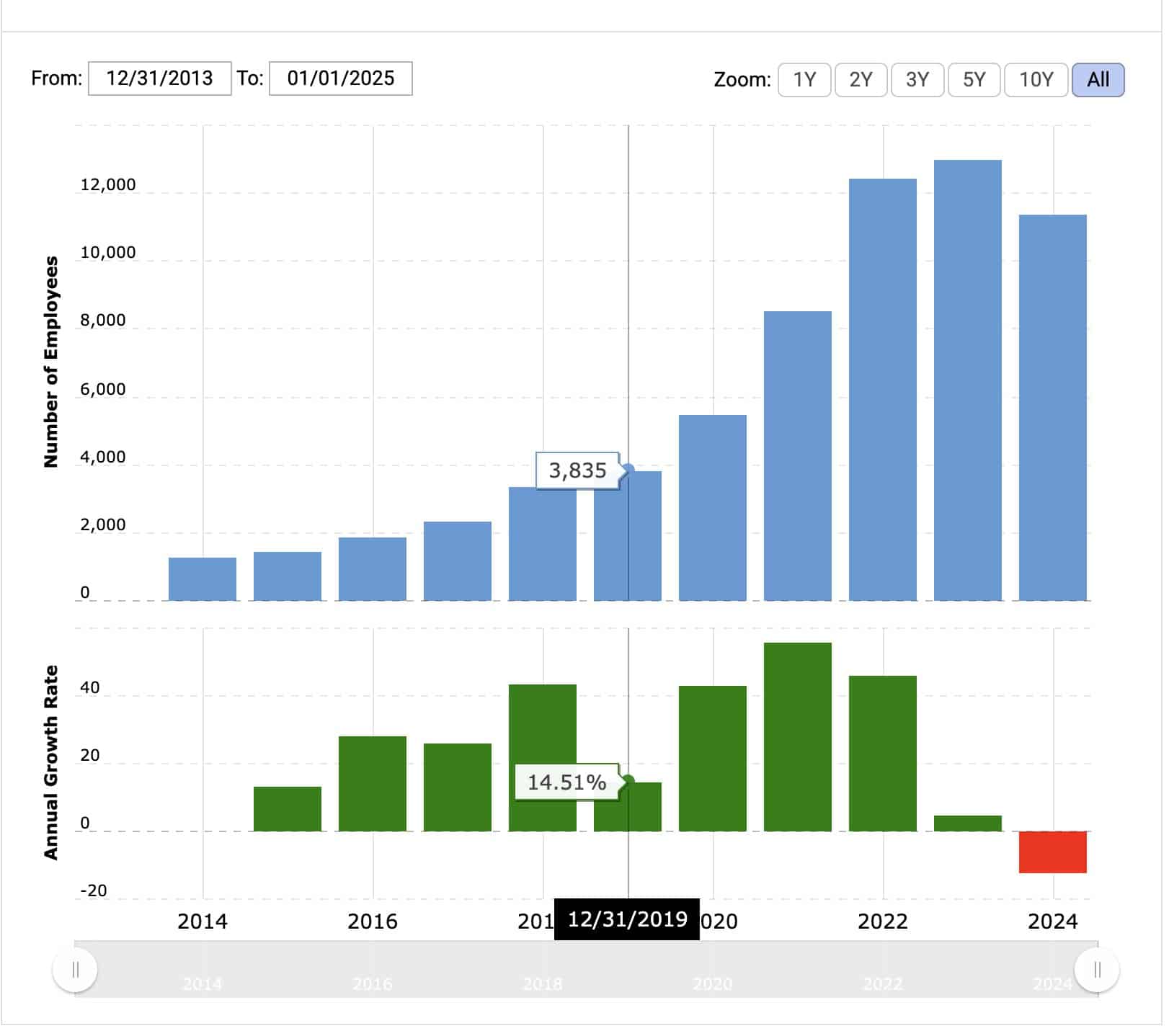
In an aggressive move, Jack Dorsey, co-founder of Twitter (X) and Block (Square, Cash App), announced a mass layoff affecting about 4,000 employees out of Block’s roughly 10,000 employees. For a company that is still growing, albeit slowly, a ~40% cut is extraordinary.
As the author of the #1 severance negotiation book, How To Engineer Your Layoff, I thought it would be helpful to review the severance package offered. But first, here’s Jack’s announcement on X.
Block’s Mass Layoff Message From Jack Dorsey
we're making @blocks smaller today. here's my note to the company. ####
today we're making one of the hardest decisions in the history of our company: we're reducing our organization by nearly half, from over 10,000 people to just under 6,000. that means over 4,000 of you are being asked to leave or entering into consultation.
i'll be straight about what's happening, why, and what it means for everyone. first off, if you're one of the people affected, you'll receive your salary for 20 weeks + 1 week per year of tenure, equity vested through the end of may, 6 months of health care, your corporate devices, and $5,000 to put toward whatever you need to help you in this transition (if you’re outside the U.S. you’ll receive similar support but exact details are going to vary based on local requirements).
i want you to know that before anything else. everyone will be notified today, whether you're being asked to leave, entering consultation, or asked to stay. we're not making this decision because we're in trouble. our business is strong. gross profit continues to grow, we continue to serve more and more customers, and profitability is improving.
but something has changed. we're already seeing that the intelligence tools we’re creating and using, paired with smaller and flatter teams, are enabling a new way of working which fundamentally changes what it means to build and run a company. and that's accelerating rapidly.
i had two options: cut gradually over months or years as this shift plays out, or be honest about where we are and act on it now. i chose the latter. repeated rounds of cuts are destructive to morale, to focus, and to the trust that customers and shareholders place in our ability to lead. i'd rather take a hard, clear action now and build from a position we believe in than manage a slow reduction of people toward the same outcome. a smaller company also gives us the space to grow our business the right way, on our own terms, instead of constantly reacting to market pressures.
a decision at this scale carries risk. but so does standing still. we've done a full review to determine the roles and people we require to reliably grow the business from here, and we've pressure-tested those decisions from multiple angles.
i accept that we may have gotten some of them wrong, and we've built in flexibility to account for that, and do the right thing for our customers. we're not going to just disappear people from slack and email and pretend they were never here. communication channels will stay open through thursday evening (pacific) so everyone can say goodbye properly, and share whatever you wish.
i'll also be hosting a live video session to thank everyone at 3:35pm pacific. i know doing it this way might feel awkward. i'd rather it feel awkward and human than efficient and cold. to those of you leaving…i’m grateful for you, and i’m sorry to put you through this. you built what this company is today. that's a fact that i'll honor forever. this decision is not a reflection of what you contributed. you will be a great contributor to any organization going forward. to those staying…i made this decision, and i'll own it.
what i'm asking of you is to build with me. we're going to build this company with intelligence at the core of everything we do. how we work, how we create, how we serve our customers. our customers will feel this shift too, and we're going to help them navigate it: towards a future where they can build their own features directly, composed of our capabilities and served through our interfaces. that's what i'm focused on now. expect a note from me tomorrow. jack
Review Of Block’s Severance Package
Given the size of Block, it likely had WARN Act obligations in at least some jurisdictions, including California, depending on where affected employees were located and how the layoffs were structured. WARN stands for Worker Adjustment and Retraining Notification Act.
Under California WARN, employers generally must provide 60 days’ advance written notice (two months pay) before a covered mass layoff, relocation, or termination. If an employer fails to provide the required notice, it may be liable for back pay and the value of benefits for up to 60 days to covered employees (subject to offsets and certain exceptions). In other words, WARN is a legal notice requirement, not simply a built-in severance benefit.
That distinction matters when evaluating Block’s package.
If employees are receiving 20 weeks of salary (roughly five months), plus one additional week per year of tenure, then the package appears meaningfully above a bare-minimum legal compliance approach for many workers, especially newer hires with five years or less of tenure.
Offering an additional one week of pay per year worked is on the lower end of severance formulas based on my own experience, my review of severance offers from hundreds of readers, and consulting with readers who needed guidance through the severance negotiation process. In my experience, the range is usually one to three weeks of pay per year worked.
However, a company paying any amount of severance beyond the mandatory WARN act pay is optional. Hence, one week is better than nothing. Please don't confuse mandatory WARN act pay with a severance package.
Six months of healthcare, if 100% employer-paid, is fairly standard for a severance package. After that, employees generally must pay out of pocket for healthcare through COBRA.
Keeping corporate devices is a nice perk, especially if you received a relatively new laptop. The additional $5,000 transition payment is also generous, and not common.
Overall, I’d give Block’s severance package a B+. I’d give it an A if it offered two weeks of pay per year worked, and an A+ for three weeks.
Just know that if you negotiate your severance package proactively, you’ll usually have more flexibility over your departure date, retirement contributions, and vesting. You may even be able to negotiate a return as a consultant at a higher rate, which is what my wife did.
Getting Laid Off Usually Comes As A Surprise
For those laid off, hearing Jack say, “we’re not making this decision because we’re in trouble. our business is strong. gross profit continues to grow, we continue to serve more and more customers, and profitability is improving,” probably doesn’t feel great.
The reality is that very few people believe they’ll be next on the chopping block – even underperformers with mediocre reviews. Most workers hold onto hope that they’ll make it through.
The world is hypercompetitive, and corporate profits reign supreme. If your company’s share price is underperforming the S&P 500 and peers, layoffs are often not far behind. I used to be a manager, and we constantly discussed how to drive more revenue and improve profitability every quarter.
The people most at risk were obvious to us: underperformers, but also “difficult” employees we didn’t particularly like working with. Thankfully, in Block’s case, because so many employees were affected, management was likely more objective and less subjective in its decision-making.
Employees who are hyper-aware of both company performance and their own relative performance are the ones most likely to secure the best severance packages. Why? Because they can see where the ship – and their career – is heading, and they proactively try to engineer a layoff with a severance package before a generic mass layoff hits.
Once a mass layoff is announced, your ability to negotiate is severely limited.
Reasons For Block’s Mass Layoffs
Although this is disappointing news for those affected, it may not come as a complete surprise to investors. Block overhired during the pandemic and paid about $29 billion for Afterpay in 2022 (roughly 40X revenue at the time). Afterpay alone added about 1,300 employees to Block and is probably worth less than $5 billion today if it were public.
This might be a case of a fantastic entrepreneur, but a less effective CEO in this moment. That said, Jack is the multibillionaire, and we’re not, so who are we to judge? Plenty of tech firms overhired during the pandemic. This is classic boom-bust cycle behavior.
Using AI as cover to cut a lot of people is strategically sound from a PR standpoint if you did overhire. It’s similar to the old playbook of hiring management consultants like McKinsey or BCG to absorb blame when management needs to cut staff.
But AI has undoubtedly improved worker productivity in some areas, which is one reason the FIRE movement is highly relevant again.
Whether AI is the true reason for the layoffs or just a convenient scapegoat, CEOs are no longer hiring as aggressively. Meanwhile, every CEO is likely considering layoffs to boost margins and support the share price, especially when markets reward these moves.
Blocks' shares surged by 24%+ at one point in after hours trading after the mass layoff announcement. However, the share price is down 75% over the last five years, which is an indication of how much the company has struggled.

Please Take Your Finances Seriously
Employees everywhere need to get into FIRE mode by saving and investing as aggressively as possible before their time runs out. You might have 10 good earning years left. Or you might have one, especially if your company has been underperforming. Meta is laying off thousands again too. Here's an analysis of Meta's severance package, which is pretty good.
The sad part about being laid off is that your identity gets ripped away, and your daily interactions with people you genuinely liked suddenly disappear too. It can be lonely, confusing, and frightening, especially if you have a family to support. Hopefully, your severance package lasts long enough for you to find another similar-paying job. If not, that’s what your savings are for.
In the meantime, do everything you can to slash expenses. I’ve done so by cutting cable in preparation for harder times. Then take on as many side hustles as you can during your job search. I used to drive for Uber and teach tennis to generate extra income and stay busy for a couple of hours a day. Please swallow your pride and do everything you can to bolster your finances.
Unfortunately, there’s a good chance a job with the same level of pay won’t come back right away. So you may need to pivot to a lower-paying role. But you can also use your newfound freedom to explore something completely different and reinvent yourself.
That’s what I did by becoming a personal finance writer. Although my total income declined by over 80% from my banking days, I truly enjoyed the challenge of doing something new.
Fourteen years into being unemployed, I’m still not homeless yet. And at this point, I don’t think I ever will be. So keep the faith that everything will work out if you get let go. You will find ways to adapt and survive!
Suggestion For Improving Your Severance Package
If you’re worried about getting laid off or want to leave a soul-sucking job, pick up a copy of bestselling ebook, How To Engineer Your Layoff: Make A Small Fortune By Saying Goodbye. Use the code “saveten” at checkout to save $10.
I originally wrote it in 2012 after figuring out how to negotiate my own severance package, which equaled five years of normal living expenses. I then helped my wife engineer her layoff in 2015, at age 35. You can read about how she received a severance package as a high-performing employee and was later asked back to consult part-time at a much higher hourly rate. She was a non-believer that getting a severance was possible.
Since 2012, I’ve revised and updated the book six times to incorporate modern strategies that have helped thousands of people leave their jobs with money in their pockets. Everything is negotiable. You just need to understand the rules of engagement and the strategies that can help you walk away with money in your pocket.


I am confused about “additional one week of pay per year worked is on the lower end of severance formulas”. Most of the hiring was after 2020 and oldest employees would have around 16 years. So for 2021 hire would get 20 weeks plus five weeks pay so five weeks per year. And for original 2009 hire, 20 weeks plus 16 weeks so around 2.25 weeks per year worked. The latest employees are getting the best severance deal and everyone getting better than two weeks per year.
As for my own layoff experience: 8 years and I got one month pay (and I was hired by their spinoff in that month).
Correct. If you joined block last month, you got the best severance package possible.
But this announcement is not to say that there weren’t individual negotiation for more senior members of the company.
> the layoffs likely should have been made 2-3 years ago.
I worked for a tech company that was super conservative in money matters: The executives resisted the over-hiring in 2021. As employees, we grumbled how people doing the same job could get 1/3 more money elsewhere. In the hindsight, the exec might be right that the money would not swish around forever.
As someone in their 60s and toward the very end of my career, I am absolutely amazed at these severance packages for mandatory layoff situations. I have never worked for or owned a company that gave more than 2 weeks pay as severance if they laid you off. And COBRA was/is available for a period of time, but you must pay fully out of pocket. Anyone can be laid off without cause in VA and no severance is required.
Do they also get to collect unemployment while collecting severance? I always thought that is why we have unemployment existed, but with these packages doesn’t seem like they should be allowed to also collect unemployment.
Yes indeed! They can absolutely collect unemployment.
Only the misinformed quit their jobs when they can get a severance package and profit for a fantastic runway.
See: https://www.financialsamurai.com/unemployment-benefits-warn-act-pay/
but…CA’s max unemployment benefit hasn’t changed in over 20 years. $450/week isn’t terrible in low cost locales, but in San Francisco, it might pay half your housing cost. It might cover COBRA alone.
Severance packages can range quite a bit between companies, even between “tech” companies. I have been in the industry for 30 years, and have seen my share of layoffs between friends, family and others in this area. Block’s package is pretty good, “B” – “B+” grade is fair. Of course, depending on where you are in CA, that package may not last that long.
My friend, you definitely worked in the wrong places with the wrong cultures. Historically and recently, packages of the nature described here are very common.
In my universe, it would have been exceedingly rare to not have access to a package well-aligned with the one here, and typically somewhat or much more, depending on the specific industry, context, etc.
Well I never did get laid off in 25 years of professional employment and did own my own firm for now these last 12 years, so never really impacted by this issue. As an owner, we try to be fair on the rare times we laid people off. We kept track of competitors policies and they all just gave 2 weeks. This wasn’t high tech. Just consulting. Not one time did a prospective employee in an interview ever ask me, “I certainly hope it never happens, but in the unfortunate event I get laid off, what is your severance policy?” Not once in 37 years.
It’s hard to blame employees for being surprised when they are let go. Getting a job is the safer route, so the default way is to do nothing to protect yourself. How many employees actually max out their 401(k)s, and aggressively build their taxable portfolio? How many employees try to take courses on the side and do side hustle to earn more
Most people are simply not proactive and just get beat up by the system one times are bad. The problem is, if you are reactionary, then it’s generally too late.
Invest in AI companies like anthropic and OpenAI, and enjoy the employment ride until it stops.