
But no matter how hard I studied, I couldn’t crack the code. I finished with a 3.65 GPA — a B+/A– average. Spanish verb conjugations tripped me up, advanced math seemed pointless, and science teachers were brutal graders. After reading some SAT prep books at the library, I couldn't break a 1,200 on the SAT either. Eventually, I gave up trying to be a nerd and focused on tennis and fun instead.
I wasn’t always a personal finance nerd, but I gradually became one out of survival. This is my story — and my observation over the past 27 years — of why being an “American nerd” has become more important than ever if you want to rise in your career or achieve financial freedom sooner.
For context, I no longer view the word nerd pejoratively as I did in high school, when I was encouraged to play sports, workout, find a girlfriend, and do well in school. I liked dating too much to be cast as a nerd. As a parent now, I’d be thrilled if my kids turned into super nerds. It might be the only way they can thrive and remain independent in today’s ultra-competitive world.
No girlfriend or boyfriend in middle or high school? Awesome! More time to study and less risk of being a teenage parent with a tougher road ahead.
Not traveling every weekend for club soccer? Hooray! More money saved, fewer injuries, and more time for learning an instrument, a second language, or the arts. After all, only about 2% of U.S. high school athletes receive any kind of athletic scholarship to play in college.
Only have a couple of friends who are also nerds? Wonderful. Challenge each other to keep learning and growing. With loving parents and maybe a sibling, one good friend is really all you need anyway… to have enough trainers to beat any legendary raid in Pokémon Go!
Today, nerds clearly rule the world. Let's dig in!
Growing Up Average
Since 1999, I’ve lived in New York City and San Francisco — two of the most competitive, brain-powered cities in America. They’re magnets for top students from elite universities who come to make their fortunes. The competition is relentless. If you can’t keep up intellectually, it’s hard to stay afloat.
When I was in public high school in McLean, Virginia, I tried to do well. I’d heard from an older student back in Kuala Lumpur during middle school that high school grades mattered, so I took that to heart.
And boy, did I have fun, perhaps too much of it. I got into trouble for shoplifting, fighting, and pulling dumb pranks that I truly regret. I’m sorry and I paid the price. Thankfully, I still got into The College of William & Mary, a good school, but not quite elite. I also knew my family couldn't comfortably afford sending me to a private university, so I stayed in-state at $2,800 a year in tuition.
With a second chance, I vowed not to mess things up in college too. Neither should you. Top universities such as Columbia has roughly 40% of its student body consisting of international students. American spots are slowly getting crowded out.
My Lucky Break
My big break came from a mix of luck, timing, and hustle. One Saturday, I got on a 6 a.m. charter bus for a Wall Street recruiting event.
None of my classmates showed up, so after 30 minutes of waiting, the driver drove me to a random shed and switched out the bus for a Lincoln Towncar to drive me 2 hours up from Williamsburg to Washington D.C. There I landed interviews with several bulge bracket firms. Thanks largely to a recruiter named Kim Purkiss, who believed in me, I joined Goldman Sachs in 1999.
Thirteen years on Wall Street taught me that intelligence is just table stakes. Being smart counts for maybe 35%. The rest is work ethic, teamwork, charm, and luck. Everyone is smart – so the real edge comes from being obsessive about learning and execution.
Enter the Super Nerds
Working on Wall Street exposed me to plenty of super nerds from top schools. But what surprised me was how many of them were also well-rounded, especially when it came to sports.
My immediate colleagues at Goldman had both brains and brawn: my boss played football at Dartmouth as a fullback, another at Penn State as a linebacker. Later, my direct boss at Credit Suisse had also played football at Cal and was president of his fraternity, Sigma Alpha Epsilon (SAE). The guy oozed charisma. We had an absolute blast entertaining clients.
However, when I went to Berkeley for my MBA part-time (2003–2006), I was suddenly surrounded by mostly super nerds. Most worked in tech. About 65% were engineers, and roughly half of those had come from India — most from the Indian Institutes of Technology (IIT), where the acceptance rate is around 1%.
Think of IIT as MIT or Caltech on steroids. Graduating from there requires both extreme intelligence and hunger. They were scary smart. Those qualities now fuel many of the leaders running America’s biggest tech firms:
Satya Nadella – CEO of Microsoft.
Sundar Pichai – CEO of Alphabet Inc. (and of Google).
Arvind Krishna – CEO (and Chairman) of IBM.
Jayshree Ullal – CEO of Arista Networks.
Aravind Srinivas – CEO of Perplexity, and Cal alum (Go Bears!)
The Nerds Have Taken Over
Now that I’m a father, I see the “revenge of the nerds” everywhere. At my kids’ schools, most parents are engineers, executives, data scientists, doctors, money managers, or entrepreneurs — alumni of IIT, MIT, Stanford, Berkeley, Duke, and the Ivies.
You don’t see many of the “cool kids” from high school here in the San Francisco Bay Area tech scene who played varsity sports and dated around. Those who coasted on charm or athletic ability had their run. It’s the disciplined problem solvers who built the systems the rest of us depend on. They are the captains now.
As an investor, I also want to put as much money as possible into companies run by super nerds and filled with the smartest employees. Score poorly on Harvard's subjective personality test to deny you admissions, despite stellar academics? You're hired!
An American company only hiring a group of diverse Americans is nice in theory. But when it comes to building and investing in great businesses, ability always trumps nationality or identity. And the reality is, America does not have a monopoly on talent or ability.
Top U.S. Companies Hiring Employees On H-1B Visas
As capitalists, if CEOs can hire the smartest people from around the world for a fraction of what they’d pay an American, they will. For most leaders, profits come before patriotism. It’s business first, always.
Below are some of the top U.S. employers for H-1B visas. LCA stands for Labor Condition Application, the form companies must file with the U.S. Department of Labor (DOL) before hiring or sponsoring an H-1B worker. These employers offer some of the highest average salaries in the nation — and, not surprisingly, are among the toughest places to land a job.

And here’s the thing: while Amazon laid off at least 14,000 mostly American employees in 2025, it simultaneously increased its number of H-1B hires from the year before. If you’re the CEO and can pay a brilliant H-1B employee an average of $149,000 instead of $350,000 for an equally capable American worker, you’re going to make that trade every time until the government tries to stop you.
Now, as a rational investor, are you really going to vote against reducing costs and maximizing profits? Of course not. The vast majority of shareholders will always support profit-maximizing moves in hopes of boosting their returns. Hence, even if you’re an American nerd fully capable of competing with a skilled foreign worker, you still might not get the job — or that promotion — simply because you cost too much.
You’ve got three options: invest in the very companies that reject you, already be wealthy enough that rejection only bruises your ego, or be so well-liked and connected that someone in power decides to give you a shot.
Back in 2012, I decided to invest in all the tech companies that had rejected me after I left finance. Thirteen years later, all the nerds have been working for me ever since. Work harder, you beautiful geniuses!

The Poker Table Epiphany
That truth hit me again at a tech poker night last weekend. Nothing has changed since I went to business school from 2003-2006. And I don't think anything will ever change given we're capitalists.
After putting my kids to bed with my wife, I showed up around 9 p.m. expecting a relaxed game – maybe a few drinks and laughs. Instead, I walked into what felt like a graduate seminar on statistics and aggression at IIT. Roughly 70% were foreign professionals working in the U.S. in high paying roles on temporary visas.
To my left sat Akshay, a software engineer who spent nearly thirty minutes trying to order coffee on an app even though the room was stocked with Red Bull and snacks. Every couple of minutes, Arvind — the player on my right — would remind him, “Akshay, it’s on you.”
Twelve times. Maybe more.
Akshay would nod, glance at his cards, and then drift back to his phone — comparing prices, maybe debugging code, or maybe just deep in thought. The whole thing was absurdly funny and deeply symbolic. Total focus, but in five different directions, and completely socially unaware of his poor poker etiquette.
Meanwhile, the game itself was intense. Only $1/$1 blinds, but pots swelling into the thousands. A room full of analytical, aggressive minds — engineers who bet probabilities like they were running machine-learning simulations.
I realized I was at the wrong table. I’d come to unwind; they’d come to optimize and take my money with a vengeance.

The Hand That Saved Me
After two and a half hours, I was barely breaking even and thinking of calling it a night. Then came the hand.
I looked down at Ace-Queen of diamonds. After a few limpers, I raised to $8. Three players called. The flop: Ace of clubs, 3 of diamonds, 5 of diamonds. Sweet! Top pair, top kicker, and the nut-flush draw. What a dream.
The small blind — Sondar, another engineer — led out for $25 post flop. I smooth called. Another player called behind and another folded.
The turn came the 7 of hearts. Sondar checked. I made a value bet of $25 to see where my opponents were at. The third player folded. Then Sondar check-raised to $75 total.
That move got my attention. It smelled like two pair, maybe a straight. I thought for 25 seconds, stared at him like a samurai for five. He stared back calmly. I called.
The river: 7 of diamonds. Bingo. Nut flush.
Sondar checked again. I paused, asked him how much he had left behind, and he respond with $130. I slid out $115, leaving him a small cushion. My goal: make it too tempting not to call because even if he lost, he'd still have three $5 chips and a chair to fight again.
“Ugh, I hate that river,” he said, showing the table 4-6 of clubs for a straight.
He stared at the board, then at me. Two full minutes of wiggling in his seat, sometimes, with his arms raised up and hands behind his head. I didn’t move. But I loved every second of it as my own heart started beating quicker.
Finally, he pushed in his chips. Call.
I flipped over the flush. He groaned, nodded, and patted the felt — the universal poker expression for “well played, you lucky bastard.”
Obsession May Be Even More Powerful Than Smarts
A couple of hands later, I cashed out for $680 after buying in for $350 and tossing $35 to the host for food and drinks. I had survived the nerd gauntlet. Now it was time to squeeze in five hours of sleep before pickleball at 7 a.m., with frankly, more nerds!
On the drive home, I couldn’t stop thinking: this table was America in microcosm. A bunch of smart, competitive, math-driven people — all chasing an edge, with a hint of obsession. Meanwhile, here I was, trying to battle while never taking calculus.
I may come across as laid-back with Hawaiian vibes, but I’m obsessed too. I’ve logged thousands of poker hours and watch poker videos for fun on a daily basis. Further, I regularly bet 30X – 300X bigger in the stock market than my buy-in, so it's hard to push me around at a $1/$1 or even a $5/$10 table. That night, luck, mixed with a hidden obsession of poker was my safety net.
If you get obsessed with something, you'll eventually get smart enough to effectively compete against your opponents. Sometimes you win, sometimes you lose. That's life. But at least you have a fighting chance to win.

Becoming an American Nerd
To succeed today, it’s not enough to be charming, athletic, or even naturally smart. You need to out-learn, out-analyze, and out-focus others.
In an interconnected world, you’re competing with brilliant, hungry people everywhere — many of whom treat mastery the way Akshay treated that coffee order: with total commitment, even when it’s inconvenient.
For decades, America has thrived by welcoming ambitious, talented immigrants from all over the world. That openness is part of what makes this country so dynamic.
But as global competition intensifies (see the AI race war with China), those of us already here can’t afford to coast. Countries with lower per-capita incomes, like India and China, naturally produce people who are driven to seize every opportunity they can find. When you’ve seen how hard life can be elsewhere, it’s easier to appreciate — and maximize — what’s available here.
Over time, privileged Americans risk taking prosperity for granted. We get comfortable. But the rest of the world is studying, grinding harder, and catching up fast. The only real way to stay ahead is to keep learning, adapting, and obsessing over improvement.
So if you want to thrive in modern America, you or your children need to become an American nerd — curious, relentless, and deeply invested in your craft. Because whether it’s at the poker table, in the office, or in life, the smartest and most disciplined players usually take the pot.
What do you think — is America losing its intellectual edge? What are you a nerd in? Have you noticed certain professions or industries where the “nerds” are clearly winning? And if you’re a parent, are you encouraging your kids to embrace their inner nerd, or hoping they find balance somewhere in between?
Subscribe To Financial Samurai
Pick up a copy of my USA TODAY national bestseller, Millionaire Milestones: Simple Steps to Seven Figures. I’ve distilled over 30 years of financial experience to help you build more wealth than 94% of the population—and break free sooner.
Listen and subscribe to The Financial Samurai podcast on Apple or Spotify. I interview experts in their respective fields and discuss some of the most interesting topics on this site. Your shares, ratings, and reviews are appreciated.
To expedite your journey to financial freedom, join over 60,000 others and subscribe to the free Financial Samurai newsletter. You can also get my posts in your e-mail inbox as soon as they come out by signing up here. Everything is written based on firsthand experience and expertise.

Dear Sam, I loved this post and watched my son embody this! Both my husband and I were more mainstream, pretty mellow and “popular” and out pops this kid who is insanely intensely academic and just wakes up everyday thrilled to chew through nails, walk on glass, do whatever it takes to beat everyone else in his chosen field. He is now a software engineer in SF and absolutely loves finally finding an environment where his intensity is normalized. He also went to U Chicago which helped.
As a parent, it is delightful to see your nerd kid win the day! But less glibly, it is a joy to watch your child so fully engaged in the world, committing to mastery and expressing their creativity. We all just marvel at him and our hearts are bursting with pride and also are grateful at his sheer dumb luck of being born in this era and in SF. I don’t think he would have been a happy farmer back in Ireland a century ago but who knows? maybe he would have just been the best farmer in the community and his desire to win would have found a different outlet.
Lastly, this child who was DETERMINED to never play a sport (sigh) wants to learn tennis in SF! Yahoo! Any interest in teaching the most insane junior software engineer who wants nothing short of world domination in the world of tech how to play? :)
I was an American nerd in high school and wish I hadn’t been. I wish I’d been better at understanding people and making friends and I wish I’d had my first kiss before 21. I wish my parents had found the courage to encourage me to excel as much in relationships, sports and arts as in academics. I wish my parents had been less afraid and hadn’t taught me to fear the world like they did, a fear I had to unlearn.
Sam, I know you are a fan of all becoming happy well-rounded humans vs. nerds coding alone on a pile of cash. You’ve also written before about how AI will replace many nerd jobs, so the nerd path may not have the same ROI in the AI future. I’d argue social skills, optimism, ethics and consistently good work may be a better path to winning the nerd wars than ultimate nerdiness. My story below is an example, and I don’t think it’s too different than many other stories of non-nerds succeeding in a nerd world.
I’m in my early 50s and have gone from dead broke to millionaire+ twice in my life. It was never grim single-minded focus on nerdy competition that helped me most.
I reluctantly studied in high school because my father wouldn’t let me do anything other than study unless I maintained a 4.0+ GPA. I didn’t really have any friends and almost no social life. In college, I rebelled against my monastic childhood upbringing and my high school valedictorian tassels. By the time I was 20, my father disowned me and cut me off from my family. I put myself through a decent state school while partying like a madman. I knew graduating from college would give me options later even though my degree was non-technical.
My parents were poor, financially illiterate and didn’t have much of a network, but I got my first tech related job out of college because it was the 90s in Seattle and everyone, including my mom, knew someone who was doing whatever[.]com, so mom introduced me to a dreamer with a friend who gave them a bit of money. The dreamer hired me because I was cheap and had a pulse, then his dream almost immediately flopped, but not before leaving the residue of brief “experience” on my resume. Did my youthful isolation and academic prowess get me that job? No. I just happened to be in the right place at the right time and someone knew someone.
One of the guys from the flopped dream team knew another guy running a tiny business and, after confirming I had a pulse, they hired me cheap to write user manuals for their niche software. They also put me through a short training course for writing test scripts, so I did a bit of simple coding but really didn’t pay much attention because I wasn’t interested. I was more focused on partying, dating and adventures, the stuff I’d missed growing up.
Adventures and dating take money, so I decided I should get more money. I applied for a contract test engineer job at Microsoft, then had no idea what the Microsoft hiring manager was talking about in the interview, so I gave up and ended the interview with a joke. I told the recruiter I’d failed and left the building. But…soon after, the recruiter told me I got the job because “the hiring manager said you were hilarious”. Did my youthful isolation and academic prowess get me that job? No. The courage to end a failed interview with a joke got me the job.
I broke my arm soon after starting the contract Microsoft job, so could only type with one hand. Instead of replacing me with another contract bot, the boss who thought I was funny took me to meetings with him because I was tall with long blond hair and he was a small, quiet man who was ignored in meetings. My job was to leap to my feet when he tapped my leg under the table to cause temporary confusion that allowed him to jump in to make his point.
Around that time I started dating the new recruiter for the contract company because she thought I was funny and cute and she got me a job with a small consulting company. Once again, my youthful nerdy flagellation didn’t prevail; it was my height, dating, and shared sense of humor with my boss that helped.
The gig with that small consulting company soon turned into a full time job with a client, and that job made me a millionaire in less than a year because it was the 90s and, like the AI boom now, stupid money flowed. I retired and hit the road to see the world. Within a year and after a market crash, I’d lost the money because I was financially dumb like my parents had raised me to be.
I moved to SoCal in my late 20s with nothing and started over with an entry level sales job at an education company. The weather was great, the girls were fun, and the parties constant. Within a couple years, I fell in love with a girl from back home in Seattle and moved back. I had very little money and she didn’t have much either. She had a friend who was dating a tech recruiter who got me a low level consulting job doing basic software testing. Again, it was primarily dating and connections that got me the job in a nerd world, not winning any nerd competitions.
And so it went…I prioritized life outside of work, spent time with our two daughters and friends, and held various jobs in Information Technology. Eventually, I became a manager, then low level exec, and never felt I really knew what I was doing. I was always in over my head and managing nerds who had forgotten more than I’d ever learn in their tech fields. I avoided most of the certifications people would get in the tech areas I worked in because they seemed boring and didn’t seem to matter that much to my success. I never ran a home lab or created any cool tech stuff outside of work. If I was good at anything, perhaps it was connecting the right nerds to relevant business problems they could best solve. I was never fired or laid off (well, until I ultimately engineered my layoff).
The nerds helped boost the stock value of companies I worked for and invested in. I sold stock to buy real estate 10+ yrs ago. For the past couple years, I’ve done a lot of traveling and playing and got lots of time with my first grandson. Thanks nerds!
My wife and I could probably retire now, but as we’re still relatively young (both in our early to mid 50s) and this first inflation of the AI bubble may last a bit longer, I decided to roll the dice one more time and see what happens. I just accepted an exec role with a profitable pre-IPO company that is part of the “picks and shovels” supply chain for the AI gold rush. It will be nice if they go big and also just fine if they don’t. Oh, and once again, I got this job because I knew a guy who worked there and his bosses needed a well-rounded leader they could trust, not because I’m the nerdiest nerd in this field. I did a bit of consulting first, then they asked me to head a technical function within the nerd camp.
For anyone who read this far, I’ll end where I began: social skills, optimism, ethics and consistently good work may be a better path to winning the nerd wars than nerdiness. So if you feel nerd wealth FOMO, consider getting a beer with friend instead of getting a nerd certification. Take some risks trying new things you don’t feel ready for. You never know….
Awesome American nerd success story to me! And thanks for sharing. It sure sounds like being a nerd paid off with riches, a wife, and two daughters and now an executive role. The way I see it, you have inspired me to push my kids to become even more nerdy. Because if you think how you ended up isn’t that great, then I’ll take it! It shows that you can develop emotional intelligence and social skills as you grow older.
Perhaps this point is more poignant?
“ By the time I was 20, my father disowned me and cut me off from my family.”
Otter to get so bad if you were off to college, studied well, and we’re having a good time?
Did you two finally reconcile?
Thanks Sam. To be clear, I think my life has been great! I made lots of mistakes and could always have worked harder, but the mistakes have made me stronger and my relative laziness has made me happier. My story just illustrates people often succeed in the nerdy tech world without maniacal focus on nerdy technical skills or the need to cut out an active social life.
My daughters weren’t nerds through high school and I didn’t force perfection. Their HS grades weren’t very good and one skipped college, but they both have a good work ethic and good social skills that helped them find career and relationship success. One is even a socially capable tech nerd now :-) . I don’t worry about their ability to take care of themselves in our ever more competitive global economy, and they’ve always got the bank of mom and dad if the proverbial shitake were to hit the fan.
As for reconciling with my old man, well, thanks for asking, but let’s call that a work in progress. However, I’m happy to say I have good relationships with the rest of the fam. Time & a variety of experience certainly helps bridge old gaps.
I have been a statistician for my entire almost 30 year professional life. I have 2 Masters’s degrees and a PhD and have witnessed and lived exactly what you are writing about. Luckily, I was mostly a disciplined saver and I am reaching the end of my professional career but I do worry what the future holds for my kids.
You couldn’t break 1200 on SATs and never took calculus…? The SATs are kind of meh since I know plenty of intelligent people who for whatever reason don’t do well on standardized tests, but never taking calculus is just shameful, my man! Calculus is one of the finest achievements of humanity, so everyone should learn it or at least have some exposure to it. Plus, how are you going to help your kids with their calculus homework in the future? ChatGPT?
Indeed, I’ve had to struggle just to stay afloat and compete. Coming to America as a high schooler and being part of a minority that was only 5–6% in Virginia at the time made fitting in even harder. English is my second language, too, which added another layer of challenge.
I wasn’t naturally gifted or smart enough to grasp calculus – perhaps, at the time, I couldn’t see any practical use for it. How often do you really use calculus in your day-to-day life?
I try to help my children with their math homework in addition to their teachers, but if they’re really struggling, they’ll need to put in extra work—and sometimes we’ll need a real math expert. It’s great that you have the ability to help your kids in Calculus.
Yes, AI is an incredible tutor, and we’re already using it to help explain concepts and define words during reading and math. But I have considered not using the tools freely available to me, like passing on using the calculator, to make life harder.
We average people have to fight on!
Right on! I use Calculus everyday to make sure I’m not overspending on groceries and optimizing where to save the most on gas based on distance of the gas station. Just kidding.
I’m impressed you recognized early on what you wanted and how useless upper-level math is. Could be one of the earliest signs of not being a sheep and following the heard.
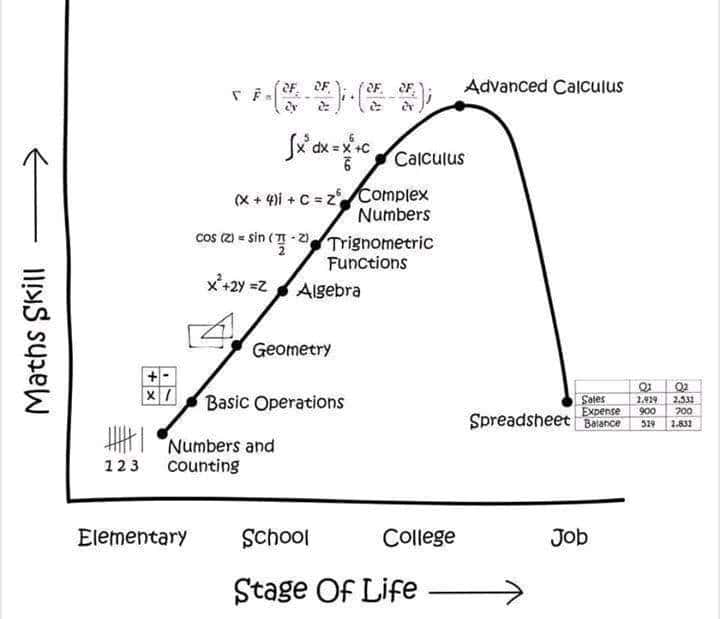
Here’s a funny chart about the uselessness of math: https://x.com/the_unix_guru/status/1122609478178881538
Haha, nice! I’ve included the image in my post.
Super great people are using Calculus in day to day activities and on their job like Michael is doing. I never have. Just basic math, which seems to be good enough for me.
I will stop using the calculator and AI in solidarity with you my man!
Average intelligence people of the world, unite!
If I can give a woman’s perspective: for all the girls I went to public high school, quite a number of the friendly but more reserved or even nerdy girls exceled in university and their careers.
From my public high school: sister’s best friend became dean of geotechnical engineering for a large Canadian university, several became teachers (1 of them bought her home, then later 2nd one a rental down the street), lawyer, physician, etc.
Nerd girls also rule later in their careers and investments.
Awesome! Girls are also dominating higher education by being a majority who graduate from college. Boys, on the other hand, seem to be struggling.
Didn’t you write an article about how compensation of ivy grads is lackluster compared to the perception?
I did. They do earn more 10 years after graduation. But it’s not magnitudes more.
Still better to be smart and the top of your class than not. The goal is to give yourselves as many opportunities as possible to succeed.
https://www.financialsamurai.com/median-income-earned-by-ivy-league-graduates/
Sure but don’t discount the non-nerd social butterflies who turn into sales leaders or blue collar types who turn into small business owners or jocks who turn into executives. All doing that without being holed up in the library missing the mixer.
For sure. EQ, charisma, and being able to socialize are important skills. They are especially important if you have no technical skills and come from money or a favored group.
I realize these guys are super smart but in the end they are going to have to come up with new stuff to buy. Right now I have everything I need and can’t think of anything to buy. I am pretty saturated with technology. Unless they come up with a robot that cleans my house, does my yard work, paints my house and do roof coatings, washes my cars,do repairs I can’t do, I don’t see they have much to offer me.
That’s what they’re doing! Robots.
My question to Sam is if the guy shoved all in instead of just raising you $50 on the turn do you call?
I’m working on the Gold story. I hope you post it.
Of course I would.
No guarantees I’ll post it. But I’ll happily read it.
Should we be investing in emerging markets. Won’t these same people start companies in their own countries.
You would think. But once you make your fortune in America and realize how good life is, it’s hard to leave if you then are able to get a green card.
I’ve been to India a couple of times and it is pretty harsh living. From the heat to the droughts to the poverty to the traffic to the pollution, I’d rather live in America.
The corporate governance issues in emerging markets is also a problem. You can invest 10 to 20% of your portfolio and international markets, but I wouldn’t do much more. My home country bias is saying that American exceptionalism is the place to be for our lifetime.
I hired a money manager last year and he believes in worldwide exposure to stocks. He has probably 20%international and 5 % emerging markets. Last year I wasn’t happy because US stocks outperformed international stocks. This year international stocks doing double the return of US stocks. I’ve always managed my own money and my wife says not to micromanage what he is doing. I trust him and he is pretty conservative like me.I decided to hire a money manager last year that when Im gone my wife followed by daughter have someone already set in place to manage our money.
The U.S. has actually outperformed internationally over the past 15 or so years actually. Only this year, has international outperformed.
See this related post: Investing In International Stocks Is Unnecessary
I get it
When I read about Indian HB-1 visa holders replacing American jobs and undercutting wages a few things come to mind:
1. My ancestors fought in every American war – from the American Revolution to the Vietnam conflict – and created the governance structures, political philosophies and economic infrastructure that made America the powerhouse that it is today. The fact that people can arrive in the last 10-20 years can claim this inheritance (without putting in generations of work) and displace long-term citizens enrages me. If a nation isn’t benefiting it’s own citizens over foreigners, then why even have a nation at all? When this happens see outcomes like the elections of Donald Trump and the new Socialist mayor of New York and a very high level of civic disengagement.
2. The idea that HB-1 visa holders are “superior” workers to American is a complete lie. I ask myself every day if “technology” now is superior to technology 10-20 years ago and the answer is no – which contributes to the continual “crapification” of the economy. Instead of speaking on the phone to a nice Midwestern person to fix my internet, I get to speak to an Indian worker that is following AI prompts and doesn’t actually solve the problem – and usually makes it worse. When they get into positions of power, they hire other Indians (unless that person is from a lower caste in which they discriminate against them – See California Cisco case). In my own experience getting an MBA, they regularly cheated – and in one case 3 of them turned in exactly the same paper and the professor failed them all. Just because somebody is “cheaper” doesn’t make them better. It’s a ploy to drive down US wages and increase profit margin for large corporations – which don’t actually care about the society in which they get to operate.
3. India’s population is 1.4 billion (and growing) and with a diaspora of around 35 million people. Why is my country being used as a population release valve when it doesn’t benefit our people or society? The complaint is that “American workers aren’t bright enough.” Well instead of importing more people and straining society, why aren’t we providing better learning environments for our children and helping them compete? Why is the solution always to import more people (with environmental impacts) instead of increasing the human capital that we already have?
The reason is because America is a capitalist country. Profit is what we value at the top or near the top of the pyramid. So if we can import cheaper labor, that is just as smart or smarter, we will to the maximum to boost corporate profits.
And because we all have the ability to invest in companies that could make us money, there hasn’t been enough will to curb cheaper foreign labor to help save and support American employees.
But if you look at places like Malaysia, where I live for four years, there are curbs and policies in place to help the Bumiputras, or the Malays.
Our politicians want to grow a rich and powerful, so they are not incentivize to change. And, the only thing we can really do is vote and invest accordingly.
H-1B visas aren’t even in the spirit of “capitalism”. Let’s pretend that I’m a qualified American worker and willing to accept a lower wage of $130k versus $149k. Would those companies be interested in hiring me because of the “invisible hand of the free market”? The answer is absolutely not. Why? Because the company has the ultimate leverage over a H1B worker – the ability to have him deported within 60 days if the H1B worker becomes unemployed. They literally can’t do anything to upset their employer or risk being sent back. Once a critical mass of H1B infrastructure is in place it becomes easier and easier to discriminate against qualified Americans because they created a network of colleges in India where they can mass import people using shaky credentials. Let’s not pretend that this program arose out of the “invisible hand” but through lobbying by big businesses (oligarchy) and the government. I agree that politicians are interested in becoming rich and powerful. But I hope/fear that a reckoning is coming because the average American worker is becoming more politically disenfranchised and poorer. I definitely invest accordingly (mainly to insulate myself), but when it reaches a critical mass the people tend to pick up pitchforks.
I would hire the same-skilled American worker for $130,000 for sure. No H-1B fee or process.
All employment is at will too, at least here in the private sector in California. Employers can fire employees whenever for whatever. Of course, employees can also sue for wrongful termination.
What is it that you do for a living and where are you based again?
There is a small error related to H1B.
You cannot hire an H1B worker for $140K position, if that positions wage level is $180K.
There are wage levels for H1B workers and they are paid excatly the same compensation which would have been paid to american citizens.
But who determines the salary is $180K? Can’t the company just claim it is a $140K job?
But isn’t part of the point of the H1B to save on employee compensation for jobs Americans can do that require more?
I wonder if we couldn’t do both. I think as a country we would always want to have the best and brightest come here. And in my opinion, immigrants contribute massively to US success. But I completely agree with you, investing in our education systems should be prioritized. Prioritized over tax breaks for the wealthy, for corporations. Other countries limit who can buy residential real estate. I fear my kids will have zero chance of affording their own home anywhere near me. These extra H1B fees should be invested in training US workers and students.
Hey Sam! Long-time reader here but this is my first time commenting!
I couldn’t help but be drawn and relate to your 6am chartered bus story. I, too, made a life-changing decision early on in my junior year of college at USC to attend an IB workshop that UCLA was hosting across town here in Los Angeles. I was getting solid/decent grades (3.6 GPA) as a business admin/finance major, but my career ambitions were zero to moot and I was constantly caught up in the going-ons at the university (frat parties, tailgating, etc.).
I don’t recall how I became aware of the workshop, but I told myself I’d go no matter what. Lo and behold, my frat had a huge party the night before the morning of the workshop (which was scheduled for 7:30am) – the prior “me” would’ve used that as an excuse not to attend, but again, I made an oath to myself. I ended up setting an alarm at a similar time as you, showing up hungover but determined, and was enamored with the IB path and how it would help set me up for future career success.
Fast forward to graduation, I had a full-time IB job here in LA locked up, and fast forward another ten years to today, and I work in real estate private equity, incredibly thankful for that decision I made way back then!
Thanks for sharing your story! Glad you showed up to the session after a wild night!
I’m assuming real estate private equity paid pretty well over the past 10 years? Do you think real estate will start coming back in 2026 and beyond?
Those of us with parents who were born in continent of Asia , have been primed for this all our lives.
So how are you doing?
I’ve been struggling to find work for a while now, and this post hit me harder than I expected. It’s been discouraging sending out applications and hearing nothing back. Reading your reminder to “be the American nerd” instead of trying to be cool really resonated — I realize I coasted too long on past credentials instead of staying hungry and curious.
It’s humbling, but also motivating. I’m going to use this time to rebuild — study, upskill, and get obsessed again like you wrote about. Thanks, Sam.
To quote Jean-Luc Picard (ST/TNG): “It is possible to make no mistakes and still lose. That is not failure. That is life.” The problem with overachievers is that this concept is a wall to them and when they plow into it (usually at relativistic speeds) it blows up their life.
Resilience and persistence are far more important in the long run. I have seen way too many overachievers blow up their lives trying to achieve beyond what a body (including its brain) is capable of and this failure then becoming the defining event that starts their life’s decline. I’d love to see studies on what percentage of mental elite make it past this barrier and what helped the survivors to make it.
I loved this article. I had an epiphany in 1998.
I am an immigrant living the American dream. Back in 1998, my parents could just about afford extra private tuitions for Math, Physics, Chem and Biology. I had another “cool” kid mention that my classes were not enough. I would be piled along with another 100 kids and the teacher would not have time to allocate to me. His recommendation was to get to the “super” private coaching where a teacher would be restricted to 20 kids max! The catch? 5x the cost. I knew it would bust our finances and take away from my future engineering tuition; already earmarked. I decided that day to make my “lesser” tuition work. How? – I would go all out at what I could afford and let the chips fall where they would. I decided to be a “nerd”. I did not know it yet!
Fast forward 2 years, I got through engineering at a decent school (the same one Satya Nadella graduated from), in the hottest field at that time. This time I decided to double down. I would give my education the best shot. I was self-learning C, C++, Visual Basic, Java, C#, Fourier analysis (never used it in life), while my friends and counterparts were smoking pot, beer ponging. I somehow knew, with good health, I would always get a chance to do all of that over the next 50 years (not my quote, but from my teacher/mentor, at 10th grade). And man! I stayed true! And did it pay leaps and bounds. By this time, I knew what a nerd was, and I was proud to be one. That also explains why I have always loved the big bang theory.
What has it got me in return? I put my brother through engineering school. I was 23, when I paid for his 1st year fees. My brother and I funded our parents’ post-retirement trips throughout the world. I got access to the American dream and am living it!
My kids are in elementary school. And one day they are going to make fun of somebody for being a nerd. My reply: “Respect that guy, be that guy! He will be the one signing paychecks!
It certainly takes a strategic and analytical mind to play poker well. I personally prefer mahjong but not for betting, just for the strategy and conversation. Totally hear you on the revenge of the nerds thing too. Albeit to rise high to the top it takes more than just smarts imo. I’m sure it’s industry dependent, but a strong element of suave, negotiating, and sharp business sense are important too.
It appears that the average American is in fact getting dumber. Google “UCSD Report on Academic Preparedness” for recent news.
From UCSD’s report: “While Math 2 was designed in 2016 to remediate missing high school math knowledge, now most students had knowledge gaps that went back much further, to middle and even elementary school. To address the large number of underprepared students, the Mathematics Department redesigned Math 2 for Fall 2024 to focus entirely on elementary and middle school Common Core math subjects (grades 1-8), and introduced a new course, Math 3B, so as to cover missing high-school common core math subjects (Algebra I, Geometry, Algebra II or Math I, II, III; grades 9-11).”
That’s right. About 12% of students at UCSD can’t do grade school math.
And we don’t need changes in our educational system?!?!?
The real problem is that failing students are never allowed to, you know, fail. They get pushed to the next class/grade/whatever. Until there are consequences for failing in school, nothing will change. This is the shadow hanging over all attempted educational reform. Now imagine a place where parents go along with make failure hurt for students, because it isn’t in the U.S.
Yes. Public education has bad incentives. Instead of evaluating schools on proficiency, they’re evaluated on passing students, graduating students, and on test scores. The teachers and administrators hate the tests, but they’re at least closer to reality than pass/fail.
Damn, you guys have uncapped buy-in so that you have $3k+ pots in a $1/$1 game? This is juicy. What is the name of the app for bying in and cashing out – the one on the screnshot?
I was shocked to sit down at the table with one guy with $2,000 in chips and another with $1,500. They had been cleaning up since 4pm.
The app is called pokerbank.xyz
Makes tracking and paying etc easier with so many people.