
Your home is more than a place to live. Done right, it is one of the most reliable wealth-building tools you will ever own.
Most people think about home design in terms of comfort and taste. You want spaces that feel good to be in, rooms that reflect who you are, layouts that support how you live. That is a perfectly reasonable way to approach it.
But there is another dimension that often goes overlooked: the financial one. A home that is thoughtfully designed does not just look good. It performs. It appreciates faster than those homes not designed as well. It attracts buyers, supports borrowing, and turns everyday living into a long-term investment strategy. The line between aesthetic choice and financial decision is thinner than most homeowners realize.
Real estate is my favorite asset class to build wealth. When you can make money on your asset and enjoy it, that's a win-win scenario. This article breaks down how design decisions translate into real financial returns, and what to keep in mind as you plan your next project.
Design is not decoration. It is a financial strategy.
Why good design holds its value
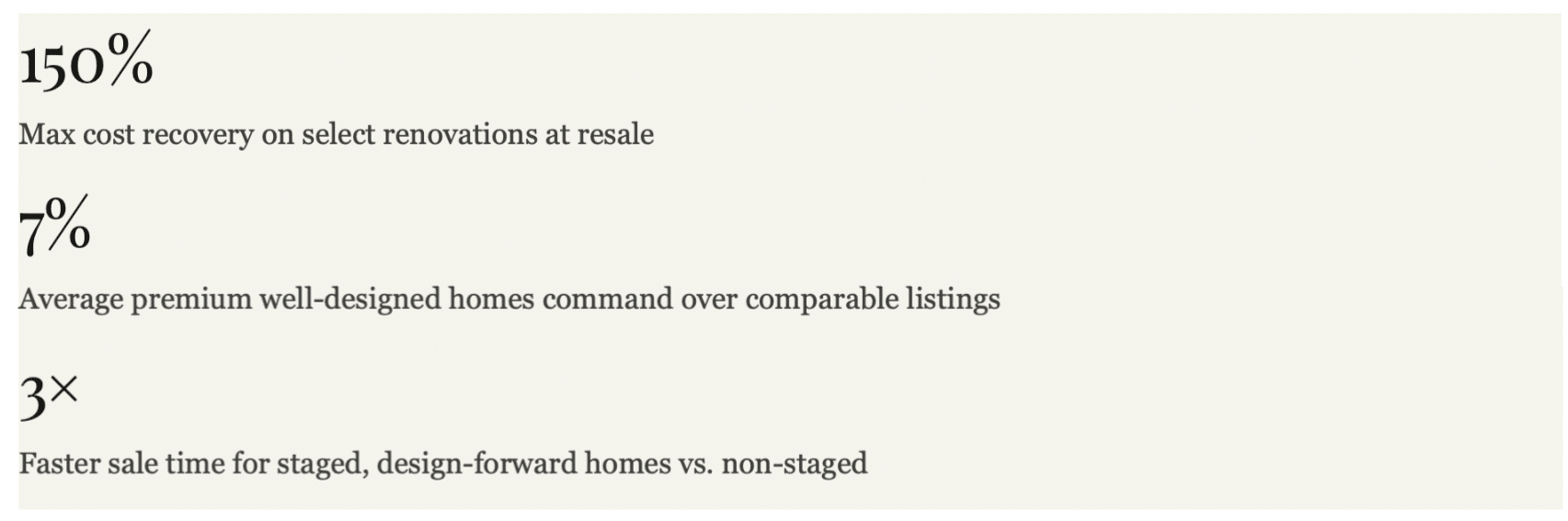
There is a common misconception that home improvements are mostly cosmetic – nice to have, but not serious contributors to property value. The data tells a different story. According to the National Association of Realtors' Remodeling Impact Report, certain well-chosen renovations recover between 50% and 150% of their cost at resale. That range is wide, and the gap between the low and high end almost entirely comes down to design quality.
A kitchen update with cheap finishes and poor layout planning will always underperform against one done with care. Buyers notice. Appraisers notice. Lenders notice, especially if the work was done without permits. Design is not just about how your home looks today, it is about how it will be evaluated tomorrow.
The renovations that actually move the needle
Where to focus your budget
Not every design project pays the same return. Some choices add real, measurable value to your property. Others look great in the moment but contribute little when it counts. Knowing the difference is what separates a smart homeowner from an enthusiastic one.
Kitchen renovations consistently rank at the top of high-return projects, but only when they are done right. Minor kitchen remodels (new fronts, hardware, countertops, lighting) tend to outperform full gut renovations in terms of return on investment.
The reason is simple: buyers expect functional kitchens, but over-improvement in an average-priced neighborhood rarely pays back dollar for dollar.
Bathroom updates follow a similar logic. Cleanliness, fixture quality, and efficient use of space matter more than luxury tile. A well-lit, clean, and thoughtfully proportioned bathroom will outperform an over-designed one in most markets.
Curb appeal is frequently underestimated. First impressions drive emotional decisions in real estate. Fresh paint, clean landscaping, and a well-maintained exterior can dramatically affect perceived value before a buyer steps through the door. It is also one of the more affordable areas to invest in.
Open floor plans, natural light, and functional storage are design features that buyers consistently pay a premium for. If you have an opportunity to address any of these through renovation, the investment is usually justified.
“Buyers buy with their emotions and justify with logic. Design shapes the emotional experience — and that experience has a price.”
Home equity: turning design investment into financial leverage
Here’s how a better-designed home improves your borrowing position.
One of the less-discussed benefits of investing in your home's design is what it does to your equity position. As your home's market value increases, driven in part by the quality of improvements you have made, so does the gap between what you owe and what it is worth.
That gap is your home equity, and it is a powerful financial resource. The longer you own a home, usually, the large your home equity grows.
Homeowners with strong equity can access favorable borrowing terms. If you have built up significant equity through a combination of mortgage paydown and value-adding renovations, a home equity loan can give you access to that built-up value as a lump sum at a fixed interest rate.
In turn, this value can then be reinvested into further improvements, used to consolidate debt, or applied to other financial priorities. The cycle is self-reinforcing: thoughtful design builds equity, equity enables borrowing, borrowing funds the next phase of improvements. This is how design decisions compound into long-term financial strength.
It is worth noting that lenders typically require a minimum equity threshold, often 15% to 20%, before extending this type of financing. So maintaining the value of your home through good design and upkeep is not just an aesthetic choice. It is a financial prerequisite.
Timeless vs. trendy: the design choices that age well
How to avoid costly mistakes
Trends are not your friend when it comes to long-term value. What is popular today may feel dated in five years, and that dated feeling will be reflected in your listing price when the time comes to sell. The homeowners who see the strongest returns over time are those who lean toward timeless design principles rather than chasing what is fashionable.
Neutral color palettes, quality materials, and classic proportions hold up. Bold wallpaper, highly personalized spaces, and maximalist styling can be wonderful to live with, but they narrow your buyer pool.
That does not mean your home has to be bland. It means anchoring your design in durable fundamentals while layering in personality through elements that are easy and inexpensive to change. Paint colors, textiles, and lighting fixtures can be swapped without significant cost. Structural decisions, flooring choices, and built-ins are harder to undo.
The goal is a home that a wide range of buyers can see themselves living in. Flexibility is value. According to Zillow Research, homes with neutral palettes and updated kitchens sell significantly faster and closer to asking price than those with highly personalized interiors.
Most homebuyers want a cozy warm home. So the more you can make your home feel inviting, the more buyers are willing to pay.
Energy efficiency and sustainable design
A growing category of return
Sustainability has moved from a niche preference to a mainstream buying criterion. Energy-efficient windows, well-insulated walls, smart thermostats, and solar panels are no longer bonus features, for a growing segment of buyers, they are expected. High-quality windows are the biggest tell regarding the quality of the home. Don't skimp out there.
The financial case is straightforward. Energy-efficient homes cost less to operate, and lower operating costs translate directly into higher perceived value. Buyers factor in utility costs. A home that costs $200 less per month to run is worth more, and experienced buyers know it.
Sustainable design also tends to be durable design. Materials chosen for their environmental credentials are often chosen because they last longer and require less maintenance. That alignment between sustainability and durability compounds over time into real cost savings.
Design for daily life, not just resale
The quality of life dividend
There is a risk of becoming so focused on resale value that you forget you have to live in the house. A home designed purely for hypothetical future buyers is rarely a home that is enjoyable to live in today. The best design decisions serve both purposes simultaneously.
Functionality matters. Storage, light, flow, outdoor connection, and acoustic comfort all contribute to daily wellbeing in ways that are hard to quantify but easy to feel. Look for homes with large useable lots with enclosed front yards. Those are some of the rarest homes that will command a premium upon resale.
Homes that have been designed to support how people actually live tend to be well-maintained, because the people in them are happy to be there. That care shows, and it has value.
Think of it this way: the return on a home design investment is not only financial. It is also experiential. You receive it every morning you wake up in a space that works well for you. That does not appear on a balance sheet, but it is real.
This combination of being able to enjoy your asset is the main reason why real estate is such a wonderful asset class. Stocks have no utility and can lose (or gain) a lot of value over night. A home can be enjoyed.
Spend The Money And Effort Designing Your Home
The connection between design and financial performance is not coincidental. It is structural. Every choice you make about your home, from the materials you select to the layout you pursue to the fixtures you install, contributes to how the property is perceived, valued, and ultimately priced.
Thoughtful design is not an expense. It is a long-term investment with returns that compound in multiple directions at once: market value, borrowing power, operating costs, and quality of life.
Approaching your home with both aesthetic intention and financial awareness is not complicated. It simply requires asking, for each decision: does this serve me today, and does it add value tomorrow? When the answer is yes on both counts, you are building something that truly pays dividends.
About The Author: Sam Dogen worked in investment banking for 13 years before negotiating a severance package in 2012 at age 34. He then started Financial Samurai, which has grown into one of the leading independently run personal finance sites in the world. Sam is the bestselling author of Millionaire Milestones and Buy This Not That. He lives in San Francisco with his wife and two young children and spends his free time playing tennis and coaching his kids' sports teams. Everything he writes is based on firsthand experience, not theory.