
Dear Financial Samurai,
This might be one of the wildest weeks in recent memory. And I’ll need your help thinking through a couple of things.
First, the PCE price index for January came in hotter than expected at +0.40% month over month, above the +0.30% forecast. We also got higher-than-expected Producer Price Index data showing +0.5-% month over month.
You would think Treasury bonds would sell off alongside stocks. Instead, Treasury bonds rallied. The 10-year yield is now below 4%, which is fantastic for the real estate market.
If you dig deeper into the PPI data, final demand goods prices actually fell 0.3% in January. Energy goods dropped 2.7%. Food prices fell 1.5%.
Those are not the numbers of an overheating goods economy. Those are the numbers of easing pipeline pressure.
The real action was in services, which rose 0.8%. Within that category, trade services margins – a notoriously volatile component – jumped 2.5% after rising 1.8% in December.
There’s growing risk-off sentiment given how much destruction AI, specifically by Anthropic, is causing across multiple sectors. Investors are selling first and fleeing to the safety of Treasury bonds rather than risk being the next casualty of Claude Code, Anthropic's product.
If investors could directly invest in Anthropic, many probably would. Roughly $1.5 trillion in public market value has reportedly been wiped out this month, attributed in part to AI disruption fears.
And just in, as I get home from a late night of poker, the U.S. and Israel have launched joint airstrikes on Iran’s military and nuclear sites.
Typically, there’s a knee-jerk selloff in the stock market, followed by a recovery once cooler heads prevail. However, Treasury bonds should continue to catch a bid in the near term, which would push yields lower.
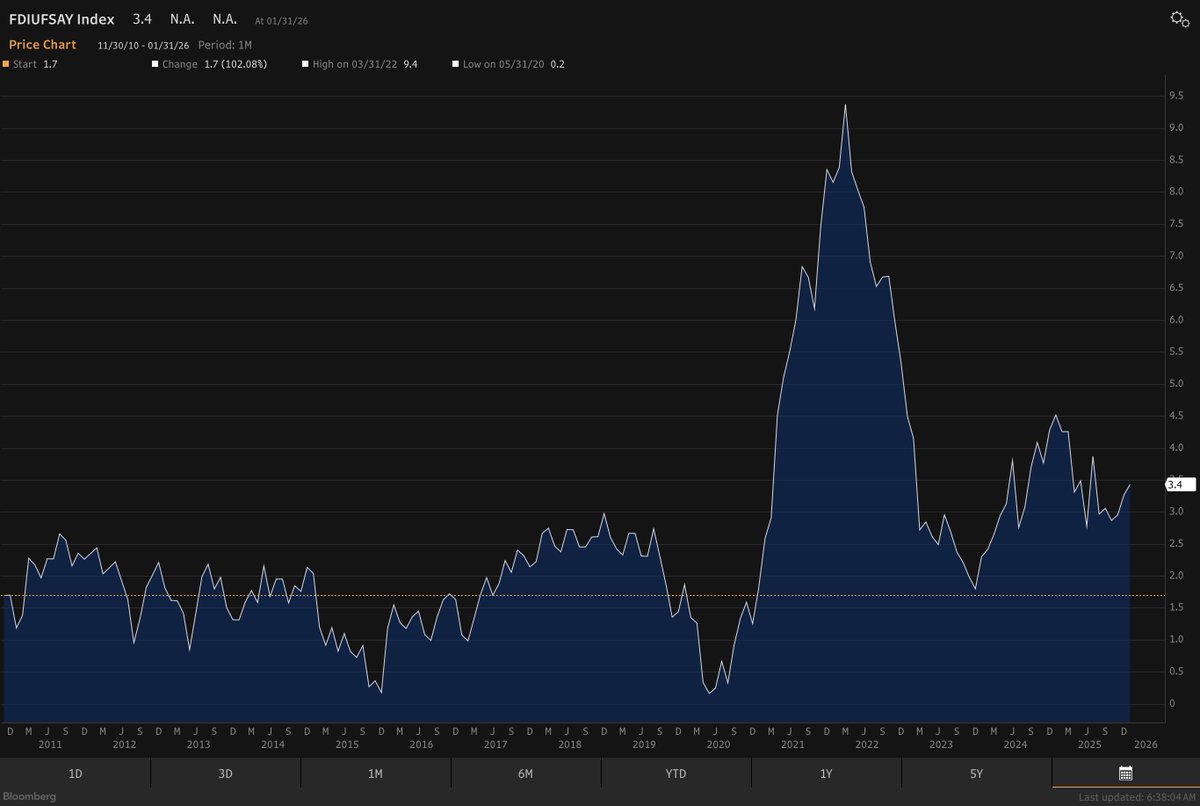
Mass Layoffs abound
Then there are the mass layoffs, led by Block, which cut 40% of its workforce, equal to about 4,000 people, in one fell swoop. The new linked post is new and talks about how Block's severance package compares to what I've seen.
Jack Dorsey attributed the layoffs to efficiency gains from artificial intelligence. However, if you look at revenue versus headcount since 2022, it’s clear the company overhired. Management also spent $29 billion acquiring Afterpay in Australia at the peak of fintech enthusiasm.
Everybody I’ve spoken to, including the CEO of a publicly traded company, believes the layoffs have little to do with AI and far more to do with mismanagement.
But here’s the problem.
Block’s share price jumped 20% after the layoff announcement. If you’re a public company CEO watching that reaction, what lesson do you take?
As a a thought exercise, the majority of companies could probably cut 10% of their workforce and not see a meaningful drop, if any, in revenue or profits. Unemployment might tick up 1% nationally into the mid-5% range.
But the S&P 500 could rise 5% to 10% on improved margins, as managers whip their employees into working more productively. What choice do employees have given they know another round of layoffs are just around the corner?
This is one of the main reasons I emphasize investing so heavily. With mass layoffs and AI threats accelerating, I wrote a new post about why the FIRE movement is so back. Please take your finances more seriously than ever if you still depend on earned income.
The window of opportunity to earn may be closing faster than you think.
Does Anthropic Increase Or Decrease In Value?
On Friday, the Trump administration threatened to blacklist Anthropic and pull its $200 million government contract if the company did not provide a “kill switch” enabling mass surveillance and autonomous weapons capability.
This is shaping up to be a moral battle.
Should a private company control its technology? Or should the federal government, a client, have overriding authority in the name of national security?
I assume most citizens don’t want to be mass surveilled by AI or have AI systems determining life-and-death decisions. Let me know if you disagree.
On the other hand, if we believe the government’s primary duty is to protect the country from adversaries who will not hesitate to weaponize AI, then some will argue the government must have maximum authority.
Initially, I thought if the government truly blacklists Anthropic, it’s a net negative. The company just raised funding at a $380 billion valuation.
But then I considered something else.
Publicity and the potential for an overwhelming amount of new customers.
Every major news organization is covering this battle. Many people who had never heard of Anthropic now know its name. Half the country is also against Trump. The company is positioning itself, rightly or wrongly, as the “moral” AI player.
It could very well gain more commercial business than it loses in government contracts.
In a small way, I’ve experienced something similar.
When Financial Samurai was criticized in the media over my views on safe withdrawal rates during the pandemic and the income required to live a middle-class lifestyle in a big city, maybe 75% of readers disagreed with my assumptions.
But traffic and subscriptions increased. Controversy can amplify reach, even though that wasn't my intention. Years, later, critics are finally understanding my dynamic safe withdrawal rate proposal as well as the true cost of raising a family in a big city.
So I’d love your thoughts. Does Anthropic’s valuation rise or fall because of this fight with the government? And why?
As a shareholder of Anthropic through VCX, I obviously have an interest.
OpenAI’s New $110 Billion Funding Round
OpenAI announced it raised $110 billion, largely from Amazon, Nvidia, and SoftBank, at a $760 billion valuation.
That’s below the $850 billion figure floated in recent weeks. But it’s still a more than 40% increase since October 2025. OpenAI has also indicated it's not willing to give the government full access to driving the car.
As a shareholder of OpenAI as well, I’m actually pleased with the lower valuation. Based on revenue growth and profit forecasts, it seems only a matter of time before its valuation exceeds $1 trillion. Therefore, I'd rather get in at a lower valuation than a higher one.
Sam Altman, CEO of OpenAI, said Friday night that his company reached an agreement with the Department of War to deploy its models within the government’s classified network. He also said the DoW agreed to OpenAI’s two safety principles: no domestic mass surveillance and no autonomous weapons systems.
So I’m not entirely sure what’s materially different between OpenAI’s agreement and Anthropic’s current standoff with the government. Perhaps there was some personality clash or diplomacy issues.
As a side note, there are reports from Bloomberg that SpaceX could IPO at up to a $1.75 trillion valuation next month, up from the previously discussed $1.25 to $1.5 trillion range. That would be a record launch, which I question whether the public has enough appetite for.
Based on all this private market value creation, in retrospect, it would have been far better to allocate the majority of our capital to private AI companies and a minority to public equities.
Unfortunately, flipping that switch and getting meaningful access isn’t easy.

Real Estate’s Year To Shine
With all the volatility in public and private markets, I increasingly believe slow-moving but steady real estate will grow in importance within our net worth this year.
I’ve seen this story before.
We get rich owning high-flying “funny money” stocks, only to give back a large portion during deep corrections.
That’s why I often think about Hong Kong conglomerates and how Li Ka-shing diversified into land and hard assets to preserve and grow his family's wealth across cycles.
In 25 years, it's hard to say if any of today's leaders will still dominate. They may not even exist.
But your home, your rental property, and most importantly, the land beneath them will still be there.
You may not get double-digit gains every six months, like private AI companies. But you dramatically increase the probability of preserving wealth.
So hug your primary residence and your rental portfolio tightly. Give them love and care. Consider asset-allocating more into residential commercial real estate, given valuations are low compared to stocks.
Mortgage rates are declining into the traditionally strong spring season.
Sometimes boring wins out over exciting.
To Your Financial Freedom,
Sam
If you'd like to receive my posts via e-mail as soon as they come out, you can sign up here. If you were forwarded this newsletter, you can join 60,000+ others and sign up here.