
I have more than 40 financial accounts across four people to manage.
More accounts means more questions. Can we spend more? Are we missing a tax opportunity? Does an investment still make sense given everything else we own? For years, answering them meant a spreadsheet, a free Saturday, and a lot of analysis that leads to posts.
Then I started using Mezzi, an AI financial advisor. What hooked me is that it's an intelligent conversation. I can ask about my actual portfolio at 11 p.m., push back, and keep going until the answer makes sense. No awkward email. No dumb questions.
Better yet, Mezzi doesn't wait for me to ask. It flags losses worth harvesting, cheaper funds, positions that have grown too big, and lots that just turned long-term. I can also give it standing assignments, like reviewing my taxable accounts every week.
Within weeks, it showed my Google exposure was about $1.3 million, not the $900,000 to $1 million I'd guessed. My Nike loss was closer to $20,000, not $10,000, so I harvested it to offset gains elsewhere.
I like Mezzi so much that I invested in the company directly and am an affiliate partner. It is the most powerful AI investment advisor I've come across.
Mezzi advises on when you can retire, how to lower your taxes, and what to buy, hold, or sell. It charges a flat fee instead of a percentage of your assets, and your money stays where it is.
My first post covered the hidden stock exposure Mezzi found. This Mezzi review goes much further. We'll follow a hypothetical Bay Area couple to see how its advice works in real life, and whether it's worth paying for. It is.
How Good Is Mezzi?
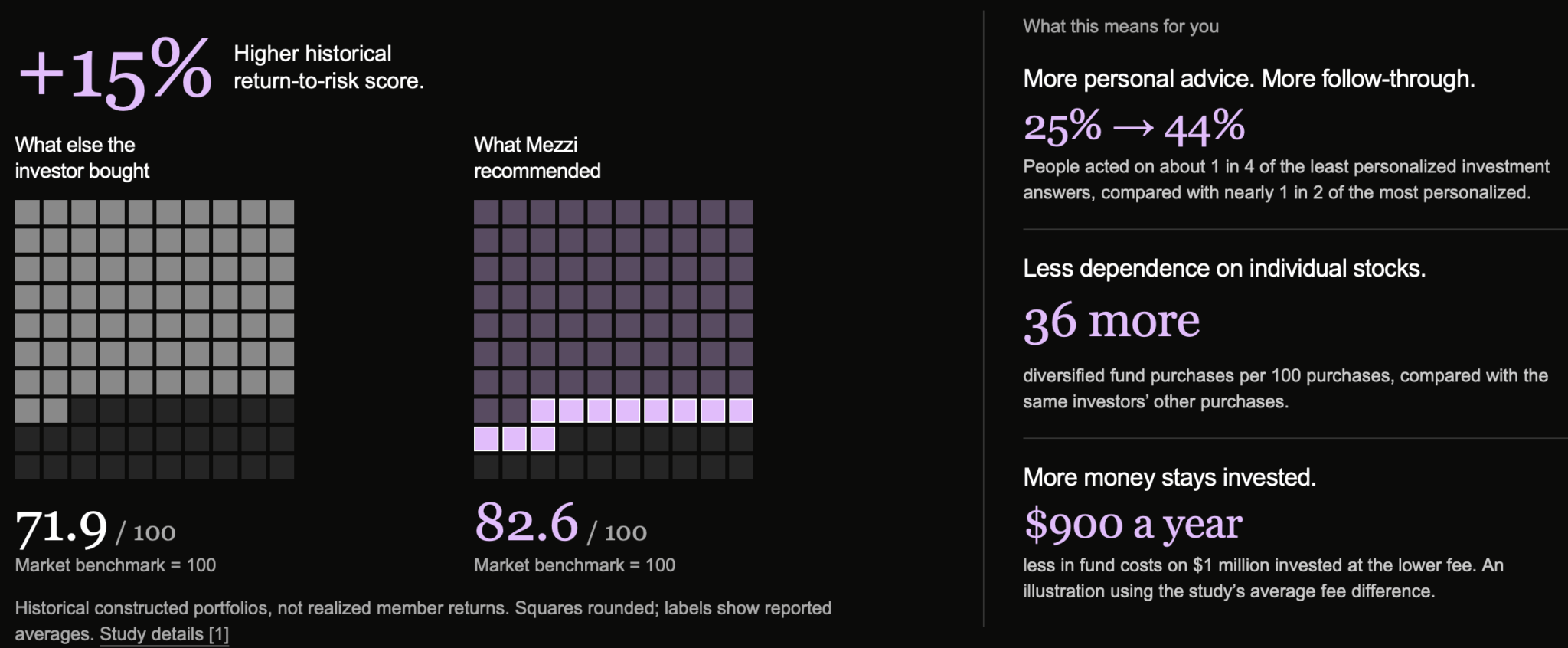
Providing financial advice with AI is new. That’s one of the reasons I was excited to invest. And I invested before the release of a study by NYU Stern researcher Valerie Baldinger examining Mezzi’s recommendations and members’ investment decisions.
In a five-year historical comparison, portfolios built from Mezzi’s recommendations showed roughly 15% stronger risk-adjusted results than portfolios built from the same investors’ other purchases.
The study also found that investors shifted more new money toward broad index funds after starting to use Mezzi and selected lower-cost funds when they followed its recommendations, with annual expense ratios about 0.09 percentage points lower.
Who Is Mezzi For?
Mezzi is for people who want help working through life’s nuance to make better financial decisions and use their wealth to achieve their goals.
Mezzi’s average customer is a millionaire. Customers typically have meaningful assets spread across multiple accounts, and more financial complexity than they want to manage alone.
- People replacing a traditional advisor who want guidance for a flat fee rather than a percentage of their assets.
- People keeping their advisor who want a second opinion on recommendations and a clearer view of their overall finances.
- DIY investors who want personalized advice and ongoing help without giving up control.

Whichever group you fall into, the questions often start the same way: Can I retire when I want? Am I missing tax opportunities? What should I do with my investments? The answers are intertwined, so this review follows one household through retirement, taxes, and investments.
Mezzi helps you work through that nuance in a natural conversation, much like talking with a human advisor, and get answers in seconds.
On Advisory and Concierge, there is no limit on how many questions you can ask. With a traditional advisor, you might hesitate to fire off another email or ask what feels like a dumb question. With Mezzi, you can ask as often as you like, at any hour, and keep following up until the answer makes sense. That advice starts with context.
A Hypothetical Household Using Mezzi's Analysis
For this review, we’ll follow a hypothetical family to see how Mezzi tailors its advice to their circumstances. Meet Manny and Melissa. Their situation is the context Mezzi works from.
Manny and Melissa are 45 and 40, respectively, with two children (5 and 10). They file taxes as married filing jointly, send their children to private school, and live in the San Francisco Bay Area. They want to pay for their children’s college education and expect a $500,000 inheritance from their parents. Their financial picture includes a smorgasbord of accounts:
- taxable brokerage
- Roth IRA
- traditional IRA
- 401(k)
- various bank accounts
- a rental property
- various credit cards
Both of them want to retire around 55 and travel the world. One works a high-paying but volatile tech job, while the other has a stable career as a nurse.
They work with a traditional financial advisor for one brokerage account.
Context Is Key
Mezzi captures your accounts, income sources, spending, tax details, family circumstances, goals, and more. Think of it as building the brain of your financial advisor.
Don’t worry, its brain won’t explode. And you decide what goes into it. So give it as much information as possible about your financial life.
The softer personal details matter just as much. Is the college money off-limits for retirement? Would you sell the family home? Are you willing to work part-time, or do you want to stop completely? Two families with the same net worth can need very different advice.
Mezzi brings together connected account data and the context you add through AI personalization. You can review and save it for future analysis, then update it through chat as life changes. With that fuller picture, a question like “Can I retire early?” becomes a much more useful conversation.

Saved personalization gives Mezzi context about your goals and everything that matters to you.
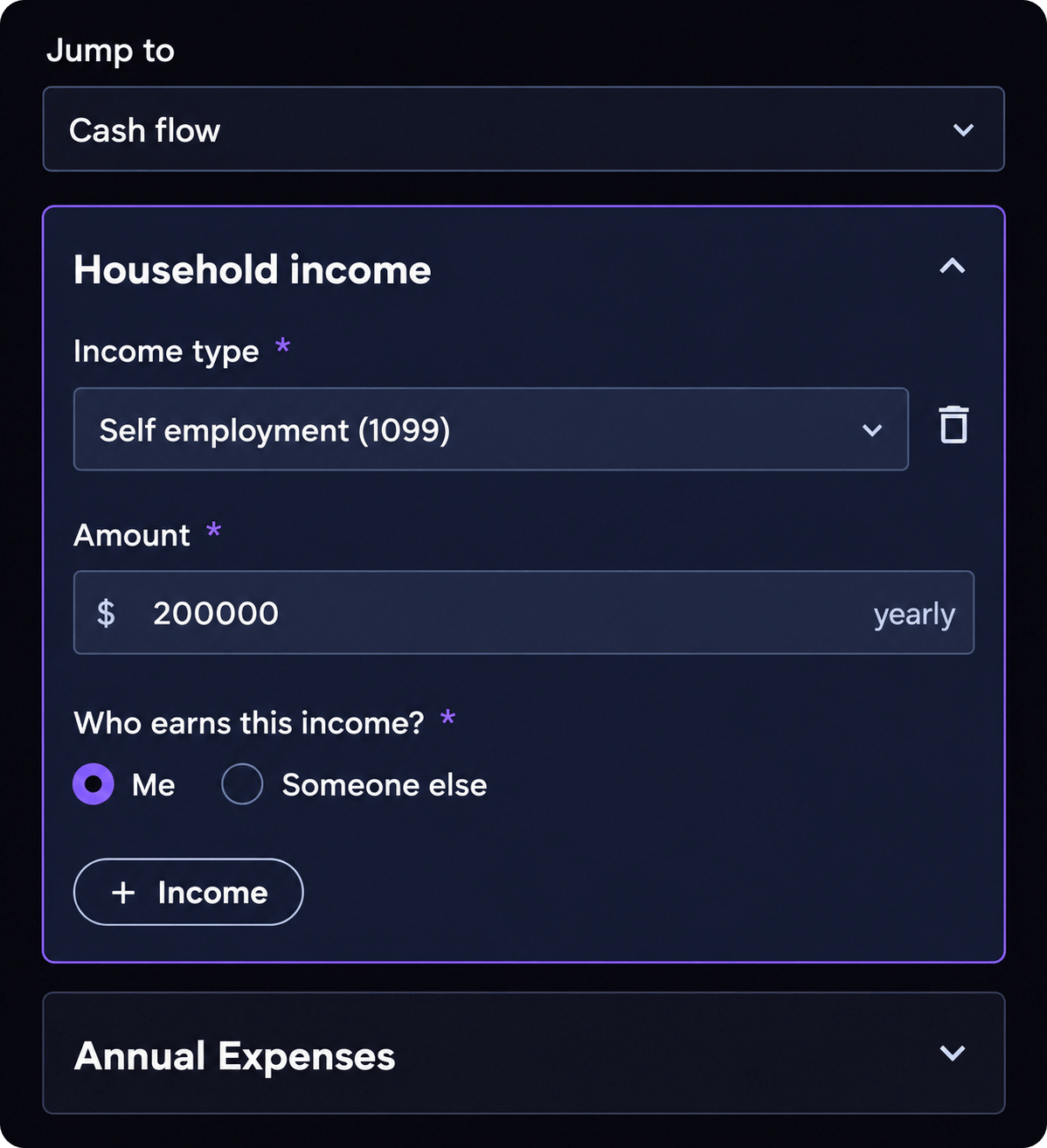
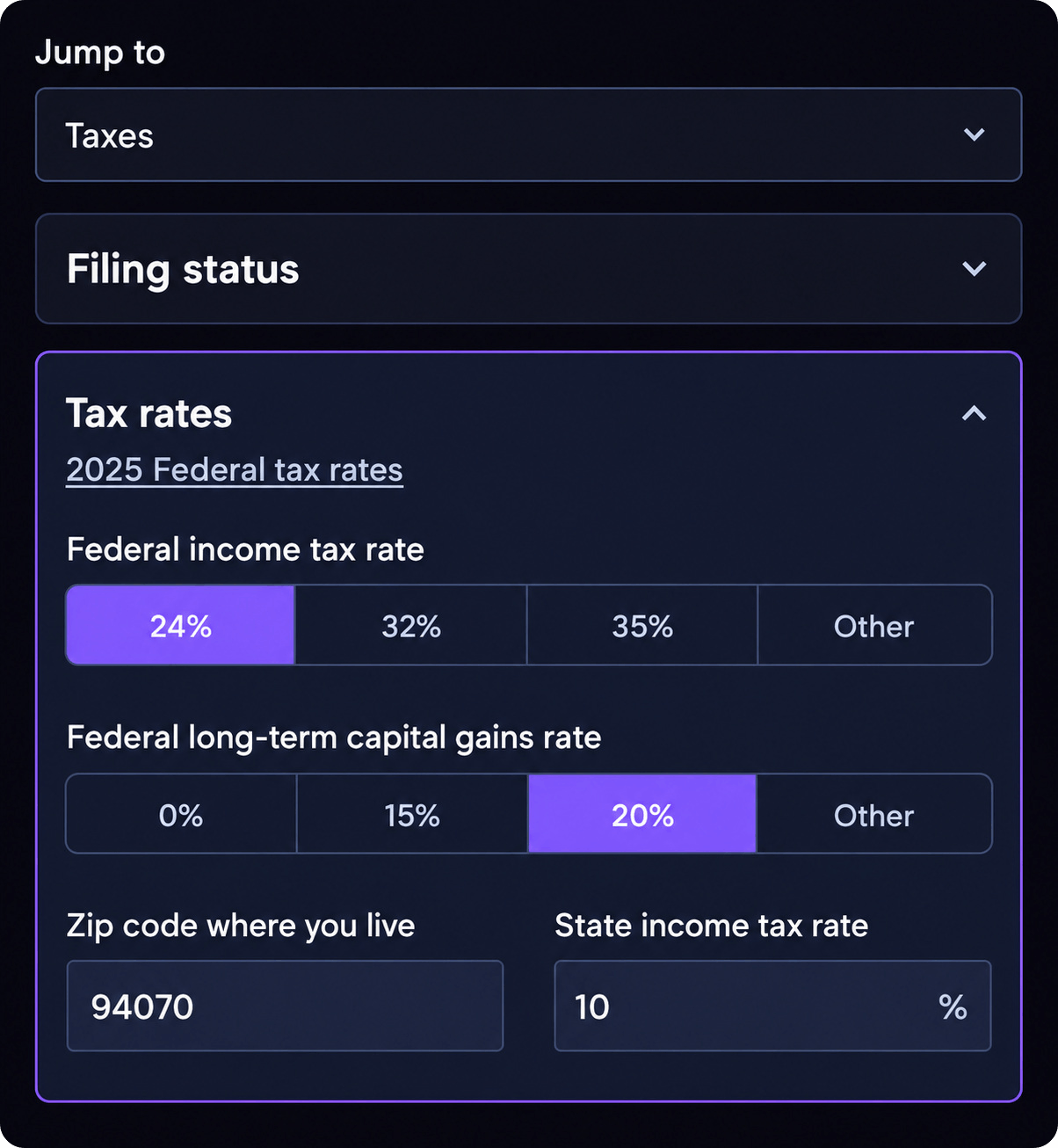
Mezzi’s Financial Profile helps Mezzi evaluate what you can spend, save, and invest.
1. Using Mezzi For Retirement Planning
Let’s say you want to retire early. Working another two years may make a retirement projection look better. Whether those two years are worth it is a more personal question. Perhaps you would rather work part-time, keep a rental property, or spend more time with your children. To weigh those choices, you need to see how your whole financial life supports them.
Mezzi can compare retirement dates, model Roth conversions, and work through which accounts to draw from first. Spending from connected accounts and the expenses you add help show what your retirement income needs to cover.
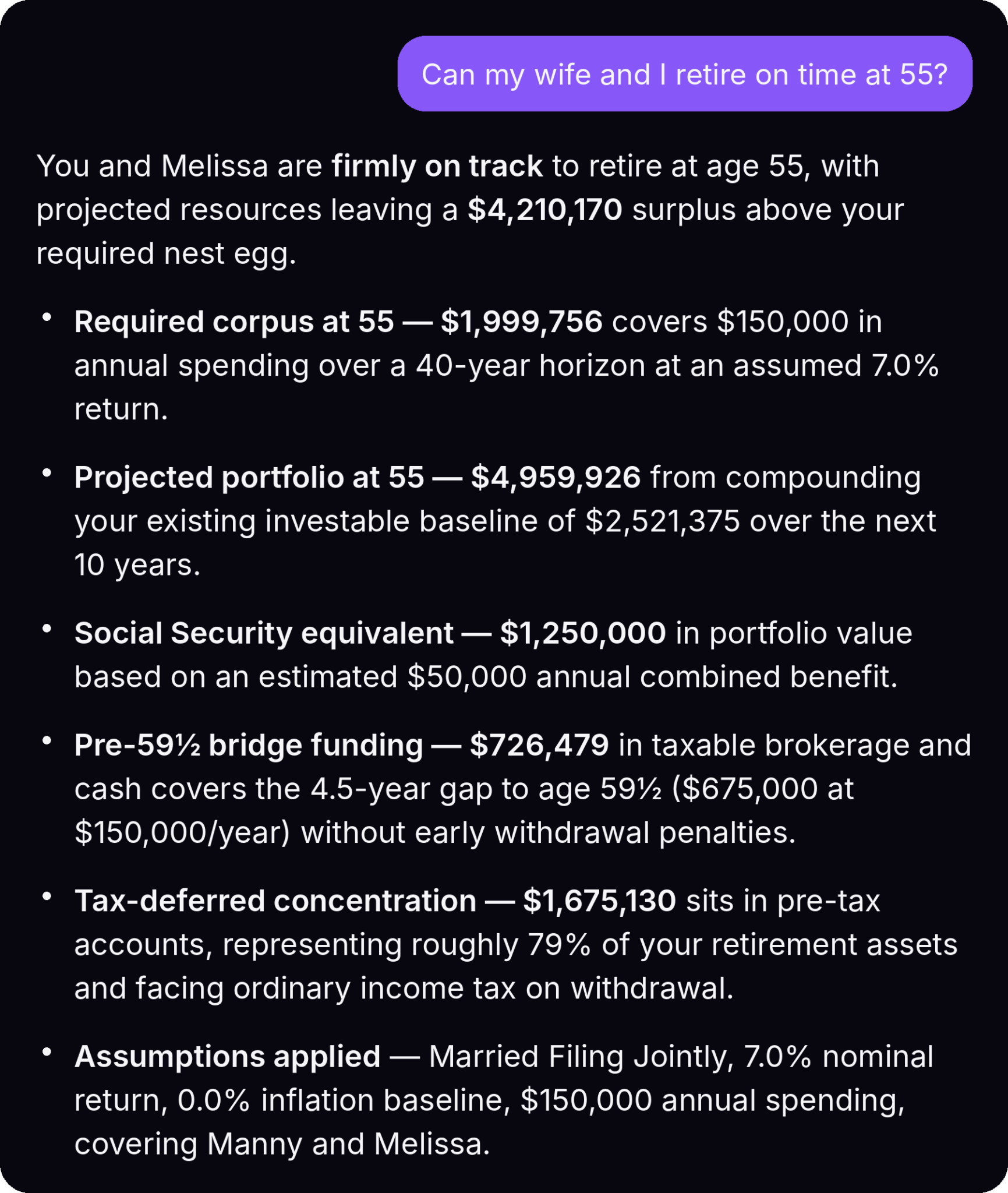
With that context saved, let’s ask whether Manny and Melissa can retire as planned, and what they might need to change.
Can they retire on time at 55?
Do they need to change their investments?
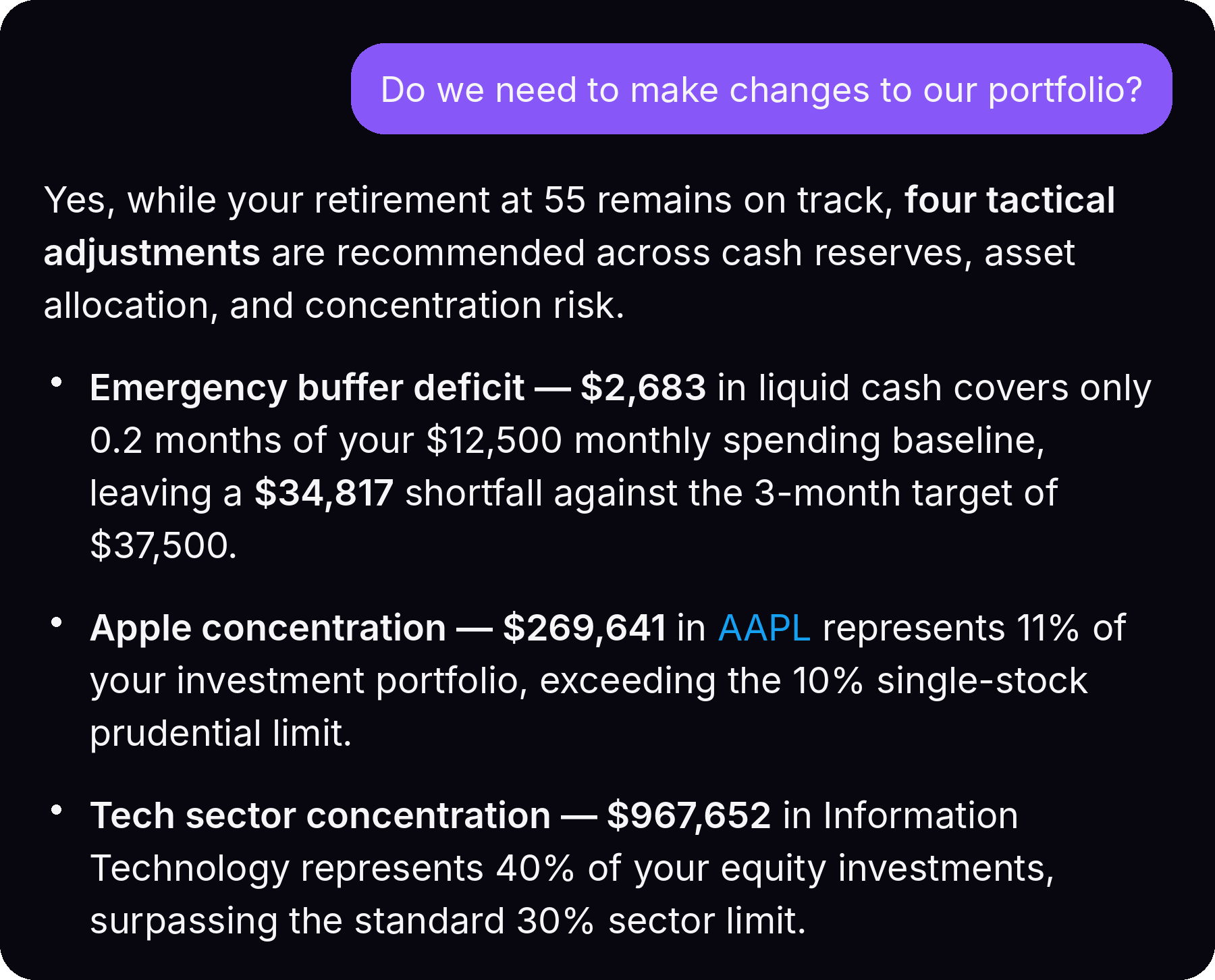
What I like here is how Mezzi connects the retirement goal to useful decisions today. It shows Manny and Melissa where they stand, then recommends ways to strengthen their plan, including building cash reserves and reducing concentrated stock exposure.

Here are a few other popular retirement questions to try:
- What’s the biggest risk to my retirement plan?
- Do I have the right portfolio to achieve my retirement goals?
- Can I afford to live in California in retirement?
- How much will I be able to pass on to my children?
- Should I do a Roth conversion?
- Project my required minimum distributions.
- Run a Monte Carlo simulation to compare retiring on time, early, or late under different market returns.
Linked questions open in Mezzi using your own accounts and saved profile. An active account and any required setup are needed.
2. Tax-Aware Investing: Keep More Of What You Earn
Figuring out whether you can retire early also means deciding how to adjust investments across your accounts to support that goal. Mezzi helps compare the tax consequences of rebalancing, identify losses to harvest, and examine dividend income and withdrawal order.
Here, Manny and Melissa ask which accounts to use to fund their retirement:
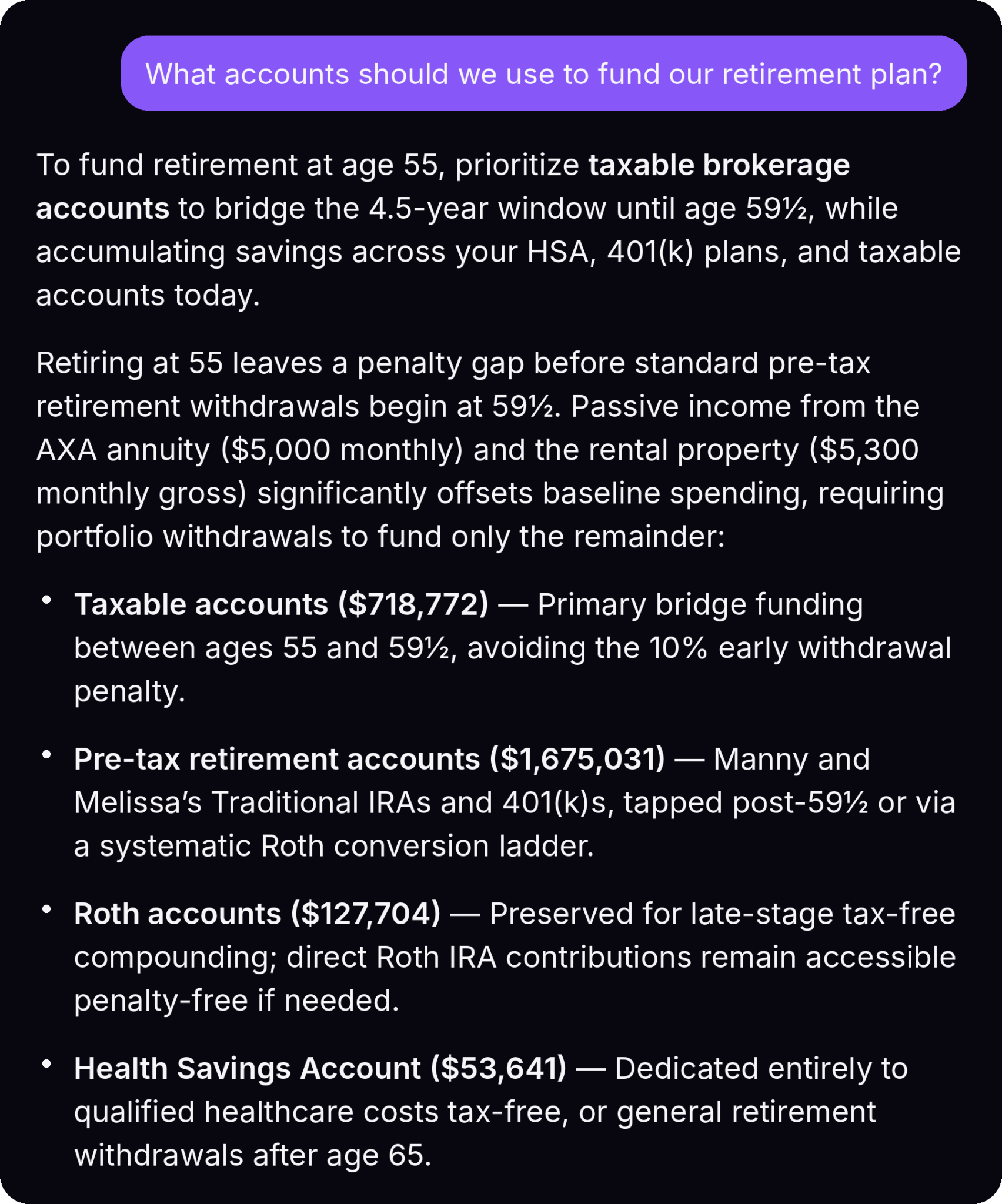
Mezzi considers continuing income and account tax treatment when recommending how to fund retirement.
Next, the conversation turns to what Melissa could hold in her solo 401(k), connecting fund selection to the same retirement goal.

The solo 401(k) recommendation pairs an allocation review with four specific portfolio adjustments.
What I love is that these recommendations consider portfolio risk alongside taxes. More on that in the investment section.
Of course, Mezzi can help with smaller decisions too. My first experience with its tax-aware guidance involved my Nike position. I thought my loss was about $10,000. Mezzi showed it was closer to $20,000, and I sold enough shares at a loss to offset long-term gains from other sales. I'm glad I did because Nike continued to decline by over 15% after my sale.
The same review is useful before a trade you are considering or one your advisor proposes. But I don’t want every opportunity to depend on remembering to ask.
Delegate The Work To Mezzi So You Don’t Have To Keep Watch
Mezzi’s Delegations let you turn a tax question into ongoing work. Give Mezzi an assignment through chat, specifying what to review and when. Think of it as creating your own financial agent for a particular job. Instead of revisiting the same question each week, you can ask Mezzi to keep doing the analysis.
To me, Delegations are the most powerful way to use Mezzi, and a peek at where wealth management is heading. Instead of remembering to check every account, you hand Mezzi the monitoring and hear back when something needs a decision. That takes much of the ongoing work of managing your wealth off your plate.
For tax-loss harvesting, you could say:

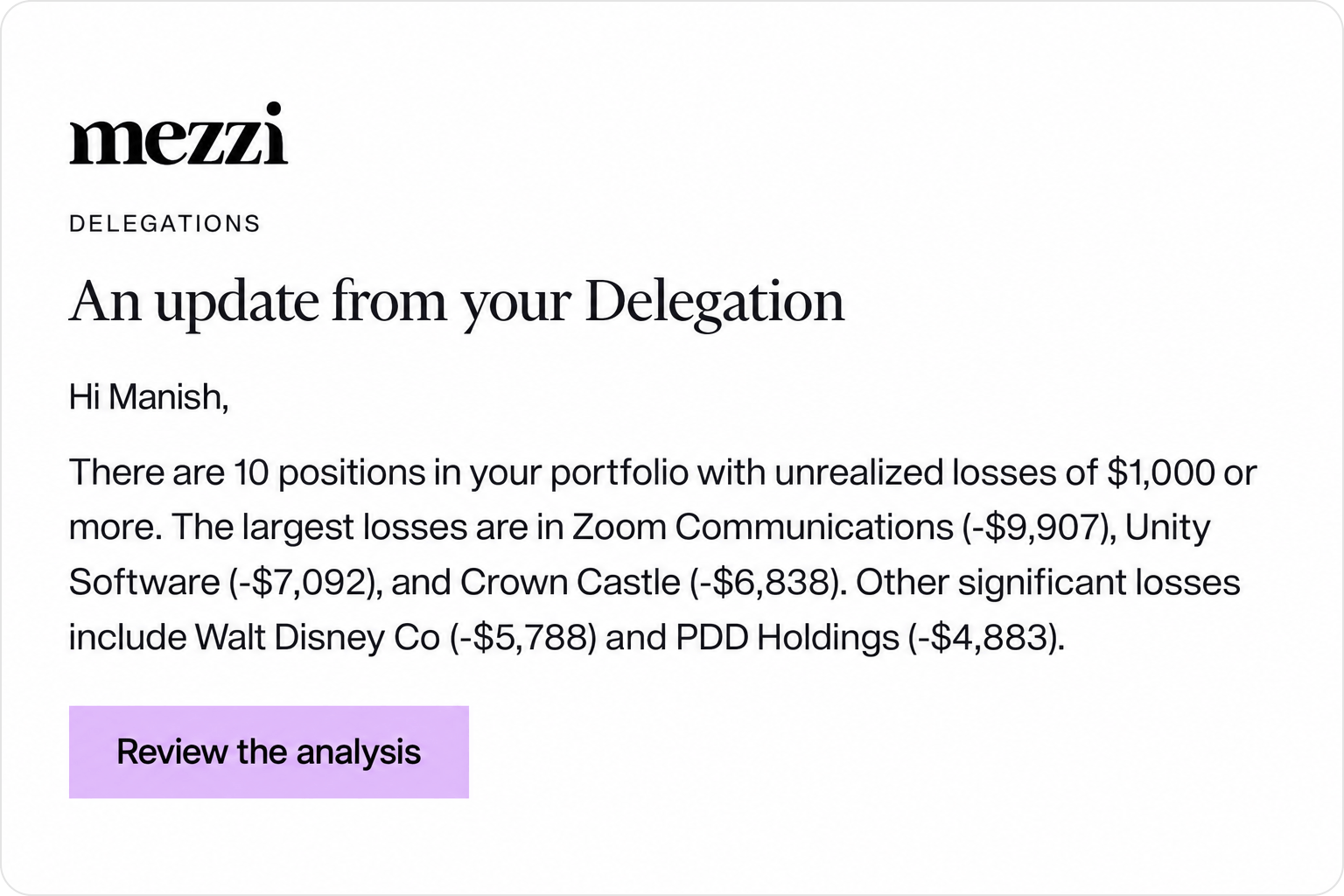
In the separate example below, a Delegation email flags 10 positions with unrealized losses of $1,000 or more, led by Zoom Communications (-$9,907), Unity Software (-$7,092), and Crown Castle (-$6,838). Mezzi can repeat the review and notify you by email or on your iPhone. Check the schedule it confirms; you can change or remove the Delegation through chat.
Some monitoring happens without a Delegation at all. Mezzi’s Home screen surfaces insights on its own, each with a next step.
For Manny and Melissa, recent cards included a reminder that there is still time to fund their IRAs and 401(k)s this year, a Roth IRA that hit a new high with an option to see what drove it, and an estimate that switching to lower-cost funds could save about $2,255 in fees over five years.
Upload Your Tax Return Or 401(k) Menu
Beyond recurring reviews and alerts, you can upload documents, such as a PDF or a screenshot, and Mezzi will analyze them alongside your accounts.
Take an employer 401(k) fund menu. Mezzi suggests an allocation from the plan’s options that fits your retirement timeline and what you already own elsewhere, with each fund’s fees shown beside it. In one example, it recommended a four-fund mix with expense ratios of 0.01% to 0.05%, while other funds on the same menu charged 0.65% to 0.80%.
Your tax return works the same way. For example:
- What is my projected tax bracket for 2026?
- Which tax-saving opportunities have I missed in the past that I should consider this year?
- Based on my 2025 tax return, how could I reduce my taxes in 2026?
Other popular tax questions to try:
- Why am I paying so much in dividend tax?
- Which of my dividends are qualified versus non-qualified?
- Do I have any tax-loss-harvesting opportunities?
- How can I avoid short-term capital gains tax?
3. Investments: What Should I Buy, Hold, Or Sell?
Beyond taxes, I want to know what to own and how much. Mezzi provides investment recommendations, from reducing concentrated positions to choosing ETFs and finding lower-cost funds.
My Google experience brought that into focus. I had estimated my exposure at $900,000–$1 million. Once Mezzi included the Google shares held inside my funds, it was closer to $1.3 million. I was carrying more of the position than I realized.
Owning several funds can make a portfolio look diversified even when the same companies appear repeatedly. That is easy to miss when the funds sit at different institutions or some accounts are managed by an advisor while others are self-directed.
Mezzi’s Diversification X-ray combines the underlying holdings of supported funds with stocks owned directly, showing company and sector exposure across accounts.
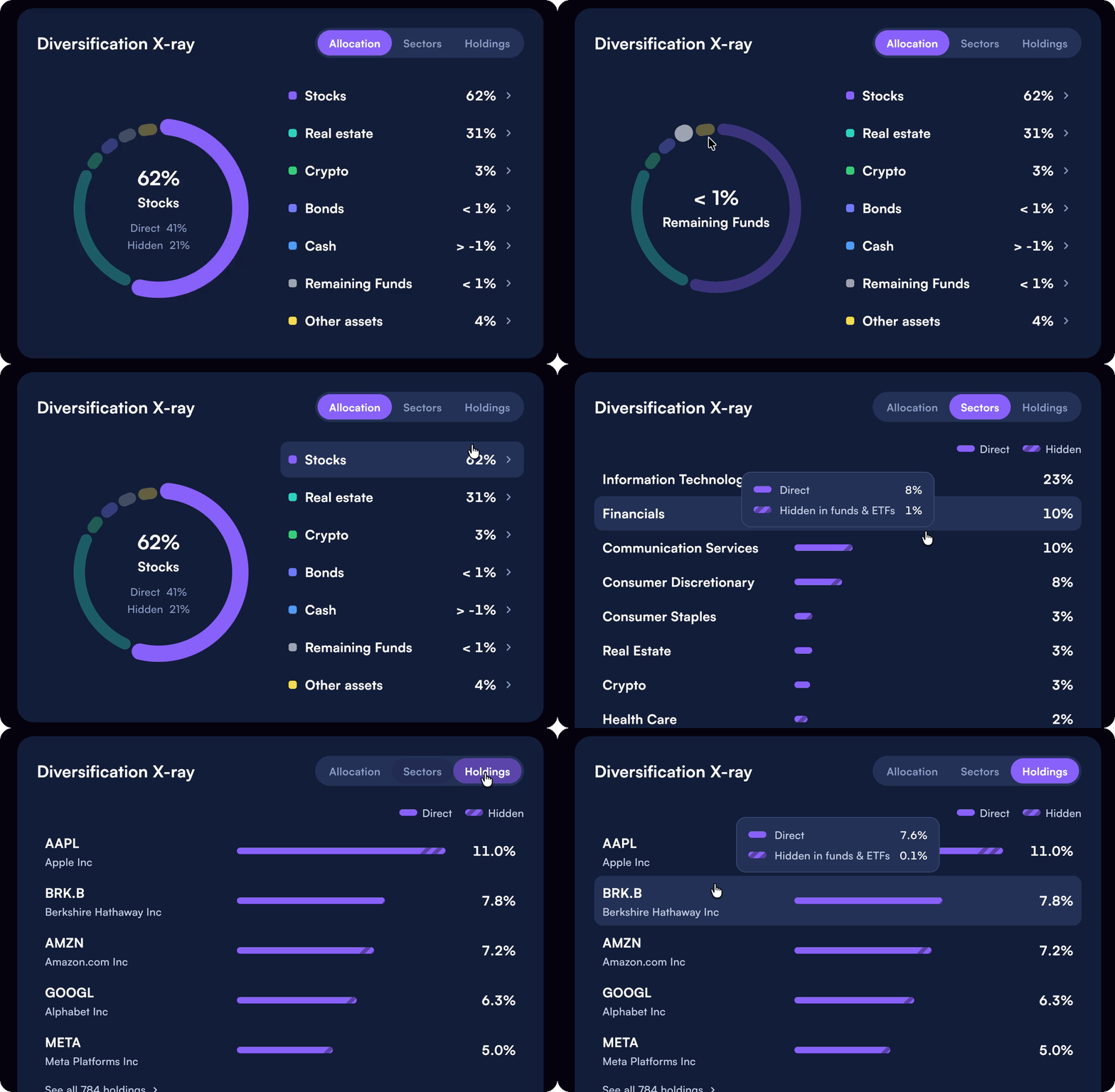
Mezzi suggested trimming about $400,000. I chose to sell $200,000 in tax-advantaged accounts to avoid capital gains tax. I valued the analysis without following the recommendation in full. That is the kind of control I want to retain.
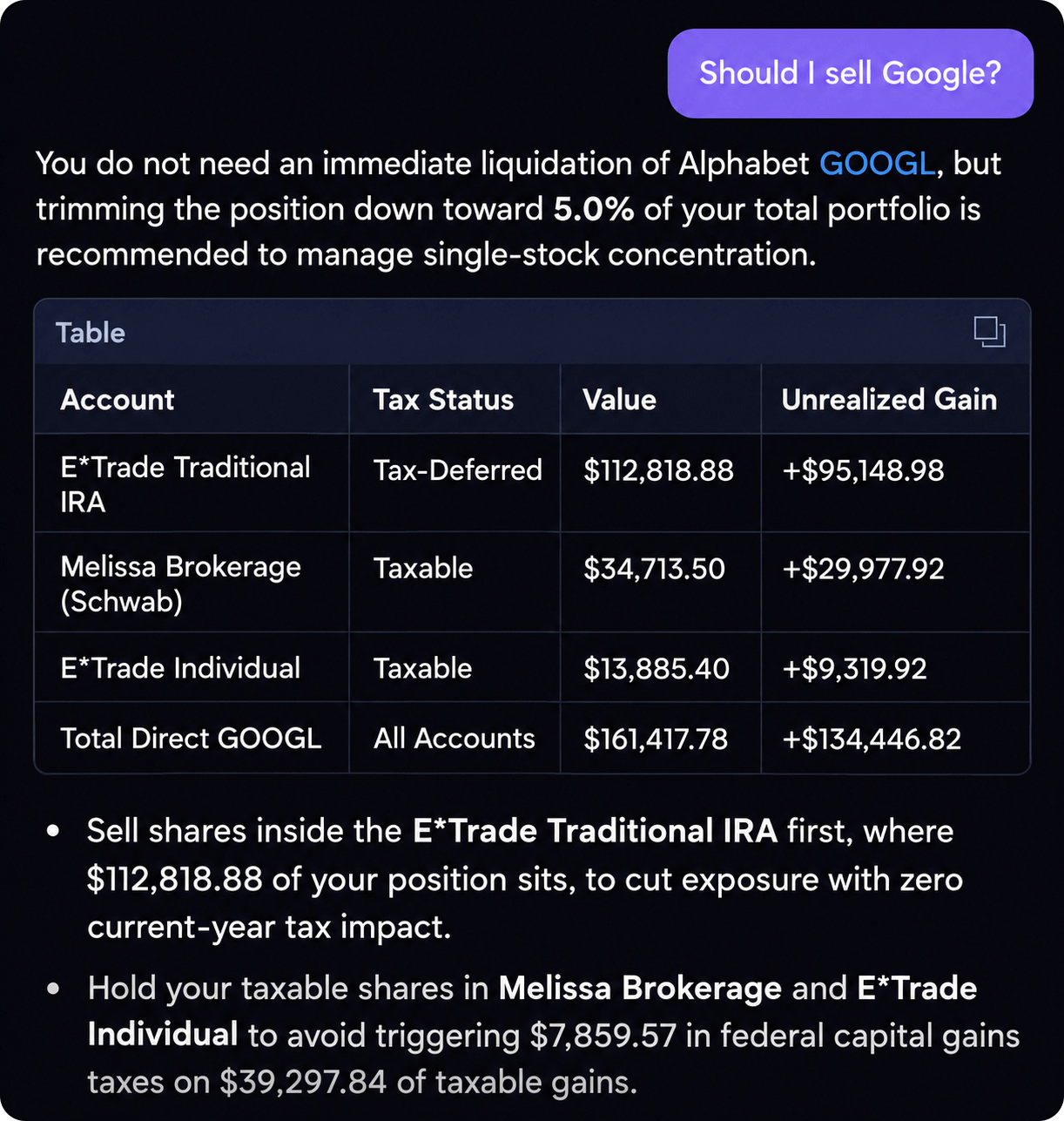
Back to Manny and Melissa, one of whom works in tech: here is how Mezzi weighs a Google sale across taxable and retirement accounts.
Other investment questions to try:
- Do I have too much risk?
- Am I invested the right way?
- Should I sell Apple or Google?
- What are the best ETFs for investing in semiconductors?
- What are lower-cost alternatives to my ETFs?
Watch Mezzi 101
For a fuller look beyond these screenshots, watch this comprehensive Mezzi 101 with CEO Manish Jain.
What’s Next For Mezzi
Mezzi ships meaningful improvements every month, building on recent additions to wealth tracking, tax-lot detail, and Delegations.
Its broader ambition is an AI-native wealth management firm spanning advice, research, and eventually asset management. Asset management remains a roadmap ambition; Mezzi does not currently execute transactions.
What Does Mezzi Cost, And Is It Worth It?
Mezzi offers Free, Advisory, and Concierge memberships. The right plan depends on how much help you want.
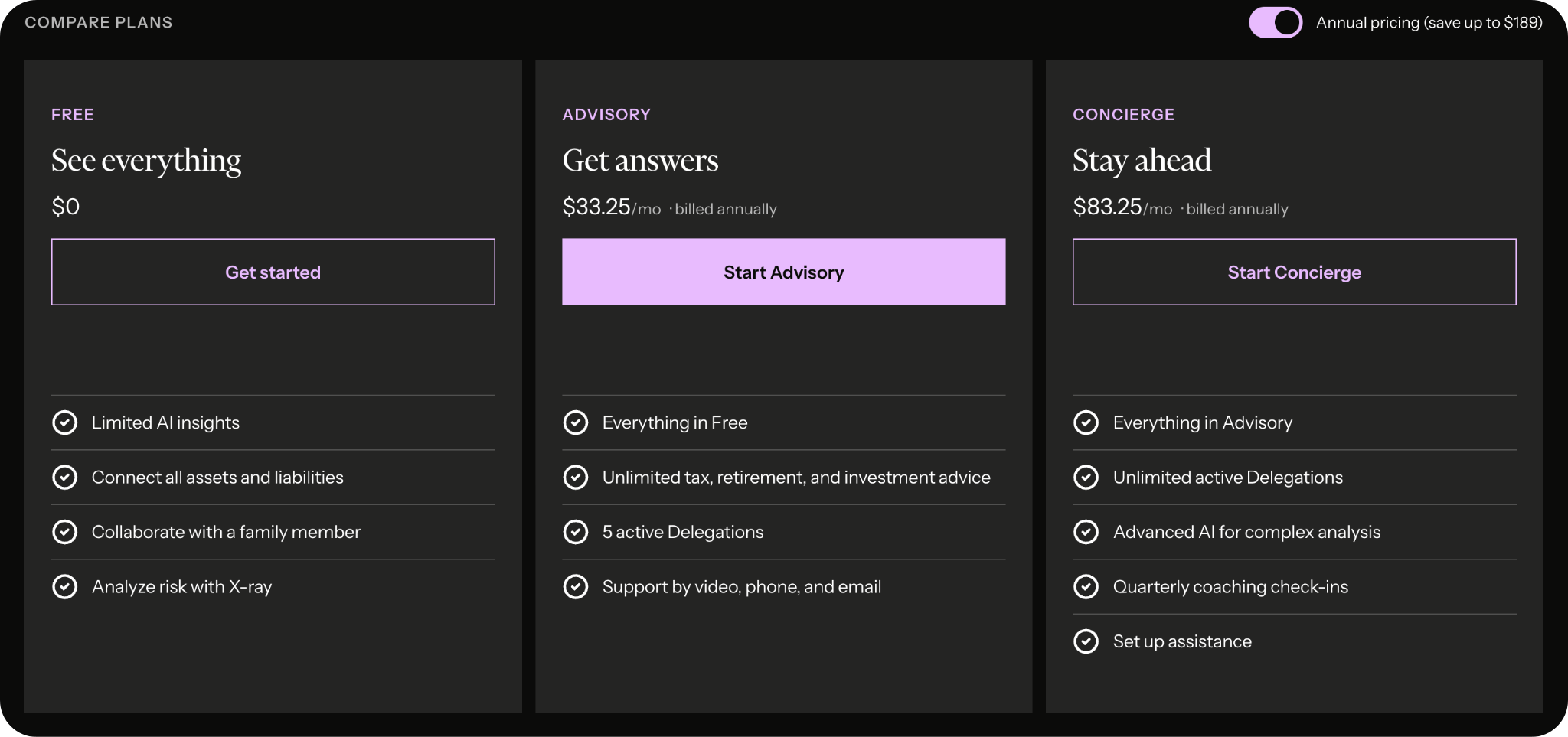
Free: Start here if you mainly want the full picture. You can connect all your assets and liabilities, add a family member, and run the Diversification X-ray, but AI insights are limited. Great if you don’t want advice.
Advisory ($39 a month or $399 a year): It adds unlimited tax, retirement, and investment advice, five active Delegations, and support by video, phone, and email. Five Delegations cover a typical setup, such as a weekly tax-loss review, a monthly retirement check, and a daily news digest on your largest holdings.
Concierge ($99 a month or $999 a year): It unlocks unlimited Delegations so you can have Mezzi monitor anything 24/7. You’ll also get access to advanced AI models for more complex analysis, and quarterly platform coaching. The coaching is great if you are newer to AI and want one-on-one assistance with getting the most out of Mezzi. Coaching doesn’t mean financial advice—all financial advice is delivered by AI.
For comparison, some financial planners charge $400 an hour, and planning engagements can run $2,500–$10,000 depending on scope and complexity.
At a 1% annual advisory fee, a constant $1 million portfolio costs $10,000 a year, compared with $399 for annual Mezzi Advisory. The services are not identical: a human advisor may also handle implementation and provide personal support. Fund expenses and other investment costs remain separate.
Who Mezzi Is Not For
If you want to hand your money to someone and never think about it again, Mezzi isn't for you. It doesn't (yet) execute trades, assign you a dedicated human advisor, prepare your tax returns, or draft your estate documents. You still pull the trigger, and you may still need a CPA or estate attorney.
Personally, I see that as a feature. After 13 years in finance, as a DIY investor, I don't want anyone moving my money without my say. Mezzi does the analysis and the monitoring. I keep the final call. That's how I sold $200,000 of Google instead of the $400,000 it suggested, without arguing with anybody.
Mezzi also isn't for someone with a three-fund portfolio and a process they already follow without fail. If that's you, congratulations. You probably don't need another subscription. It's built for U.S. households, and like any advisor, human or AI, its advice is only as good as the information you give it.
But if you've got multiple accounts, a few moving parts, and more decisions than free Saturdays, Mezzi earns its keep, and then some.
If that sounds like you, the next questions are practical: how your accounts connect, who can see your information, and how Mezzi fits with the services you already use. Let's go through them.
Mezzi Frequently Asked Questions
Do I Have To Move My Investments?
No. Connected accounts stay at your existing institutions. Mezzi uses read-only information and does not execute trades or move funds for you.
Is Mezzi A Registered Financial Advisor?
Yes. StockTalk, Inc., doing business as Mezzi, is an SEC-registered investment adviser.
How Is Mezzi Different From Asking A General AI Chatbot?
Mezzi provides personalized financial advice, not just explanations of financial concepts. Its advisory service is subject to fiduciary standards: the advice must be in your best interest.
Mezzi uses your connected accounts, saved financial profile based on your inputs, and specialized portfolio analysis to recommend what to do across retirement, taxes, and investments. Home insights and Delegations support the ongoing follow-up.
How Is Mezzi Different From Other Personal Finance Platforms?
Mezzi is a financial advisor, not just a personal finance dashboard. Tracking accounts, spending, and projections helps you understand your finances. Mezzi uses that information to recommend what to do: how much to save, which investments to buy or sell, and how to coordinate tax and retirement decisions.
You can question a recommendation, compare alternatives, and assign ongoing reviews. The value is personalized advice and follow-through, not simply another place to see your accounts.
Can I Use Mezzi Alongside My Existing Advisor?
Yes. Use it to examine managed accounts or recommendations, as Manny and Melissa could with the brokerage account their advisor manages.
What Happens If An Account Or Fund Is Missing?
You can add an account manually or scan a statement. For a plan-specific 401(k) fund without a public ticker, contact support@mezzi.com for help matching it to an analytical reference. Review that match so the exposure analysis reflects what you own.
Can My Spouse And I Use It Together?
Yes. You can invite your spouse or partner as a collaborator and see your finances in one shared view. It's included on every plan, including Free.
This is a bigger deal than it sounds. In 2023, I spent four months consulting for a fintech startup trying to solve exactly this problem: how two people manage money together. It was harder than anyone expected. The product never quite worked as planned, and the team ended up being acquired by a larger financial institution a year after I left.
So I appreciate how easy Mezzi makes it. Now both of you can ask questions, see the same recommendations, and stop having the “wait, how much is in that account?” conversation at dinner.
Is My Financial Data Used To Train AI Models?
No. Mezzi prohibits third-party AI providers from training on user data. It does not sell personal information or store brokerage login credentials.
Does Mezzi Help With Tracking Expenses?
Yes. You can review spending across connected bank and credit-card accounts, then ask Mezzi how it affects your savings or retirement plan. You can also add expenses directly to your financial profile.
Does Mezzi Manage Assets?
Not yet. Mezzi currently provides financial advice; your assets stay at your existing institutions and you carry out any trades. Asset management is on the roadmap.
Can Mezzi Include My Rental Properties?
Yes. Add each property’s current value, cost basis, mortgage, rental income, and operating expenses. Mezzi can then consider your real estate alongside your investments and other debts when recommending how to invest or fund retirement.
Does Mezzi Support Accounts In Other Countries And Currencies?
Not currently. Mezzi focuses on U.S. households and does not yet support multi-country accounts or foreign-exchange tracking. International support is on the roadmap.
Mezzi As My Interactive Wealth Management Guide
Every investor I know thinks they're above average. I used to think so too. Then I started asking Mezzi hard questions about my own portfolio, and my ego took a few body blows.
That's why I'll keep using Mezzi as my interactive guide. Its job is to keep me honest about my performance and my risk, because my ego certainly won't. The bigger and messier your portfolio gets, the easier it is to fool yourself. Having an AI advisor that never sleeps, never gets annoyed by follow-up questions, and never tells you what you want to hear is worth a lot.
Give Mezzi a try and see what blind spots or opportunities it finds in your portfolio. Worst case, you confirm you're as savvy as you think. Best case, you catch something before it costs you.
It's free to start. If you have questions, email founder Manish Jain directly at manish@mezzi.com and tell him Sam sent you. He'll give you a guided tour, show you how to get the most out of it, and answer anything else on your mind. I've met plenty of founders. Very few will personally answer your email.
Manish has also offered Financial Samurai readers 15% off the first year. Use code FS15 for an Advisory or Concierge membership.

Disclosure:
StockTalk Inc., doing business as Mezzi, is an SEC-registered investment adviser. I am an investor and affiliate promoter of StockTalk Inc. All opinions and portfolio figures are my own, and I only partner with companies whose products I personally use. This post is for informational purposes only and should not be construed as personalized investment advice, a securities recommendation, or an offer of advisory services. SEC registration does not imply any level of skill or training. Past performance is not indicative of future results. Any third-party ratings, reviews, rankings, testimonials, or endorsements may be unaffiliated, subjective, not representative of all client experiences, and not a guarantee of future performance.
Here's my conversation with Manish about his entrepreneurial journey and what Mezzi can do to help its customers build more wealth and clarity.



Oh wow this looks amazing. And having a free or a flat-fee based pricing structure is HUGE for advisory services. I really dislike the traditional percentage based models elsewhere. It’s too hard for me to willingly fork over thousands of dollars each year, which is why I stopped paying for an advisor. Perhaps the industry will eventually shift out of that dated percentage based fee structure, but why wait for them to change when there’s a better option already.
I also like that you can essentially setup scheduled tasks for it to track and keep you updated on. And I assume you can create multiple as well. I’ve never had a financial advisor that would do anything like that except like a quarterly check-in but only if I scheduled it in advance. Being able to set up alerts on a frequent basis is a huge advantage from an investment and wealth management perspective especially at a flat fee.
And I also like that you can rattle off questions at any time of day or night. For me, the best time I think about my finances is usually late at night when nobody else can bother me, but regular advisors are obviously not available at those hours. I’ve had three advisors in the past and I just never felt that great about scheduling meetings with them. They were always in a rush or just didn’t give me a whole lot of detail. And one guy just really didn’t seem to like his job so he was a bad fit for me. Anyway, thanks for this detailed review. I’m going to check it out now.