
A few months ago I scraped the right front side of my car while parallel parking in San Francisco. The culprit was a bike rack sticking three feet off the back of the car in front of me. I didn’t see it.
My first thought was relief that I never bought the new Range Rover I was so tempted to buy. Because I follow the 1/10th rule for car buying, a scrape on an older car is an annoyance, not a crisis.
My second thought was about insurance. I’ve been a careful driver for decades. Yet a careful record only goes so far when the price of a policy depends on so much more than you.
Big city drivers know this pain well. Toronto is a great case study.
Toronto-area insurers price the claims they expect to pay as well as a driver’s own record. The car and where it is kept affect those expected costs. So a Toronto driver with a clean record can pay more than someone elsewhere in Ontario.
That feels unfair. But insurance isn’t a report card. It’s a bet on the future, and you are only one input.
The wider region has higher average premiums, though individual households can pay less. That pattern doesn’t make Toronto the most expensive place in Ontario for every car or policy.
Toronto and regional premiums are different measures
The Greater Toronto Area includes Toronto and communities outside the city. An average for that region isn’t an average for Toronto alone. Keep that difference in mind when comparing your bill with published figures.
As of June 2026, insured private passenger vehicles in the Greater Toronto Area had an average annual premium of $2,868. Other urban areas averaged $2,131, and rural Ontario averaged $1,791. The figures cover premiums over the previous 12 months.
In other words, the GTA average runs about 35% higher than other Ontario cities and about 60% higher than rural Ontario. That’s a lot of extra Tim Hortons.
But an average is just an average. The figures include people with different driving records, cars and coverage. They aren’t quotes for one person trying several addresses. A Toronto driver can pay less than the regional average. Someone outside the city can pay more.
The data helps explain the question. It can’t tell you which part of your own policy made it expensive.
How local collisions affect premiums
City drivers share the road with other cars, pedestrians and cyclists. At an intersection, several people may be turning or crossing at once. Not to mention the occasional bike rack lurking behind a parked car.
An insurer looks at how often a covered collision might happen and how much it might have to pay afterward.
Your miserable commute doesn’t turn into a set amount on your bill, though. Busy roads have slow stretches and faster ones. The insurer uses claims information to price risk. Your stress level on the Gardiner tells the company nothing about what those claims will cost.
A collision can also injure people, not just damage a car. The insurer may have to pay injury-related costs that won’t appear on a repair bill. Ontario requires some injury benefits, and drivers can choose more protection. Those benefits belong in your policy comparison too.
Here’s the part careful drivers hate. The company collects premiums from a group of drivers to pay the claims it expects from that group. It still takes your record into account. But someone who has never made a claim can still pay for insurance that reflects losses elsewhere in the group.
You are subsidizing your neighbors’ bad parallel parking. Possibly mine too, if I lived in Toronto.
Higher repair bills and theft losses can raise premiums.
That can affect a careful driver at renewal, even if the company has no new collision to add to their record.
For a Toronto household, the cost of car insurance in Toronto depends on the vehicle, address and protection as well as the driver’s own accidents. A clean record helps, but it doesn’t settle the full price.
Your insurer should explain which of those costs applies to your particular policy. “City driving is expensive” is not an explanation. It’s a shrug.
Theft risk depends on the vehicle
Living in San Francisco, I’ve learned to never leave anything visible in my car. Some locals leave their doors unlocked so thieves don’t bother breaking the windows. Theft is part of city life, and insurers know it.
Thieves target some makes and models more often than others. Stolen vehicles also cost different amounts to replace. An insurer can charge more for a car that attracts theft, even when its owner has never had a collision. A Toronto address doesn’t give every car the same theft risk.
Comprehensive coverage generally covers insured theft and other losses beyond collision damage. Changing cars can change the price of that coverage while your address and driving routine stay the same.
So before you buy, get a quote on the exact vehicle you’re considering. Insurance is part of the true cost of ownership, not an afterthought you discover at signing.
Theft figures also need a date. Ontario vehicle thefts fell 25.9% in the first half of 2025 compared with the first half of 2024. Describing theft as something that rises every year would overlook that drop.
But don’t expect an instant refund. Insurers also expect to pay for other kinds of claims, and they estimate what those future claims will cost when setting premiums. A province-wide drop in theft doesn’t promise the same price cut for every model or Toronto neighbourhood.
Parking and security measures may affect your quote, though companies treat them differently. A garage or tracking device doesn’t earn the same discount from every company. The insurer must confirm any saving before it becomes part of your quoted price.
Related: The Best Life Hack For Americans: Take Advantage Of Canada
Why modern repairs cost more
A car’s safety features can help prevent a crash. Ironically, those same features can make a fender bender far more expensive.
If my scrape had hit a bumper packed with cameras and radar sensors, the fix wouldn’t have been a simple paint and panel job. Cameras, sensors and connected electrical systems may need tests to find the damage. The shop may also need to calibrate the equipment so it works correctly after the repair.
That takes time and skilled labor beyond replacing a part that looks damaged. A car with many sensors can cost more to fix. Insurers look at your particular vehicle instead of assuming all cars built in the same year will have similar repair bills.
Rising repair costs are also why the dealer’s finance office loves selling extended warranties. The pitch is simple: cars are expensive to fix, so pay us now and sleep better later.
Lots Of Repairs With My Car
When I bought my 2015 Range Rover Sport in December 2016 with 10,800 miles on it, the dealer offered seven years or 100,000 miles of coverage. The price was $4,500 with no deductible, or $2,500 with a $1,000 deductible. I passed.
Roughly 67,500 miles later, my repairs, excluding oil, tires and brakes, have come to about $4,325. A fan, a water pump, a vacuum pump, a gasket and some sensors. Annoying, but not ruinous.
Meanwhile, both warranties would have expired in July 2022. I only drive about 6,000 miles a year, so the calendar would have killed the coverage long before the odometer did. By my math, the no-deductible warranty would have cost me $5,550 all in, and the deductible version $5,250. Both more than I actually spent.
I break down every repair bill in why an extended car warranty is probably not worth the cost. The short version: warranties are priced so the seller wins on average. So is insurance.
The difference is you can’t legally drive without car insurance. But you can absolutely self-insure your repairs. Set aside the money you would have spent on a warranty, get a pre-purchase inspection, and find an independent mechanic you trust. Mine is close enough to walk to, which beats paying for an Uber to and from a distant dealership.
Not everyone wins this bet. A minority of owners get hit with repair bills far bigger than any warranty would have cost. But if you have an emergency fund, you’re the house, not the gambler.
Time without the car adds another cost. If your policy pays for temporary transport, a longer repair means paying for that transport for longer. Parts, labor and the rental coverage you chose all affect what the insurer may pay.
A cheaper car to buy isn't automatically cheaper to insure, so its insurance cost needs to come from a quote for the exact model and chosen coverage.
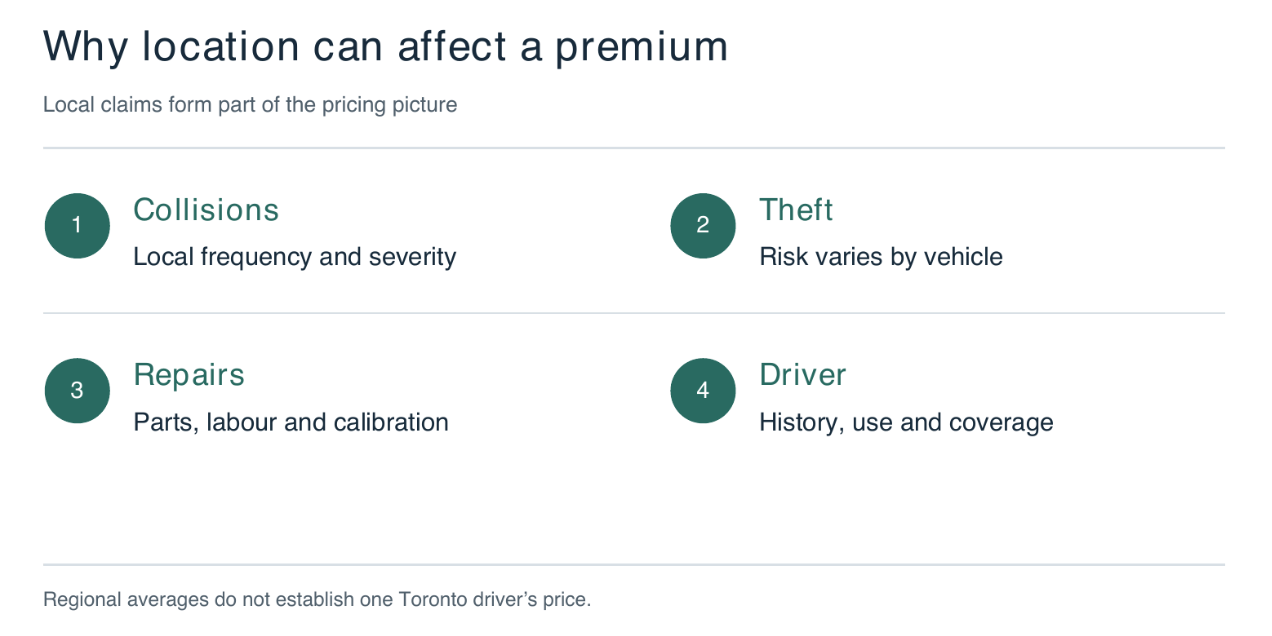
When personal details outweigh location
Location gets the headlines. But your own details can matter just as much.
Someone driving long distances from a rural home may bring different risks than a Toronto resident who rarely uses the car. Comparing their bills requires looking at the car, license history, yearly distance and household drivers, alongside coverage, deductibles and liability limits.
I’ve written before about how to save money on car insurance, and the principle hasn’t changed. Shop around, compare apples to apples, and don’t let inertia pick your premium for you.
If you’re a Toronto household, quotes should use your actual address, parking and vehicle use with the same protection. The regional average explains a broad cost pattern. It can’t show how much of your bill comes from location versus everything else.
A clean driving record is necessary. It just isn’t sufficient. The rest comes down to what you drive, where you park it, and whether you bothered to ask your insurer the right questions.
Readers, do you live in a big city and feel like you’re paying a premium for other people’s driving? Has your car insurance gone up even though your record is spotless? Did you get a quote before buying your last car, or did the insurance bill come as a surprise? And what’s the dumbest fender bender you’ve ever had?
Related: If U.S. Home Prices Get As High As Canadian Home Prices
