
For those who work in AI, let me share a cautionary tale based on history. You may be getting incredibly rich right now, but there’s little point in being rich if your safety is constantly at risk.
Back in 2008, I was working in finance at Credit Suisse Group in San Francisco. There were constant protests against all financial institutions for the next three years.
The most famous slogan to come out of the global financial crisis was, “We are the 99%!” People camped out in public parks through NYC and other big cities, and anybody who worked in finance was the bad guy. And you definitely didn't want to tell people you worked in finance out of fear of being mugged and beaten.
It was a strange time for me given I had nothing to do with folks not paying their mortgages or loan officers lending money to households they probably shouldn't have. Further, I was losing a fortune, given ~95% of my net worth was invested in risk assets.
My friends, colleagues, and clients were getting laid off left and right. I remember counting seven rounds of layoffs at Credit Suisse over only a two-year period. The global financial crisis was a stressful and scary time as I thought I might end up losing everything. In 2005, I had bought a single family home with a huge mortgage and had no more cash after the 20% down payment.
At one point, my net worth was probably down about 40% in six months that took 10 years to accumulate.
I wanted to protest too!
The Beginning Of The End
In retrospect, the GFC began sowing the seeds of my discontent. Before the collapse, I felt proud to have had a job in finance. I was helping institutional investors better allocate their capital in the Asia region. It was also enjoyable to meet entrepreneurs and company management during their IPO roadshows to help them raise capital.
However, once the GFC hit, I lost almost all my pride and joy for the business. Not only was I getting crushed financially, I also felt bad working in finance given all the constant attacks.
And so, I began to daydream about a simple life after finance and plan my escape. First came the launch of Financial Samurai in July 2009 as a cathartic way to make sense of the chaos. Then came even more aggressive saving and investing, bumping up my saving rate to ~80% for my final 2.5 years. Finally came gaining the courage to raise my hand to get laid off and negotiate a severance package.
Yes, I missed the money. But my soul also felt lighter leaving the financial services industry.
The public had influenced my belief that I was bad, even though I worked in international equities. I had to make a decision whether grinding 60 hours a week doing something that society looked down upon was worthwhile. And my decision was no. Besides, I was already burned out.
The GFC's Damage Was Real, But Relatively Contained
Between 2007 and 2010, there were approximately 3.8 million foreclosures. Across the full decade-long crisis, there were about 6 million completed foreclosures, roughly one out of ten households with a mortgage. Somewhere between 10% and 12% of all mortgage borrowers lost their homes. However, the vast majority of homeowners, representing 60% of Americans, never had a mortgage at risk.
The damage was devastating for those caught in the crossfire. Only a quarter of foreclosed households ever regained homeownership, taking an average of four years to do so. Even five years after foreclosure, only about half of borrowers had recovered their credit scores to pre-foreclosure levels. The despair among families and couples was vast.
But here is the important distinction: the GFC was triggered by reckless lending and borrowing decisions concentrated in a narrow slice of the financial industry, and most of the harm was eventually reversible. Home prices recovered. Equity came back. Life went on.
The same cannot be said for AI.
Working In AI Is Worse Than Working In Finance During The Global Financial Crisis
Think about this situation for a moment.
You are working at a hot AI company like Anthropic. They pay you a $400,000 base salary plus a $500,000 initial stock grant that vests over four years. Thanks to rising valuations and continued annual grants, your total compensation is now over $1 million a year. Whether you realize it or not, you are rich.
But here is the thing. The success of your AI company may also help displace millions of jobs. The richer you become, the poorer millions of other households become. It is essentially a zero sum game as the crushing of software companies in 2026 has demonstrated.
Compare that with most people who worked in finance during the Global Financial Crisis. Many had nothing to do with the mortgage industry. Further, a large number of finance workers were losing money themselves, while watching colleagues get laid off.
Unlike the mortgage lenders of 2007, you cannot claim ignorance. You know what you are building and what may happen if it succeeds. I’m sure you’re a nice person too, like most people in finance were. But the public will despise you for making them lose everything.
Your boss regularly goes on television and talks about how 50% of knowledge-worker jobs could be wiped out in a short period of time. The more the company can replace labor, the larger its total addressable market (TAM), and the more valuable its shares may become.
The Scale Of Disruption: What The Data Actually Says
On the more hopeful end for humanity, Goldman Sachs estimates that if AI use cases expand across today’s economy, roughly 2.5% of U.S. jobs could be displaced. In a more aggressive adoption scenario, that rises to 6%–7%.
They also argue the shock may be temporary, noting that each 1 percentage point gain in technology-driven productivity has historically raised unemployment by about 0.3 percentage points, with the effect typically fading within two years.
On the more alarming end, World Economic Forum’s Future of Jobs Report 2025, based on surveys of more than 1,000 employers representing 14 million workers, projects 92 million roles displaced by 2030 and 170 million new ones created, for a net gain of 78 million jobs globally.
The International Monetary Fund estimates 40% of global jobs face meaningful AI exposure, rising to 60% in advanced economies like the United States.
So which is it, manageable friction or civilizational upheaval? I’m leaning more toward the rough scenario. But the optimistic framing deserves scrutiny.
“Net job creation” is an aggregate statistic that masks individual pain. The headline may show +78 million jobs by 2030, but displacement spreads broadly while new opportunities cluster in a handful of industries and cities. The 51-year-old truck driver in rural Ohio does not benefit from a 26-year-old prompt engineer getting hired in San Francisco. Nor does my dad, who used to edit all my posts and is permanently out of a job since 2023.
Signs Everywhere AI Is Displacing Jobs
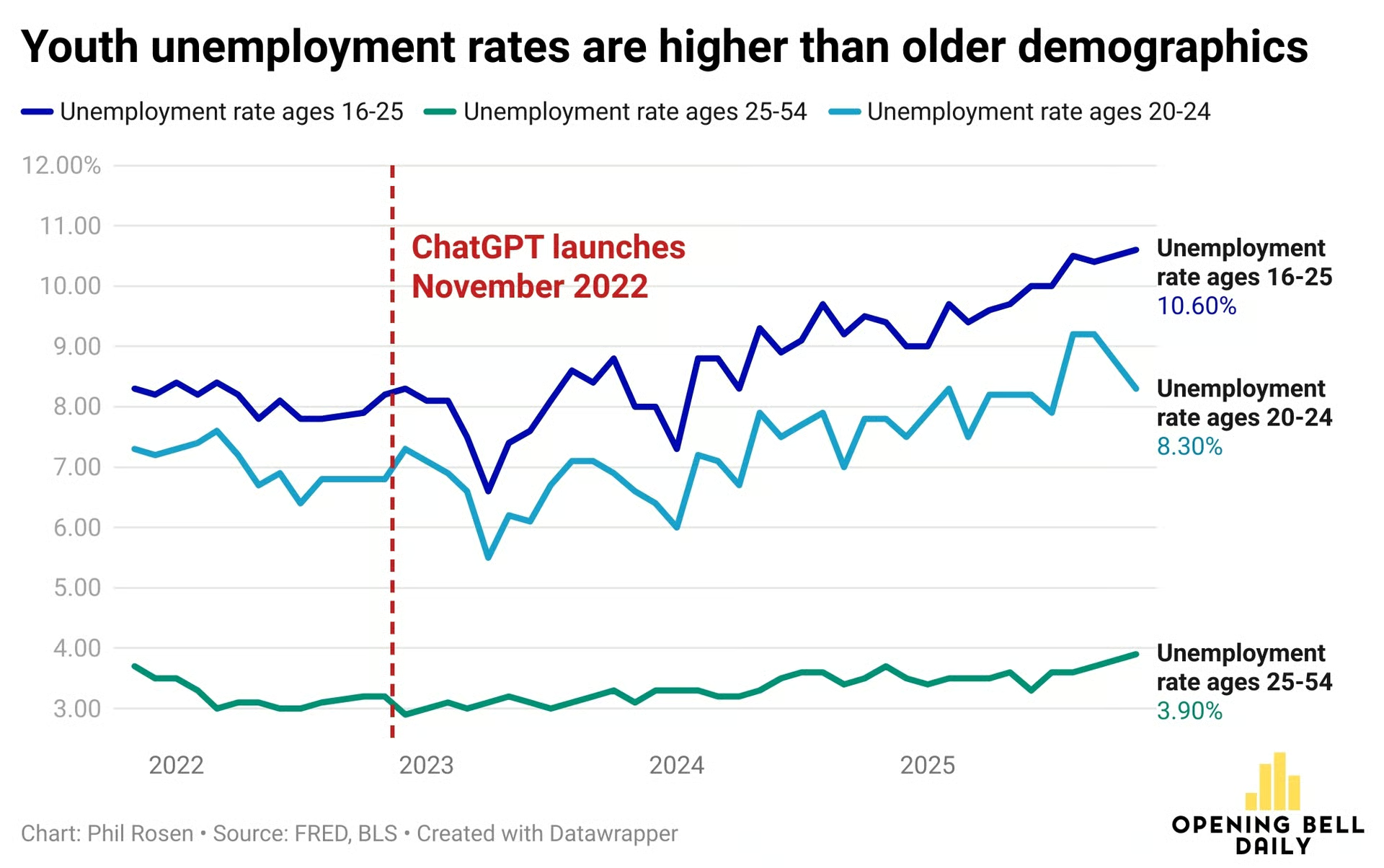
Unemployment among 20 to 30 year olds in tech-exposed occupations has risen by nearly 3 percentage points since early 2025, well above their peers in other fields, a sign that AI is hitting the very workers who were supposed to be safe from automation.
The ServiceNow CEO said the unemployment rate for college graduates could be 30% in a couple years. In 2025 alone, nearly 55,000 U.S. job cuts were directly attributed to AI, with Amazon, Microsoft, Salesforce, and Workday all explicitly citing AI as the reason for layoffs totaling tens of thousands of positions. Meta is planning on cutting another 10% (8,000) of its workforce in 2026.
For comparison: the GFC produced roughly 6 million foreclosures over a decade. That is devastating, but it was concentrated among homeowners who took on debt they could not afford, and most eventually recovered. Today, 41% of employers globally say they plan to reduce headcount in areas where AI can automate tasks within the next five years, and unlike a foreclosure, a job automated away does not come back when the market recovers.
Nobody knows exactly how big the disruption will be. What we do know is that even the optimistic scenarios involve enormous pain for real people, and that the workers building AI tools today will bear direct responsibility for that pain in a way that a junior mortgage officer in 2008 simply did not.
The Faces Behind the Numbers
Here are some examples of people who might be put out of a job due to AI.
A 28-year-old computer programmer who is included in one of the 20% laid off by Meta. His girlfriend dumps him as he has to go move back in with his parents. For revenge, he decides to stake out your home and throw Molotov cocktails over your gate in the middle of the night.
A 48-year-old lawyer with a stay-at-home spouse and two children. Without his $500,000 income, they need to sell their 4-bedroom house and rent. But they can't find affordable rent, so they end up relocating to a lower-cost area of the country.
A 35-year-old 5th grade teacher with an underemployed husband and two children. The stress of losing a $95,000 teaching job due to AI becomes too difficult to bear for the 39-year-old husband who has been looking for full-time work for two years. He feels so guilty about not being able to provide for his family that he asks for a separation.
A 51-year-old truck driver with a stay-at-home spouse and one child. Self-driving trucks become commercialized and he loses his $160,000 a year job. The company does not provide a pension and goes under as well.
From customer service representatives to marketing managers, pharmacists to doctors, architects to accountants, no job is truly safe. And the workers in these occupations do not get to ride out the recovery the way a homeowner who kept paying their mortgage in 2009 eventually did. A job automated away does not appreciate back to full value over time.
The Moral Burden Is Heavier Because You Know
The loan officers at Countrywide and WaMu could at least claim they believed in what they were selling. Many genuinely thought housing prices only went up. There is also responsibility from the borrower to pay what is owed according to their contract they signed. Many were wrong and reckless, but delusion was a partial defense.
AI workers have no such defense. The displacement is not an unintended side effect of a bet gone wrong. It is a design feature baked into the pitch decks, the earnings calls, and the investor memos. “We will replace X% of your workforce with our platform and boost profits” is often the product's core value proposition. Every percentage point of productivity gain is a percentage point of human labor no longer needed.
That is a heavy thing to carry home at the end of the day, no matter how many zeros are on your paycheck. What happened to using AI to cure cancer and other life-saving diseases?
When the revolution comes, and if projections are even half right it will, I suspect no AI worker will be safe. There is no way to claim innocence.
Remember, OpenAI was originally founded with a nonprofit mission focused on benefiting humanity. Over time, it adopted a capped-profit structure to raise the massive capital needed to build advanced AI systems, while the original nonprofit retained control.
The broader lesson is that idealism and incentives often collide. When enough money is at stake, financial interests can begin to outweigh original principles.
Survival Recommendations For People Who Work In AI
If you're an AI employee or founder and you don't want to get robbed, beat up, or worse when the uprising comes, here are my suggestions:
Never say you work in AI. If someone presses you, be vague. “I work in tech” is your new answer. “Software” works too. Practice saying it without flinching.
Scrub your digital footprint now, before the riots start. Remove the AI company from your LinkedIn, your Twitter bio, your Instagram, all of it. The internet has a long memory and so do angry people with time on their hands.
Stop doing media. Do not give interviews about how transformative your AI product is. And for the love of God, do not go on video gleefully explaining how AI will eliminate millions of jobs. Those clips will age very poorly and they will find you.
Develop a real grievance with AI. Think of one or two genuine ways AI has made your life or someone you love worse. Maybe it killed a creative project you cared about. Maybe it put a friend out of work. Find it, hold onto it, and lead with it in any conversation that gets uncomfortable. Empathy you have to perform isn't empathy. Find the real version of it or people will see right through you.
Practice stealth wealth. Do not tell people where you live, what you make, or what you're worth. Do not casually mention your stock grants, your last liquidity event, or that you're “pretty well diversified.” Nobody should know.
Drive a boring car. A Mercedes, BMW, Porsche, Land Rover, and the likes is a magnet for resentment, especially once people connect your wealth to their unemployment. Get a Honda Civic or a Toyota Camry. Something gray. Something forgettable. If you must drive something nice, keep it in the garage in your vacation home far away from civilization.
Learn to act middle class. This is a skill. Study it. Know what things cost. Know what it feels like to worry about a bill. Be able to have a conversation about grocery prices without your eyes glazing over. The goal is to be invisible, not impressive.
Dress down aggressively in public. No designer anything. No logos. No watches that cost more than a used car. Wear a hat. Wear glasses. The less memorable you are, the better.
Cut the virtue signaling immediately. People can smell it from a mile away and it makes them angrier, not more sympathetic. Posting about AI safety or economic inclusion from your $15 million Pac Heights home isn't going to save you. It's going to infuriate people. Say less. Do more, or just say nothing.
Don't cluster. AI workers have a bad habit of only socializing with other AI workers, living in the same neighborhoods, eating at the same restaurants, flying the same private terminals. That insularity is exactly what makes a group an easy target. Diversify your social circle before circumstances force you to.
Have an exit plan. Know where you're going if your city starts to riot. A second home in a place nobody associates with tech money is not paranoid, it's prudent.
Give back in ways that are visible to all, not just the tech community. Donating to an AI ethics nonprofit does nothing for the 51-year-old truck driver who lost his livelihood. Writing a check to the local workforce retraining center, coaching someone through a career transition, or quietly funding a small business in a displaced community actually means something. It also, frankly, gives you cover.
Learn a trade, at least at a hobbyist level. Know how to fix something with your hands. Being able to talk about building a deck or changing your own oil is social camouflage, yes, but it's also a genuine reminder that not everything worth doing runs on a GPU.
The GFC bankers had it rough for a few years and then the world mostly moved on. If the projections are even half right about AI's impact on employment, the backlash that's coming will not be a few years of awkward cocktail parties and some chanting outside your office. Plan accordingly.
Reader Questions And Suggestions
Why do you think AI leaders are so gleeful in telling people millions of people will be out of work soon? Are they not afraid of their lives? What are some other tips for AI workers to survive the inevitable uprising?
After you get rich from AI, make your exit and disappear. Learn how to negotiate a severance package through my bestselling ebook, How To Engineer Your Layoff and break free. Use the code “saveten” to save $10 at checkout.
Recently, I went to the post office to send out a dozen signed copies of my USA Today bestseller, Millionaire Milestones. If you're interested in participating in the promotion, you can sign up for a free financial consultation with Empower. You can read about my experience and the instructions in this post.
Get my posts in your inbox as soon as they are published by signing up here, and subscribing to my free weekly newsletter here. I've been writing about personal finance since 2009, and everything is based off firsthand experience and expertise.

Sam,
That was an interesting read and didnt go where I expected. I agree with your resentment proofing your life theme. I also have concerns with the impact of AI but I think there is another side to it as well.
What about the skilled trades, performing arts, tourism, and personal services industries. Most are low paying today and very short staffed. Maybe all those white collar jobs get replaced with more mechanics, landscapers, chefs, bar tenders, elder care people, nurses, counselors, handyman, roofers, construction workers, painters, electricians, plumbers, tour guides, adventure guides, hotel workers etc. And maybe those jobs all pay better than the white collar middle level and front line jobs they replace.
Not disagreeing with your core premise butI think there is another highly possible outcome that should be represented. You live in Tech centric N CA and in middle America, the impact hits different perhaps.
I appreciate you very much sir. Thanks for writing that article. It’s a good thing to get out there for discussion and collective thought.
M
The displacement via AI has been (at least partially) demonstrated by the computerization in the 1990s. I predict that AI will be here to stay in some shape or form after a crash.
In the 1990s, plenty of people felt they’re robbed by computerization in the 1990s. Machines have been counting bank notes and coins. Students’ report cards have been stored on computers instead of papers in file cabinet.
I spoke to numerous individuals over 40s who had lots of trouble on computers or didn’t want to learn computers. Bankers got laid off over the computerization initiatives. Teachers had trouble filling in the report cards. Entry-level jobs to file cabinets in offices disappeared.
The job created by computers did not benefit the people being displaced at all. At the same time, some people made (and lost) money in tech but we still went ahead and adopt computers in our daily lives, including how this blog was conceived!
If the cycle repeats itself, there’ll be an crash that a lot of people loose a ton of (paper) money in AI. There will be pitchforks. Then people will adopt AI or some form of automation in a less hype way.
Well thanks for that scare. But yes, we can’t ignore it. As a dad of 3 teenage girls, I’m going to do my best to help them choose colleges (or not college?), majors/careers with this topic in mind. I still heavily believe in the trades, nursing, etc.. I think it’ll be difficult for AI to replace the HVAC guy who installs the new air conditioner. I am pretty burnt out on how screens and tech run our lives now and have been robbing our society of interpersonal connection but I am also a heavy user of ChatGPT, which is amazing IMO. It most recently helped me evaluate a limited partnership agreement in minutes when I would’ve had to spend a couple grand and a couple weeks on a lawyer review.
It’s a great tech. I learned so much about how to trim and cut hedges to make them thicker and grow more the way I want yesterday. Although I had to do the work, and felt good to learn and save on the $1500 quote from the gardener.
I appreciate this perspective because it’s easy to forget how quickly public sentiment can shift and how people who weren’t directly responsible for the GFC still faced consequences.
Your point about awareness stuck out for me because with AI there’s less ambiguity about the impact because they’re building tools that can replace human labor at large scale.
It’s a reminder that efficiency gains come with real human costs and those costs won’t be evenly distributed.
There are a lot of benefits of AI but man there are also a lot of downsides. So much is changing and certainly faster than most corporates or the government can keep up. And it’s helpful to take in more perspectives and think about what we can and can’t control.
This one doesn’t track for me. As you said the GFC is apples to oranges. One was brought on by poor financial structure/guardrails and poor decision-making, this is through “technological advancement.” We have never seen large-scale revolt and “hatred” toward people involved in technological advancement. Was their widespread riots against car assembly line workers (or GM and ford) by horse carriage workers? Was their widespread riots by field agricultural workers plowing with hoe and horse/ox when John Deere and Caterpillar made it all mechanical?
This isn’t overnight. yes it is happening fast but if you have been in college recently or now you can/should prepare. And if it truly worst case then many many baby boomers like myself with way too much money than they need can house the kids for longer while this plays itself out over 5-10 years. If it is truly revolutionary and eliminated jobs, government will provide compensation. The rich don’t want the poor to riot :)
As with many of Sam’s posts I think some of it is tongue-in-cheek. I think he’s mostly questioning the wisdom of CEOs that go on TV and tell everyone that they will lose their jobs. In my opinion these tech bros don’t have the highest emotional IQ.
You mentioned you are near retirement, so I’m assuming that losing your job doesn’t really matter so much. But for the people who are still in their 20s 30s and 40s, it’s gonna be a very trying period.
Are you not concerned about your children’s futures? What type of jobs are they working now and how are they planning to hedge against AI’s job market destruction?
Suggest you look up the Luddites, definitely meets your criteria for a large scale revolt against technological advancement, albeit during the Industrial Revolution in England.
Another thought provoking post, Sam! On the the other hand, be sure to invest in AI companies through vehicles like Fundrise (FCX). I remember the GFC quite well. And the Dot.Com Bomb. I plan on lurking around these comments for a couple of days to see how this shakes out!
Good to see Amazon announce today they plan to invest up to $25 billion in Anthropic. So much money. And in turn, Anthropic will use more of Amazon’s products. A win-win. Good for Seattle, good for San Francisco Bay Area’s ecosystems. However, only if there are enough jobs to benefit.
I am speaking as someone who invested in NVDA after using DALL-E in early 2022 and tripled my money in PLTR before it went even higher (sold too early due to ethical concerns). So, I not consider myself a luddite. Having said that, I do not believe the current state-of-the-art LLMs will lead to AGI. I would call LLMs “philosophical zombies,” or what others call “stochastic parrots.”
Jan Leike, former head of Alignment at OpenAI and now at Anthropic has argued that LLMs are essentially “guessing” based on statistical patterns and that we lack the technical means to ensure they are actually reasoning or following human intent in complex, novel scenarios. His skepticism focuses on the idea that scaling will “solve” safety and logic automatically. Andrej Karpathy has also stated that AGI is at least a decade away. (Quotes provided by Gemini)
Ultimately I think the scaling issues with current AI technology will help punt “judgement day” (Terminator reference, not religious). I don’t think the technology leading to AGI has been invented yet. Even when the tech is invented, we won’t have the energy to power the whole world with AI (unless they invent a new hyper-efficient algorithm).
Some nicely timed entry points.
Don’t think we need AGI to have massive job losses whatsoever. It’s happening already.
Sam I work at a Fortune 500 company where i’m leading corporate AI initatives – and I agree, it’s such a fine line to tread talking in town halls about our company’s AI adoption while still being able to blend in with my peers and “complain about the system”. I am an investor in Fundrise Innovation fund which has done quite well since 2023 and I do scrub toilets to stay humble and practice stealth wealth among my coworkers.
The Amazon news investing $25 billion in Anthropic is good for investors. And hopefully, the money will flow through the Seattle and SF ecosystem. But it likely won’t benefit enough people.
Gotta keep staying humble! Just did some gardening myself.
I spent a good part of the day today building a deer fence around a beautiful apple tree in our front yard. Our 85 year-old neighbor walked across the street to introduce herself (we moved into the house a couple of months ago). She was happy to see we were working to protect the apple tree. She said the people we bought the house from took down the fence and the tree was at risk from “deer pruning”. Turns out she shared the raspberry plants we found in our backyard with the original owner of the house way back in 1966! I told her that was the year I was born and we are thankful for her raspberries! I only checked my VCX restricted share price once this morning. So you see, humanity and neighborly connections still reign supreme, if you stay open to that.
Sam I just found out my company has contracted with Anthropic. I volunteered as one of the Claude implementation champions so we shall see what happens!