
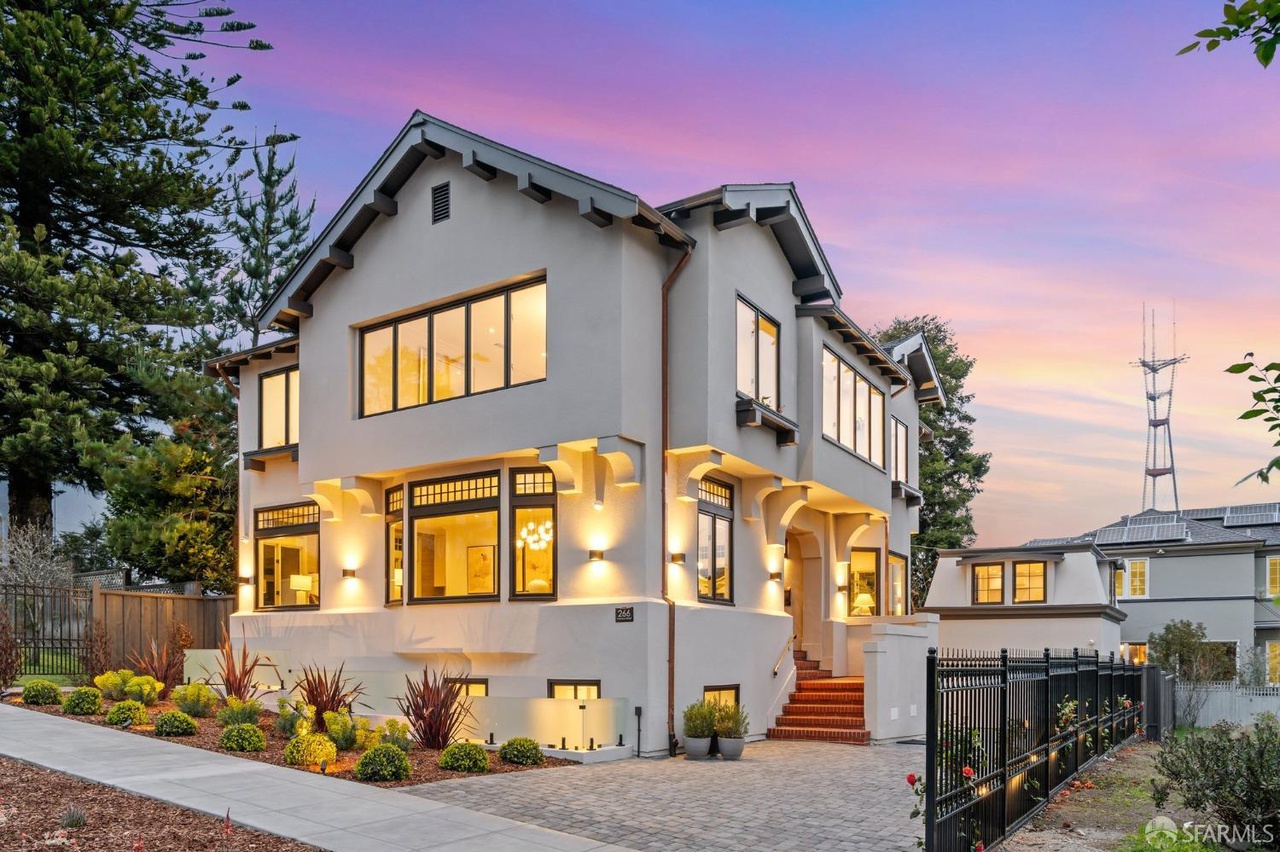
On September 9, 2026, 135 San Benito Way in St. Francis Wood hit the market for $4,495,000. Twenty days later, it sold for $6,610,000.
That’s $2,115,000 over asking. Or 47%. For a 5-bedroom, 3.5-bathroom, 2,924 square foot house. Roughly $2,260 a square foot.
A fellow dad at school, who also happens to be a real estate agent, told me he’s stopped being surprised by final prices in St. Francis Wood, Noe Valley, and Pacific Heights. This one was the talk of brokers tour on Tuesday.
Congrats to the sellers. They just made more in three weeks than most people make in a career.
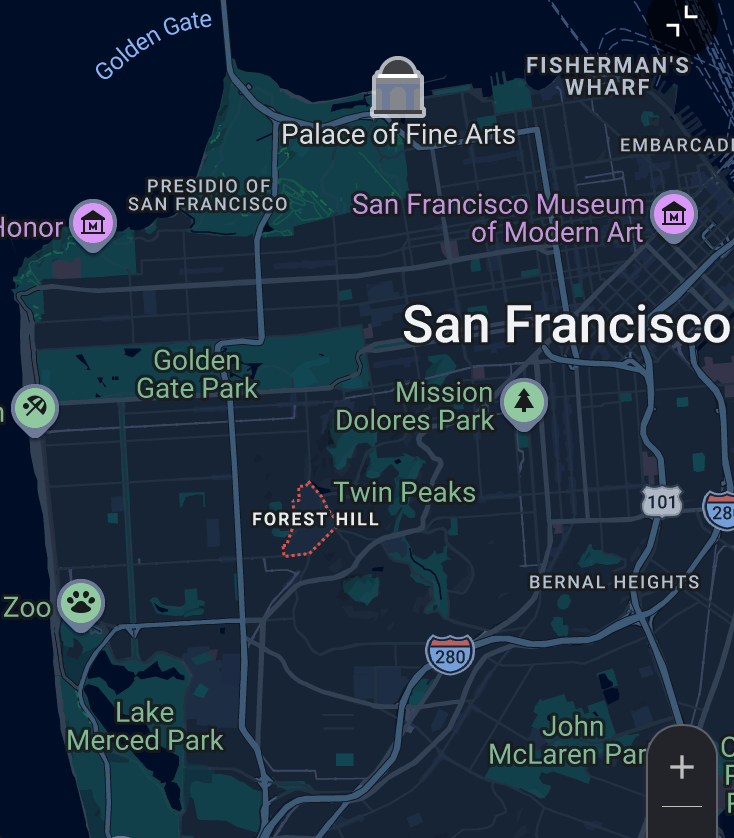
But while everyone is gawking at St. Francis Wood, its quieter neighbor up the hill keeps getting overlooked. I’m talking about Forest Hill.
If I were a newly liquid AI employee looking for a forever home on the west side of San Francisco, Forest Hill is where I’d focus. It’s the last hidden neighborhood in the city where you can buy great single-family homes at a more affordable price. And it won’t stay hidden for long.
What Makes Forest Hill Different
Forest Hill is one of only eight master-planned residence parks in San Francisco. Developer Newell-Murdoch broke ground in 1912 on a hillside Adolph Sutro had planted as a forest. The first home was finished in 1914.
Today there are roughly 650 homes and about 2,000 residents. That’s it. In a city of over 800,000 people.
Every one of those homes is a single-family house. No apartment buildings, condo towers, or six-unit boxes squeezed onto a corner lot. Many homes sit on lots that are generous by San Francisco standards, in Spanish Mediterranean, Tudor, Prairie, and Arts and Crafts styles.
Bernard Maybeck designed homes here, plus the 1919 clubhouse that still hosts neighborhood events today. Willie Mays used to throw block parties for the neighborhood kids with cake and ice cream.
That tells you everything about the vibe. Forest Hill isn’t trying to impress anyone. It’s trying to be a great place to raise a family.
Quieter Than St. Francis Wood
St. Francis Wood is beautiful. The gates, the fountains, the grand boulevards. But grand boulevards attract cars. Plenty of drivers use the neighborhood as a cut-through to 19th Avenue and points south.
Forest Hill does the opposite. Its streets wind along the contours of the hill. They were so narrow and steep the city refused to maintain them until 1978.
Nobody cuts through Forest Hill to get somewhere else. If you’re driving down Sotelo, Pacheco, or Magellan, you either live there or you’re lost. And that’s exactly what you want as a resident.
The result is something rare in San Francisco: silence and that cozy nestled feeling. Tall trees. Stairways linking one street to the next. Terraced medians. Peekaboo views of the ocean and the Golden Gate. It feels like a suburb, yet it sits in the geographic center of the city.
For parents, low traffic is underrated. It’s the difference between letting your kids ride bikes out front and nervously hovering on the sidewalk. There’s a reason Sotelo Avenue topped my list of the most prestigious streets in San Francisco.
Forest Hill Even Has Its Own Muni Station
How many secluded, single-family-only neighborhoods come with their own subway stop? In San Francisco, basically one.
Forest Hill Station opened on February 3, 1918. It’s the oldest subway station in North America west of Chicago and the deepest station in the Muni system. It’s so deep most riders take an elevator to the platform.
Here’s the genius part. Newell-Murdoch donated 21 lots to the city to make sure their new neighborhood connected to the Twin Peaks Tunnel. That decision is still paying dividends 108 years later. Further, Forest Hill’s MUNI station is down below, so it’s at the edge of the neighborhood, not in it.
The K, L, and M lines stop there. You almost never have to wait longer than 5 minutes for a MUNI train as a result. Hop on and you’re downtown in roughly 15 to 20 minutes, no parking garage required. Taking the N train is at least 2X slower due to how many more stops there are. The trains that depart from Forest Hill station are express trains.
Walk the other direction and you’re at West Portal’s shops or the Inner Sunset’s restaurants. UCSF Parnassus is right next door.
So you get suburban quiet with urban convenience. Usually you have to pick one.
The Comps Say Forest Hill Is Half Price
Here’s what recently sold in Forest Hill versus the St. Francis Wood blowout everyone is talking about.
| Address | Sold | Price | Bd/Ba | Sq Ft | $/Sq Ft |
| 34 Dorantes Ave | 5/22/26 | $3,575,000 | 4/4 | 2,541 | $1,407 |
| 1990 8th Ave | 6/26/26 | $4,280,000 | 4/4 | 3,255 | $1,315 |
| 2031 9th Ave | 6/23/26 | $2,510,000 | 4/5 | 2,285 | $1,098 |
| 77 Ventura Ave | 5/19/26 | $3,355,000 | 3/3 | 3,145 | $1,067 |
| 2266 9th Ave | 6/29/26 | $3,300,000 | 6/4 | 5,240 | $630 |
| 190 Dorantes Ave | 5/8/26 | $3,908,000 | N/A | N/A | N/A |
| 135 San Benito Way (St. Francis Wood) | 9/29/26 | $6,610,000 | 5/3.5 | 2,924 | $2,261 |
Source: MLS sales via Estately. Includes the MLS-defined Forest Hill area, which takes in some 8th and 9th Avenue blocks on the Golden Gate Heights edge. 190 Dorantes square footage not reported.
The five Forest Hill sales with square footage averaged about $1,100 a square foot. 135 San Benito Way went for $2,261. Same west side. Same detached homes. Roughly half the price per square foot.
To be fair, I’m comparing against one blowout sale. Not every St. Francis Wood home clears $2,000 a foot. But even the best Forest Hill comp at $1,407 is a 38% discount. That’s great value for a home with views on a big lot in quieter neighborhood.
And don’t think Forest Hill is sleepy. 2031 9th Avenue listed for $1,695,000 and sold for $2,510,000. That’s 48% over asking. Smart money is already sniffing around.
Scarcity Is The Whole Point
With only about 650 homes, Forest Hill sees a handful of core-neighborhood listings in a given year. Families move in and stay for decades. Many homes only come up when an estate sells.
Supply can’t grow either. There are only a couple parcels left to develop and no apartment buildings to tear down and replace. What you see is what there will ever be.
Now look at demand. Anthropic, OpenAI, and SpaceX employees are sitting on more liquidity than any generation of San Francisco buyers before them. The west side has gone from overlooked to on fire. Buyers who get outbid in St. Francis Wood will start looking one hill over.
Fixed supply plus a wave of new money only goes one direction. The window where Forest Hill trades at a discount to its flashier neighbor won’t stay open forever.
I saw the same thing happen to single-family homes in the Golden Gate Heights neighborhood. There are great homes with panoramic ocean views that were trading at a discount to median. Now Golden Gate Heights is one of the most sought after neighborhoods, especially for buyers who can work from home and have children.
The Downsides, Because Nothing Is Perfect
I’d be a terrible friend if I only gave you the sales pitch.
- Fog. Summer can be gray. If you need more sunshine, the Mission is calling.
- Hills and stairs. Great for your glutes, not great if you have bad knees or plan to age in place.
- Old homes. Most were built in the 1910s to 1930s. Budget for foundation work, seismic retrofits, and old wiring. The inspection report may humble you. One of the downsides of living in a nice neighborhood is the constant remodeling going on.
- No shops inside the neighborhood. You’ll walk or drive to West Portal or 9th Avenue for coffee. Some would call that a feature. Because if you can’t easily walk to the bars, restaurants, and shops, other people can’t either, which helps keep Forest Hill more peaceful and quiet. Besides, with inexpensive rideshare and food delivery services, it’s more convenient than ever to eat and move around.
None of these are deal breakers. They’re the price of admission for living somewhere this quiet.
If A Forest Hill Home Comes Up, Bid On It
Because listings are so rare, you need to be ready before one appears.
- Get your liquidity lined up now. Pre-approval, cash positions, and any stock sales planned in advance. You won’t have time to scramble.
- Visit on a weeknight. Walk the streets at 7 pm. The quiet is the product.
- Do inspections before you offer. Especially the foundation. A 100-year-old house on a hill deserves respect.
- Know your walk-away price. Follow the 30/30/3 home buying rule and don’t let a bidding war turn you into the next brokers tour headline.
St. Francis Wood gets the gates and the headlines. Forest Hill gets the quiet, the trees, its own train station, and the neighbors who never leave.
The last hidden neighborhood in San Francisco won’t stay hidden much longer. If you get a shot at it, take it.
Sources
- Estately: Recently sold homes in Forest Hill
- Forest Hill Association: History
- Western Neighborhoods Project: Forest Hill Station
- Wikipedia: Forest Hill, San Francisco
- Hoodline: Forest Hill Clubhouse
Author Background
Sam started Financial Samurai in 2009 and is widely credited with kicking off the modern-day FIRE movement. He spent 13 years in equities at Goldman Sachs and Credit Suisse, earned his MBA from UC Berkeley, and left banking in 2012 at age 34 by negotiating a severance.
Sam is the author of two national bestsellers with Portfolio Penguin, Buy This Not That and Millionaire Milestones: Simple Steps To Seven Figures. His next book, Your Children Will Be OK, is on its way. These days his favorite job is being a full-time dad to two young children.
If you care about San Francisco and your personal finances, subscribe to his free weekly newsletter he’s been putting out since 2009. Sam has lived in San Francisco since 2001. Read more on his About page.