
I’ve been a Google shareholder since 2010 and I'm thankful. But yesterday’s earnings, and the 12% collapse that followed, left me thoroughly disappointed.
Search is under siege. Gemini isn’t leading the AI race. And Google is spending like a drunken sailor to catch up.
Spending $200 billion in CAPEX is more than the GDP of most countries. And free cash flow just went negative $9 billion for the quarter.
What does $200 billion buy you? Third or fourth place in the AI race, depending on who you ask. Behind Anthropic. Behind OpenAI. Maybe neck and neck with whoever else is closing fast.
That’s pathetic. And as a shareholder, it’s demoralizing.
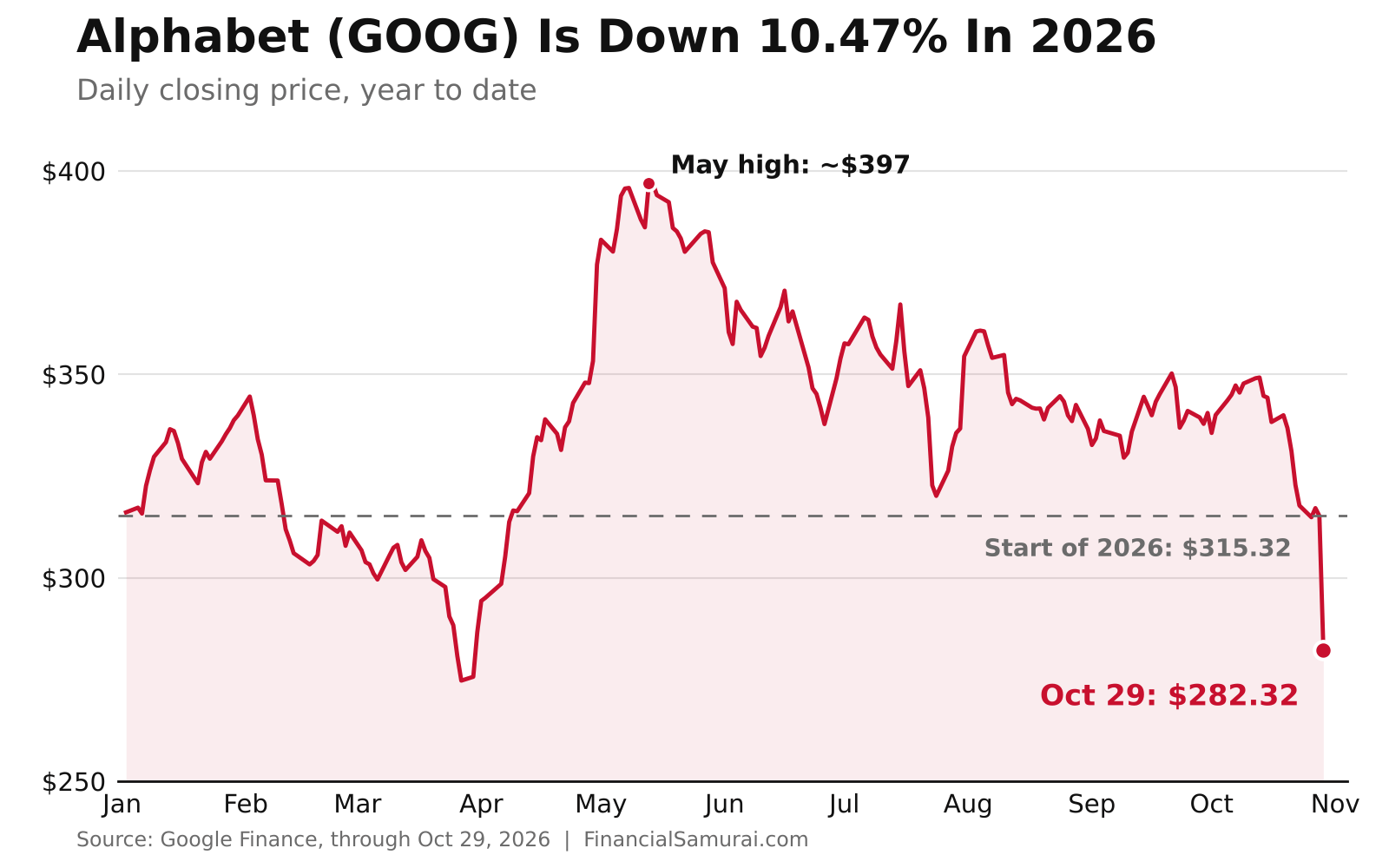
Googles' Massive Head Start
Here’s what frustrates me most.
Google researchers wrote the 2017 paper that introduced the transformer, the “T” in ChatGPT. Google owns DeepMind. It designs its own TPU chips. It has Search, YouTube, Android, Gmail, and roughly 3 billion Chrome users. It understood large language models years before most of us knew what it was.
And yet most developers aren’t coding with Gemini. They’re using Claude Code, Codex, or something else.
In the most transformational technology since the internet went mainstream, Google had a ten-mile head start, outspent nearly everyone, and still got lapped.
Meanwhile, executives collected enormous pay packages. Nice work, which most of us can't get.
The Best Place In America To Rest And Vest
Everybody in Silicon Valley knows Google is one of the best places to “rest and vest.” HBO’s Silicon Valley spoofed it with Big Head, who got promoted at Hooli into a big title, a rooftop office, and zero responsibilities.
Who doesn’t want to get paid a lot to work less?
But resting and vesting only feels good when the stock keeps going up. When the stock stalls, you’re just resting and asking whether this is all there is to life.
I’ve seen this movie before. I left Credit Suisse in 2012 partly because technology was squeezing the business. Algorithmic trading was compressing commissions toward zero, which is why trading is basically free today.
Our Asian equities group was competitive. But the firm overall was lagging Goldman, Morgan Stanley, JPMorgan, and UBS. Staying at a firm falling behind, in an industry being hollowed out, felt like polishing brass on a sinking ship.
So I left to build my own thing. I made a fraction of my old income for years. But watching something I built actually grow was more thrilling than any bonus check.
Momentum is energizing. Decline is a slow poison, even when the paycheck clears.
Google Versus The World
Part of the reason I invested in Google was its dominance. Two Stanford PhD students, who fittingly never finished their PhDs, hired an army of brilliant nerds from Stanford, MIT, and the Indian Institute of Technology.
They commanded over 90% search market share. They piled up over $100 billion in cash. Then they used monopoly profits to enter new businesses and crush the competition.
In other words, Google became the trust fund kid. Let’s call him Chip.
Chip was born on third base. Parent's money, the search monopoly, pays for everything. Grandpa’s name is on the library, which is the transformer paper and DeepMind. Family friends can make one phone call and open any door, which is Android, Chrome, and the default search deal with Apple.
Chip still posts on Instagram about his “grind” while sipping a $28 smoothie.
Everybody else in the AI race is the middle-class or poor kid. There is no way Chip should lose his incredible head start, unless he really messes up.
Now, before the comment section lights up, I know. OpenAI has Microsoft’s money. Anthropic has Amazon’s money. Their founders went to Princeton, Stanford, and other elite schools. Nobody here is eating ramen.
But wealth is relative. Next to Google, everybody is middle class.
Losing With Enormous Privilege
Google started the AI race with billions of users, a cash machine, and its own chips. Everyone else started with zero users and had to beg investors for money just to rent compute. Every dollar they raised came with a pitch deck and a deadline.
The middle-class kid has to justify every dollar. The trust fund kid just asks Dad for $200 billion.
And here’s the most trust fund kid thing of all. Google is an investor in Anthropic. Chip is literally paying tuition for the kid who’s beating him.
As a capitalist, you usually don’t bet against Chip when he’s smart and connected. You invest in him, especially if you can't get in yourself. I’ve watched the kid with every advantage win since 2004, when Google went public.
But every so often, Chip gets comfortable. He takes a third gap year. He hires expensive consultants to tell him what he should already know. Shiny object syndrome takes hold, and financial resources and attention get diverted to solving core problems.
Meanwhile, the middle-class kid has no safety net. If he doesn’t ship, he doesn’t eat.
Crafting The Other Side
Dario Amodei is a good example. He grew up middle class in San Francisco. His dad was a leather craftsman. His mom managed library projects. He went to Lowell, a public high school, studied hard, and actually finished his PhD.
In 2021, he co-founded Anthropic with his sister Daniela and a group of colleagues. Five years later, Claude is what developers reach for, and Anthropic is one of the most valuable private companies on earth.
It’s Google versus the world. And the world is the rest of us.
The trust fund kid has every advantage except one. He doesn’t need to win.
The middle-class kid has only one advantage. He must win or be relegated to the permanent underclass.
Hunger is the great equalizer. And unlike a trust fund, it can’t be inherited.
Karma Finally Comes For Google
There’s another reason I’m not shedding too many tears for Chip, even though my portfolio needs to go to the ER. For years, he’s been taking other people’s lunch money.
Google built its empire by sending traffic to websites like mine. That was the deal. Bloggers, journalists, and small publishers created the content. Google organized it, sold ads around it, and sent readers our way. Everybody ate.
Then Google got greedy.
First came featured snippets, which lifted our answers onto the results page so readers didn’t need to click. Then Google stuffed its own products at the top: shopping results, travel results, maps, “People also ask” boxes, and more ads. The organic results, the content people actually searched for, got pushed so far down you needed a scuba tank to find them.
Then came AI Overviews. Now Google reads our work, summarizes it, and serves it as its own answer at the top of the page. The attribution, if there is any, is a tiny link most people never click.
Imagine writing from firsthand experience since 2009, only to watch a multi-trillion-dollar company repackage your insights and keep the reader. That’s not a search engine. That’s a very polite pickpocket.
And yes, I know the AI companies trained on publishers’ work too without attribution or payment. Nobody in this race has clean hands. But Google was supposed to be the partner. It sent us traffic for two decades before deciding it would rather keep it.
The Rich Getting Richer Is Still The Default
I don’t want to oversell the hope. Since graduating college in 1999, I’ve watched the rich get far richer than everybody else.
The first reason is math. The rich have more capital, so a bull market hands them bigger absolute dollar gains. The longer compounding runs, the bigger the pile gets.
I saw it at Goldman in NYC, at Credit Suisse in SF, and every year since I left in 2012. Some friends from my tennis club who were mere millionaires 15 years ago are now multi-billionaires.
The second reason is proximity. Rich people mostly hang out with other rich people. And proximity creates opportunity.
Say you’re genuinely friends with a General Partner at a top venture firm whose funds are always oversubscribed. There might be 200 to 400 Friends & Family spots and demand from 100,000 qualified investors. Guess who gets a spot.
Once you’re an LP, you might get invited to co-invest in a hot private AI company the fund has high conviction in. That’s how the gap widens, one quiet invitation at a time. Be nice and helpful to as many people as possible.
Everybody rolls their eyes at networking. I hated it too. It’s likely the main reason I never made Managing Director. I couldn’t fake enough agreeableness with the powers that be.
The lesson to pass to our kids: you don’t have to be fake. But you do have to show up.
Why Google’s Stumble Gives Me Hope For Our Children
The beauty of FIRE is freedom. The problem with being a FIRE parent is that your network withers once you leave the workforce.
The people who could introduce you to clients, write a preschool recommendation letter, or refer you for a better job slowly disappear. And if you’re truly FIRE, you stop caring about getting ahead. Otherwise you’d still be trading time for money.
Then you have kids. And suddenly, money and status matter again in a hurry.
That’s why Google’s stumble actually provides hope, despite the paper loss.
If a company with $100 billion in cash, 3 billion users, the transformer itself, and a $200 billion annual budget can fumble its lead, then advantages aren’t destiny. They’re a head start. And head starts can be squandered.
Which means a hungry kid with no connections still has a real shot. So does the poorest minority kid in America.
My children won’t inherit a monopoly. But they can inherit a work ethic, some hunger, and the knowledge that Chip can be beaten.
My Two Requests To Google Employees
Look, you’ve had a great run. Thank you for your hard work all these years. Google’s strategic drift isn’t your fault. That’s on the C-suite.
But as a shareholder, I have two requests.
1) Get back to the office five days a week and put in 60+ hours.
This is wartime, not peacetime. Mass layoffs are likely coming, and the people who survive them tend to be the ones who are visibly in the building.
It’s been fun playing pickleball with many of you at 11:30 a.m. on a Tuesday. I’ll miss the competition. But that has to stop now.
2) If you’ve made enough money to have options, do something new.
The stock could be dead money for a year or two while the supertanker turns. If you’re only staying for the next vest, you’re not resting. You’re rotting.
Golden handcuffs are still handcuffs. And gold is heavy.
Go be the middle-class kid in your own career. Join or start something where you have to win.
What doesn’t work is the middle path: staying, coasting, and feeling empty. That’s the worst of both worlds for you and for us shareholders. If you decide to leave, please try to negotiate a severance package. You have nothing to lose.
Google has the resources to recover. Trust fund kids usually get a second chance. The only question is whether Chip still wants it badly enough.
Readers, do you think Google can regain its AI lead, or has the trust fund kid permanently lost his edge? Is spending $200 billion a year a sign of strength or desperation? If you work at a big tech company, are you resting and vesting, or quietly planning your exit? And as a parent, how are you teaching your kids to compete without a trust fund or a powerful network?
