
Perhaps some of you are in the market for a new car. I'm definitely not.
After almost a year of deliberating between replacing my 2015 Range Rover Sport or continuing to fix it, I've finally decided to keep fixing it indefinitely.
The main reason is that we may relocate to Honolulu in 2028 for my son's 6th grade year and my daughter's 3rd grade year. If we're in Honolulu, I could take care of my parents, which would be an honor.
Buying a new car and then selling it in under two years would be a waste.
The Math On A New Car vs. Fixing The Old One
An exact replacement for my car runs about $110,000 before tax and fees. In San Francisco, the 8.625% sales tax adds roughly $9,500, and California registration on a vehicle that expensive runs over $1,000 in year one. Call it $120,000 out the door before I've driven a single mile.
Luxury SUVs typically shed 20% of their value in year one and another 10% to 15% in year two. On $110,000 that's $33,000 to $38,500 gone by the time we'd be boxing up the house.
Add the sales tax, which I never get back, and I'm looking at $43,000 to $48,000 to drive a car for 24 months. That's roughly $1,800 to $2,000 a month, and that's before insurance and gas.
Now compare that to fixing an 11-year-old Range Rover. Even if I spend $3,000 a year keeping it alive, that's $250 a month. I could have two catastrophically bad repair years back to back and still come out roughly $40,000 ahead.
The math isn't close. And it gets worse when you factor in that shipping a car to Honolulu costs about $5,000, which is why I don't plan to ship mine at all. Whatever I'm driving in 2028 gets sold before we go. So a new car purchased today would be a two-year rental at $2,000 a month that I also have to find a buyer for.
But the money wasn't what finally decided it for me.
That took something that made me cringe, and then feel an enormous amount of relief.
The Hidden Cost Of Owning A New Car
Eight of us met at the pickleball courts at noon to play until 3pm. We're all about a 4.0 to 4.75 level, so the games are intense and you sweat profusely.
I saw a spot to parallel park and did my usual maneuver. But something weird happened. I felt resistance going backward despite my right wheel not having touched the curb yet. So I pulled out and tried again. It was a busy street and I didn't have much time.
Once again I felt resistance going into the spot. So I finally got out to check what was going on.
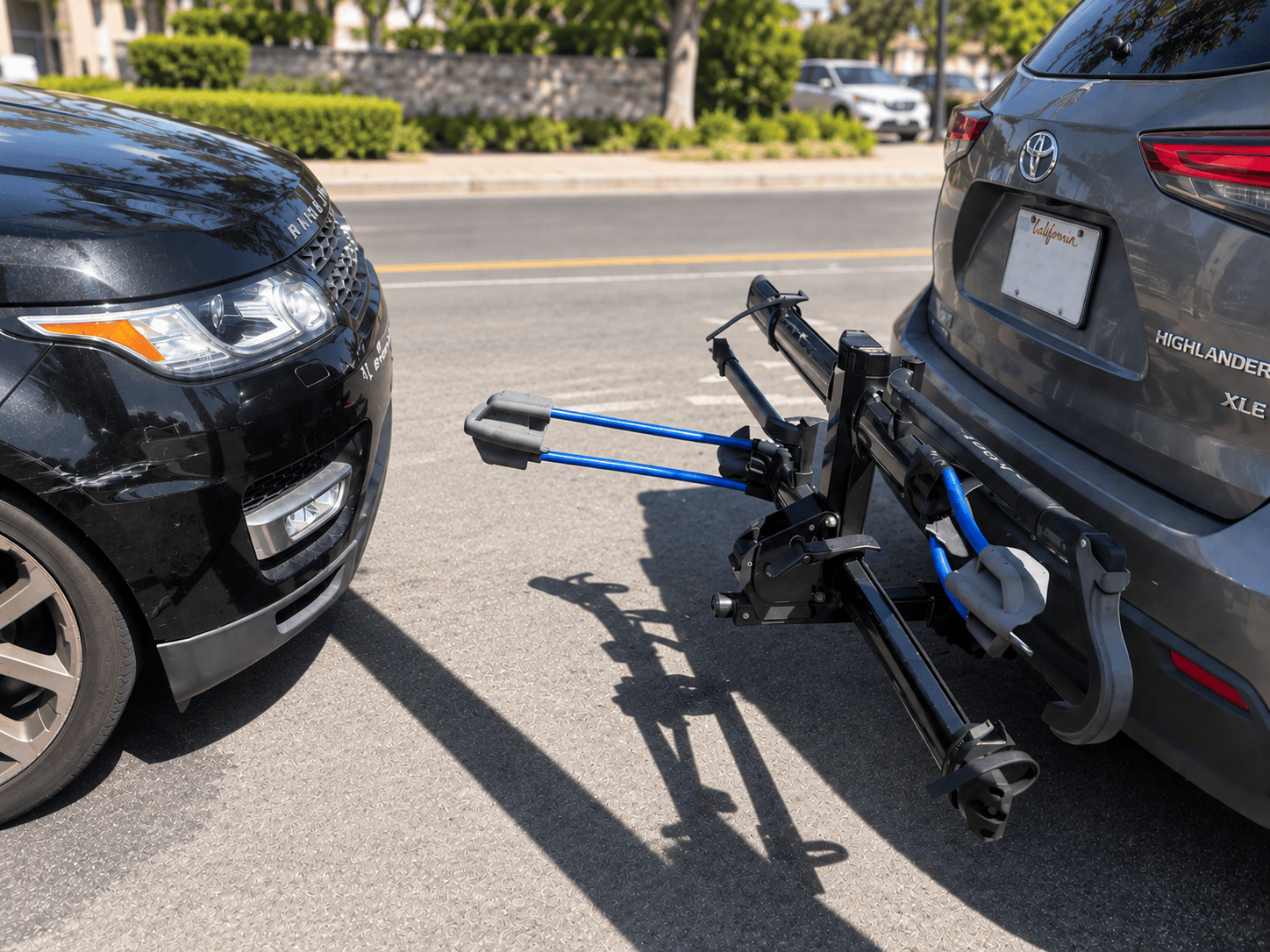
Lo and behold, the right side of my bumper was scraping along a protruding rod from the front car's rear bike rack.
It was the type that attaches to a hitch down low, so I couldn't see it from the driver's seat. And it was sticking out from the back of the car by two to three feet. The driver had left the arm fully extended instead of folding it in.
Three sections of my bumper were indented and scraped. Fixing it properly would run $3,000 to $4,000. That's an entire year of my Range Rover repair budget, gone to a bumper.
I was furious. Who leaves a bike rack fully extended when there are no bikes on it?
But it's my fault for not spotting a three-foot metal arm, and I have nobody to blame but myself. Perhaps if I'd left for the courts five minutes earlier I wouldn't have been rushing to park.
From Anger To Pure Relief
Then something surprising happened. Within about three minutes, the anger turned into relief.
Because I was this close to buying a new or lightly used car when I got back from the summer holiday. If I'd done the same damage to a $110,000 vehicle I'd owned for only a few weeks, I would have felt sick to my stomach.
I have never been happier driving an 11-year-old car already riddled with dings.
We all know the upfront costs of a new car. The taxes, the fees, the insurance, the sticker shock of a $50,000 average transaction price. Those are the numbers everybody runs.
Nobody runs the other one. The hidden cost of a new car is that you start caring what happens to it. Every parking garage or street spot becomes a calculation.
That cost never appears on the window sticker. But you pay it daily, for years, and there's no way to negotiate it down.
Not Caring Is The Whole Point Of Owning An Old Car
One day, parking at my children's school, a girl got into the car next to mine and swung her door open hard enough to dent my panel. I was sitting in the driver's seat when it happened. The mom and daughter didn't say a thing and drove off.
I was annoyed. Then I let it go, despite the obvious ding.
Same thing with the bike rack. Three minutes of agitation, then nothing. I'm going to gladly leave the bumper exactly as it is. In fact, I might get lucky and have someone hit me in that same spot, so I can get the whole thing fixed and repainted on their insurance.
With old cars, every ding lowers the stakes of the next one. The first scratch on a new car is a tragedy. The twelfth scratch on an 11-year-old car is camouflage.
With an old car, you're king of the game of chicken. Nobody can take anything from you that you haven't already given up.
I've come to value a car more the older it gets, purely for the peace of mind it provides.
Still Want To Buy A New Car? Know The Four Layers Of Car Pricing
Labor Day weekend kicks off the fall sell-off season. Demand tapers as families shift attention to the school year and holiday spending, and dealers need floor space for next year's models arriving shortly. That combination produces real discounts.
But most buyers get confused by the definitions and end up paying more than they should. Here's what you're actually negotiating against.

Layer 1: MSRP
MSRP is the manufacturer's suggested retail price. It appears on the Monroney label, the window sticker that's been federally required since 1958. It includes the destination charge. The word “suggested” is doing a lot of work.
Watch for a second sticker next to it. That's the dealer addendum, where paint protection, pinstriping, nitrogen-filled tires, and VIN etching appear. This is the highest margin junk on the lot and almost all of it is negotiable to zero.
Layer 2: Dealer Invoice
Dealer invoice is what the dealership supposedly paid the manufacturer. Most buyers treat invoice as the floor.
It isn't. Here's why.
Layer 3: Holdback
Manufacturers pay dealers back roughly 1% to 3% of MSRP after the car sells. On a $50,000 vehicle that's $500 to $1,500 the dealer collects no matter what you paid. So a dealer can sell you a car “at invoice,” look like a hero, and still make money.
That doesn't mean the holdback is yours to claim. It's how dealers keep the lights on. What it tells you is that invoice is not a wall. There's another 1% to 3% of room underneath it, and how much of that room you get depends entirely on how badly they want the car gone.
On a hot model with a waitlist, you'll pay over MSRP and thank them for the privilege. On leftover inventory at the end of a model year, which is precisely what this weekend is, pushing below invoice is realistic.
Layer 4: Manufacturer-To-Dealer Cash
This is the layer almost nobody sees. These are unadvertised incentives paid to the dealer to move specific inventory.
Right now Honda is running Labor Day Closing Cash on the 2026 Accord, Odyssey, and Ridgeline. It comes as $100 certificates the dealer can stack up to $1,000, and dealers are prohibited from advertising it.
Read that again. There is money on the table this weekend that the dealer is contractually not allowed to tell you about. The only way to reach it is to ask for pricing directly and negotiate.
These programs change constantly, by model and by region. So train yourself to always ask what dealer cash is running on the exact car you want. The worst they can say is none.
Then Ask For The Out-The-Door Price
Once you've pushed the price toward invoice and below, ask for one number and one number only. The out-the-door price. Vehicle price plus tax, title, license, and documentation fee.
It's the only figure that matters and the only one that can't be quietly rearranged.
Doc fees are where states differ wildly. California caps it around $85. States with no cap routinely see $800 or more, and it is pure profit.
Get the out-the-door number in writing by email from three dealers before you set foot in a showroom. Most of the games require you to be sitting in a chair.
Treat It As Three Separate Transactions
The price of the car, your trade-in, and the financing are three different negotiations. Dealers make money by blending them so you can't tell which one you lost.
Settle the purchase price in writing first. Don't mention a trade-in. Don't say how you're paying. Only after the price is locked do you introduce the other two.
And be careful with financing. The average 60-month new car loan is running near 7%. Stretching to 72 or 84 months to hit a comfortable monthly payment can erase a 10% discount entirely. If you're shopping by monthly payment, you're not shopping by price, and the finance manager knows it.
Car Negotiation Calculator If You're Shopping For One
Here's a car price negotiation calculator I created to help you get the best deal possible. Once you have some price anchors, you can negotiate with conviction. Remember, the person who cares the least, usually wins the most in a negotiation.
The Easy Car Buying Test To Follow
Before any of this matters, run my 1/10th rule for car buying. Spend no more than one-tenth of your gross annual household income on the purchase price of a car.
At $50,000, the average new car requires a $500,000 gross household income. That should tell you something about why so many people feel broke while sitting in a nice vehicle.
The rule sounds harsh. It's really just the anxiety tax written down in advance. Once a car represents a small enough fraction of your income, you stop caring what happens to it. And the older I get, the more I'd trade horsepower for not caring.
Readers, Over To You
Have you ever felt relief about damaging an old car instead of a new one? What's the longest you've held onto a vehicle, and did it get easier to own the older it got? And for those buying this weekend, what's the best negotiating tactic that actually worked for you?
If you're weighing a big purchase like this, my book Buy This Not That goes deep on how to make optimal money decisions when the answer isn't obvious. It's a Wall Street Journal bestseller published by Portfolio Penguin, and it's built for exactly these kinds of forks in the road.
Subscribe To Financial Samurai
If a friend forwarded you this post, join 60,000+ readers and subscribe to the free Financial Samurai newsletter here. To get notified of new posts, sign up here, where you'll get every article ad-free for the first few hours.
Financial Samurai began in 2009 and is one of the largest independently-owned personal finance sites today. Everything is written based on firsthand experience, because money is too important to be left up to pontification.

Hi Sam. Great article as always. Having bought both new and used cars. To me it feels harsher when the first ding on a new car happens, vs a used car that comes with a ding or two on it. For a car that has a few dings as long as they are not too bad another one won’t make much of a difference. I bought a new Honda civic in 2012 for $18,500 all in on a President’s day sale. 3 months later a tree jumped out behind me an and dinged the trunk. I swore and pouted for a few days got over it. Then in 2015 was side swiped and the drivers front panel peeled up. Got that fixed but didn’t really phase me. Drove that car to 400,000k miles. Did all my own repairs too. Owned it till last year then bought a used 2020 Honda civic with 40k miles bc the first treated me so well. Bought it as a restructured title. Price $15k. Kelly blue book valve of equal car no accident 20k. The accident: minor side swipe that came with a drivers mirror that was hanging on by one loose screw. Fixed that. But the engine is sound. I plan on driving this one to equal miles as the first. Maybe more! If it gets a ding ohh well. Cheers!
Wow, 400K miles is huge! That’s awesome. Great testament to Honda. I love Civics and had one myself in the past.
Makes my 71K miles on my Range seem so small, and also disappointing with its problems.
I’ve purchased cars new but waited till end of model year refreshes to get some really good deals. I bought a 2018 Mazda mx-5 RF for 27,500 (~7,500 off sticker) since they refreshed the model for the 2019 year. Sold it this year with 33,000 miles for 22,500. Bought a Tesla model Y long range for 37,500 in 2024 and took advantage of both the EV tax credit ($7500) as well as price adjustment/referral credit (additional $7680 off) bringing the price down to $38,450 before TTL. I previously registered/insured a 2012 Tacoma as well as the 2018 Miata so the savings from a single vehicle helped offset the increased carrying costs for the Tesla here in California. Lastly I’m fortunate to live next to a public library with EV charging for 11 cents per kWH. We use the Tesla as our primary vehicle for any drives for the household and have put close to 40k miles on it in 2.5 years.
Still have a Porsche 911 as the dream car and that will break the 10%,1% rule for us but we’re still in our peak earning years so I feel better spending the money now rather than later on when I won’t have the income to justify the expense. Looking for a 2016-2019 model year base or carrera s with some miles in the 60-80k range. The depreciation curve flattens out considerably for the 911 (unfortunately has even increased in the past few years which doesn’t help me as a buyer). It will still have high carrying costs for ownership but I hope to not lose too much from depreciation.
We stopped buying new cars in 2013. We still own that car (Honda Odyssey). We also own a 2003 Mazda MPV (we’re the original owners), a 2009 Volvo XC70 (paid $6500 probably 8 years ago). And a 2003 Honda Accord V6 we bought for $3500 probably about 6 years ago. We repair them. Probably looking at a used AWD drive vehicle soon. Maybe a 2020 model year. We have the funds to buy a new car, we just won’t do that again.
I hear you. I have a slightly different angle. I know as FIRE we are obsessed with getting the highest quality for the lowest fee, but my biggest struggle in car buying and other basic commerce is figuring out what is “fair.” I made my career in engineering and the bottom line is no business stays in business giving stuff away for free. Could we charge less to design a building, sure. And sure there is always a next guy who can do it cheaper. The Client is always free to shop around for “the best deal.”But I have determined my work demands compensation. So I have no qualms about letting a hard working person make a buck – be it s car, appliance, or any other salesman. Unless they allow us to buy right from the manufacturer, there will be a middle man that needs to make something. Assuming all dealerships will need to make something off the sale, when does the discount you get intersect unfavorably with the time and effort to go around to multiple dealerships trying to knock it down 1k more?
So what is “fair” if the dealership paid 45k to get the car on the lot? Sure I’d love to get the car from the dealer for 45.01k,, but he does need to run a business. What percentage of profit are you willing to let the dealer have and still feel like you did well for yourself and didn’t get taken advantage of?
I guess that is where a CArMax comes in if you want to settle for a used car.
We have a First Edition VW ID.Buzz and I’m deathly afraid of dings and dents like you describe. Years ago, my wife promised that if an EV Bus ever came out, we were getting one. Normally we be used and drive cars until they give out. I find myself doing things like stepping outside at a restaurant or similar, just to make sure the Bus isn’t “in danger.” I worry about it being vandalized because it is so distinctive and some people mis-apply an overt political agenda to something that is just a cool automobile.
The whole thing is ironic to me because virtually every VW Bus you’ve seen in your life has been through it all. That’s part of its charm.
I love that car! I totally wanted to get it as well. Is it everything you dreamed it would be? One of my dreams when I wanted to retire early was to just buy a VW Euro van and just live in it.
It was our first EV, so definitely a steep learning curve. To me, its best quality is when we pick up our nephews on a trip and they play with all the buttons. Ooh, my seat is getting warm. Can I sit up front? Luke, I’m getting a massage. What does this button do?
Half the time I don’t even know. But I’ve never had a car that actually makes other people happy and excited to be in it. If you move to Hawaii, I think it could be a great option. Its more limited range is less of an issue on an island. And there are tons of camping mods and such that you can add.
Sam, Cameron here with the old Moose I still have from high school. I went to schedule 179c and bought a Defender X in 23, and now I’ve just bought an old disco from 2000 and turned it into my daily driver down in Laguna Beach. One car cost 85k, the other cost 9k, and I could not be happier. Your writing is spot on, I even have my tape player back now :)
I’m not a fan of newer cars. It squeaks a lot more because it uses a lot more plastic materials, the interior has less physical buttons (or no buttons at all), and the repair bill is expensive, e.g., I can’t imagine shelling out $1,000 – $2,000+ to replace a windshield.
Great post, as always, Sam! This one really resonates with me since I still drive a toyota corolla with 307,000 miles on it :)
not paying the hidden cost of caring is priceless, especially in LA where my car’s destiny is in the hands of others, not mine.
its also super fun playing chicken every time i drive somewhere. its funny seeing people’s faces when they veer into my lane in their super expensive cars while I’m hugging the dashed line divider. i never swerve to avoid them and their reaction is hilarious.
only thing better is not having a car payment at all!
Sam, I don’t have any car stories to share as I’m happily car-less in a city full of public transit. However, can we unpack the bit about you considering it a great honor to take care of your parents? I think we need an article on that. I’m continually amazed at how much reverence you give to this imminent task, even when you acknowledge both the financial cost and personal sacrifice. I imagine some of that comes from your Asian background and cultural values, but I suspect there’s more to it than that. Is it a sense of gratitude for what your parents have given you? A different way of thinking about family obligation? Or are you simply more prepared (mentally and financially) than the rest of us, so the task of caring for aging parents doesn’t seem laden with dread or apprehension, the way it feels for many of us? Tell us your secrets! I recently had to help my mom with her recovery after a hip surgery, and it occurred to me that this could be the beginning of the next phase of our relationship, and I’m SO not ready, and certainly not nearly as enthusiastic as you seem to be!
I much prefer older cars for the reasons you state, but not the repair bills. If you were looking at retirement in the next couple of years, would you buy new or used? Part of the thought is that once retired, the mileage one puts on a car is a lot more controllable. But the key thought is to potentially make this the last car we buy. So new or used?
I’m probably relocating in two years, so I’m going to make my existing one last until then. Hopefully it makes it.
I have gotten a few cars to 200,000 miles, and had aspirations of getting one car to 300,000, but concluded a little past 200,000 that the frame was starting to become compromised. Pretty reliably, I can’t get far past 200,000 miles. My driving climate is likely the contributing factor. I’ve seen a lot of very old cars inland in the south, but not northeast or near the ocean. Now, if I’m thinking about buying a car, I always use 200,000 miles to estimate its useful life and value. Now, I am also planning to trade in or junk a car once it gets to 200,000 miles rather than pushing it. In my experience that’s been the cliff, and I might get a little more at that point trading it in instead of junking it a few thousand miles later.
200,000 is an incredible number to achieve. After that, I do worry about structural integrity and safety, such as deploying airbags. Also.. there should be new tech that makes cars safer too by then. Every 10-20 years is a lot.
150K on a Ford Aerostar (sold on the street) then 220K out of a Suburban (gave to one of my children), 180K on a Towne and Country (gave to my other child, still driving it at 218K, he loves it). We did “splurge” on a new Telluride, which we bought late in 2024. Nice vehicle, unfortunately it is a desired vehicle for good reasons and wasn’t much wiggle room. As we are retired it will go the distance as occasional rented camper hauler, etc. Dealers are such a PITA. My ride is a 2017 VW Alltrack with 108K on the clock. Agree with above once any car gets above 200k it’s prolly time to move it along unless you’re working on it yourself or there is a person in need of a bridge car in the family.
Perfect timing!!! We will need a new car soon. Both of our cars are 8 years old and paid off. One has 95K miles and the other has about 60K miles. We need a bigger car for our family adventures but I’ve been holding off because I hate taking on debt for a depreciating asset. We are going to rent a minivan for our next weekend adventure…and probably buy at the end of November or December when deals seem to be best. I would rather have one newer car than 2 cars that are both going to need brakes, tires, etc. The other thing that comes up is that I’m a woman and have a teenage daughter. Safety is a big concern. Men in my family drive cars with over 200K miles but as a woman I get concerned driving in remote areas with an older car.
since retiring my 40K miles a year are now down to under 5K per year…. no new cars in the future, only used…. there will be a new motorcycle though….
That was quite a lot of miles in the past and quite a drop now. The other thing, I only drive about 6200 miles a year on average.
Be safe on that motorcycle!
Long live the Rover! Took my 2013 RRS w 127k miles on it up to the mountains of CO this weekend on a long rocky and dirt road to the trailhead. Couldn’t be happier! When the car was new to me (but still well used) I used to avoid the harsh 4wd roads and baby-ed it. Now that it’s old and not worth much, I don’t care! Put about $7k into the car in 5 years of ownership and now know more about car maintenance. It still looks great and is just as capable as the current $110k version. Rock on, Sam!
Awesome! That sounds so much fun. And that’s the thing about fixing your car. The more you fix it the more you know about it and the more you find comfort in the new parts and stuff that you fixed.
I love this post. I’m retired on fixed income & have an apparently sought after (& paid for) 4×4 SUV that the dealer tries to buy off of me & sell me another new one every time I have it serviced. It’s a “dog car”, mild/moderate scratches, fur & smells but I do search & rescue with it so all of its scars have a story. I’d love a new SUV, 4×4, all of that. The one I have is much loved & I’ll run it into the ground. I’m hardly wealthy but I follow you to keep everything in perspective. Thanks for reminding me what is important.
Good stuff about the animal rescues. The older your car, the more valuable it gets because the more peace of mind it provides.
We have an 8 year old top of the line Chrysler Pacifica. We need the space for a property rental business. We like the car and the way it drives and looks. Best of all, we have an extended complete warranty which has saved a lot of money on repairs. The dealer offers an even longer warranty for $85. per month which will give us peace of mind on large repairs. We intend to keep the vehicle because we know all the controls and don’t have to move and reprogram everything. Gate, garage and other settings. It’s very economical to own.
Thanks for another thought provoking article. I wish I had your ability to shake it off after 3 minutes. I drive a 2001 BMW 3 series convertible that I bought new in 2000. While I forgive the failing plastic bits and the touch up paint that didn’t age like the original I still fume when I ding something. I have come to terms with occasional expensive repairs, which over the life of the car have been relatively minimal, but I am still contemplating a new EV, which I totally don’t need. I think cars make us mostly rational people a little irrational.
I hear you. You don’t need the car, I think you should not get it. The war will increase, unless it’s less than 1/10 of your annual income or just one percent or less of your net worth.
We have had used Volvo’s for over 55 years. We always purchased them with at least 100,000 miles . Kept them a number of years and sold to others who owned them for a few years. So reliable. My last one was purchased about 8 years ago. It is standard transmission and has currently 198 ,000 miles. Supposed the safest car if you are in an accident. I am 84 and love my Volvo.
I have never been a car guy and generally do not care about vehicles — the specs, the status symbol, the whatever. I never buy new and I never take out a loan.
With that as a backdrop, I recently bought a 2023 Tesla Model Y and it completely changed my perspective on transportation. It is fun to drive. The FSD is very very good, and 90% of the time the car is moving me around like my personal non-human Uber chauffeur who is a better driver than I am. I basically did not have my hands on the wheel for a 10-hour road trip this summer, and I arrived refreshed and ready to socialize. The sound system is great and I listen to podcasts or watch Netflix in the car while waiting for things. It makes every errand better.
This has not really been a financial comment but on that front, a used Y can be had for around $30k, less than (imo) lesser vehicles like a run of the mill Mazda or Volkswagen. I spend very little on charging and plug it into a regular outlet at night. The car told me I could use a new filter and a tire rotation and a camera cleaning, so I used the app to have a technician come to my house. He did all of it for $150.
I think if most people ignored politics and drove a Tesla with FSD, they would be convinced. Especially older folks who do not like to drive and parents of teens who realize most of that dumb teen driving risk could be taken off the table.
I hear you on FSD, and that is the number one. Reason why I’ve been thinking about switching to a Tesla model Y performance. The safety is huge.
I’m hopeful, there will be full FSD in the near future where you don’t even need to have your hands on the wheel and your eyes open.
Were you really able to drive 10 hours without putting your hands on the wheel? I thought that was key component for it to work.
It’s already doing what you want! For the new version of FSD, you go completely hands-free. There are safety protocols in place of course. The car will warn you if you are not paying attention to the road (it can detect if your eyes are down), and after a few warnings the car will pull over and FSD will be disabled. You need your eyes up. Some might say that this shows it’s not really driving itself and I say try it and you will be amazed. So anyway, yes, I’ve gone on a 10 hour road trip without touching the steering wheel or the pedals. Additionally it’s VERY good at parking in tight spaces, so I always use auto park for parallel parking in cities. I am a good driver but FSD is better.
Ah, good to know! I hope by 2028, when I’m in Honolulu, it is even better. It can serve as my parent’s robo chauffeur when I’m not around, which would be sweet.
You are right on with your analysis, but I would go a little higher than 1/10th of gross income to purchase a new vehicle if you are debt free otherwise. That being said, I found the best part of your article was the honor you felt in taking care of your parents. Everything else pales in comparison. Bravo to you for feeling this way.
Think the pitchforks of dissatisfaction would really come out if I said being debt free given many have mortgages. But consumer debt free, yes, that is a no no having credit cards revolving debt at a high rate. Disaster for your personal finances.
I heard a saying once “you should rent your financial mistakes”. Buying may cost you 2-3k per month before you move, but if you wanted to, you could budget 1k per month on a nice leased car. You eat the cost, but also make your future move easier. No need to rush to sell your car the day before you fly out, you just hand back the keys. And you get to drive a nice car for a bit.
It’s a good saying. But buying a new car and driving it during its steepest depreciation curve of the first tooth to three years and then having to sell it or return the lease is a really bad financial mistake. It is an unforced error and I’m too into personal finance to make that error.
They really are no great value two-year leases given the depreciation of a new car is great during the first few years.
But I hear your point. My Epiphany is realizing that having a utility vehicle that I don’t care about provides way more value than having a brand new vehicle in the city that I have to worry about.
Every time I drive around and see so much traffic, I actually Marvel how there aren’t even more accidents.
Simplification is better as I get older.
Last year I leased a 2025 Toyota BZ4x for zero down and $40/month. I’m actually making money not having to pay for gas or maintenance with my 2005 4runner. Just saying that leasing isn’t always “a really bad financial mistake”!
Did you have a trade-in or otherwise how is this possible? A 3 year lease for $1440 total on a new car seems unrepresentative of a deal most people could get …
You have $15m. What is the utility of money? What are you trying to do? Die the richest man in the graveyard.
All money is capital to be spent. What are you doing? Using it as a scorecard to win? To be virtuous?
Read die with zero and art of spending money and the wealth ladder to realize what are you waiting for?
You post about trying to save for what? What is the purpose? Saving for savings sane at your level is ridiculous. Doing it to teach the kids the value of money maybe but then why even have a land rover in the first place? True virtue would have been even stealthier.
You don’t have to buy a new Rover. Many families live with used cars that aren’t beaters. And many families never drive that luxury category of cars.
Is the virtue you don’t buy a 6 figure car? Great. But it’s not virtue compared to reality.
I think you should buy something that makes you happy for two years because it doesn’t move the needle. Yeah on your 15m $100k does that in a day.
I read your stuff and it was way more interesting. Now it seems like lectures on not spending money instead of actually examining the value of money. And how much it’s worth saving.
Great comment. I appreciate it that’s great comments are often window’s thought process. It is interesting you read my post as a lecture to you on frugality instead of highlighting how an older car actually provides more value in peace of mind because you don’t have to worry about it as much anymore.
Where did you get $15 million? I wouldn’t be hung up on my net worth or anybody else’s net worth, especially if it’s greater. It will only agitate you, and that’s no good.
I think one of the greatest misconceptions about Bill Perkins is that people don’t realize he’s worth well over $100 million. So when you have a net worth that high, you can spouse the luxury belief of dying with zero.
If there is something you want, like a new car, but you’re holding back, go for it! Take your own advice and splurge. Don’t take my lack of splurging as an offense to your desire. It’s your money and your choice.
Go ahead and buy the new car. You deserve it. And if you end up regretting spending too much money on a new car, then just sell it and take the loss and try again.
No big deal. It’s always weird to see readers get personal and attack an author instead of argue about the substance or views of the post.
So whatever is making you feel bad or guilty, go ahead and address it directly.
This is absolutely a big factor. My solution is having two cars. One for higher risk situations and one to baby and keep pristine. The nice car is only ever parked away from congestion. The other, while not a beater, does not stress me out if something unfortunate were to happen.
Happy Labor Day and thank you for all of your hard work researching and writing posts for us to enjoy for so many years. There’s truly no other personal finance blogger like you.
And man what a crazy experience. Ugh I’m sorry to hear about your car. How annoying is that?! But yes you’re so right on the relief of it happening to your older car versus a brand new one.
In my life this parallels to clothes. It would pain me too much to buy expensive new clothes because I’m constantly spilling something or getting splattered on by my kids. I still get annoyed when I ruin a shirt but I also feel relieved every time that it happens on an old shirt or a cheap replacement $6 shirt versus a $50-75 new one.
And yeah with big city driving the likelihood of dings and scrapes is frustratingly common. So I agree you made the right call to keep your car especially if your usage timeline is limited to just a couple more years.