
Public venture capital is a new investment category created by Fundrise with a simple goal: democratize access to venture capital for everyday retail investors, the little guys who have historically been shut out entirely.
For decades, venture capital has been the most exclusive asset class in finance. Not exclusive in the way that a nice restaurant requires a reservation. Exclusive in the way that most people were never allowed to know the table existed.
If you wanted access to the best private growth companies before they went public, you needed to know the right people, write a check of at least $250,000, and agree to pay fees of 2% annually plus 20% of all profits. That is the famous two and twenty structure that has made venture capital firms extraordinarily wealthy while their limited partners hoped for the best.
That era of high fees and exclusivity is ending. Fundrise, a company I've partnered with for over 10 years, is the reason why.
What Is Public Venture Capital
Public venture capital (PVC) is exactly what it sounds like: a venture capital fund that trades on a public stock exchange, accessible to any investor with a brokerage account. No minimums beyond the price of a single share. No invite only access. And no carry fees eating into your returns.
Fundrise launched VCX, the first ever public venture capital fund, on the NYSE on March 19, 2026. The debut was unlike anything I have witnessed in 30 years of investing.
The fund's net asset value going in was $19 per share. Within hours, bids were coming in over $42. Trading was repeatedly halted on various brokerages because demand was simply too large to process. By any measure, it was an extraordinary moment in the democratization of venture capital investing.
The Fundrise Story: A Decade of Democratization
To understand why VCX matters, you need to understand what Fundrise has been building toward since its founding in 2012.
Fundrise was created around a simple but radical idea: the best real estate investments in America should not be reserved exclusively for institutions and ultra high net worth individuals. Commercial real estate, the kind that generates steady income and long term appreciation, had always required either enormous capital, deep connections, or both.
Fundrise changed that by allowing everyday investors to participate in diversified real estate portfolios for as little as $10.
It was one of the first real estate crowdfunding platforms in the country, and it pioneered the eREIT structure that allowed non accredited investors to access private real estate deals for the first time. That was not a small thing. That was a genuine structural change in who gets to build wealth in America.
I discovered Fundrise in 2014 when I was looking for a way to diversify away from my expensive San Francisco real estate holdings. I had developed a framework I called BURL: Buy Utility, Rent Luxury, which argued that investors in low cap rate cities like San Francisco should deploy capital into higher yielding markets in the heartland of America instead. Fundrise's Heartland eREIT was a natural fit, and I wrote about it extensively on Financial Samurai.
That was the beginning of a relationship that has now lasted more than ten years.
Evolution Of Fundrise Since 2012
Over that decade, I watched Fundrise navigate the strong real estate market of 2016 to 2021, including a remarkable 40% return in 2020 for its heartland fund. I watched them stay the course when the Fed began hiking rates aggressively in 2022 and commercial real estate got hit across the board. And I watched them keep innovating when many of their competitors stood still or quietly disappeared.
In 2022, despite an extremely different period in the markets, Fundrise created their venture capital product. They saw opportunity to invest in some of the best private tech names after valuations had come down from their 2020-2021 highs.
Today Fundrise manages approximately $3 billion in residential and industrial commercial real estate. And now, with VCX, they have expanded into an entirely new asset class with another $3 billion or so.
Why Venture Capital Needed Disrupting
Traditional venture capital is one of the most return generating asset classes in history. It is also one of the most structurally unfair.
The typical venture capital fund requires a minimum investment of $250,000, and many top tier funds require far more. You need to be an accredited investor, which means meeting net worth or income thresholds that automatically exclude the vast majority of Americans. And even if you clear those hurdles, you still need a personal introduction to get in the door. The best funds are not advertised. They are whispered about.
Once inside, the fee structure is punishing. The standard two and twenty model means you pay 2% of your assets annually regardless of performance, plus 20% of any profits above a certain threshold. On a $250,000 investment generating strong returns, that carry can represent an enormous transfer of wealth from investor to fund manager over time. Meanwhile, some venture capital firms have the audacity to charge a 3% management fee and 35% of profits.
The result is a system where the people who need transformational returns the most have the least access to the asset class most likely to generate them.
The Returns Have Been Moving Behind Closed Doors
There is a shift that has been happening quietly in markets for the past two decades, and most retail investors have no idea it is occurring.
The best returns from transformational technology companies used to flow to public market investors. When Microsoft went public in 1986, it was a relatively young company with most of its growth still ahead of it. Public investors who bought in at the IPO participated in one of the greatest wealth creation events in corporate history. The same was true for Google, which went public in 2004 just six years after founding, and Facebook, which listed in 2012 after only eight years as a private company.
Those windows do not exist anymore.
Today's most valuable private companies are staying private far longer, deliberately and strategically. Stripe was founded in 2010 and remains private today, more than 15 years later, with a valuation estimated north of $150 billion.
SpaceX has been building toward becoming the dominant force in aerospace for more than two decades without giving public investors a single opportunity to participate. Databricks, Canva, and dozens of other companies worth tens of billions of dollars have made the same choice.
Private Markets Are More Liquid Today
The reason is straightforward. Private markets have become so deep and well capitalized that companies no longer need to go public to raise growth capital. They can access all the funding they need from venture capital firms, sovereign wealth funds, and private equity, while avoiding the regulatory burden, quarterly earnings pressure, and public scrutiny that comes with a NYSE or Nasdaq listing.
The consequence for everyday investors is significant. By the time these companies eventually do go public, the extraordinary early growth phase is largely over. The ten, fifty, or hundred times returns that early investors captured have already been realized in the private markets. Public investors are increasingly buying in at or near maturity, participating in steady growth rather than transformational appreciation.
Consider the numbers. When Google went public, it was valued at approximately $23 billion. Within ten years that had grown to roughly $370 billion, a 16 times return for public market investors who held on. Facebook listed at a $104 billion valuation and grew to over $500 billion within a similar timeframe. Those kinds of multiples from a public market entry point are almost unimaginable today, precisely because the companies that might deliver them are choosing to stay private.
This is not a temporary trend. It is a structural shift in how the most valuable companies in the world choose to operate. And it means that without access to private markets, everyday investors are increasingly locked out of the most dynamic and return generating part of the economy.
VCX exists to change that.
What Makes VCX Different
VCX addresses every one of these structural problems simultaneously.
First, accessibility. VCX trades on the NYSE like any other stock. You can buy a single share through any brokerage account, including Fidelity, Schwab, or your Fundrise account directly. There is no minimum beyond the share price, no accreditation requirement, and no invitation needed.
Second, fees. VCX charges a flat annual fee of 1.85% with no carry whatsoever. No performance fees. No two and twenty. The fund manager's incentive is to grow the fund, not to maximize the fees extracted from it.
Third, liquidity. Traditional venture capital funds lock your money up for ten years or more with no ability to exit. VCX trades daily on a public exchange. You maintain control of when you buy and when you sell.
Fourth, holdings. VCX holds positions in some of the most compelling private technology companies in the world, including Anthropic, the AI company behind Claude, one of the leading large language models competing with ChatGPT. The portfolio is built around the thesis that the most transformational technology companies of the next decade are being built right now, and that everyday investors deserve access to them before they go public.
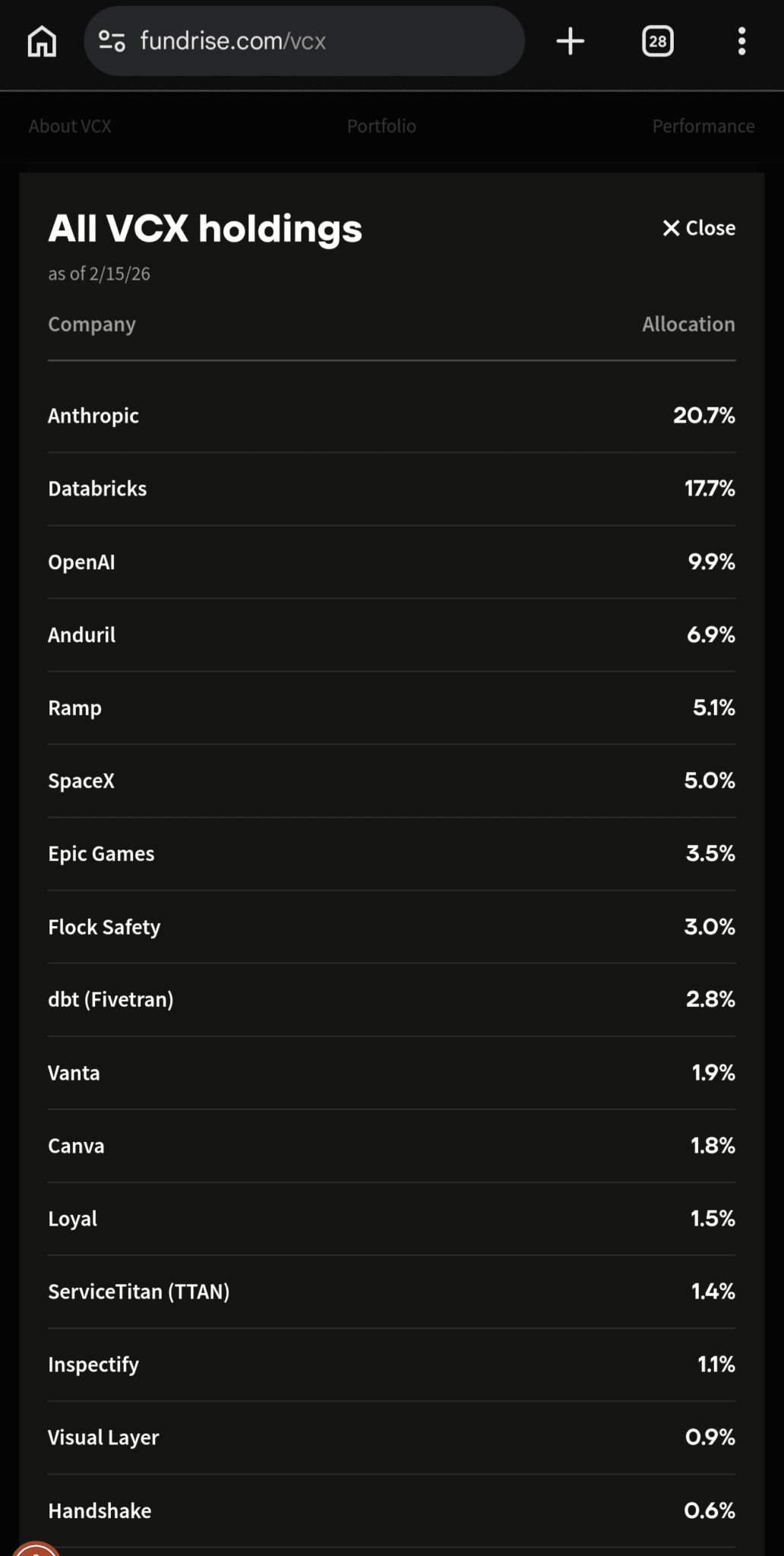
The fund launched with approximately $550 million in assets under management and is already attracting significant attention from investors who have never had a viable path into venture capital before.
The Debut That Stopped Trading
The VCX listing on March 19, 2026 was one of the more surreal days of my investing life.
I was sitting in my car in a school parking lot after dropping my son off, tracking bids on my phone and texting my wife. The NAV was $19. Bids were opening at $42, $70, $90, $108. Fidelity kept halting trading because the system could not keep up with demand. Emails were flooding in from Financial Samurai readers who had invested, equally stunned by what they were seeing.
A premium to NAV of that magnitude on day one reflects something important: investors were not just buying the underlying portfolio. They were buying the concept. The idea that public venture capital is real, that it trades, that anyone can own it. That kind of enthusiasm is rare and worth paying attention to.
Whether the premium holds, grows, or compresses over time remains to be seen. All VCX investors, myself included, are subject to a six month lockup period as part of the listing process. The real test will come when that window opens. But the day one signal was about as strong as any new financial product has ever received.
A Note On My Background And Why I Wrote This
I spent 13 years in finance, including time at Goldman Sachs and Credit Suisse, before leaving in 2012 to focus on Financial Samurai. I started the site in July 2009 during the financial crisis as a way to make sense of what was happening to markets and to my own finances. It has since grown into one of the largest independently run personal finance publications in the country. You can read more on my About page.

I have been working with Fundrise as a partner and investor for more than ten years. I have real money invested in VCX and am sitting through the same six month lockup as every other investor. My interests are completely aligned with my readers on this one.
I write about Fundrise because I genuinely believe in what they are building. Staying invested through the hard commercial real estate years of 2022 and 2023 when it would have been simpler to quietly move on taught me something about the value of conviction. Fundrise had it.
Public venture capital is not a gimmick. It is a structural change in who gets to participate in the most dynamic part of the economy. Fundrise did not just identify that gap. They built the product, listed it on the NYSE, and watched it halt trading on day one because the demand was overwhelming.
That is what a decade of unglamorous, innovative work looks like when it finally breaks through.
How To Learn More About Public VC
If you are interested in learning more about VCX and whether it belongs in your portfolio, you can explore it directly through Fundrise. As with any investment, do your own research, understand the risks, and make sure it fits your personal financial situation and risk tolerance.
The era of invite only venture capital with $250,000 minimums and two and twenty fees is not over yet. But it just got a very serious competitor.
Here is the Fundrise Public Venture Capital investor day video presentation by Fundrise before the listing of VCX.
To achieve financial freedom sooner, rather than later, join 60,000+ others and sign up for my free weekly newsletter. I started Financial Samurai in 2009 and helped kickstart the modern-day FIRE movement. Everything is written based off firsthand experience and expertise.