
In 2009, I watched about 35% to 40% of my net worth disappear in roughly six months. A decade of saving and investing, gone in two quarters. The global financial crisis was absolutely the worst.
That experience permanently rewired how I think about risk. Before I make any speculative bet now, I don’t ask how much I can make. I ask how much I’m willing to lose. I cap my downside so I never get in deep trouble.
Most people with a “fun money” account get this backwards. They set aside a little cash to trade individual stocks, crypto or options. Then they give it a job. Double it by summer. Make $500 a month. Pay for the vacation.
The moment fun money has a return target, it stops being fun. It becomes a second job with a terrible boss: you.
Return Targets Turn Fun Money Into A Problem
Return targets make sense when you’re judging a long-term strategy against a proper benchmark. They make no sense for money you’ve deliberately thrown at highly uncertain outcomes.
Say you put $2,000 into a speculative account and decide it needs to become $3,000 within six months. Three months in, you’re down to $1,600. Now you need an 88% gain in three months to hit your goal.
The deeper the hole, the more absurd the required comeback. Lose half and you now need a 200% gain just to hit your original target.
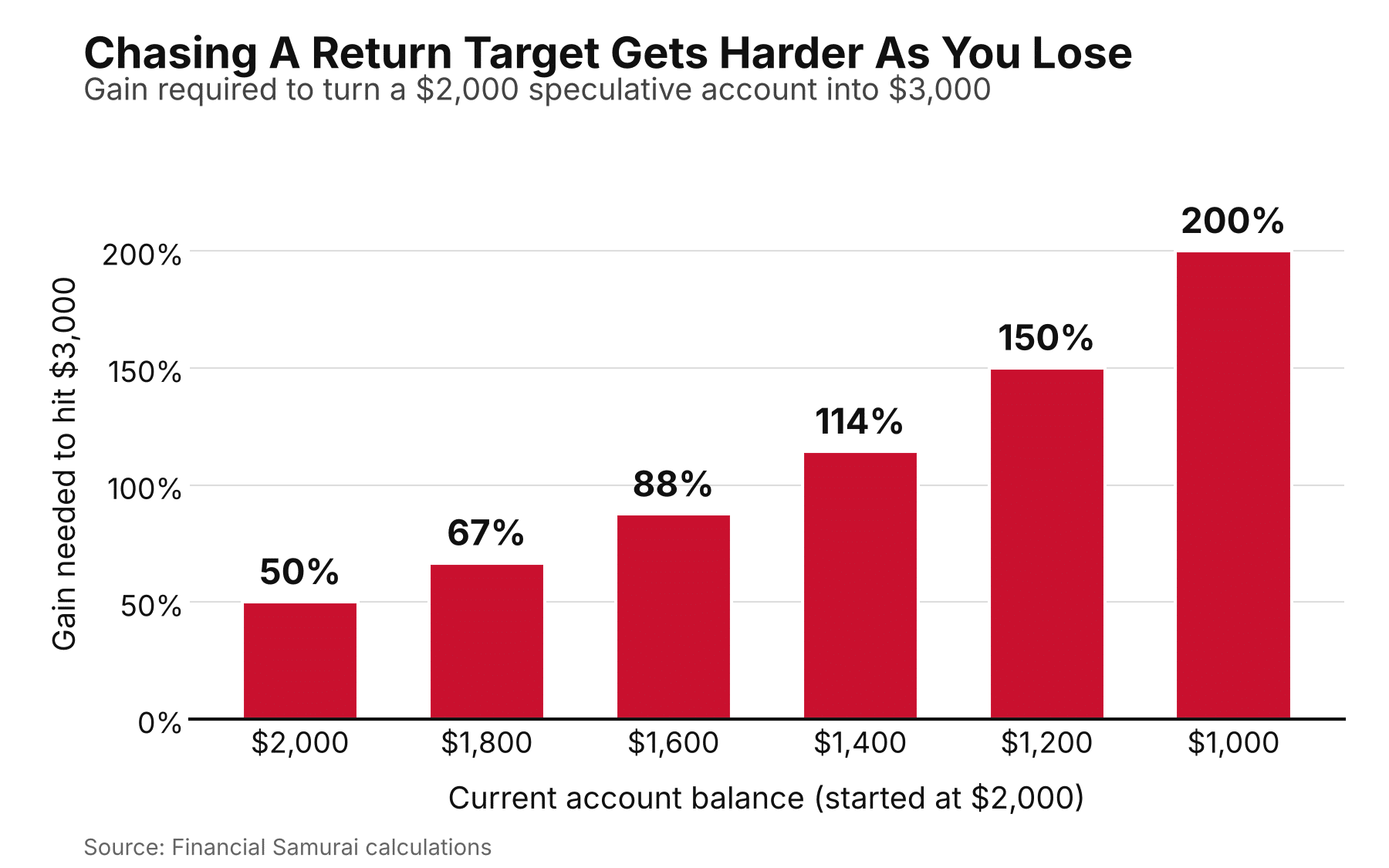
So what do people do? They size up. Not because the investment case improved, but because the calendar is running out. Decisions get tied to a deadline instead of the market. And a small experiment quietly becomes a bigger financial commitment.
I’ve seen this movie many times. It rarely ends with a better plot.
A maximum-loss framework flips the question. Instead of asking what the account should earn, you decide what you can commit and lose completely without anything else in your life changing.
Pick Your Maximum Loss Before Anything Else
Base the number on your net worth, not your paycheck. Plenty of high earners have thin savings, big debts or a tuition bill coming. A fat salary doesn’t automatically mean you can afford to speculate.
One reasonable ceiling is 5% of net worth. If you have $100,000 in net worth, that’s a maximum of $5,000. Note the word maximum. It is not a target, and nobody is giving out awards for maxing it out.
Before you use that number, check four things:
- Emergency fund: Money for job loss, medical bills or a dead transmission stays out.
- Debts and near-term obligations: These come first. Always.
- Existing risk: If you already own a lot of volatile assets, count them. Your company stock counts too.
- Your stomach: Could you lose all of it without changing your household plans? If not, it’s too much.
For many people, the right answer is well below 5%. For some, it’s zero. That’s not failure. That’s maturity.
I’ve written about how to invest in speculative investments without huge losses, and the core idea hasn’t changed: size the bet so being wrong is survivable.
Even with my more aggressive private investing, I keep a hard ceiling. I cap venture capital, venture debt and angel investing at 20% of my investable capital. I explain why in why aggressive venture investing after FIRE isn’t reckless. A cap only works if you never negotiate with it.
Also remember that net worth moves. If markets fall, your speculative bucket becomes a bigger slice of a smaller pie. Review the percentage periodically. Just don’t treat a lower balance as permission to top it back up.
Not All Speculation Dies The Same Way
Individual stocks, crypto and options are not interchangeable. They lose money through completely different mechanisms, so they deserve different allocations.
Take a $5,000 speculative account. One possible split is $2,500 in individual stocks, $1,500 in crypto and $1,000 in options. This 50/30/20 split is a starting framework, not gospel.
Individual stocks carry concentrated company risk. One bad earnings report, a surprise CEO exit or an accounting issue can gap a stock down 30% overnight. Owning three companies is not diversification. It’s three lottery tickets with ticker symbols. Just look at how much NVIDIA fell after the Jensen Huang (CEO) affair broke. When investing in stocks, there's an en external locus of control element since you have no say in how a company is run.
Crypto trades 24/7, swings wildly and depends heavily on liquidity. Major coins have suffered long, painful drawdowns. Smaller tokens can go to nearly zero and stay there.
Options are their own animal. A purchased option can expire worthless from time decay even if you’re right about the direction. Being right too late is the same as being wrong.
The faster something can go to zero, the smaller its slice should be. These type of investments are risky.
Pre-Fund The Account And Wall It Off
A speculative account gets dangerous when money can flow into it every time you get excited. You start experiencing investing FOMO, the most dangerous type of FOMO there is. The fix is boring and effective: fund the whole allocation upfront, once.
Say you approve $3,000 for the year. Transfer all $3,000 into a separate brokerage account in January. That creates a visible wall between speculative money and your real portfolio. If you lose it all, you can't easily transfer new funds.
Then you decide how much of that balance goes into each position. Cash sitting there doesn’t need to be deployed immediately. No good ideas this month? Great. Do nothing.
A separate account also makes the scorekeeping honest. Trades, fees, realized losses and leftover cash all live in one place instead of hiding inside your 401(k) or index funds.
For budgeting purposes, treat that initial transfer as money already spent. If it grows, wonderful. If it doesn’t, your plan was built for that.
Recreational Spending Is Not Investing
Not every discretionary dollar belongs in an investment account. Some money exists to be spent on fun, not to compound. Mixing the two is how people convince themselves an expense is a strategy.
Gambling is the clearest example. Online casinos run on deposits into player accounts, not investment contributions. Casino games should be budgeted as entertainment, funded from money you’ve already earmarked for discretionary spending.
For example, I went to Las Vegas for a family vacation and lost $350 in poker, and silently felt stressed. But then I viewed it as entertainment and felt better, although I was tired the next day.
The treatment matters more than the amount. Your entertainment budget needs a hard monthly ceiling, and nothing spent inside it should come with expectations of future income. Keep deposits separate from your brokerage accounts and your savings.
If part of your monthly leisure budget goes to pikakasinot, treat what you deposit like a concert ticket or a nice dinner. It’s consumed entertainment, not capital expected to earn a return. Set the limit in advance, and never refill it from savings or investments. That’s the line between a night out and a bad habit.
Years ago, my father’s words made me rethink my own gambling habits. I share the full story and why knowing when to quit gambling matters more than any winning streak. The people who get hurt aren’t the ones who lose $100 on a Friday night. They’re the ones who never set a ceiling and keep chasing.
Write It Off Before You Place The Bet
Mentally writing off the money before you invest makes it much easier to think clearly later. That doesn’t mean ignoring new information or refusing to sell. It means accepting upfront that you might lose it all.
Each instrument tests that acceptance differently.
With options, the clock is the enemy. Know before you buy that the entire premium can vanish by expiration, and don’t assume more time always helps.
With crypto, the danger is the 24/7 price feed. Checking your phone at 11 p.m. on a Saturday is a great way to make impulsive trades you regret by Sunday brunch.
With individual stocks, respect the fundamentals. A big drop after a bad quarter might be the market telling you the business got worse, not that it’s on sale.
The mental write-off separates your ego from your analysis. You still have to do the work. You just stop clinging.
Loss Limit Example And Chart
Here’s what a loss limit looks like on a single position. Say you put $1,000 of your speculative money into a hot stock at $100 and decide upfront that $75, a 25% loss, is where you walk.
The stock pops to $110 and you feel like a genius. Then it grinds lower for two months. At $75, you sell. You lose $250. It stings, but $750 lives to fight another day.
Now imagine you skipped the limit and told yourself it’ll come back. Seven weeks later the stock is at $40. Same company, same thesis, but now you’ve lost $600.
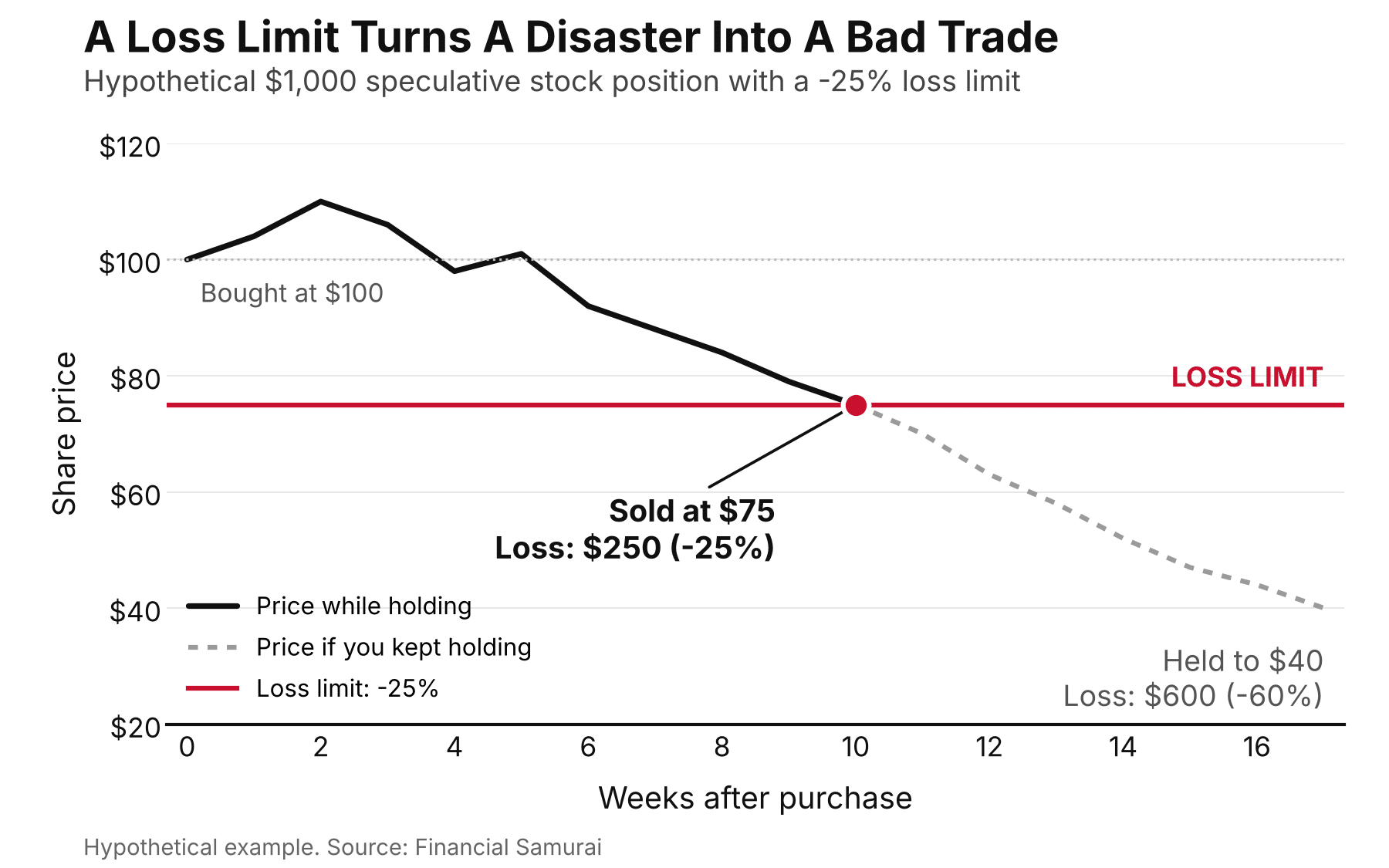
One caveat: a stop-loss order isn’t a guarantee. If a stock gaps down overnight on bad earnings, it can open well below your limit, and you’ll sell at whatever the market gives you. The limit still helps. It just isn’t magic.
When It Hits Zero, You’re Done
The final rule is the one nobody wants to follow: once the account is empty, the experiment is over.
Say you commit $4,000 and lose it all after a string of bad trades. Adding another $4,000 doesn’t “get you back to even.” It doubles your original commitment, which your plan never approved.
Repeated deposits also hide the true cost. An account showing $2,000 today looks harmless until you add up the deposits and realize you’ve put in $12,000 over five years. Sound familiar? Many of us have a brokerage account we’d rather not audit.
Writing wire after wire for venture capital calls taught me how fast “just one more” adds up, even when the commitments are planned. With unplanned speculation, it’s worse because there’s no contract forcing you to stop and look.
So set a no-replenishment rule. When the money’s gone, you stop speculating. You don’t dip into savings, retirement accounts or credit to keep the game going.
Your fun money doesn’t need to hit a return target to justify its existence. Its discipline comes from three things: a defined allocation, sensible position sizes and a stopping rule you keep even when results stink.
If it makes you rich, great. If it doesn’t, you’ll still be fine. And that’s the whole point.
Readers, do you keep a separate fun money or speculative account? How much of your net worth do you allow yourself to speculate with, and have you ever broken your own limit? What’s the most you’ve ever “re-upped” after blowing through your original allocation? And do you count entertainment spending, like gambling, as part of your speculative budget or keep it completely separate?
Get More Frameworks Like This In Your Inbox
Join 60,000+ readers and sign up for the free Financial Samurai newsletter here. I’ve been writing from firsthand experience since 2009, including my share of speculative losses. You’ll also get new posts in your inbox as soon as they’re published, ad-free for the first few hours.
And if you want a step-by-step plan for building wealth without betting the farm, pick up a copy of my USA Today bestseller, Millionaire Milestones: Simple Steps To Seven Figures. The best way to afford fun money is to build a big enough foundation that losing it never matters.
