
I was talking to a full-time mother the other day, and she was pissed. Her full-time working husband was heading out on yet another business trip. It was his third week-long trip that month, and she was over it. Their two kids missed their father, and she didn’t think all the travel was truly necessary, even if it was for work.
After all, we all went through COVID, and everything worked out just fine with video conferencing. She felt he was choosing to travel more than he needed to, mainly for the fun of it and to get a break from the kids.
That conversation got me thinking about the tension that builds in households where one parent stays home and the other goes to work. I feel it too. Every time I debate attending a conference versus preserving a precious weekend with my wife and children, the internal pull is real. With my two kids now in school full-time, the weekends matter even more. So I haven’t gone to a conference yet.
The Challenge of Being a Stay-at-Home Father
Given I'm a man, I'm going to write this post from a father's perspective. But it is just as relevant for mothers too.
Men are trained from a young age to provide. Even if nobody acknowledges the work, we continue showing up. We feed, protect, teach, drive, fix, support, and problem solve through every stage of our children’s lives.
Being a father requires intrinsic motivation. You cannot expect, let alone crave recognition for a job well done, because nobody cares. Nobody asked you to be a father, and society doesn't do a good job in appreciating a man's efforts when it comes to the family.
Gus Fring, from Breaking Bad, sums up one version of what it takes to be a man today. Is it any wonder why so many men opt out of marriage and fatherhood?

Being a full-time parent can be so demanding that some parents actually crave the structure of work just to get a break from parenthood. There’s no off switch with full-time parenting. One distracted moment can lead to disaster.
So after years of pickups, drop-offs, cooking meals, teaching skills, and spending weekends away from friends, how do you let go of the guilt when you finally take a break? How do you give yourself permission to leave your family behind for a little personal leisure?
You start by comparing yourself to other parents, and follow a new framework I've created, in true American nerd fashion.
Step One: Compare Yourself to the Average Dad (Or Mom)
When you become a stay-at-home father, you lose touch with the rhythms of normal working dads. Once your children enter school and you start meeting other parents, the contrast becomes obvious.
Most fathers are working full time. Supposedly, the average dad spends just 60 to 80 minutes a day with their children. I know, it's hard to believe, but that's what the data says.
In contrast, a stay-at-home fathers spends anywhere from 8 to 24 hours a day, depending on the age of the children and the occupation of their partner.

Do the math:
If you spend 12 hours a day caring for your child during the first three years, while the above-average dad spends about two, you're putting in six times more daily time. In terms of total hours invested, those three years equal roughly 18 years of parenting time for the average dad.
In other words:
You are not falling behind by taking a break. You are still years ahead.
Give yourself permission to rest. You have earned it.
Step Two: Ask Other Dads (Or Moms) About Their Travel Schedules
Now that you know the general amount of time the average dad (or mom) spends with their children a day, it's time to get granular. Just like how real estate is local, father time also depends by region. And you want to compare your efforts to your immediate peers.
Therefore, you must ask as many dads (or moms) you know about their work hours and travel schedules to understand how you compare. Here are some examples that I came across.
- One dad was gone for two weeks on the East Coast, then a dad's golfing trip for four days, then a week in Asia. He was away for almost a month in six weeks.
- Another travels two weeks every month for work.
- Another travels to Europe, Asia, and the Middle East for about a month a quarter to fundraise.
- Finally, another dad says he flies to NYC twice a year for a week to kiss the ring and hope to get promoted. On top of that, he sees clients around the country once a month for three-to-four days.
My Estimated Annual Travel Schedule If I Was Still Working
If I was still working in finance, I would probably travel to Asia two-to-four times a year for 14 – 28 days. I'd probably also travel domestically for five days a month to see clients for a total of 74 – 88 days away for work. Wow, that's a lot if I wanted to give everything to my job and climb to the highest ranks.
After having children, I'd have to imagine I would limit my Asia trips to just twice a year for 20 days max. Then, maybe I'd send my junior colleague to see clients every other month to cut down my total domestic travel to 30 days. Although 50 days away from family a year still sounds like a lot, it seems much more reasonable than 74 – 88 days away!
Step Three: Build Travel or Time-Off Credits
Once you understand how much other parents travel for work, both from the top down and bottom up, you can start building “credits” for every trip you skip and every day you stay home.
This year, for example, there was a dad trip to another state. It ran from Thursday through Sunday, and my wife was totally fine with me going. But I skipped it. We had a parent–teacher conference on Friday from 10 a.m. to 1:20 p.m., and I wanted to meet all eight teachers we had scheduled.
I also wanted to use the weekend to teach my kids tennis through Daddy Day Camp. Public court access in San Francisco is tough, so Friday afternoon after the conferences was prime time to get out there.
By skipping that four-day trip, I built enough “credit” to take a more meaningful six-day trip to Honolulu to surprise my father for his 80th birthday. I still felt guilty leaving my family, but far less than if I had gone on the dad’s boondoggle. I also put in extra time with the kids during those four days, even while feeling a bit sick, which helped reduce the guilt later. The more effort I put in upfront, the lighter the guilt became.
No matter how much your partner insists it’s fine to take a weekend boondoggle with the guys or a business trip to New York for steak dinners and late night partying, some resentment will inevitably build. That is just human nature because solo-parenting is hard work!
A Simple Formula That Helps You Take Time Away Without Guilt
Now let’s build an actual formula so you can take action to feel great about more personal time away from the family. Use my formula as a baseline, and then adjust it to your individual family situation.
1. Ask five working dads (or moms) how many days they spend away from their family each year.
Include work trips, conferences, and boondoggles.
2. Calculate the average.
3. Divide that number by two.
This becomes your guilt-free allowance to travel as a stay-at-home parent or take a break from parenting. For example, if you find the average working dad spends 30 days a year away for work, then you can take 15 days guilt free to do whatever the heck you want.
Why half? Because full-time working parents are providing financially. Travel is often part of their job, even though we all know workers no longer have to travel to build relationships or close deals after 2-3 years of Zoom meetings during COVID.
If you are not the main financial provider, you don't get to travel and have the same number of days the average working parent gets. Half the average is a fair split.
When to Use a Divisor of One (Equal Travel) – When You Are a FIRE Parent
A FIRE parent is someone who retires earlier than normal so they can be a full-time parent while still serving as the main financial provider. This is different from a full-time parent who steps away from their career entirely while their partner continues working.
If you are both the main financial provider and the stay-at-home parent, then it’s only fair that you get to take as many breaks or trips as the average number of trips taken by the five parents you surveyed.
If you happen to know five stay-at-home dads, you can also divide by one instead of two as well. Their averages will generally be lower, but also more aligned with your lifestyle reality.
That said, I still don’t believe a FIRE dad should take more days off than the average stay-at-home dad, even though he’s also the financial provider. Part of the FIRE mindset is maintaining high standards and outperforming the average in both dimensions.
Being a FIRE Dad Is Not Normal
If you reached financial independence so you could spend more time with your children, understand that your lifestyle is rare. FIRE is already rare, but FIRE parenting is even more so given how much it costs to raise a family nowadays.
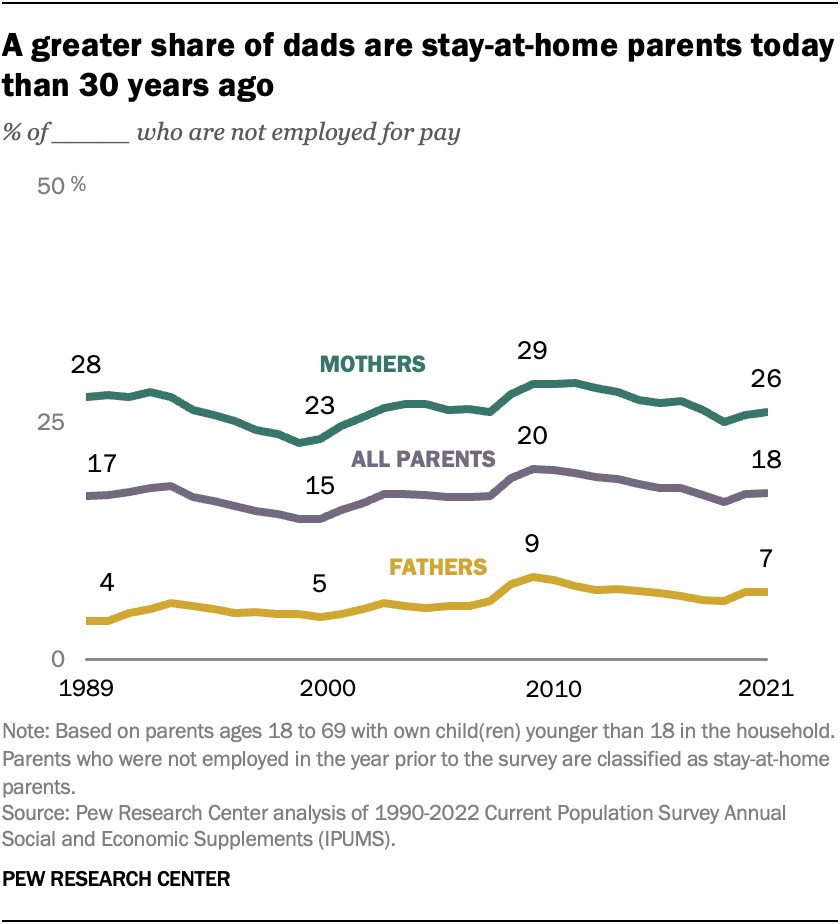
- According to Pew Research, only about 7% of fathers who live with their children under 18 are full-time stay-at-home dads. Fathers now make up roughly 18% of all stay-at-home parents (with the other ~82% being mothers).
- Meanwhile, I estimate less than 30% of the 7% of full-time stay-at-home dads are FIRE dads who stay home and are also responsible for the bulk of the family finances. In other words, 70% of the full-time stay-at-home dads have working partners/spouses who bring home the sashimi.
The discipline it takes to become financially independent is not easy. The discipline to then spend the next 18 years raising your children full-time is even rarer.
However, if you never take a break, resentment eventually builds. You may start comparing your arrangement to households with a more balanced setup. Without finding a better balance, a marriage can easily break apartment.
You cannot sustain full-time parenthood long term without caring for yourself.
There Is No Prize for Being a Martyr
If you work full time and still travel for weeks or months each year, you have an incredibly supportive partner at home. Appreciate them. Solo-parenting for weeks on end is not easy.
If you are a full-time parent or FIRE parent who feels guilty even thinking about taking a weekend away, remember this:
You have already spent more time with your children than many working parents will spend in a lifetime.
Your presence, consistency, and sacrifice are already changing the trajectory of your children's lives.
But none of it matters if you burn out.
A rested parent is a better parent. A resentful parent is a dangerous one.
Give yourself permission to step away. You deserve the rest. You deserve the freedom. And you deserve the same grace you give to everyone else.
If you're a stay-at-home parent, how do you overcome the guilt of taking time for yourself? Do you think my formula is fair? If not, how would you adjust it? And for the working parents out there, how many days a year do you travel for work?
Take Care Of Your Family, Even When You're Not There
As stay-at-home parents, we carry the invisible load. We show up every day, even when we’re exhausted. But the truth is, none of us can be present 24/7. Whether you’re traveling, working, or finally taking that long-overdue break, having the right life insurance means your family is protected no matter what.
That’s where Policygenius comes in. It’s my preferred life-insurance marketplace because it does all the comparison shopping for you, quickly, clearly, and at the lowest prices available. In minutes, you can compare top insurers side-by-side and get the coverage your family deserves.
If you’ve spent years putting your family first, make sure you protect them with the same intention. Once my wife and I got matching 20-year term life insurance policies through Policygenius, we breathed a huge sigh of relief. They were affordable and enabled us to better focus on being present for our children.
Check your life-insurance rates today with Policygenius. Your future self, and your family, will thank you.
Subscribe To Financial Samurai
Listen and subscribe to The Financial Samurai podcast on Apple or Spotify. I interview experts in their respective fields and discuss some of the most interesting topics on this site. Your shares, ratings, and reviews are appreciated.
To expedite your journey to financial freedom, join over 60,000 others and subscribe to the free Financial Samurai newsletter. You can also get my posts in your e-mail inbox as soon as they come out by signing up here. Everything is written based on firsthand experience and expertise.

When it comes to taking time for myself as a (mostly) stay at home parent, I remind myself that the quality time with my children matters, and that it’s sometimes better to take a break, rather than be present and grumpy. I would feel better about the formula: allowable travel days = (working spouse’s travel days/2)-1.
Thanks for sharing. What’s the thought process behind -1 in the equation?
My thought is that if my spouse travels just for a couple of days for work, an individual getaway isn’t necessary, so the need gets phased out. But it is still a rule of thumb and subjective. I got away for a weekend last year for an athletic event. I don’t have the desire this year.
I did some travel for work in the middle of my career. I enjoyed some of the time away to have a change of scenery and see new places and restaurants. But the rest of the trip time was usually stressful. There was always a business objective to achieve or some damaged client relationship to mend. I don’t miss that at all. And luckily my business travel frequency was very low. Only like three, maybe four trips total in ten years. Anyway…
It sounds like the trip you took to see your parents was well worth it and worked out nicely. Your trip had both purpose and enjoyment, which is a double win. And you got lucky with your flights and the cost to boot. That’s like icing on the cake. Your kids are fortunate to have you genuinely so involved in spending time with them and teaching them so many valuable things all the time. My parents were reasonably involved when I was growing up, but there was also a lot they didn’t do as well. Neither of them had to travel for work, but one had trouble keeping a steady job and the other never really advanced, so they had a different set of challenges.
Only three or four trips in 10 years is huge! If you had children, then, that would be pretty ideal.
I am impressed with how some parents can spend so much time away from their family for work. I asked her about age 33, I really started getting sick of Travel. Unless it’s some incredible conference with tremendous business impact and entertainment, I really don’t wanna go.
I think the ideal amount of time to travel a year might be 10-15 days. Enough to see your clients and bosses in the headquarters, and not too much where you start feeling guilty missing out on your kids upbringing.
Early in our marriage, after our first son was born, my wife and I decided that it would be best for her to stay home and raise our son (and our future additional 4 kids). At the time, it was a definite financial strain (and career sacrifice for her), but we ran the numbers and realized the cost associated with two working parents (daycare, etc.) made the decision obvious to us. Especially since we valued family (and especially motherhood) more than incremental financial gain at the expense of our son’s early years. Anyway… over the years, I ended up in the tech field and eventually started my own tech business and that work required a fair amount of travel to conferences and business peer groups. I traveled 5 or 6 times a year for 3 or 4 days at a time, so not too crazy, but my wife was home juggling several kids on her own. One thing about a larger family though; eventually the older kids can help take care of their younger siblings. As the kids got older, we’d take them along with us to my business trips and my wife would visit museums, and explore the area (Boston, Kansas City, Orlando, New York, etc.). We home educated all of our kids, so this was just a “field trip” for them. We’d usually stay an extra day or two once my conference was over. I’m retired now and we’re in the process of moving from an expensive coastal town, to Cody Wyoming! A place we could not have lived when I was working. A little geographic arbitrage as recommended by Financial Samurai. Actually, we did that 20 years ago when we sold our Santa Barbara home and bought a bigger, better home an acreage for less than half the price. That home is now fully paid for and we’re not selling it. Our adult sons still live and work in the area, and they’re moving in to take care of the homestead. There’re lots of ways to build wealth and a family legacy.
What a blessing to have four kids. If I could talk to my 25-year-old self, I would shoot for having kids younger.
Please let me know how you enjoy Wyoming! I found that as we get older, we get settled in our ways and relocating to a new town gets more difficult. So if you could share your experience, that would be great.
We want to relocate to Honolulu, or at least I do in my 50s. I think the pace of living would match my age and desire to take things down. And I’ve “tried “living in Honolulu before actually relocating for my entire life. So I think I would fit right in.
I have to admit, I have to go for Business Travel to take a break from my wife and kids. I travel about six weeks a year and each time it’s just nice to just be able to focus on my work and other things without my wife and children pulling me in different directions.
Sure, I make the money and get work done during my travels. But if I’m honest with myself, I really don’t need to travel as much. Maybe one or two weeks at most.
I need a break too. It’s exhausting working so much and taking care of the kids when I get home. Many other fathers I know who travel for work are eager to travel more!
Traveling does indeed provide for a nice respite, doesn’t it? And the heart generally does grow fonder after two or three days away. And if you are dual stay at home, parents, having the occasional break, I would say once a quarter is healthy for a relationship.
That would be really difficult!
Indeed! Might as well, just rent a hotel room or Airbnb for a week in that case!