
Dear Financial Samurai,
This week finally had me questioning whether to take some profits or hold by keeping 99.9 percent of my rollover IRA long equities.
As I wrote last week, I was already watching individual stocks blow up left and right. This week, some of my own positions started getting shot up, including my largest holding, Google, after it reported great earnings but guided to a roughly $200 billion capital expenditure plan, much higher than expected. Amazon followed with a similarly unbelievable CAPEX guide.
The last thing I wanted to do was roundtrip my positions like what happened in 2022 after a strong 2020 and 2021. When we roundtrip our gains, we do not just lose money. We lose time. And given I am 48 and realistically 60% through life, time is far more valuable now than when I was trading time for money in my twenties through my mid thirties.
Ultimately, I decided to white knuckle the volatility and buy the dip using proceeds from Treasuries I sold once the S&P 500 began trading below 6,800. It seemed odd to me that with roughly $650 billion of planned capital expenditures from mega technology companies due to overwhelming demand, stocks like Nvidia were trading down.
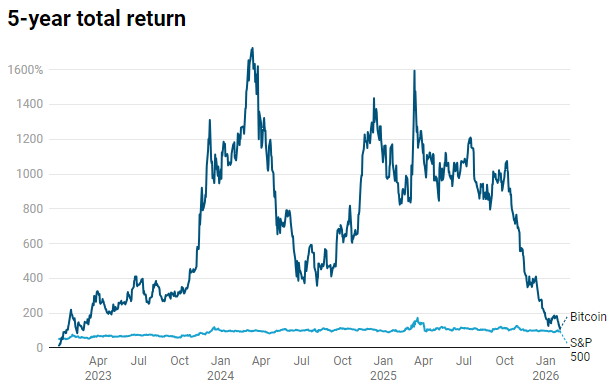
My suspicion was that institutional investors were crowded and leveraged, then forced to sell as Japanese bond yields rose and speculative assets like Bitcoin, silver, and gold collapsed.
It is terrifying to watch software companies like NOW and CRM lose roughly 30 percent of their value in just one month. As a growth investor, you must occasionally take profits when valuations stray far from their historical norms, especially since most growth stocks do not pay dividends. Capital gains are your dividends.
Another thing I reflected on this week was the importance of not panic buying. Corrections can take months to play out. A 2.5 percent decline in the S&P 500 is nothing. Stay measured. You do not want to deploy all your dry powder only to see another ten percent leg down.

Too Much Attention On Stocks
Here is another realization that has been brewing. Stocks are supposed to be passive compared to owning physical real estate. Yet when I looked back through my newsletter archive, I noticed I write far more about stocks and policy impacts on stocks than I do about real estate.
If stocks were truly passive and therefore more relaxing to own, I should be writing less about them. Who really cares if Claude Code threatens to disrupt SaaS companies if you are a long term holder of the S&P 500. The answer is emotion.
Those of us with large stock portfolios care deeply about outperforming and about not losing a debilitating amount of capital. Because we can easily press a few buttons and move large percentages of our portfolios, volatility encourages constant second guessing.
I know some of you are experts at rarely checking your portfolios and hardly worrying at all. Wonderful! My concern with this monk-like approach is that it may reflect a lack of aggressively building a large taxable brokerage account that provides the optionality to walk away from work.
If and when AI disrupts your livelihood, it may be too late to start building that freedom portfolio. Amazon, for example, has laid off roughly 30,000 people since October 2025 and then reported earnings that sent its stock down 11 percent at one point. Losing your job while watching one of your largest holdings crater compounds stress quickly. Prepare accordingly.
Please do your best to diversify your net worth so you become more antifragile when the next downturn arrives.

Real Estate Coming Back To The Forefront
When stocks, commodities, and cryptocurrencies sell off at the same time, it is natural to look toward more stable assets like real estate. This week, I published two real estate posts that should help you find better deals and also help you feel wealthier along the way.
The first article is called Why The Best Deals Exist Outside The Real Estate Frenzy Zone. People move in herds. They eat lunch at noon and wait twenty minutes instead of going at 11:30 or 1:30 and walking right in. Real estate behaves the same way.
Buyers tend to cluster around a narrow price band that I call the frenzy zone. That is where competition and overbids peak. To get better deals, you need to step just outside that range. I share three examples in the post to help you identify your neighborhood’s frenzy zone and bid accordingly.
The debate between real estate and stocks as the better investment never ends. I like both. However, the return of extreme stock volatility combined with a large neighborhood housing overbid made me realize real estate deserves another point in the battle.
Real estate does not evaporate overnight the way stocks can. Its permanence helps you feel more confident that you are wealthier after a neighbor sells their home for a large sum. By contrast, it is hard to fully trust a sharp rally in a growth stock, especially one with minimal profits. We saw a nice rebound on Friday, February 6 into the close. But can we really trust those gains to stick? Nobody knows, and I remain skeptical.
Check out Why The Feel-Good Wealth Effect From Real Estate Beats Stocks.
Fundrise's Venture Product Listing On The NYSE
Finally, Fundrise's venture product, plans to list on the NYSE under the ticker VCX. When I first received the email, I was skeptical, especially given how badly growth stocks were getting hit this week. Ironically, many of those growth stocks were being disrupted by the very AI companies the Innovation Fund holds, such as Anthropic.
In other words, Fundrise's venture product is the one doing the knocking, if you have ever seen Breaking Bad.
Because it is extremely difficult for retail investors to gain exposure to private AI companies that are reshaping valuations and livelihoods, a successful listing under the ticker VCX could result in the fund trading at a premium to net asset value (NAV). If that happens, investors would benefit not only from the growth of the underlying companies, but also from a supply and demand dynamic that has little to do with fundamentals. Of course, the opposite could occur as well.
Going public exposes a company to the entire world. Sometimes the world is kind. Other times it is ruthless. But reaching the scale and credibility required to list on the NYSE is a meaningful reputation boost. The exchange does not let just anyone list.
You can read more of my thoughts in my post, What The Innovation Fund’s NYSE Listing Could Mean For Investors. I have an auto debit of $1,000 a month and decided to invest another $3,000of cash flow after the announcement.
Update: Thankfully, VCX debuting positively. But I'm staying measured given there is a 6-month lockup and anything can happen.

To you financial freedom,
Sam
If you want to sign up for my free weekly newsletter, you can subscribe here. Fundrise is a long-time sponsor of Financial Samurai and Financial Samurai is an investor in Fundrise products.