
My primary goal for this site is to help you achieve financial freedom sooner rather than later. And if you’re still on your path to financial freedom, sending your children to private grade school often works against that objective.
I’ve experienced freedom from bosses, work travel, rush hour commutes, and client pressures since 2012. And I can unequivocally tell you the sacrifices you make to reach FIRE are well worth it. Your health improves. Your happiness increases. And you finally have the space to find something meaningful to do with your one and only life.
In this post, I want to highlight the latest private grade school tuition figures out of New York City and remind you to run the numbers before taking the plunge. The opportunity cost is not pretty.
The last thing you want is to sacrifice 10+ years of retirement just to send your child to private grade school, only for them to graduate, attend the same colleges, and pursue the same careers as everyone else who didn’t pay an arm and a leg for education.
The Private Grade School Debate Began Before Our Children Were Born
Paying for private grade school tuition is something I’ve debated since 2016, a year before my son was born. We visited a couple of private grade schools in Honolulu, and I wrote about whether paying for private school was worth it.
Like most parents, we initially paid for private preschool because cities don’t provide free childcare to families not in poverty. Then COVID hit, and my wife and I homeschooled our son for 18 months both because we could and to protect our baby daughter.
It was refreshing to get a break from tuition. But as our investments grew and our desire for bilingualism increased, we decided to send our kids to a Mandarin immersion school.
Today, the cost is about $44,000 per child per year, or $88,000 in after-tax income for our two children. At a 30% effective tax rate, that requires roughly $125,000 in gross income just to cover tuition.
That’s a lot of money, taking up about 34% of our passive income. As a result, I’m still constantly reassessing each year whether it’s worth it.
The Value Of Mastering A Second Language Matters To Us
That said, our kids are happy, the school is excellent, and we highly value learning a second language. I’d personally pay $500,000 or more to be fluent in another language. When you can truly speak a second language, your world expands.
I loved living in Taiwan for four years as a kid and studying abroad in China for six months in 1997 during college. Learning to think and dream in another language is a gift. It’s almost like being FIRE, where you get to live two lives before and after retirement, but mentally.
Just imagine how much more you would’ve enjoyed the 2026 Super Bowl halftime show featuring Bad Bunny if you understood Spanish.
Debí tirar más fotos de cuando te tuve. Debí darte más beso' y abrazo' las vece' que pude. As a FIRE practitioner who is sensitive to how fleeting life is – and how quickly our kids grow up – I feel these lyrics from the song, DtMF.
Too bad, after four years of studying Spanish in high school, and two years living in the Spanish House at William & Mary, my Spanish is terrible. I wish I started studying sooner.
Paying Private Grade School Tuition At The Expense Of Your Financial Health
Let’s be honest. Learning a second language is no longer necessary, especially if you don’t plan to live abroad. English dominates, and technology now translates languages instantly and for free.
Much like college, mastering a second language has become a growing luxury. There are also public schools that teach second languages for free, though very few start as early as preschool.
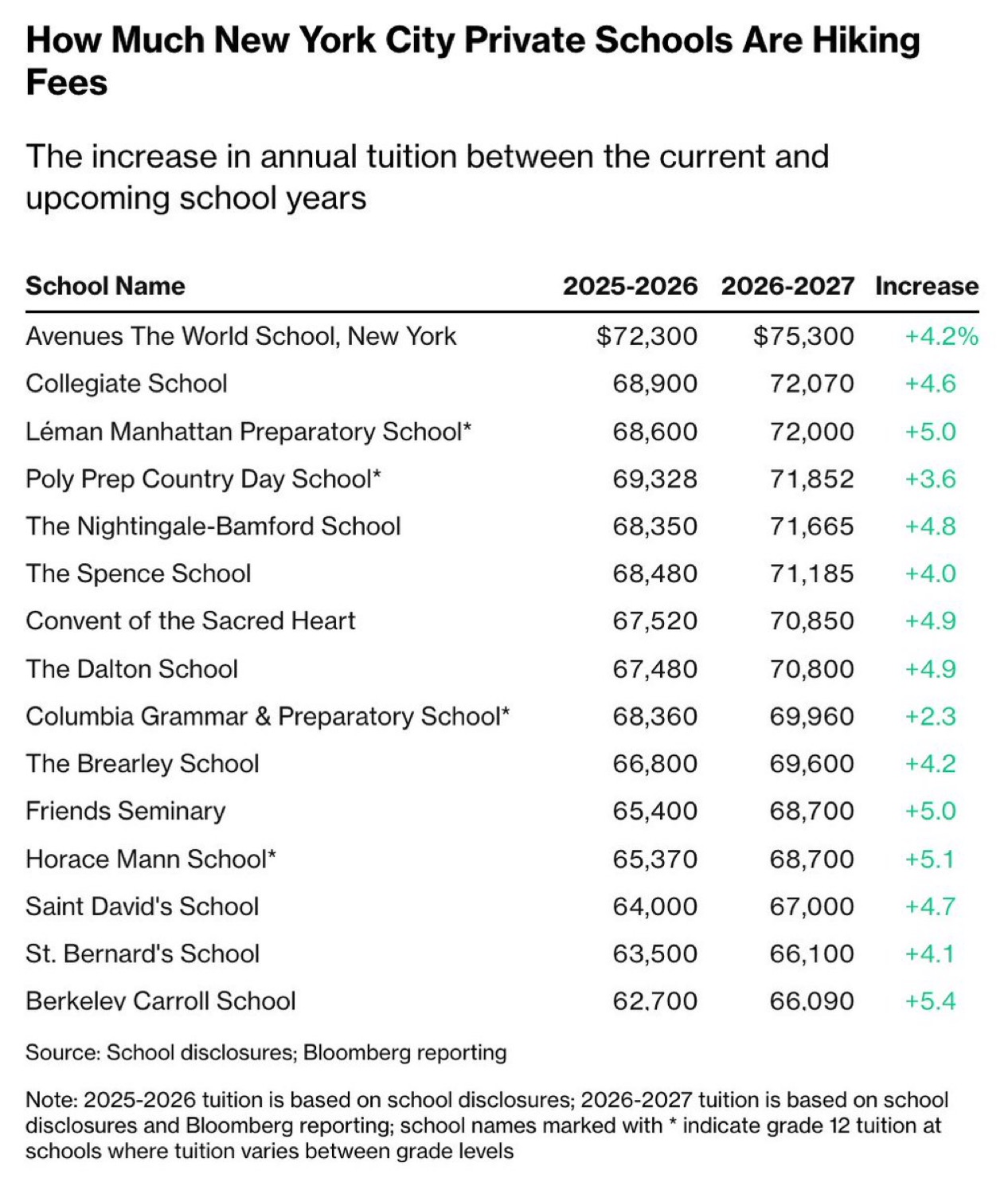
So when I saw the latest New York City private school tuition for 2026–2027, I was impressed. Even though some debate it, New York City is at least 20% more expensive than San Francisco. Seeing schools charge $70,800 to $75,300 per year is staggering.
At a 30% effective tax rate, a family needs to earn at least $100,000 in gross income just to pay annual tuition for one child.
Three Types Of Families Who Send Their Children To Private School
After four years of private schooling and speaking with hundreds of parents, there are three main groups who send their children to private school:
The ultra-wealthy, earning well over $1 million a year and/or with net worths well north of $20 million. To them, $70,000+ per child barely registers. They’re happy to spend freely on education. I estimate they make up about 20% of all private school families.
Lower-income families, typically earning under $200,000, who receive substantial financial aid. These families often make up about 20% of the student body. The $200,000 cutoff aligns with standards used by elite universities like Yale and Harvard. I estimate they also make up 20% of all private school families.
The mass affluent, or HENRYs, earning roughly $300,000–$600,000. They earn too much for meaningful aid but not enough to feel comfortable paying full tuition. This is the type of family who has a chance to FIRE, but ends up working 60 hours a week and grumbling about life, partially due to private grade school. I estimate these make up the bulk of private school families, about 60%.
If you’re ultra-wealthy or heavily subsidized, private school is manageable. It’s the mass affluent class that gets squeezed, paying 80%–100% of tuition while deciding whether private school is worth the tradeoff.
Run The Numbers On What Private School Tuition Really Costs
Let’s assume when your child turns five and enters kindergarten, you start investing $70,000 a year for 13 years instead of paying private school tuition. Your contributions increase by 5% annually, and you earn an 8% annual return. By the end of that period, you would accumulate roughly $2.1 million nominally. Adjusted for 3% annual inflation, that equates to about $1.43 million in today’s dollars.
Reduce the starting contribution to $50,000 under the same assumptions – 5% annual contribution growth, 8% annual returns, invested for 13 years beginning at age five – and the ending value comes out to roughly $1.5 million nominally, or about $1.02 million in today’s dollars after adjusting for 3% inflation.
That’s the real cost of private school, not just the tuition price. And I haven’t even included 1-3 years of preschool tuition, which can easily run $25,000 to $60,000 a year. I get it.
If you’re middle class, sending your kids to public school and investing the difference is often the smarter move. Giving each child $1 – $1.4 million in today’s dollars when they turn 18 is hard to argue against.
Ask your kid if they’d rather have a million dollars at 18 and attend public school, or attend private school and receive nothing. The answer is obvious.

Years Taken Away From Retirement
I get it. We all want our kids to have upward socioeconomic mobility instead of getting stuck in the permanent underclass. But at what cost?
Let's apply this to a real household.
Assume a $500,000 household income in New York City. Two children require roughly $200,000 in gross income annually for private grade school tuition alone. After taxes and living expenses, the household saves $50,000 a year, or 10 percent of gross income. Respectable, but not exactly aggressive if your goal is financial independence.
Let’s assume that $50,000 is invested annually at an 8 percent return.
To accumulate $1.02 million after tax (roughly the lower-end inflation-adjusted opportunity cost for one child), it would take about 12 to 13 years of consistent saving.
To accumulate $1.43 million after tax (the higher-end inflation-adjusted opportunity cost), it would take about 15 to 16 years.
That is per child.
If you have two children, you are looking at roughly 15 to 20 additional working years to replace the lost compounding, assuming markets cooperate and you stay disciplined.
Do you really want to work an extra decade or two so your child can attend private school from age five to eighteen?
If you already have the wealth or substantial free financial aid, the decision is easier. But if you are middle class and grinding toward freedom, you must be honest about the tradeoff.
You are not just buying education. You are potentially selling years of your life.
As one commenter points out, I'm likely overestimating the amount of time you need to work by not accounting for the growth of your existing investment portfolio. Hopefully, your existing net worth will compound with solid investment returns, and you will continue to earn and save more over time, cutting that additional 15 to 20 years of work down. But you never know.
If you want to achieve FIRE, you must generate enough passive income to cover your basic living expenses. And if you're a typical dual income household in a big city earning $300,000 – $600,000 a year, but do not have a large investment portfolio to begin with, retirement delays will be inevitable.
$500,000 Household Income And Budget
To give you a crystal clear view of how quickly a $500,000 household income disappears, I’ve put together an updated budget chart with reasonable expenses for a family of four. Instead of assuming $70,000 plus per child in private grade school tuition, I used a more conservative $60,000.
Their home is a modest three bedroom, two and a half bathroom house with about 1,900 square feet in a good neighborhood. The 45-year-old couple saves a combined $40,000 a year in their 401(k) plans and another $10,000 a year across two 529 plans.
After covering all expenses, they are left with about $20 a year. Let's hope there aren't any emergency expenses that come up.

Now imagine how many more years the parents have to work if they only make $300,000 a year? A lifetime! Even if they have a realistic $2 – $3 million portfolio compounding at 8%, they will not be able to FIRE if the don't slash expenses.
And remember, when you spend this much on private education, expectations rise. Parents naturally hope for elite colleges, exceptional careers, and financial outperformance. When outcomes end up similar to those of public-school peers, disappointment can creep in.
The Rich Are Really Rich
Now you see how wealthy families comfortably afford $70,000 per year for 13 years. To them, spending $1–$2 million per child doesn’t materially dent their net worth.
A $20 million portfolio growing 10% produces $2 million in gains. That single year of returns can cover decades of tuition.
For these families, private school is the default choice. Even if there's only one fewer student on average per class, it's worth the tuition.
The top 20 percent of families are effectively expected to subsidize the bottom 20 percent through donations on top of full tuition. Meanwhile, the remaining 60 percent of families earning upper middle class incomes are the ones getting stretched the thinnest.

Income And Net Worth Guidelines
If you want the option to retire before 60, earn at least 7X net tuition per child. Paying $70,000 means earning roughly $490,000 with one child, or $980,000 with two. With a $20,000 discount, $350,000 for one or $700,000 for two, may suffice.
After 2020, I raised the guideline from 5X to 7X as education ROI declines due to technology. However, you can still use the 5X guideline if you wish.
For net worth, aim for 25X net tuition, excluding your primary residence. In other words, Paying $71,000 requires at least $1.78 million in investable assets per child.
While 25X is a bare minimum for FIRE, tuition is temporary, and assets usually compound faster than tuition inflation. Further, I assume you’re still working and adding to your retirement portfolio.
If these guidelines sound harsh, don’t worry. They are guidelines, not rules of law. If you choose not to follow them, just be honest about the tradeoff and model more years of work and fewer years of retirement. That approach works well if you truly love what you do.

Why I’m Still Uncomfortable Paying So Much
As FIRE parents in San Francisco, we’re considered middle-to-low income but have high net worths after decades of compounding. We pay full tuition, donate what we can, and feel the squeeze. Nearly all of our passive income now goes toward living expenses.
That’s normal post-FIRE. Kids are excellent decumulators of wealth. Still, spending this much after 20+ years of aggressive saving is uncomfortable. I'm making progress, but probably still need a few more years to be fully comfortable.
Long term, I’d rather relocate to Honolulu before high school, where tuition in San Francisco is currently around $60,000 a year. Private tuition there is closer to $36,000 per year through high school, saving between $8,000 – $24,000 a year after tax per kid.
That tradeoff alone could let me fix my 11-year-old car stress free and buy endless amounts of the best Hawaiian poké and mangos. I gotta say, that sounds pretty amazing to me!
Are you a mass affluent parent paying private grade school tuition? If so, how do you justify the cost, and are you prepared for you or your spouse to work many more years than necessary? And have you ever asked your child whether they would rather attend public school and receive over a million dollars at 18, or attend private school and receive nothing?
Suggestions For A Better Life
If you have debt and children, protect your family with an affordable life insurance policy through Policygenius. My wife and I both secured matching 20 year term life insurance policies during the pandemic to protect our two young children, and once we did, a tremendous amount of financial worry disappeared.
If you want to hedge against AI disrupting your children’s livelihoods once they graduate, check out Fundrise Venture. It invests in some of the top private AI companies, including OpenAI, Anthropic, and Databricks. Investing in AI has made me feel much better about all the disruption ahead. The minimum investment is just $10.
To expedite your journey to financial freedom, join over 60,000 others and subscribe to the free Financial Samurai newsletter. You can also get my posts in your e-mail inbox as soon as they come out by signing up here. Financial Samurai is among the largest independently-owned personal finance websites, established in 2009. Both Policygenius and Fundrise are affiliate partners of FS.

This article is hitting at the perfect time. Here in Vancouver, BC top tier private high schools (grades 8-12) are C$35,000 and mid-tier C$6,000-$8,000 per year. I’d consider our family lower mass-affluent. We choose private school because we want a faith-based education. We have been pressured to strive for top tier but after reading the article I must admit it made us feel financially stretched and uncomfortable. You’re right, if all roads lead to a similar destination then the least expensive (highest ROI) road makes most sense. Keep up the great articles.
Thanks Chris. C$6 – $8K a year in tuition seems quite reasonable actually. Hope it works out for you.
The concern I have is AI eliminating so many jobs for new college graduates that I wonder what is really even the point of spending 4 years and lots of money for college, let alone private grade school.
I just spent the last 10 days homeschooling our kids b/c they had time off. Although it was a ton of work (took them out for 7 hours today for swimming, lunch, tennis lessons, reading, sports basement, and Land Rover dealer), the time also flew by.
Don’t think we’ll ever regret spending more time with our children.
Many Public Schools in SF are great and so worth it imo. Check out Alice Fong Yu K-8 Chinese Immersion. It is wonderful!
How long have your kids been going there?
I heard it’s tough to get in due to it being a city wide speciality school.
We want to focus on Mandarin.
I did Spanish Immersion (Alvarado and Hoover, now in Lowell) Public all the way!
https://www.kqed.org/news/12048313/san-francisco-unified-plans-new-mandarin-immersion-school-amid-charter-push
Not sure this was mentioned but AI is all the more reason to think twice about spending on private school K-12. They can learn almost anything online and tailored to their interests and needs for a fraction of the cost. For the bright kids neither public nor private can fully engage them( in SF!) Private schools might have better project based learning making it more fun for sure, but public schools provide the opportunity to socialize with a diverse set of kids and families and that is priceless. The social emotional skills are what can’t be taught online and maybe thinking where is a good fit for them should be based on that. For now it still seems worth to pay for fancy private colleges for the networking and job opportunities but not K-12.
We are in SF with a gifted kid and tried private, public schools and settled in public system while supplementing at home with self guided online learning and some tutoring.
Theoretically yes they can learn almost anything online (me I do the same also) and tailored to their interests and needs for a fraction of the cost BUT like someone with some personal experiences in the family, online and in presence, I can tell you that this work for some of them till 14 maybe 15 years (later for only child and first born). After this age start to rise to questions, them don’t belong! Social animals start to kick back.
I think you overstated how long you must delay retirement by a lot here due to two math errors.
It treats the tuition like you must “replace” the full future value of 13 years of contributions as if your FIRE portfolio isn’t compounding at the same time.
Two key math issues:
Putting it together with a $10M FIRE example: if you’re already close to $10M, private school may delay FIRE by far less than “15–20 years,” because (a) your existing portfolio keeps compounding, and (b) the correct “cost” to compare is the PV of tuition, not the FV of hypothetical contributions. The right way to estimate the delay is to model the portfolio path with and without tuition (same return assumptions), and measure the difference in the year you cross $10M.
You make some excellent points. Thank you. My goal is to help readers think about lost time in an extreme sense.
However, I’m not talking about the $10 million net worth couple paying for private school. It still stings, but not that much.
I’m talking about the $1 – $3 million net worth couple still grinding away making $300,000 – $600,000 a year. This is the bulk of the private grade school family demographic. They save maybe 10% of their gross income a year, but a lot goes to tax advantaged accounts they can’t touch without penalty until 59.5.
In my $500,000 household budget example, they have $20 left a year, and are spending $310,000 a year. Extreme? Yes, but trying to make a point.
At 45, can they FIRE before age 60 with a $1 – $3 million portfolio growing at 8%, even if they cut their expenses by 20% to $240,000 a year? Doable, but tough, especially with inflation.
They have to work until they are pushed out. It’s too scary to retire with just 25X your annual expenses in investments.
Maybe world it is not just SF?
With $300.000 per year in SE Asia you will be a ”king”?
Having lived in Kuala Lumpur, Malaysia for four years and loved it, I absolutely agree.
But I always write from firsthand experience, and my experience is currently living in San Francisco.
Do you live in SE Asia currently? And if not, when do you plan to move there to live like a King? I’m always interested in learning from people who take action based on their beliefs, b/c too many people believe but never do.
It is a LOT of money to give up for no significant return. Safety factors are really the only realistic issue. And why tolerate that? School choice should be demanded. There is no reason to tolerate taxpayer dollars funding abusive, worthless, negligent public schools who use the funds for circular union politics instead of education. Demand school choice. We loved charter schools for most of our kids most of their education. Dual enrollment high schools (early college) are amazing. All of it through public schools.
We chose to move to a city with the combo of the best job prospects, lowest housing costs and the best public schools in a state with no income tax. It allowed us to easily fund retirement savings, travel and 529 accounts for out-of-state college costs (good thing because both our kids hate the politics of the state we live in and who could blame them, LOL) after switching to one income.
Growing up, I personally learned way more about drugs and sex from my private school friends than anyone I knew in my public schools.
We are mass affluent at a good public school. We use the tuition savings to pay for private tutors, as we can easily afford to pay a Phd to tutor our oldest, who was struggling in writing, for twice-weekly sessions, which has made an immense difference in their writing. I don’t think 5 hours of English at a private high school is as helpful as 2 hours of private instruction with a Phd English tutor. Now, if we could afford private school and the same tutor, the decision might be different. The decision would also be different if we didn’t live in a good school district (with dual language immersion). Our private high school has over 25 AP classes, which is basically a school within the school and provides many of the private school benefits, like a high-achieving peer group and a more rigorous curriculum.
Supplementing with a private tutor sounds good. What grade did that start and how much does one cost?
What I’m finding is that maybe 30-50% of families in private schools also supplement with a private tutor. At least the private tutor ensures the child doesn’t fall through the cracks, especially if the parents are too busy or uninterested in staying on top of the kids homework.
We started with a writing tutor in 8th grade, but I regret not starting sooner. For a long time, I thought I could just help myself, but the parent-child dynamic is different from the tutor-student dynamic. The tutor is much better at connecting with my kid, and my kid went from a reluctant reader who hates to write to a competent writer who reads poetry for fun. We pay $100/hour, so about $800/month. I expect to continue through the end of high school. It also helps my kid plan better and complete their written work early, giving them time to review it with their tutor before turning it in. I think public schools do a good job teaching math and science, but not so good with writing.
My oldest did private school every grade except third. Her one year of public school resulted in bullying and the girls spending recess on their cell phones instead of playing. The cell phone policy alone is a reason I’m willing to pay. Our tuition is much cheaper (catholic school at $8500/year) but only goes through middle school.
Our youngest is currently in the same private school but may go to public school for middle school because her grade is filled with a lot more rich kids who are kind of bullies. Not thrilled with our public middle school but with the extra $24k (8k for three years) we can put up with it.
I prefer a public high school for diversity given that our high schools are quite good.
I hate bullying with a passion. I experienced various degrees of that growing up, but I always fought back.
I would happily pay the tuition to prevent the bullying that I experienced. But these conflicts also toughen you up for real life. There’s always gonna be mean people, uneducated, people, cliques, etc. I see this all the time in the online world, as well as the personal finance world.
So in that sense, a moderate amount of conflict/bullyint can be good preparation for the real world. But as a parent, it’s always heartbreaking to see. And as a parent, it’s hard not to blame the parent of the bully for not educating them better.
It seems like your situation shows that whether private or public, a lot of of it is Luck of the draw regarding the classmates of that year and the parents.
What’s funny is I’m in this exact same predicament and closer to the “ultra wealthy” at around $15M and am about to have twins this year. I’ve been thinking very hard if I should go the private or very good public route myself even though I went private when I was young.
I will say that going private, I met an incredible group of friends who are all successful and also helped push me to be the best I can be. This was absolutely invaluable in my life.
The private school I went to is now $50K/year and back then it was $20K/year. W 2 kids that’s 100K/year now.
I don’t have a house (currently based in Asia) and so that’s gonna be 3,4,5M for a house when I move back to the US and then if we do private school tuition and do country club like I want to, things start to get a bit tight.
Luckily I have around 4-5 more years to compound and we’ll see then.
Congrats on the twins! You have plenty of time to think about it. I suspect with 90% certainty you will go private, especially if your NW continues to grow.
How did you build your wealth and how old are you?
Education is such an important and complex topic. I went to both public and private schools. In my own experience, the quality of education I got at private school for just two years was undeniably better than anything I experienced prior. I didn’t have any bad teachers at public school. But I felt that the teachers were better at private and the resources the school had were immensely larger. I also had smaller class sizes and no more violence in the hallways or bullying behavior to worry about once I switched to private. The circumstances vary so much from one town to the next, even one neighborhood to the next. And for me, private were the best years I had as a student.
But obviously the finance aspect is hugely important as well. And sometimes it just doesn’t make sense. I was only able to attend private because I got a scholarship and grant money. I wouldn’t have been able to go otherwise. So yeah with the vast majority of private school families falling in the range of too wealthy to get substantial aid and not rich enough not to bat an eye at the cost, it can be quite a predicament.
you hablo espanol y no le entendi a bad bunny
This is a very long, rambling post as we used a combination of public, private and homeschooling to wrangle our 3 children through k-12. And I have many thoughts and opinions on this subject.
The private experience was a Catholic middle school, which was a good fit as we were raising our kids Catholic. However, after a year, my daughter announced that the kids at her school — while very nice — were out of touch with reality. (She’d gone to quite diverse public schools prior.) Our local public high school offered the International Baccalaureate program, and she insisted on transferring there to enroll in it.
While in middle school, my son asked to be homeschooled. He was miserable, so I reluctantly agreed. After tapping into the local homeschool network, I found homeschooling quite easy. We had the money to pay for specialized teachers, which we did; a marvelous French tutor set him on the path to his current fluency.
He returned to public school for high school and I estimate he was about a semester ahead. Turns out he still disliked attending school, so he transferred twice during the 4 years. At one point, he attended a specialized school that mostly catered to pregnant teens. He learned a lot!
Our kids were/are strong-willed. After elementary school, I found that they had strong opinions about where they wanted to go. I tried to browbeat our youngest to attend Catholic middle school — no go.
For college, we told them they could go in-state or to Canada, where they were born. Our son opted to attend the Universite de Montreal… after his excellent homeschool grounding in French. On his own, he figured out how to establish Quebec residency during his first year, and we ended up getting a tuition refund. The fees were already just a few thousand.
He eventually transferred back to North Carolina, where we live, to finish his degree. His college education was so reasonable we had enough left in his 529 to cover a Master’s degree at the University of Edinburgh. Currently, he’s an actuary with EY in London.
Our middle girl graduated from UNC-Chapel Hill. She has a young child and works part-time.
After graduating from NC State University, our youngest was recruited by Deloitte.
Final thoughts:
For elementary school, our kids attended a magnet school for the creative arts. To this day, they all love and appreciate the arts. At the time, there was nothing equivalent in the private school sector.
My husband and I worked in health care. He’s a dentist, and I was a physical therapist. We worked with everyone — from the CEOs of companies to the homeless. If you’ve only ever encountered a narrow socioeconomic band (as in a private school), will it take time to learn how to interact with people from all strata of society?
We spent some of the money we saved on private school tuition on travel experiences for our children. On our dime, they traveled to India, Nepal, Cambodia, Laos, South Africa, Thailand, Ireland, Canada, Scotland, Poland, Spain, France…
If your child attends public school, you can supplement their learning with private tutors — at a fraction of the cost of a private school. On parents’ night, when I saw the size of her grade 10 math class, I immediately proposed to my daughter that we hire a tutor. She agreed.
Bottom line: I’m glad we went the route(s) we did. And our retirement nest egg is all the healthier for it.
Thanks for sharing! Sounds like everything worked out fine!
“While in middle school, my son asked to be homeschooled. He was miserable, so I reluctantly agreed. After tapping into the local homeschool network, I found homeschooling quite easy. We had the money to pay for specialized teachers, which we did; a marvelous French tutor set him on the path to his current fluency.”
Can you share why your son was miserable in middle schools? I just came back from my school for a celebratory lunch, and my 3rd son was crying b/c he asked to sit in a chair and two boys said no, and it was “reserved” for someone else. That made him sad, and my wife was volunteering. So I think he let out his emotions with her as he knew she was there.
I was there to eat with him and comfort him, and waived one of his female friends over to sit with him, and she did. The teachers were attentive, and one of the teachers was upset and said she’d talk to the two boys after.
My takeaway is that no matter where you go, kids can be cruel and exclusionary. But that’s life and development. Hopefully these negative moments make him stronger. It’s always sad for the parent to see a bullied or sad child. I hardly ever see it, but I saw it today, and it makes me upset.
I’m sorry you had that experience today with your son. It’s so painful to witness our children suffer. Parental wisdom — which I’m still working on — is knowing when to merely offer support and perspective and when to advocate for or take action.
My son was miserable in middle school for a number of reasons. Too complicated to go into the details, but in a nutshell, he found school boring, he found the social milieu difficult, and he longed for more personal autonomy.
We looked at all educational options around that time, but as you noted, no matter where you go, many of the same issues crop up. Seems like some developmental stages have to be endured more than enjoyed.
I tried as best I could to keep communication flowing so he could always express how he felt. I think that’s important.
Wow! interesting story! I like how you involved them in the decision to choose their schools/paths, I bet that has given them a sense of ownership of their situation and environment; I think that can be very powerful. We also are giving our girls the choice of what high school to go to; they all 3 chose private.
I probably would have liked a little less of their involvement in the decision-making :-) As I mentioned, they are strong-willed and wanted their say. But I do think it’s important to involve children in these decisions. Unless there are no options, that is. Sounds like you and your girls are all on the same page!
I grew up in Ireland. I remember my mother consulting with me as to what secondary (high) school I wanted to attend. All these years later, I still appreciate her doing that.
As someone who went through public school, earned an academic scholarship to a state university, and later retired early, I struggle to see a strong correlation between early private education and long-term financial success.
I’m sure private schools can offer advantages — smaller class sizes, networks, resources — but I’m not convinced they produce dramatically different outcomes in the real world.
In my experience, the roadmap to becoming a millionaire has far less to do with where you went to school and far more to do with grit, work ethic, and a willingness to bet on yourself.
It definitely is hard to say. Where are you sending your children to school and what is your thought process behind it given you have enough money to have retired early? thanks
My kids go to public school. We have many kids in our neighborhood who go to private schools, and while they may be perhaps academically ahead, they also have less time to actually be kids.
I think my kids will learn the most when I have them go and get jobs at 16. I know that was a big eye-opener for me.
Sounds good to me. Does your wife prefer your kids go to public or private?
I’ve found the pressure from the spouse to be quite high among the men I’ve spoken to who send their kids to private school.
I had to laugh at your comments about the Super Bowl show. I live in Mexico and my Mexican wife and her colleagues remarked that they could not understand a word of Bad Bunny’s music; we are all over 50. One of them commented the best part of the Super Bowl was when he switched channels during halftime since the game had been so boring. It reminds me when I was a kid and our parents could not understand a word of hard rock lyrics.
American football is fairly popular in north east Mexico.
I think your wife needs to improve upon her mumble rap Spanish slang! :)
I really enjoyed the halftime show and it made me lament on not taking my Spanish studies harder. It also made me want to go and check off the bucket list and travel to various South American countries again.
If you’re very lucky you’ll have high quality Catholic/Jesuit school which should cut these tuition numbers in half and feed you into Notre Dame/Georgetown for top students or BC/Fordham 1 step down.
In HS I saw first hand rejections turn into admittances after the right priest gets on the phone with the right university contact.
True. I asked my wife, and she’s too concerned about the child abuse scandals in these schools. Although, now that I think of it, I think she went to such a school.
Sam,
The discussion seems to be focused on $ vs education. As someone in psychiatry, would also consider how much is the environment worth?
1 million to avoid the substance your child got introduced to in high school that they are now addicted too. 1 million to avoid the sexual assault that happened to your daughter in high school.
Think the better debate is k-12 vs college. Rather pay for private and avoid childhood trauma, than save for college. For college, there is always potential sports/merit scholarship or they may forgo college altogether for a trade.
Oh no, is this some of the trauma you and your children experienced? If so, I’m sorry to hear it. What would you have done differently?
Sam, these are patient stories of trauma and there are hundreds of them. As for my family, children are in private school
I tend to agree. There is not a price I’m not willing to pay to raise my children correctly. You only get one chance to get it right, there are no do-overs. The cultural rot in public schools is a lot worse than it was 30 years ago. The [public] high school bathroom has a litter box in it for the mentally deranged to relieve themselves. No thanks!
Signed,
A dad who cares
How much does private grade school tuition cost a year in your part of town, partner?
Yeah, cause rich kids don’t do drugs and date rape doesn’t happen in private school…. what world do you live in? Unless you are already rich, going to a top private school like Harvard Westlake sounds like it would be a problem. Pressure cooker private schools drive kids to suicide and mental health issues.. throw in being the “poor kid” with the family only making $200K a year? A safe public school in a nice area always beats a private school if your family isn’t ultra wealthy already.
These prices are insane. But like most of your articles, it’s the location. In my area (midwest suburb) there are alot of small, Church based private grade schools. The one near us is about $7500/yr for 1 kid, $11k for two kids, $12,500 for 3 kids. We are in a good school district but it is very common for parents to send their kids there. My guess around me is that the “mass affluent” category you mentioned is around $200k-$300k HHI, maybe up to $400kish, so these tuition prices aren’t much of a factor. My kids went to public grade school and we were satisfied (less satisfied with the middle school), however high school is a whole other topic. If I had to do it over again, I’d go the private grade school route with the costs I’ve outlined above however, per the topic in the article, I’m not sure that tuition would be that huge of a sacrifice. This is a real topic for us now though because we are sending our 3 kids to private high school, which are very different numbers so the sacrifices are there just in a slightly different way than your article describes.
Hi Geoff – Thanks for sharing. Can you expand upon why you would do the private grade school route if you were to do it over again? Are you seeing your 3 kids in private high school get a far better education or have a better experience overall?
Here in San Francisco, for example, households earning less than $200,000 per kid can get significant financial aid. Someone even told me a family of four with two kids in private school making close to $1 million were getting free financial aid. But that seems extreme, unless they are a special family.
Related post: How To Get Free Financial Aid Making Multiple Six Figures A Year
Also
The Income Limit To Qualify For Free Financial Aid In College Is Now $400,000
As I said we weren’t unhappy with grade school but middle school wasn’t great. At the price point I mentioned I think it’s a pretty low commitment. I just like the environment of the private schools. They are smaller, and seem to have a tighter parent community with lots of involvement. We are not a very religious family, however there is alot of emphasis on community service and involvement. Additionally, they don’t really tolerate bad behavior, a bit more structured.
To clarify, I have one in private high school now and two 8th grade twins joining their sister next year (all girls school). Better education? Mmm, not sure, the public school will challenge the brightest kids who choose that path. The thing is there is no easy path at the private school. Again, it’s more structured, stricter discipline, require community service and club participation. They don’t allow cell phones, belly shirts, etc, etc.. The social environment is that of high performers. It’s cool to be smart and get good grades. Sticker price is $23k per year per kid. My girls are getting a modest amount of academic scholorships, a sibling discount of 10% per second and third kid, and a small amount of income based aid. Our HHI is about $220k/yr. Will it make a difference? I have no idea but it only will delay our FIRE situation by about 1-2 years.
I do like the ZERO tolerance for bullying at some private schools. I went through too many battles growing up to allow bullying in school for my kids.
Congrats on getting academic scholarships with your income! Did you have to apply, or was it voluntarily given, the academic scholarship portion?
I know A LOT of households who make $200,000 – $600,000 and feel too embarrassed to apply for financial aid. But I tell them they should try anyway.
A delay of only 1-2 years is not much. How old are you now?
One kid is receiving $3500/yr, one other is getting $6000/yr based on test scores (it’s hard for the third one mentally that she didn’t get awarded one). It’s renewable as long as they maintain a 3.5 GPA and they are automatically in the honors track, which is difficult. I have no shame in applying for aid, the school has millions in endowments. However, we are not there to “take”, they will be asking for donations for the rest of our lives and I plan on supporting the school no matter how small the contribution. I agree I bet ALOT of folks don’t even apply for the aid. I also think ALOT of grandparents chip in. You can also use 529 funds these days for private education.
I’m about to turn 52 so youngish to retire but I’m in the fire service and have a number of serious injuries and I really need to retire. We’re midwest leanish fire with a vested pension, a few rentals, paid off primary, a vested medical stipend in retirement (till age 65), and a little over $1MM in 457/after tax brokerage. Wife works modest job, I’ll do some modest work that I enjoy as well. Thanks Sam!
All these numbers are sobering. We plan to do public for K-8. Unless the high school in our neighborhood has a turnaround in the next 8 years, we will be going private for high school (for 3 kids). At least we’re doing a hybrid. I couldn’t fathom K-high school private school tuition.
Hybrid sounds like a plan. Going the public school route in the beginning makes sense, especially if you feel the school is close by, feels safe and has involved parents.
Children just need love, time, encouragement, and support in the beginning especially!