
Back in 2018, I wrote that households need to earn $300,000 a year to live a middle-class lifestyle in an expensive coastal city. The internet was not pleased. I was called out of touch, delusional, and a few other things I can't print on a family finance blog. After having a second child in December 2019, I upped my estimate to $350,000, which went over about as well as you'd expect.
Well well well. The latest data is in, and it turns out a family of four now needs to earn $408,000 a year to live comfortably in San Francisco. We’re number one! Congrats to all who live here.
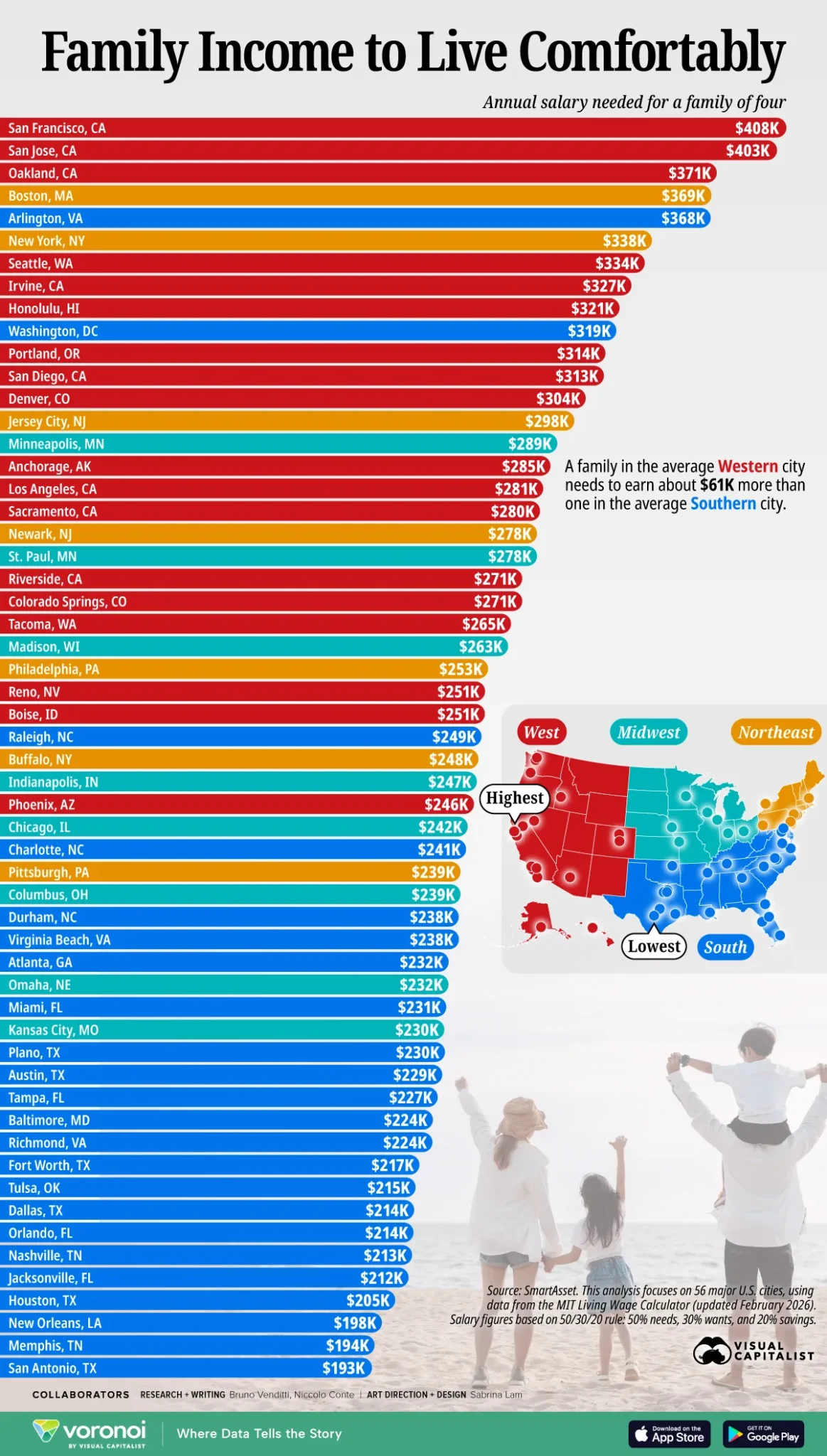
I'd like to say vindication feels great. But being right that the middle-class lifestyle now requires a top 5% income is a hollow victory. It means affordability got worse, exactly as predicted.
Let's break down what these figures actually mean, whether they apply to you, and what you can do if your income falls short. I'd also love to hear from you whether you believe these figures are accurate based on where you live.
What $408,000 A Year Really Means After Taxes
For the record, going from $300,000 in 2017 to $408,000 in 2026 works out to a 36% increase, or roughly 3.5% compound annual cost-of-living inflation for a family.
That's still higher than reported CPI, which is what happens when your personal inflation basket is stuffed with housing, tuition, childcare, and healthcare instead of flat-screen TVs. But it's not far off, so please be aware of how sneaky inflation can be.
After a 32% effective federal plus state tax rate, $408,000 comes out to about $277,440 a year before any tax-advantaged retirement contributions. And you know what? That sounds about right coming from someone who lives in San Francisco with a family of four.
We currently budget about $280,000 a year after taxes, which is why I aim for about $380,000 a year in gross passive investment income to retain my FIRE membership card.
Why not $408,000? Because investment income is taxed at a lower rate than W2 income. We're talking about a 26% effective tax rate versus 32%. Qualified dividends, long-term capital gains, and depreciation-sheltered rental income are more efficient income sources.
However, due to inflation, I need to keep growing my passive income by 3-5% a year to keep up, so surpassing $400,000 is only a matter of time.
Sample Household Budget
To illustrate how quickly $408,000 a year can get spent, here's a realistic sample budget I've put together for a family of four living in a high cost of living city like San Francisco.

Notice how roughly $121,000 a year goes to taxes to support the community using a 32% total effective tax rate. Meanwhile, $30,000 goes to fund retirement and $16,000 goes to saving for college. Not a bad 11.4% saving rate, but not ideal if you want to FIRE.
Besides food ($3,042/month) and vacations ($9,000/year), there's not that much to cut until life starts getting less comfortable. No single line item is outrageous. It's the accumulation of reasonable expenses that gets you.
But of course, the big elephant in the budget is the $90,000 a year in private grade school tuition that's only going to increase as the kids get older.
So if a family can control their children's grade school spending by simply sending them to public school, then the family can live quite well. $49,000 a year can go to 401(k) contributions instead of just $30,000 for 2026. A healthy amount can be contributed to their taxable portfolios, which is necessary for FIRE. Or, they can buy a nicer car and house too. Plenty of money left to spare.
Given we highly value learning a second language, we are comfortable paying up. Looking back at my education, one regret is not mastering Spanish and Mandarin. I'd happily pay $500,000 to be fluent in Spanish and $1 million to be fluent in Mandarin today. With those figures in mind, the tuition becomes far more digestible.
Social Media Weights In
What's wonderful about a free country is that we get to share our views and have others pitch in with theirs. When I shared this budget on X, it received over 3.5 million views and 1,400 responses.
The bottom line? Americans are doing far better financially than the negatively-biased media makes us out to be. And based on the food budgets people shared, we're much healthier too. I wrote a detailed follow up post analyzing all the feedback, and I'm encouraged!
What Is Considered Living Comfortably Is Subjective
Comfort is a moving target. Personally, I found working 60 hours a week under a tremendous amount of stress too uncomfortable to continue. So I left finance at age 34.
Before I left, I took six weeks of vacation during each of my last two years, to the dismay of my bosses. During my final two-week trip to Europe, I devised a way to get even more comfortable by figuring out how to negotiate a severance and break free. In retrospect, it was the best thing I could have ever done for lifestyle.
That said, if I had known COVID would happen and millions of knowledge workers would get to work from home while not really working, I probably would have worked for five more years.
It was eye-opening to play pickleball and tennis on weekday mornings for three years alongside all the work-from-home employees. The courts were packed at 10 am on a Tuesday. Productivity was clearly through the roof, making FIRE obsolete.
Beyond career comfort, all I want is a typical middle-class lifestyle:
- The ability to afford four economy class roundtrip tickets two to four times a year anywhere in the world
- A median-priced to 50%-above-median single-family home with at least three bedrooms and two bathrooms
- A safe and reliable car that costs less than $60,000 (the median price of a new car is about $50,000)
- Enough savings to pay 100% of both kids' public university tuition
- Healthcare coverage plus the ability to afford the 20% co-insurance (not co-pay) when something goes wrong
- The ability to help my parents and in-laws when in need, including setting aside at least $250,000 for eldercare
- New shoes and clothes when needed. Our kids burn through their shoe soles within four months.
- Being able to afford some type of activity once per week for two kids
Notice what's not on the list. No boat. No first class. No vacation home in Aspen. This is the middle-class dream, and in a big coastal city, it now requires a top 5% household income.
You Don't Need To Save Much For Retirement Once You Retire
Because my wife and I FIREd in 2015 and 2012, respectively, we no longer have to save aggressively for retirement.
Not having to save for retirement is one of the budget surprises pre-FIRE folks don't properly account for.
Conceptually, everyone understands it. But the habit of oversaving is so ingrained that most people keep doing it right up until the day they leave, and then feel shocked by how much extra cash flow they have.
If you're saving 30% to 50% of your income today, your comfortable lifestyle number in retirement is 30% to 50% lower than your current gross income implies. The chart's figures assume you're still saving for the future. Retirees get a discount.
I was saving about 75% of my after-tax income during my last two years of work because I was hyper-focused on escaping. So losing roughly 80% of my total income after leaving didn't feel like a big shock. The initial sting lasted one month, right after my WARN Act pay ended and the bi-weekly paychecks stopped. Then a severance check arrived, followed by unemployment benefits, which further softened the blow.
In other words, my lifestyle was exactly the same after leaving my job. I would argue it was better, given the freedom I gained. Freedom, it turns out, is the ultimate luxury good, and it doesn't show up on any cost-of-living chart.
Note, if you quit your job, you don't get a severance check and are not eligible for unemployment benefits. Hence, please don't quit your job, get laid off instead. Quitting is leaving money on the table. Negotiating a severance is getting paid to leave a job you wanted to leave anyway.
How To Calculate Your Own Comfortable Income Number
Don't just accept a headline figure from a study. Calculate your own number in four steps:
- Track your actual annual spending. Not what you think you spend. What you actually spend. Pull 12 months of statements or use a free tool like Empower to aggregate everything. Most people underestimate their spending by 10% to 20%.
- Add the middle-class checklist items you're deferring. No kids yet but want two? Add childcare and education. Haven't been to the dentist in three years? Add real healthcare costs. Deferred spending is still spending, just with worse timing.
- Gross it up for taxes. Divide your after-tax spending number by 0.70 if you're a W2 employee in a high-tax state, or by 0.74 to 0.80 if your income comes mostly from investments. This is your required gross income.
- Subtract savings you no longer need to make. If you're financially independent or close to it, remove the retirement savings line item. Your number just dropped meaningfully.
Run this exercise and you'll know whether your city's figure in the chart is your reality or someone else's.
Can't Hit The Number? Deploy The Proper Geoarbitrage Strategy
If your household income falls short of your city's comfort figure, you have three levers: earn more, spend less, or move somewhere cheaper. Many people jump straight to fantasizing about moving to Portugal or Thailand. Slow down.
As I wrote in The Proper Geoarbitrage Strategy, the correct order of operations is to first relocate within a cheaper part of your own city, then a cheaper part of your state, then a cheaper state, and only then a cheaper country.
Moving to a developing country to save money sounds romantic until you realize you've abandoned your entire network, your kids' friends, your favorite dim sum spot, and easy access to aging parents. Too disruptive for most households.
Instead, look three miles down the road. In 2014, I moved just three miles west within San Francisco and cut our housing expenses by roughly 40%. Same city. Same friends. Same doctors. An extra 8 minutes of driving to the tennis club. No big deal.
Every expensive city has a cheaper side of town that locals irrationally dismiss. That irrationality is your arbitrage opportunity. Only after you've exhausted the intra-city discount should you consider a bigger move.
Relocate To A Cheaper City With Better Weather
What's exciting about living in the most expensive city in America is that I can look down the chart and choose literally any other city to save money.
Given I'm visiting my parents for a month in Honolulu, and did so for six weeks in 2025, the logical choice would be to relocate to Hawaii. According to the data, it only requires $321,000 a year in household income to live comfortably in Honolulu.
Coming here is like rewinding time five to ten years, back when it only cost $300,000 to $350,000 to live comfortably in San Francisco. Who needs a DeLorean?
$321,000 is $87,000 less than the $408,000 required in San Francisco. Meanwhile, housing is about 10% cheaper and private school tuition runs $10,000 to $25,000 a year less per student. Unfortunately, childcare costs are equally as expensive. However, with multi-generational living under one roof, more family members can help out.
At a 4% return or withdrawal rate, needing $87,000 less per year means needing roughly $2.2 million less in capital. Significant! Moving one flight away from San Francisco is worth over $2 million in required net worth. That's the power of geoarbitrage at the city level.
Other Cities Under Consideration
If I didn't have family in Honolulu, I might consider San Diego ($313K), Los Angeles ($281K), Richmond, VA ($224K for my wife), or Orlando ($214K). Although after living in Virginia and New York City for 10 years, I'm not sure I could handle the summer humidity in Richmond or Orlando again. Some discomforts no amount of savings can offset.
So we're back to determining what is comfortable.
To me, comfortable weather is a top three consideration. Other considerations include safety, cleanliness, natural beauty, quality food, entertainment, educational institutions, and diversity.
Perhaps these are some of the reasons why a family needs to earn $61,000 more on average in a western state than in a southern state. You're paying a sunshine and lifestyle premium, whether you realize it or not.
If You Don't Want To Move, Attack The Income Side
Relocating isn't for everyone. Roots matter. If you're staying put in an expensive city, which usually provides you with the most opportunities to make the most money, focus on these instead:
- Build passive income streams. Every $10,000 in annual passive income is $10,000 you don't need to earn from a job, taxed at a friendlier rate to boot.
- Negotiate your compensation every single year. The difference between asking and not asking compounds into hundreds of thousands of dollars, if not millions, over a career.
- Cut your optional expenses honestly. A $90,000 private grade school tuition bill is a choice. You likely have your own version. Owning your choices beats resenting your city.
- Get on the right side of inflation. Own assets that benefit from rising prices, like your primary residence, rather than only renting them from someone else.
The chart tells you what comfort costs. It doesn't tell you that you're helpless. You always have more levers than you think.
Readers, what do you think? Do the figures in the chart properly represent what a family of four needs to live comfortably in each city? Where do you live and how much do you spend a year? Have you ever geoarbitraged within your own city before making a bigger move?
Build Wealth Faster No Matter Your City
If you want a step-by-step guide to building enough wealth so cost-of-living charts become trivia rather than terror, pick up a copy of my USA Today bestseller, Millionaire Milestones: Simple Steps To Seven Figures, published by Portfolio Penguin. It lays out exactly how to accumulate the capital needed to live comfortably anywhere, on your own terms.
For more nuanced personal finance content, join 60,000+ others and sign up for the free Financial Samurai newsletter. Financial Samurai began in 2009 and is one of the largest independently-owned personal finance sites today. Everything is written based on firsthand experience because money is too important to be left up to pontification.

Hi Sam… Off topic question. I’m hopeful your parents in HI are ok since hurricane Lala has passed. Not sure exactly where they are, close to Kahala I thinking. Kahala looks to be outside of the impacted area but wanted to hear they and their property are ok. Please email so I don’t miss the update.
Thanks. They are doing well and the hurricane was downgraded to a storm.
Here’s an update: Buying A Mansion In Paradise Might Be Backwards
Great article! Moving away from kids’ friends is a big deal, indeed.
Aging parents is tricky: many of us moved to expensive cities/countries for work, leaving parents behind. Persuading them to follow is hard (also not an easy paperwork) and moving back closer to them is often not a good choice (lower safety, higher taxes) or even impossible if parents and in-laws live in different places. Thoughts?
FWIW, your calc on health care cost is low, at least compared to NY/NJ. Employer sponsored for a family, I pay $430/mo medical, plus $99 for dental & vision = $530/mo. This was the better priced of plans b/w me and the spouse, both working at Fortune 500s. I also do the HSA, an additional $687/mo, though that can be viewed as forced savings.
Cell phones are @$250/mo, for 3 lines.
We have the highest property taxes in the country (exceeding your monthly combined tax/maintenance), so I won’t add those, but I still view your house maintenance budget as low — repairs, landscaping, etc. One blown HVAC or roof issue, and your 17k/yr will be doubled (ask me how I know). HTHs.
Gotcha. Or perhaps the employer is more generous with the health care benefits than yours?
Everybody’s expenses will be different around the country that’s for sure.
Speaking from Marin County, the utility, property tax and life insurance (OK, I am older) numbers are woefully low in your sample budget. Conversely, the private school number is obscene. In the 1960’s and 1970’s, one could receive a fine education in an inner-city public school (I did).
The numbers seem high to me. We have two children in private school and live in a fairly expensive Australian city. Including mortgage principal (which I usually consider saving) but not taxes, we spent USD 140k per year last year. The private school in your SF example is more expensive than the most expensive private school in Australia. We just bought a car for USD 20k (3 yo Camry). Check my blog for a detailed spending breakdown!
Which Australian city? Sydney seems like the only comparable city for matching high cost cities here in the U.S. But I’m not sure about Melbourne.
A couple of thoughts:
– The vacation budget seem really low….even if you use points for all of the flights. Not impossible, but not realistic for a family who spends $90k on private school.
– The $17k budget for property tax and maintenance sounds really low as well, unless you’re in a condo. $17k for a mid sized detached house could be your maintenance budget alone.
– Food seems high, unless you’re ordering a lot of Skip, or going out much more than a weekly date night.
– Interesting point: I recently also purchased $2m personal umbrella liability for $150 annually ($ CAD).
Sam, This is so contextually dependent, beyond location. In your table above, applying to my case, removing just 3 big ticket items that don’t apply to us (mortgage, private school tuition and 529 plan – our kid is in college, with separately allocated funds), brings the monthly total to $7586 (even if I accept your generous budget items in all other categories) – that is, $91K a year. That’s assuming all of San Francisco costs you budgeted other than the 3 categories. In our MCOL location, our actual expenses work to $75K a year for our family. My point is that in addition to location, where a family is situated in their life matters a lot.
Congrats on paying off your mortgage! More people should do so, but HCOL means high median home prices. It’s $2.2 million here in SF.
Sam, This is so contextually dependent, beyond location. In your table above, applying to my case, removing just 3 big ticket items that don’t apply to us (mortgage, private school tuition and 529 plan – our kid is in college, with separately allocated funds), brings the monthly total to $7586 (even if I accept your generous budget items in all other categories) – that is, $91K a year. That’s assuming all of San Francisco costs you budgeted other than the 3 categories. In our MCOL location, our actual expenses work to $75K a year for our family. My point is that in addition to location, where a family is “situated” in their life matters a lot.
Little seems to gets people going like being put in a box. Boomers say they aren’t Boomers, rich people say they’re middle class, and the middle class says YOU aren’t! That makes this a great article cause people are fired up over semantics but miss the real problem – efficient vs. inefficient earnings.
This is what drives inflation while ripping the median further from the average – leaving the middle class as a whole poorer while benefiting the few. All income should be taxed at same rates including corporate income BEFORE EDITBA. Why! Cause no one earns money in a way that shouldn’t support the govt equally. And SC ruled corporations citizens, so…
i realize this is a dual argument- but the basic problem is the system is rigged to hurt the working class- even high earners. Fix that and Americans may believe in the Dream again.
The one budget line that stood out to me was the $9,000 annual vacation allocation. I actually don’t think that’s unreasonable, and if anything it could be a little light for a family of four depending on where you’re traveling.I actually think travel is one area where people leave money on the table. I work in luxury travel, and it’s surprising how often the advisor rate is identical or better to booking direct but includes breakfast, resort credits, upgrades, and late checkout. It won’t change the cost of living in San Francisco, but it can make the vacation budget stretch a little further.
Living in the Peninsula and utilizing the public school system, I think your estimate is still below the real “comfort” number. A no-fancy, middle-class life style here is getting way more expensive after all the taxes!
IMO this budget is too light for the lifestyle you’re talking about. It doesn’t really make sense.
Should the ranking be done at the county / bourough level? Ranking NYC (10x population of SF) as a single entity is misleading as there is a huge cost of living difference between Manhattan vs. Queens, Bronx, or Staten Island. I think if you separate by county, Manhattan becomes #1 by far!
Yep, metro areas have varying cost of living. Plus NY/Bay are VHCOL and this budget is not applicable to other cities (Seattle/Denver) nor other countries (Vancouver).
Interestingly, the source data is pulling from https://smartasset.com/data-studies/salary-needed-live-comfortably-2026, where their definition of comfortable is 2x the MIT living wage for a family of 4 with 2 working adults.The SF comfortable number drops to 240k if one parent can stay at home (not applicable to all, obviously). So already this picture of 400k has a huge caveat, even before arguing before/against private grade schooling.
Yep, metro areas have varying cost of living. Plus NY/Bay are VHCOL and this budget is not applicable to other cities (Seattle/Denver) nor other countries (Vancouver).
Interestingly, the source data definition of comfortable is 2x the MIT living wage for a family of 4 with 2 working adults.The SF comfortable number drops to 240k if one parent can stay at home (not applicable to all, obviously). So already this picture of 400k has a huge caveat, even before arguing before/against private grade schooling.
So why do we think Arlington VA is way up there?!?
Arlington VA is way up there. Can we assume the prices are driven up there due to lucrative government contracts?!?
Arlington VA is way up there. Can we assume the prices are driven up there due to lucrative government contracts?!? Not cool US government.
Wow what a big jump! But I believe it. Everything is so expensive in California so I’m not surprised in the number of West coast cities at the top of the list. Inflation feels worse to me than what the reports say so I’m trying to stay as far ahead as I can with being a bit more aggressive with my portfolio allocation than I would prefer. Thanks for sharing!
I feel like HNL is way too low. its $13 for a gallon of milk in Safeway dammit!
Unfortunately you are right. My kids who are a few 100k above the 300k but live in some of those expensive cities, cannot even buy a condo on one income.
Time for Bank of Mom and Dad to come up with the down payment? I estimate between 30-40% of first-time homebuyers here in SF get help from their parents.
It is interesting your kids making over $500K can’t afford a home yet. But maybe it’s just a timing issue? B/c they should after several more years of saving.
Nice bro. Looks like the old standard still holds up. Take the median home price in your neighborhood and divide it by 4. That’s a reasonable income starting point in a high cost city. I saw that my area was omitted from the list (Summerlin, Nevada) in the Las Vegas valley, but it’s probably most similar in cost to Reno or Phoenix.
Yeah, I was looking for Las Vegas too. Wonder why it was omitted, but quite close. Divide by 3 to 5 makes sense, as that is the inverse of my 30/30/3-5 home buying rule.
Yeah, the word, “comfortably” as you wrote is highly subjective. Obviously, many are living off far less, even in your city. Does that not mean they are not comfortable? I understand your worksheet (minus the insane private school tuition cost) but your list of “typical middle class lifestyle” is not even remotely close to typical middle class. My wife grew up in Newport Beach and we have this same debate all the time so again, it’s subjective, I recognize that. Furthermore, I’m not hating, but to claim your desires are middle class because you don’t fly first class or don’t have a vacation home in Aspen isn’t quite the benchmark most go by. A family of 4 flying anywhere in the world 2-4 times per year, albeit economy, is not middle class by any stretch. Doesn’t the phrase, “you need top 5% income to be middle class” contradict itself? Isn’t that by definition NOT middle class? You are rich Sam, be proud of it, you’ve earned it!
Here’s the fun part: in your opinion, what is considered middle class?
Given you bring up flights, are you saying middle class means only being able to fly ONCE a year in economy anywhere? Or perhaps your threshold is that the middle class cannot fly anywhere ever?
What are some other conditions that enable people to be called middle class? We can create the definitive handbook so more people can feel included, and excluded!
Related: A Middle Class Lifestyle Is The Same As It Ever Was
Yes, middle class is generally considered one vacation a year. Average US income is about 45-55k a year, so a baseline dual income middle class family is maybe about 100k annually.
Got it! I will include only one vacation a year in the Middle Class Handbook guide I’m going to create!
Any other restrictions that jump out in my example that conflict that I should add?
Your other article uses the median home price for middle class, so why don’t you use the median income for middle class, too? 300k is absolutely not median income – that is an extremely high income in ANY state.
In the handbook can you please include a blank template of the income/expenses ? This would be helpful to have a visual of your finances.
That sounds accurate. Per Gemini: The average middle-class American takes 1 to 2 vacations per year, which typically includes a mix of weekend getaways and one longer trip. However, as travel costs have risen, many families are adjusting their habits by opting for shorter stays or driving instead of flying.
watching the old TV shows, made me think that middle class was to be able to live in the suburbs, on one income, taking vacations by driving to see family. A shallow opinion as the shows didn’t discuss health care, retirement income, etc.
Mmm, what is middle class? What then would be upper class? I guess that’s the debate however it sure seems desired lifestyle of the “middle class” has crept up since we were kids (I’m about the same age as you). I don’t have an issue with how anyone defines middle class, I just feel we are all (myself included) a bit spoiled with our luxuries. Your income/expenses for a HCOL in your example budget I feel is pretty reasonable minus the crazy $90k for tuition, therefore less income would be necessary (and less tax bill). I was giving you a hard time because your description included what I felt was a bit over the top with the 2-4 airline trips per year anywhere worldwide. This as well as a top 5% income to afford middle class. I think I more agree with you than disagree overall though.
I think two to four domestic trips in economy class annually for a family is a reasonable expectation for the middle class in USA.
Trenton says only 1 economy flight is allowed a year to be considered middle class.
Calling Sam rich, I’m not disagreeing, is so subjective.
“Middle Class Lifestyle: The ability to afford four economy class roundtrip tickets two to four times a year anywhere in the world.Too Funny! Sam jumped the shark!
What is the right number of economy class flights a family of four can take a year to be allowed to stay in the middle class?
Sam, I recommend you speak with a few truly middle class families and ask them that question. Through your site, you’re likely chatting with the mass affluent class and higher. Of all the “middle class” families I know, none of them are going on international flights once, let alone four times per year. Their typical family vacations are camping or going to an amusement park.
Sure. I didn’t say 4 international flights a year.
Feel free to tell me what is the right number of economy flights a middle class family is allowed to take.
When you go to the airport, do you feel everybody flying are mass affluent class or higher only? Because I see regular people flying to Disney land or to see their parents wherever they live.
And when I talk to my neighbors in economy, and listen to their stories, they sure seem like regular people making middle class incomes to me.
Sam – I have to agree with those taking issue with calling up to 4 flights for your family per year “middle class.” There is certainly nothing wrong with that, and travel/experiences is one of the best ways you can spend your money. But this is why people find you out of touch even though you provide good, thoughtful articles and discussions. A typical middle income family takes 0 flights in a year, not 2-4. They might fly once to Disneyworld during their kids’ entire childhood and that’s about it. Many don’t even do that.
Well noted. And it will go in my Middle Class Identification guide handbook. FIRE has made me soft.
BTW, I’m not flying to Disney World and spending a fortune on tickets and waiting in line. I’d rather just fly to see my parents.
And I have to be careful with wording, as I wanted to emphasize affording up to 4 Economy class tickets for a family of 4, and going on 2 to 4 trips a year. That includes going on a drive somewhere, like we do to Tahoe or Napa.
Do you take 0 flights a year? When was the last time you took your family on a flight somewhere, and where?
Now you’re being pedantic, lol. “Beyond career comfort, all I want is a typical middle-class lifestyle: The ability to afford four economy class roundtrip tickets two to four times a year anywhere in the world.”
None of the “middle class” people I know are taking multiple family flights per year. Their typical vacations are going camping or spending a day at the amusement or water park…because they can not afford to fly a family of four on a vacation let alone cover the ancillary costs such as hotel and dining out.
When talking with your flight neighbors in economy the only way to know if their flight is a reasonable expenditure is to ask them about their financial health, (eg: what is your debt to income ratio and/or what percentage of your income goes towards saving/investing). For all you know, they put the trip on their credit card and won’t be able to pay it off for many years.
Maybe! I provided the option to go anywhere in the world, but really, most of us just fly domestic.
So since you asked me “ask truly middle class families,” what do you do and how do you spend your vacations? Don’t be shy to share!
Well, I’m not “middle class”, my partner and I both practice medicine. Vacations with our kids are typically to Hawaii or international tropical destinations. If I take a solo trip it’s along the lines of hiking the Inca Trail, climbing Kilimanjaro, back packing Torres Del Paine, or rafting the Futaleufú. As a family, we take multiple trips per year. However, many of my friends are not as fortunate as I am and are statistically in the middle class. They go to Wally World or the like for vacation because that’s what they can afford.
Ah, gotcha. HoweverX perhaps you cannot speak for the middle class then if you are not middle class? I think that’s a fair supposition.
Also, why is it that one of the most common viewpoints I get from readers is that everybody ELSE is suffering but me. At some point, aren’t we everybody else?
I think so. I look around at the packed malls, at busy airports, at traffic, at homes, the grocery store etc. It’s not possible that majority of these people are upper middle class or Rich. Instead, the more realistic scenario is that they are part of the middle class and doing just fine.
The middle class is strong! And that is the key feedback after 3.5+ million views and 1,500+ comments now on X for this tweet:
https://www.financialsamurai.com/why-americans-are-richer-happier-and-healthier-than-you-think/
I feel comfortable speaking about the middle class because I spent most of my life in it. I grew up in a family that couldn’t afford vacations. I made it to Wally World once or twice as a child, but I suspect that was only because admission was covered by my father’s employer as part of an official company family event.
Readers of financial and personal finance blogs are not representative of the general population. They tend to skew more affluent, creating an inherent sampling bias.
I agree that many people you see in malls, stores, airports fall under the umbrella of middle class. But a significant proportion of them likely live at or above their means. They are either financially illiterate and/or complacent with debt and accepting that they will be a wage slave until they retire with only social security to get them through their later years.
Cool. I, too, grew up middle class. Went to public school for HS and college, lived in a townhouse and my parents drove an 8-year old Toyota. So I have the same argument. Here’s a fun post: Spoiled Or Clueless? Try Working A Minimum Wage Job
It’s natural to say other people are worse off while we are doing fine. It makes our relative position feel better. However, it’s worth believing in the people, who are rational actors and doing better than we think. That is my thesis in this post.