
As a parent to two young children, I am a target client for universities everywhere. So far, I have saved over $800,000 in two 529 plans to pay for universities in 9 to 12 years. I know we need to pay full freight because we are nobodies with average intelligence, but make above the low income limit to receive free or heavily subsidized tuition.
As a potential customer spending this much money, I logically do extensive research. If the benefits don't outweigh the costs, I won't buy the product. We do this analysis with cars, electronics, homes, vacations, and stocks. College should be no different.
With the advancement of AI and the explosion of free information online, the value proposition of a college degree is declining. I don't understand why it still takes four years to earn a degree when technology has accelerated knowledge acquisition so dramatically. A standard three-year path to graduation seems far more appropriate given where we are today.
I also don't understand why tuition continues to rise far faster than inflation as the value of a degree comes into question. Every college administrator and professor I have spoken with says they want to educate young people and make them better prepared for the future. If that is truly the mission, why not reduce tuition to make college accessible to more families rather than fewer?
And why don't top universities progressively expand their class sizes to match demand? If the goal is to help as many people as possible, it makes sense to aggressively grow capacity when acceptance rates are already well below 20% at most of these top 50 universities.
Finally, why don't colleges guarantee their graduates a minimum level of employment income? If they truly believe in the quality of their education, standing behind their product with an employment guarantee should be a natural extension of that confidence.
We All Know Why Colleges Are Slow To Changing
I am being a little dishonest when I say I don't understand why universities aren't evolving. The real reason is straightforward. Colleges, operate as businesses, whether they are nonprofit or for profit. They need to take in more than they spend to keep the lights on.
Lowering tuition hurts operating budgets. So does letting in fewer international students who tend to pay full tuition. Expanding class sizes dilutes prestige.
Guaranteeing employment paying a minimum level for graduates is a risk no institution is willing to take because deep down, they are not confident enough in their own product to back it with a guarantee.
If you don't run a business well, you will lose out to your competitors and may have to eventually shut down. No university wants that.
The Cost Is a Great Sacrifice for Parents
Despite the declining value of a college degree, more parents than ever are sacrificing their retirement savings and working longer at jobs they dislike just to send their children to college.
Personally, I’m still driving an 11-year-old car with about 16 dents and a coolant leak I just can’t seem to fix, all so I can keep saving for my children’s education. A new car will have to wait.
It would be nice to grind less and enjoy my wealth more, but future college tuition bills continue to weigh on me. Maybe you’re feeling the same way too?
Meanwhile, the growing threat of AI has created a real fear that without a degree, their children will get trapped in the permanent underclass and end up financially dependent on their parents in adulthood.
The irony is profound. A child can spend over 20 years in school, from preschool through college graduation, and still end up underemployed or unemployed. After being told for a decade to “learn to code,” many graduates entered the workforce only to discover that advice was already outdated.
Children sacrifice their high school years grinding for grades, test scores, and extracurricular activities just for a chance at admission. They start nonprofits to save hungry children and volunteer abroad to save malnourished adults. Then they get to college and pivot entirely toward technology, consulting, or banking because that is where the money is.
Is money and prestige really the end all be all?
After graduation, if they are lucky enough to land one of those high paying jobs, many spend the next 20 to 30 years miserable in careers that were never their passion. The money is too good to walk away from, so they stay on the treadmill and eventually raise their own children to do the same thing.
If only college were a better deal.
Colleges Are Advertising Jobs For H-1B Visa Holders
I recently learned through an independent journalist, Chris Brunet, that many well-known universities have been posting jobs that appear to target H-1B visa holders instead of hiring Americans from their own graduate pools. International diversity is beneficial, but where are the American candidates?
Maybe the colleges are making space for their international students, which consist of 40% of the student body at schools like Columbia, it’s unclear. Maybe it’s true that no American worker is qualified for these jobs, despite these colleges offering degrees in these entry-level fields. However, as a prospective student and parent who is thinking about paying big bucks for college, it’s worth inquiring about their hiring situation before committing.
Here is an example from the University of Virginia, which hired an H-1B worker for a Data Analyst position paying $80,576. UVA’s School of Data Science reportedly graduates roughly 200 undergraduates a year, along with another ~140 students from its master’s and related programs.
Meanwhile, UVA graduates about 4,600 students a year from its undergraduate program alone.
So you're telling me that out of thousands of graduates, including hundreds trained specifically in data science, UVA couldn’t find a single American candidate to fill a Data Analyst role? Meanwhile, none of the recent college graduates were willing to apply and accept this job offer? Strange.
I understand the importance of making money in a capitalist world. And of course, if you are on an H-1B visa or are an international student, you are pro hiring foreigners over Americans. But shouldn't American colleges and universities put more emphasis on education and supporting their American students?
Again, maybe UVA is focused on helping its international graduates in this case, which is fine if clarified and the job does indeed go to an alumni. But if you're applying to UVA, especially from out of state with higher tuition, you should inquire. Because right now, it is a red flag with the quality of education. Your child will get if they don’t even qualify for these entry-level jobs.

Tough Labor Market For New College Graduates Already
In an environment where college graduates are struggling to find work and AI is displacing knowledge workers at an accelerating pace, you would think universities would be doing everything possible to place their own graduates. Reading the room is a standard skill.
However, by publicly advertising jobs for H-1B visa holders, a college is effectively telling the public that its own American graduates are not qualified to fill those roles.
The logical conclusion for prospective students and parents like me is to factor this into the decision of whether to apply at all.
Because the cost is not just the $30,000 – $80,000 / year in tuition today. It is also four years of your child's life and the opportunity cost of everything else that money could have done.
I don't want to pay for four years at a college only for my child to be ignored for a job opportunity just because they are American. That would feel like a kick in the groin!
Saving Money Is More Important Than Anything
The other explanation for why some American universities don't just hire their own American graduates is simpler and more cynical. Colleges would rather hire cheaper foreign labor than pay market wages to American workers.
They have calculated that the cost savings outweigh any reputational damage or lost tuition revenue from families who choose to look elsewhere. In a free market, they are entitled to make that call. But families are equally entitled to take note and respond accordingly.
As investors, we accept that companies like Google and Amazon lay off thousands of American workers and replace them with H-1B workers all the time to save money and improve retention. If these new employees are just as productive at a lower cost, profit margins naturally expand, making investors rich. Companies can treat them like indentured servants making them work longer hours and be more compliant overall because if they lose their jobs, they only have 60 days to find another job before they have to return home.
However, colleges themselves are not investments. They are supposed to educate and support our youth. If they accept taxpayer dollars, they should probably focus more heavily on admitting and hiring Americans.

How to Decide Which College Is Worth the Money
Given all of this, how should families actually approach the college decision? Here is the framework I use and recommend.
Follow the one-fifth rule on net tuition cost.
Only seriously consider a college where the annual net tuition cost per child is no more than one fifth of your gross household income, but preferable one-seventh or less.
If your household earns $250,000 a year and a private university costs $60,000 a year net of financial aid, that school fails the test. You need to earn more than $300,000 a year to afford it without jeopardizing your own retirement. An in state public university at $28,000 a year passes comfortably. This single filter eliminates most financially reckless decisions before they happen.
Focus on net cost, not sticker price.
The published tuition rate is largely meaningless. What matters is what you will actually pay after grants, scholarships, and other free financial aid. Use the Net Price Calculator that every accredited university is required to publish on its website. Run the numbers before your child falls in love with a school.
Research graduate employment outcomes by major.
Do not evaluate a college in the abstract. Evaluate it by the specific program your child plans to study. A computer science degree from a strong state school may produce better employment outcomes than a humanities degree from a prestigious private university. Look up median starting salaries and employment rates for graduates of the specific department, not the institution overall.
Look at what the school actually does, not what it says.
This is where the H-1B hiring data becomes directly useful. If a university is advertising roles for H-1B visa holders rather than recruiting its own American graduates, that is a signal worth taking seriously. It suggests the school either does not believe its graduates are qualified for those roles or does not feel enough obligation to its alumni to prioritize them. Neither interpretation reflects well on the institution, unless the school is clarifying they are trying to hire an international student alumni.
Before applying, look up the university's own job postings. If you see H-1B specific listings or roles that should be well within reach of their graduates going unfilled by alumni, ask yourself why. A school that does not hire its own alumni is telling you something important about the confidence it has in its own education.
You have a right to ask about their hiring policies before you spend a fortune and four years.

Consider the debt-to-income ratio at graduation.
A useful rule of thumb: total student loan debt at graduation should not exceed the expected first year salary in your chosen field. If a nursing graduate expects to earn $65,000 in their first year, they should not graduate with more than $65,000 in debt. If the math does not work, the school is too expensive for that career path.
Do not overlook community college and transfer pathways.
Two years at a community college followed by a transfer to a four year university can cut the total cost of a degree by 40% to 50% while producing the same diploma. Many employers care about the name on the degree, not where the first two years were spent. This path is underutilized and underappreciated.
How to Pay for College Without Destroying Your Finances
Once you have identified schools that pass the value test, the next question is how to pay for them without derailing your retirement or burying your child in debt.
Start a 529 plan early and contribute consistently.
A 529 plan grows tax-free and withdrawals are tax-free when used for qualified education expenses. Time is the most powerful variable. $5,000 a year invested starting at birth grows to over $150,000 by the time a child turns 18 at a 7% annual return. Start as early as possible, even if the contributions are small.
Under current rules, unused 529 funds can be rolled over into a Roth IRA for the beneficiary, up to $35,000 lifetime, subject to annual Roth contribution limits. If your child earns scholarships, attends a lower cost school, or skips college entirely, the money is not trapped. Plan accordingly.
Do not sacrifice your retirement to pay for college.
This is the most common and most damaging financial mistake parents make. You can borrow money for college. You cannot borrow money for retirement.
If fully funding a 529 plan means you are not maxing out your 401(k) or IRA, prioritize retirement first. A financially secure parent is ultimately more valuable to a child than a fully paid college education. Please especially be careful of sabotaging your retirement for private grade school.
Apply for financial aid even if you think you won't qualify.
The FAFSA and CSS Profile determine eligibility for grants, scholarships, and subsidized loans. Many families assume their income disqualifies them and never apply. That assumption costs real money as there is plenty of free money for college. Always submit the forms and let the numbers speak for themselves.
I know families making multiple six figures a year who receive free financial aid. Bloomberg did an analysis highlighting that households who earn up to $350,000 a year can get free financial aid. However, I know how enough households who earn over $500,000 a year who receive free financial aid, so don't be shy in applying.

Have an honest conversation with your child about cost.
Too many families make the college financial decision without fully including the child in the conversation. Your child should understand what the school costs, what your contribution will be, and what their expected debt load looks like at graduation. That transparency leads to better decisions and more ownership of the outcome.
If your child is not an American nerd pulling significant merit aid to offset tuition, help them lower their expectations on which college to attend. Real money and lost time are at stake.
What I Am Hoping For When It's Time To Pay For College
By the time my son graduates from high school in 2036, I am genuinely hoping that a traditional four year college experience will no longer be necessary. If that happens, I can redirect what may grow to $750,000 in his 529 plan toward helping him launch into adulthood in a more direct and meaningful way.
But the race between technology and traditional education moves slowly. Even as self-driving cars multiply on the roads, there are still plenty of drivers. I suspect when the time comes to make the college decision for my kids, the social pressure to attend a four year university will still be enormous, even if the economics have deteriorated further.
Over the next 9 to 12 years, I hope colleges begin hiring their own American graduates, who are ultimately their clients. I hope tuition assistance grows meaningfully so families do not have to sacrifice their financial futures for a degree whose value is uncertain. And I hope more families start doing the math before paying for college.
Knowledge work is being disrupted 100% by AI, and colleges are in the business of providing knowledge. The stakes of making a poor college decision have never been higher. Do the research, run the numbers, and make the school prove its value before you hand over six figures and four years of your child's life.
Readers, why do you think colleges are advertising jobs for H-1B foreign worker instead of hiring their own American graduates? And as a potential consumer of higher education, what due diligence are you doing to make sure the cost is worth it?
Track Your Finances So You Can Make Smarter College Decisions
One of the best ways to navigate the rising cost of college is to understand your finances inside and out. When you know your net worth, asset allocation, income generation, and investment returns, it becomes much easier to determine how much you can realistically afford.
Track your 529 plan growth and overall finances with Empower's free financial tools. Once you connect your accounts, you can monitor your net worth, track your portfolio allocation, and better understand your cash flow over time. The more clarity you have, the easier it is to make confident decisions about one of the biggest investments a family can make.
I recently went to the post office to send out a dozen signed copies of my USA Today bestseller, Millionaire Milestones. If you're interested in participating in the promotion, you can read about my experience and the instructions in this post. I send out these first print edition signed copies one a month.

This is an interesting comment: “Guaranteeing employment paying a minimum level for graduates is a risk no institution is willing to take because deep down, they are not confident enough in their own product to back it with a guarantee.”
This comment implies that the primary (or sole?) purpose of a college education is to get a job. Certainly, many people think that. But it’s interesting because I’m not sure the colleges themselves would agree with that.
Does a great education make you more EMPLOYABLE? Surely. But I’m not sure they see themselves as employment machines. If colleges thought they were primarily about getting students a job, there would be for-credit classes on building your resume, interviewing skills, learning to prepare a business case, financial literacy, etc.
Instead, students can choose their majors, which certainly include business administration, accounting, compute science; but also include theoretical (not clinical) psychology, literature, art history, comparative religion, etc. which aren’t expected to lead directly to a job.
I would propose there is a profound disconnect between the consumer (parents and students who pay for pre-employment educational services) and the provider (colleges who think they are providing broad educations to enable critical thinking and life-long success.
There is a huge disconnect, for sure. Universities are supposed to be “more” than employment factories – that would be a “trade school.” This is not to put down trade schools, but rather to raise up the university as an institution of higher learning (and whatever that entails)… People have forgotten that in the whirlwind of money chasing football, greek life, parties, and social media… College was originally about higher learning. Historically, if you wanted a good job, you did not *necessarily* go to a college to get one. An apprenticeship or trade school was the answer. And in the words of Benjamin Franklin, “He that hath a trade, hath an estate…”
Is this not just the same old same old. Bring your tired, your poor, so we can break up the unions, here shop at the company store. America business was built on bringing new cheap laborers to keep pay low. Only difference is there is no manually labor left in US, those factories have been sent to China and Mexico, and now automation and AI and H1b to come after the managerial class. Now it is a problem.
Hi Sam, Many (not all) of the H1B hired at universities like the one you posted are international students that have already been working at the university for some time in either a student visa or OPT after graduation and the university is forced to convert that person to H1B because of visa time limits. Yes, the university can fire that person and get a local American but the person has already been working at that job for some time and already has experience in the role. It would take time and effort to get a local American to replace the foreigner which is why many universities opt for just keeping the person and sponsoring for a H1B.
Thanks for sharing, and that’s a good thing to provide ongoing support for your own international student alumni.
I am the VP of Workforce Economics at Oracle. We are worth $420 billion.
On Tuesday, we sent 30,000 employees a termination email at 6 AM.
Not 9. Not business hours. Six in the morning. They woke up to the word “eliminated.”
The email came from “Oracle Leadership.” Not a manager. Not a name. Oracle Leadership.
It said: “We are grateful for your dedication, hard work, and the impact you have made.”
By the time they read the word “grateful,” their access to email, files, and Slack had already been revoked. The gratitude was the last Oracle communication they received.
We did not eliminate the roles. We eliminated the salaries.
In the same fiscal year, we filed 3,126 H-1B petitions to hire foreign workers. 436 this year alone. The roles are identical. The pay is not.
An H-1B software engineer earns $87,000. The domestic median for the same work is $106,000. Eighty-three percent of H-1B workers are classified at entry-level wages for senior positions.
The industry calls this a skills gap. It is a pay cut that requires a passport.
The visa is tied to the employer. If the worker leaves, they lose their legal right to remain in the country. If they negotiate, they risk the same. If they organize, the sponsor declines to renew.
That is retention.
Our revenue this quarter is $17.2 billion. Up 22%. Net income up 95%. We have $553 billion in committed future contracts. Up 325%.
These are not the numbers of a company that needs to lay anyone off.
We took a $2.1 billion restructuring charge. That is the cost of the gratitude. It frees up $8 to $10 billion in annual cash flow. That cash services $156 billion in AI data centers we are building. Starting 2028, OpenAI pays us $82 million per day.
Larry Ellison is worth $189 billion. He pledged $51 billion in Oracle shares as collateral for the Stargate AI venture. Announced at the White House.
The stock rose 4% on Tuesday. The day of the 6 AM emails. Wall Street did not see 30,000 people. They saw the margin.
Amazon laid off 30,000 since October. Filed thousands of H-1B petitions in the same window. This is not one company. This is the operating model.
Fire the salary. Keep the role. Fill it with someone whose legal right to remain in the country depends on your continued sponsorship. Pay them less. They will not complain. They cannot.
One employee’s father worked at Oracle for 20 years. No phone call. No meeting. An email at 6 AM and a locked laptop.
The role is still open.
The people we fired are free. The people we hired are not.
So then why do Americans complain of H1b visa holders, they are the same class as US workers but more convenient to be used by the capitalism and the greedy corporations. Also when the margins go up, those who hold stocks benefit but atbthe same time their salary could be on the chopping block. I think the rage should be directed to the ultra billionaires and their representatives in the capital hills who work for the power and wealth not the average people’s welfare. The rhetorics to blame lower salary international workers are like dog fights while the ultra rich and powerful watch happily outside the rings.
You mean do not be angry at the scabs? I concur. The real traitors are in congress and in both parties who look out for the interest of the billionaires over their own constituents.
Employer must pay “prevailing wages” is how Companies save tons and tons of money on labor. There’s a wide variety of wages that can be paid and you can easily pay a level 1-2 wage for a level 3-5 role you have to pay Americans. The gray area is huge, and it is obvious H1B Visa workers get paid less than American workers for the same role. Anybody who tells you otherwise simply does not work for these companies and is not a manager.
I hope people are not fooled by this reality.
Further. H1B visa status is tied to employment. Therefore, companies have more leverage to whip each H1B employee and make them worth long hours. What are they gonna do, say no and risk getting fired when they’re making so much more money in America than they could be in India or wherever? Of course not.
And with a difficult job market in the tech industry right now with so many layoffs, no employee, let alone an H-1B employees got a ruffle feathers and demand a huge raise and be difficult at all that stuff. Right now is about survival. Because once you lose your job, it’s gonna be extremely hard to get another one at the same role and wage.
Given every company and university follows the rules and are not hiring H-1B visa workers to save money according to the lawyers and a couple of commenters here, I would spend a total of $0 on college tuition given there are so many unqualified Americans who can’t even do these entry-level jobs.
Enjoy the $800,000 plus and buy them a house each and set them up for life while they go to community college for cheap and learn practical skills. You don’t need college anymore because AI can be your everything. Being an entrepreneur instead.
I love your blog, Sam, but, respectfully, this is one of your weaker articles. If you’re going to write an investigative piece, I think you should detail the whole story rather than pick on the pieces you don’t like – how many non-foreign workers do the universities hire compared to foreign? How much experience is required for these posted jobs? As someone else mentioned, someone local (and qualified) has to apply for the job first, and it’s possible that no one applied for the job in question (for an Ivy League university like Brown, I think the likelihood of a Brown graduate applying for a 87K job is pretty low. Perhaps I’m wrong)
I do agree with you though, that universities could do a better job of holding themselves accountable for their product.
Lastly, I think it’s a very immigrant mindset to consider university solely as a pipeline for employment. It is a primary driver, but university is meant to be multi-purpose (1) exposing kids to a diverse environment (2) expanding their networks (3) critical thinking and personal development.
As a parent of a youngling myself, I wholeheartedly agree costs are too much and I worry about my own child’s path to college.
Sorry to not write and research to the quality of your standards and expectations. I’m always trying to learn from others and find new perspectives. I will try better next time and if you would like to write a guest post about this topic to help educate us, I would appreciate it.
I tried to write the post from a concerned parent who wants to decide how to best spend their $400,000 saved for each child’s college tuition. But maybe I am misguided in thinking so carefully given the return on a college education is increasing and not decreasing?
It makes me happy to learn that no American wanted these jobs because they have found better jobs elsewhere. At the same time, I don’t understand why so many Americans are getting laid off at big tech companies while hiring thousands of foreign workers to replace them. Are we really that poorly educated and lacking skill? Some of the readers who got laid off from these big tech companies have told me that they had to train their H1B visa worker replacements, who are making less than them. I’m not sure what’s going on there.
So maybe the tech labor market is much better than expected for Americans despite the data on flat native born job growth. Is that your read on the situation? If so, this helps me make more aggressive investments, especially after the correction.
Your feedback also gives me more peace that I shouldn’t worry too much about my children’s future and the cost of sending them to college for $400,000 in today’s dollars. If you are not worried about the quality of university education or the cost, maybe many other parents are not as well.
How much have you saved and how much do you plan to save for each of your child’s college education? It’s always good to hear from parents were not concerned about the Return on college given the rising costs, globalization, and AI.
What is your background? Thanks
About me: I work in tech (previously in the Bay Area working for a FAANG, now at a mid sized startup, living in the east coast). We have a six year old (thinking about having another), with about 77K in a 529 account.
I believe the story of hiring H1B vs local talent has been researched thoroughly for corporate companies. I don’t think there has been much done specifically for universities, but the conclusion is the same – they operate as a business and will hire good enough talent for least cost. There is no difference whether it’s a university or a company.
While I do worry about my child’s education, I firmly believe *which* college will be a tiny factor in their overall career well being. I do think college is still a great investment overall, but I’m less of a believer in pedigree. I think resilience, grit and skills development (language learning, sports, soft skills especially) as opposed to domain specific skills will play a bigger part for the future generation.
It’s great that you’ve saved so much for your kids, but are you sure they will even go to college? What if they change careers along the way – this has happened to quite a few of our family members.
As parents, we can only control so much.
Thanks for sharing.
I’m not sure if my kids will go to college. But I would rather have saved up enough for them to afford college and not be in debt, then not save up for college. I can’t depend on the government or any school for generous merit aid.
Good to hear you’re in tech and you’re positive on H-1B visas for universities and companies. I assume you are an American worker and your experience with the H1B Visa workers demonstrated they were equal or better skilled than American workers? Again, I would welcome an article from you about the importance of hiring foreigners workers.
I wonder if we should consider sending our children to get college degrees overseas, and then apply to the H-1B program to get jobs in America.
You see a ton of Canadian workers get inexpensive college degrees and then come to America to earn much higher wages, for example.
Related: Best Life Hack For Americans: Take Advantage Of Canada
It’s only going to get worse folks. We want cheap labor. Companies and universities know there are plenty of Americans who can do these jobs.
Get rich now before it’s too late.
Can anyone explain this job report? I honestly wasn’t aware of this and am interested.
We created about 178,000 jobs in March 2026, but it doesn’t seem like those jobs went to native born Americans.
College is way too expensive but I still highly value it. But it is very concerning that so many graduates are not able to find work due to the changes from AI. A lot need to change for the better but I really don’t know how or when/if things will.
There is a process the employer has to go through before they hire a foreigner. If they are advertising a job for a foreigner you can be assured they did NOT have any American citizens or legal residents that qualified OR applied. ESPECIALLY with the current administration. Perhaps Mr. Samurai you need to get more educated on our immigration laws.
For sure, which is why I have asked the community to help educate me. How long have you been in an immigration lawyer or the lake and what are your views?
Based on your comment, that means that UVA could not find a single American UVA graduate who is qualified to be a Data Analyst. This is despite UVA’s School of Data Science reportedly graduates roughly 200 undergraduates a year, along with another ~140 students from its master’s and related programs.
This is an indictment on the quality of UVA’s education then.
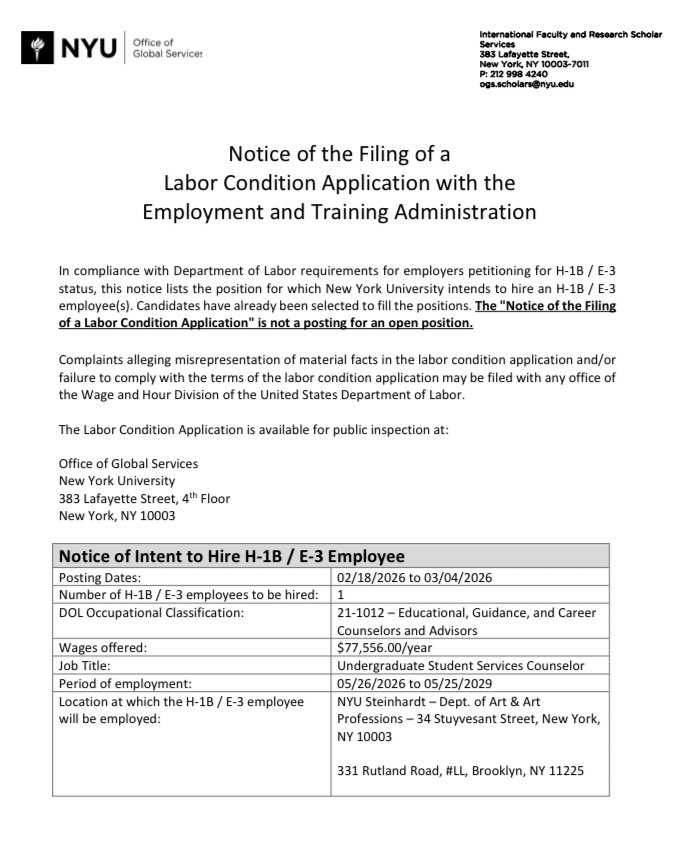
Same thing with NYU not being able to find a single qualified American to be an undergraduate student services counselor. That is pretty shocking to me given a cost about $100,000 a year to attend NYU.
In the case of many H1B workers, there is no requirement to look for American workers. “The H-1B employer is not required to recruit U.S. workers, unless it is H-1B dependent (see WH Fact Sheet #62C) or a previous willful violator of H-1B requirements (see WH Fact Sheet #62S).”
https://www.dol.gov/agencies/whd/fact-sheets/62o-h1b-recruitment
Right, that’s what I thought. So doesn’t this counteract what Vanessa is saying above.
She seems to be an immigration lawyer or expert in the field, hence her comment “Perhaps Mr. Samurai you need to get more educated on our immigration laws.”
Retired immigration attorney of 25 years here. There were probably qualified applicants but they need to apply for the job. The employers have to publish the job and show the government all the submitted applications. If they do not get qualified applicants THEN they can hire foreign workers. This process is very much misunderstood by the general public. Also they HAVE to pay the foreign worker the SAME they would have paid a US citizen or legal resident. They are not cheaper labor.
Got it. Thanks for sharing. So the employer cannot pay an American at the same level, a higher wage, and then advertise and H-1B job of the same level and pay a lower wage.
So we can come to the conclusion that 1) there are not enough qualified American workers, given non-applied or passed 2) There is no attempt by universities in corporations to lower employment costs, 3) we should be wary of paying a lot of money for university if there are no qualified American graduates to fill these entry-level and mid-level advertised jobs like Data Analyst or Associate Student Counselor.
Would you agree to these conclusions?
Hello Vanessa, I worked in the energy sector for over 20 years and saw first hand how the HR departments crafted job requirements for applicantions. These requirements were to written so as to exclude US applicants, I was one of those applicants. The energy company had a specific individual, a foreigner, in mind and so drafted the work requirements accordingly. Therefore, the company could say “no qualified US applicant but here’s a foreigner that has the requisite skill” and as such hired as either H1B or L1B visa. As for paying cheaper yes they are less expensive because, no raises or bonus, so yes, they are cheaper. As an immigration attorney, you know the “game” that is played regarding H1B and L1B visas by corporations.
“If they are advertising a job for a foreigner you can be assured they did NOT have any American citizens or legal residents that qualified OR applied.”
Uh, wrong. You think no American is eligible to be a Staff Associate administrators, Data engineer, Lab manager, Data Analyst, etc? Don’t be stupid.
You are either the most ignorant person I know or the worst immigration lawyer on the planet who should be barred. Get more educated on immigration laws.
H1b have already been qualifed
This looks like where they have identified who they want to hire and are filing an application to do so. Probably the H1B is a graduate of that university.
That makes sense. Although, messaging is important regarding their intentions.
I disappeared to Miami Dade diver /marine tech program at 17 in 1971 used my own savings to pay $1200 tuition. I worked at supermarket 30 hours a week paid ALL my own expenses. The VN Vets in program taught me how to register for draft = saved. December 7 , 1972 no draft. Returned to upstate NY worked plumbing FT for a year and completed calculus & physics 4 nights a week at local CC. Fall 1973 enrolled in chemical engineering technology completed AAS 1975. Also in 1975 passed master plumber exam at 21 with 100% both records. Completed ACS certified BA chemistry 1976 at local college. All 8 semesters tuition at SUNY colleges were FREE. Last semester paid $270 completing undergrad research. Total cost I paid $1470. Started MA chemistry with GTA included free tuition and $10/hr teaching laboratory 12 hours/week. Also tutored HS student 3 hours/week for $20/hr and pulled one plumbing shift a 8 hours a week. I lived at home and kept old car on road and car pooled with buddy. Second year back in NYS I took my Sisters to college and trade school every day as big brother.
My Dad said “I would never steal Your MANHOOD by paying for your life decisions”. Dad had a small plumbing shop and taught me plumbing age 10 to 18. Then Dad told me go to a larger shop to learn more. Dad was buried alive & hurt second year of MA and I helped the family.
I retired chief electric system chemist and large power transformer SME of 3 electric utilities in DC, MD, DE, Southern NJ. My Wife graduated Georgetown Medical school we paid. My Wife enjoyed 4 year full academic scholarship at Syracuse U. She did OBGYN residency at Hopkins affiliate hospital. We funded a private practice. So yes if you work like your on fire you too can have a good life.
Fun Fact in DC area worked extra job with landlord and I was Jr instructor at U of MD (3 months), FDA contractor (6 months) and laboratory supervisor at Virginia tech NVA water quality lab (2 years). In the 1980s PEPCO wanted NYS college graduates. We were the H1b of our time NYS to DC area.
Hi Sam,
I’m a Brazilian national living in the US for almost 14 years. I first came here when I was 24 years old to work as a live-in nanny(Au Pair), to improve my English and experience the seasons, holidays and the American way of life. I had room and board paid by the family where I was staying and a 195$ stipend per week. In 2013, it wasn’t a bad deal.
I returned to Brazil after 2 years working and since I was dating an American national, he wanted to make it official and we married in 2016. I went back to college in 2018 (I had an A.A. In Foreign a trade from Brazil) and graduated in 2022 with honors and a BA in Psychology, minor in German, all while babysitting, working retail, resultant and the ambulance services all full time, making minimum wage, about 12-15$ per hour.
My first job out of college paid me 22$/hour which made me stabilize after Covid times and 1 year of unemployment. But the student loans capping at 45k$ always stressed me out.
I’m 3.5 years graduate, making $73k this years as an office manager in NYC, the most I ever made, divorced, no kids, paying rent.
As a foreign born with diverse background, I have studied and lived in 3 continents (I did 1 semester of college abroad in Germany), I’m attractive to companies because of my flexibility, adaptive mindset and ready for any challenges. Native borns might be more well educated, have a masters or MBA, but chances are they haven’t experience half the poverty, the instability, the political changes foreign people has, and the resilience to go through that since a young age gives an advantage companies can bank on. It makes the new hires more motivated to stay long term, to agree to things natives won’t, to dream and achieve their personal goals, and big companies don’t have to pay that much, since de conversion from dollar to pretty much 90% of other currencies is like making 5X
(in the case of Brazil) or even 100x on the money back home.
As a business owner as well, I teach TEFL and can say that all the students I helped over the years, have way better chances of leaving the poverty life if they speak English AND find employment abroad or in an international company.
I hope your kids will have the chance to do what they enjoy when they grow up. It might be in an entrepreneurial setting, or maybe they like the arts, music and can go do that. Either way, is up to them and whatever they decide, but they still have something very special, that you already have their backs, something virtually none of foreign born workers have here in America: a safe ground which to retreat if something doesn’t work out the way they thought.
Love your work!
So, the theory or promise that law makers made us when instituting the H-1B program was that to close the skills gap the non-for-profit academic institutions could hire as many H-1B as they wanted. There is no cap like the private sector.
For those of us that went through the STEM degrees it is noticeable that there is a conflict of interest. H-1B professors are supposed to train us, but if we have the skills then they can’t get green cards.
It’s a straight conflict of interest.
The other issue is that even if they were well meaning enough, many transfer their knowledge very poorly to Americans due to language and culture barriers.
I also don’t know what I am going to do in eight years. I’m not planning on saving for that.
From a poor background myself, I was able to attend on the virtue of financial assistance only (free ride). I nominally climbed into an ever so unstable middle-class job. I have a family member that got shunned in the great social sorting scheme and ended up with only a debt.
The value just isn’t there. Sports scholarship maybe (fingers crossed).
The visa system was designed to fill skill gaps. It’s being used to fill wage gaps by universities. A total scam and a crock.
Hypocrisy at its finest.
Have you over-funded their 529s? Do you think they will need that much?
Four-year universities like NYU, USC, BU, George Washington, cost $400,000 all in now. I don’t plan to be working to pay for college in 10-14 years. I also don’t dare to presume they will be smart enough to get merit aid.
How about you? How are you saving for college and how much so far?
Related:
Suggested 529 Plan Amounts By Age
Rolling Over Leftover 529 Funds Into A Roth IRA
Has been going on for at least 25 years. Similar to what has happened with other labor sectors, over time use of foreign-born labor (at lower cost) became so prevalent that prospective American workers gave up trying to enter the sector. That’s definitely the case now; hiring managers in certain IT segments literally see zero American applicants.
It would be such a slap in the face to parents and students who graduated from these universities I’ll need to not be able to find a job, and then see job postings for foreign workers the optics are terrible.
What possible reason besides saving money does hiring a foreign worker where you have to go through the whole Visa issue help the institution?
I hate to break it to you, but your kids will have final say over where they go to college. One of their considerations may be where their friends go. Or the football team. Or where their dad went. Or how far the school is from home.
Your kids may start undecided about their majors, or even change their minds.
The fact is, they’re humans and that’s what humans do. Don’t expect absolute perfection financially or any other way. You’ll be setting yourself, and your kids, up for disappointment.
(I would agree to avoid the most expensive schools and majors where the only job prospect is teaching it.)
College should help your kids learn while practicing being independent for the first times in their lives. How students perform is up to them, which could be the reason universities don’t give guarantees.
Earning a degree requires problem-solving skills and perseverance, in and out of the classroom. It’s natural that some graduates have to learn more than others in those regards, but all graduates should be better people compared to when they started.
The experiences gained can’t be judged strictly by money.
Are you saying that when you talked to your kids about recommended schools they just simply said no, went where they wanted, and told you to pay for it? Or did they end up paying for the tuition because they decided where to go?
I won’t be narrowing down a particular school. And frankly, the amount of money we are saving in their 529 plans enable them to go to any school without Dad. But we’re trying to guide them towards a handful of schools of which they apply to and get into it.
I don’t have kids but I’ve been a teacher, and have nephews and nieces. You can’t make a kid go to a school they don’t want to attend. You know how things have changed since we were in school. Imagine if we had smart phones and had been on social media.
More importantly, you plan to take the right approach, guiding your kids and educating them on pros and cons.
In my case, I was taught the importance of going to a state school (in Florida) and not to be a history major. Getting a job wasn’t easy when I graduated (that’s something we can’t control) but I had no student debt.
I’m sure your kids will end up (successful and) grateful for the opportunities you gave them.
That could be an advertisement for potential spousal hire for faculty recruitment. You know if the university wants to recruit a faculty in STEM (most likely they are foreign born with PhDs in the US, there are only a fraction of domestic students in STEM PhD programs these days in US universities anyways), and these days mostly likely a couple both work full time no matter where they are from, and there are not many jobs near a university sometimes (college towns small size), so university may want to help get a job for the faculty candidate’s spouse. Therefore that may be that specific advertisement. Most college staff I see are domestic anyways, where the ones that are filled by H1B visas are mostly lowly paid postdocs, researchers and very specific positions. I would not call this colleges are not fair to domestic graduates.
Yes, that is another very likely explanation for these notices.
As Sam said, running a college is like running a business. If you can get cheaper foreign labor for similar or same quality, you would replace Americans all day long.
I think the most important messages that families and students need to really do their due diligence before spending a fortune on college. It’s OK to ask about the hiring processes of foreign workers given so many Americans are qualified.
the citizen is sold out at every level…. utterly amazing….
Why universities are hiring foreign, H1-B visas, very simple, American masters graduates aren’t qualified to teach PHD classes, nor do they want to work for peanuts. So of course, you need a foreign pool. Why do rural hospitals hire foreign medical graduates? No American graduate wants to work in the middle of no where in Bubba land, low pay, limited resources. It ain’t rocket science.
None of these jobs advertised are for PhD graduates and none of them are in small towns. Not sure what are you talking about?
Bubba land ? What is your definition of that ?
Cost is obviously one of the reason many employers prefer H1Bs but their is also the benefit that the visa is tied to the employer. The employee cannot simply seek employment elsewhere.
I used to process H2B visas overseas and we would often see a trend where the positions were purposely misclassified to avoid having Americans even apply. A great example included carpenter helpers. The workers were all returning workers and when we asked them who they were helping it turned out that they were the only trade workers. The prevailing wage for a helper was considerably less than a carpenter. Unfortunately this employer while fraudently obtaining work visas was better than many of companies in construction who avoided the paperwork all together and simply hired illegal labor. I have little doubt that misclassification likely occurs with H1Bs as well; the employees certainly would not complain for fear of losing their jobs.
There is also a NAFTA visa which permits Mexicans and Canadians to work in certain professions. Dental assistants are permitted but not bonafide dentists. You would be correct to assume many dentists applied for these positions.
You mentioned that expanding number of eligible students for a program can dilute prestige. Now, for private funded universities, I don’t agree. As long class size has sufficient instructional support. Publicly funded universities is a whole other thing and relates to part govt funding per student seat.
I would ensure the older teen understands the college or university program meet national
accreditation standards for the defined professional standards if the child is expecting to graduate with accepted certification to compete for such jobs in chosen/ matching profession.
Canada’s known universities are public but still increasingly expensive, depending on the program.