
Are you trying to decide between a 30-year fixed rate mortgage loan or an adjustable rate mortgage (ARM)? My opinion is that a 30-year fixed mortgage loan is a suboptimal mortgage that will cost you extra money. For most homeowners, getting a 7/1 ARM or 10/1 ARM is the better way to go.
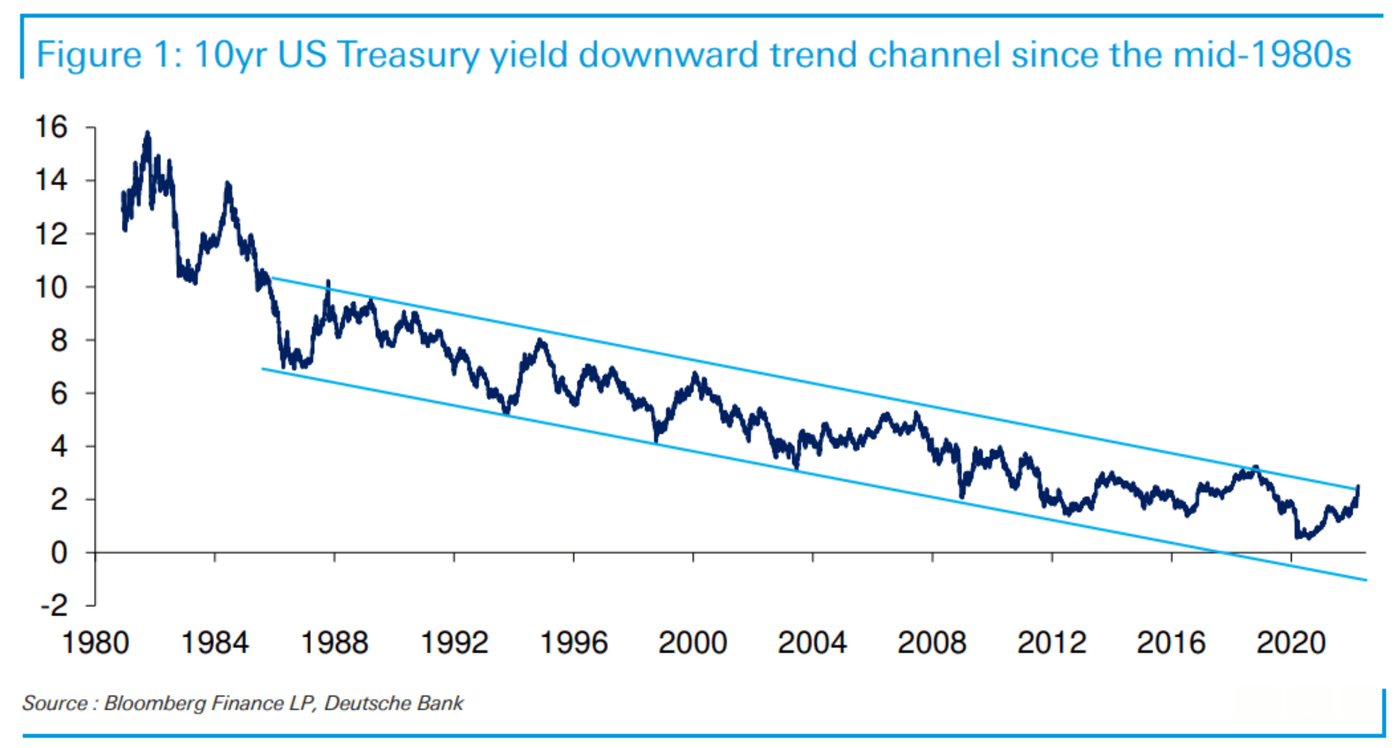
After taking out multiple mortgage types since 2003, getting an adjustable rate mortgage is cheaper and will save you more money over time. We've been in a declining interest rate environment since the 1980s. To pay more for a 30-year fixed mortgage loan is unnecessary.
Banks Love 30-Year Fixed Mortgage Loans
One of the biggest secrets banks don't want you to know is that they make more money off larger and longer duration loans because they can charge a higher mortgage interest rate.
Banks take advantage of fear of the unknown by selling borrowers peace of mind. There's certainly value in knowing that over a 30-year period, your mortgage rate will never go up. However, there's something bank also don't want borrowers to know.
Interest rates have been coming down since the late 1980s as the Federal Reserve has become more efficient in managing economic cycles and the US has grown to the world standard for sovereign assets through the purchase of US treasury bonds.
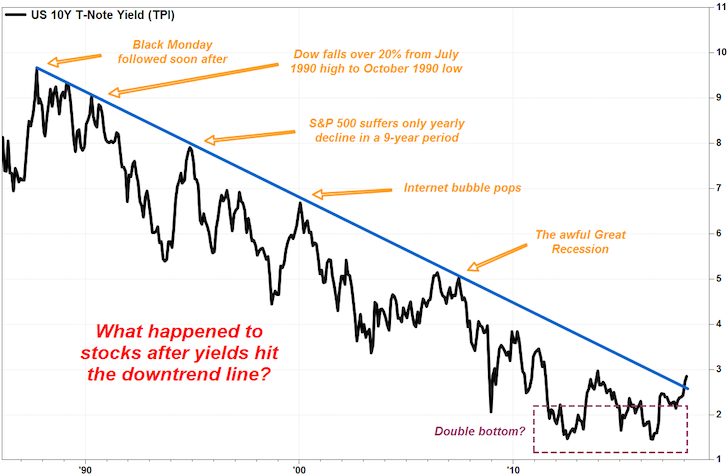
From this simple chart, you will understand:
- The risk-free rate of return
- Expectations on interest rates
- Expectations on inflation
- Borrowing/credit costs
- Risk aversion, or lack thereof
- The health of the economy
That's right. By understanding what the latest 10-year treasury means, you will be able to save a lot of money, potentially make a lot of money, and stop being so fearful of the future.
Borrowing on the long end is a suboptimal use of funds. The people who are pushing you into 30-year fixed loans: 1) Are not economics majors or bond traders, but journalists and/or 2) Have a vested interest in you borrowing as long as possible so they can make as much money off you as possible.
The higher the rate, the easier it is for them to earn a wider spread. This means more profits.
Why A 30-Year Fixed Mortgage Loan Is A Waste Of Money
1) Upward sloping yield curve.
But, if you want to borrow money from me today, to pay back over the next 30 years, you better hell believe I'm going to charge you an interest rate above inflation to counteract inflation, make some money, and bake in some risk of default.
In other words, if you borrow at a 30-year fixed rate, you are borrowing at the most expensive part of the yield curve. Below is an example of a kinked yield curve, where there's a lot of value in borrowing at the 3-5-year fixed-duration mark. In general, the yield curve is upward sloping.

When the yield curve is inverted, it actually makes sense to borrow where the yield curve is lowest.
From the inverted yield curve below, you would strategically want to borrow with a 10-year fixed duration and buy one-year Treasury bonds. Here's a post on how to buy Treasury bonds and buying strategies.

2) Average homeownership duration is much shorter than 30 years.
First of all, the average duration one lives in and owns a home is about 12 years. If that's the case, what on earth are you doing borrowing a 30-year fixed rate mortgage for? A 17-year overestimation of ownership is a serious miscalculation based on the statistics at hand.

If you plan to live in your house for 10 years, take out a 10-year fixed-rate ARM that amortizes over 30 years. It is the most conservative loan duration. A 10-year ARM is cheaper than a 20 year or 30 year fixed rate. It is only logical that you match your mortgage fixed rate with your expected duration of stay.
Sure, you might stay longer, but you might also stay shorter as well. If you know you plan to stay in your house forever, it's more justifiable to take out a 30-year fixed, but I still wouldn't because 1) You will likely pay down your loan faster than 30 years, and 2) the spreads are unjustly high in this environment.
3) Adjustable rate loans have an interest rate cap.
People think, thanks to fear mongering by the media and mortgage officers, that once the adjustable rate loan period is over, your mortgage rate will skyrocket and make things super unaffordable.
This is not the case because everything is relative and rate adjustments are capped. I got a 7/1 ARM in 2020. In 2027, the maximum it can reset to is 4.125%. Whoopdee doo! After seven years, even if I don't pay any extra principal, my principal mortgage amount will be about 15% less. A 4.125% mortgage rate on a 15% lower principal amount is very digestible.
See: The Anatomy Of An Adjustable Rate Mortgage
4) If rates rocket higher, you will be OK because your house is likely appreciating.
Things don't happen in a vacuum. The 10-year yield is a reflection of inflation expectations. If the 10-year yield and mortgage rates are rising, that means inflation expectations for higher growth are also rising. You don't have inflation expectations going higher unless demand for real goods and services going higher.
Higher demand is a reflection of a stronger economy, and your real assets (property), by very definition or inflating. So what if inflation rises from 2% to 8.5% the year your ARM resets? There's usually a 2% cap. If your home is now inflating by 8.5%, you're making a big cash-on-cash return. Let's say you put 20% down. An 8.5% return is a 42.5% cash-on-cash return.
Real estate is one of the best asset classes to own in an inflationary environment. As we exit the pandemic, inflation will pick up, partly because there's been so much monetary stimulus. As a result, I've been buying rental properties and investing in real estate crowdfunding to ride this wave.
5) Interest rates have been coming down for 40 years.
Look at the historical 10-year treasury yield. Rates have gone down for 40 years in a row. Yes, there will be occasional inflation spikes mainly due to supply shocks, as we experienced in 2022 and 2023. However, you must look at the long-term trend. And the long-term trend is down-to-flat.
In these 40 years, we've become a much more efficient society who enacts monetary and fiscal policy in anticipation or with shorter lead times. I highly doubt there will be a 5-10 year continuous ramp in inflation. Therefore, your 5-10 year ARM will do you just just fine.

What's fascinating is that despite interest rates coming down for so long, the percentage of loans that are adjustable is still quite small. We're talking less than 5% of all mortgage loans are adjustable rate mortgages. What a shame that so many homeowners with a mortgage paid a higher interest rate than they needed to for all these years.

What Is Your Peace Of Mind Worth?
Insurance salesmen and mortgage officers are very skilled at evoking fear. They will paint worst case scenarios of super inflation. They'll tell you about crushing payments so you can pay more money now than you should.
A 30-year fixed provides a great peace of mind that your payments will never go up. In fact, your real payments will actually go down over time given. The reason is because you will be paying back a fixed loan with ever depreciating dollars thanks to inflation.
The question is, at what price is this worth?
Given you know the yield curve is generally upward sloping, you must study the spreads between each borrowing point.
Example Of Paying For Peace Of Mind
Let's say a 30-year fixed loan is currently around 4% vs. 2.625% for a 5/1 arm. Let's say you borrow $1 million. $1 million is the ideal mortgage amount. $1 million X 1.375% = $13,750 more in interest expense you will have to pay every year for the length of ownership.
If you own the home for 7 years, that's $96,250 more in interest expense you would have paid if you borrowed at 30 years. If interest rates stayed the same (not down as it has for the past 30 years), then you would have paid over $420,000 more in interest during the lifetime of the 30 year fixed loan! That is just ridiculous.
However, is your peace of mind worth $96,250 or $420,000? If you don't know the reality of economics and don't know your options, then go for a 30-year fixed.
The next time someone is hawking you a 30-year fixed ask them: 1) What their major was in college or grad school, 2) How many times have they refinanced before, 3) Quiz them on what the current 10-year treasury yield is, 4) Where was the 10-year treasury yield 10, 20, and 30 years ago, 5) If they are a homeowner, 6) How much more are they going to make off you.
An adjustable rate mortgage is the best type of mortgage to get for most people. Why pay more mortgage expense than you have to?
Big Difference Between Neg Am Loan And ARM
Please not there is a BIG difference between a negative amortization loan and a adjustable rate mortgage. A Neg Am loan causes your principal to grow larger every month because it is by definition, negatively amortizing. The Neg Am loan generally is only fixed for one year and a teaser low rate.
Hence, you have a lower than market rate + a payment that's based on a lower amount that gets added to the principal. This is where people get in trouble. People who have normal ARMs have not been getting in trouble. When their ARM floats, their rates are LOWER than when they first locked! Please understand this point.
Real Estate Recommendation
If you don't have the downpayment to buy a property, don't want to deal with the hassle of managing real estate, or don't want to tie up your liquidity in physical real estate, take a look at Fundrise, one of the largest and oldest real estate crowdsourcing companies today.
Real estate is a key component of a diversified portfolio. Real estate crowdsourcing enables you to be more flexible in your real estate investments. You can invest beyond just where you live for the best returns possible.
For example, cap rates are around 3% in San Francisco and New York City, but over 10% in the Midwest. Sign up and take a look at all the residential real estate opportunities Fundrise has to offer. Fundrise manages over $3.5 billion and has over 500,000 investors.

Another private real estate platform to consider is CrowdStreet. Crowdstreet is a marketplace that mainly sources individual commercial real estate deals from various sponsors around the country. This way, you have more customization to build your own select private real estate portfolio.
Make sure you diversify your portfolio and do your due diligence on all the sponsors. Look up their track record, their management, and whether they have had any blowups before. Although CrowdStreet screens the deals, you have to do your screening as well.
Financial Samurai was founded in 2009 and is one of the must trusted personal finance sites in the world with over 1 million pageviews a month. Sam has taken out both a 30-year fixed and an ARM over his 21 years investing in real estate.

Hi Sam,
With the mortgage rates over 6%, are you planning to do an update to this post? I think it would be an interesting a post on how it seemed that the rates would be below 3% during our lifetime to the current increase, which few if any foresaw.
Keep up the good work and thanks for the information you provide.
Best,
L
I can update it. I am pretty confident mortgage rates will fade back down in 2023 and beyond inflation is coming back down.
Even if you got an arm in 2020-2021, it won’t rest for years. By the time it resets, mortgages rates will have come back down again.
Don’t think anybody thought the 30-year fixed would be below 3% for our lifetimes. But the magnitude of the rise in rates in 2022 was surprising.
Thanks Sam…I look forward to the updated post.
I have a dillema. Got a 30yr fixed rate at 2.55 that requires me to move my primary checking account to the lender (seems like a hassle. Also got a 10yr ARM at 2.375%, so less than 20bp spread.
Not sure if it’s worth doing the 10/1 ARM, we think there’s a 80% chance we’ll move within 10 yrs. The saving will be ~$2k a yr between those two loans. what would you do?
10Y ARM. If moving is a negative reason, even less reason to get a 30Y fixed.
Hi,
I am on a 30 year fixed at 2.5%. I have been offered a 7/1 ARM at 1.75%
Is it worth going to ARM, for a spread of 0.75% ?
Refi amount 600k, Current loan at 2.5% fixed is 1 year old and i have been in the house for 3 years now
I think so, especially if it is no cost.
It is clear that an ARM is superior. The one question I still have is if I should consider a 30 yr fixed if I plan to retire early and therefore wouldn’t have the same income to qualify for a refi at the end of my AR term (and don’t plan on paying off San Fran home before retiring). Would sufficient assets offset the lack of income for the underwriters?
I have the same question as BRog…it would be great to get Sam’s thoughts on assets vs. income that underwriters will look at to qualify for a new loan if you need to own the home beyond the ARM loan period. My guess at the answer is this: Your principal balance will be lower. You should be able to estimate your income (in my case two small pensions, Social Security, stock dividend income, and any side gig income) then factor in your estimated debt obligations to see if you might be over the 40-50% typical loan to value threshold.
Hi – great website!
Looking to do a jumbo loan. Trying to decide between a 30y fixed at 3.375% and a 10/1 ARM at 3.000%.
Realize they are both pretty good rates. Tempting to take advantage of the ARM, but we dont really plan to sell (ever?) and the spread between the 30y fixed and ARM isnt that dramatic.
Any thoughts appreciated!
Hi Bart,
I am shopping for a 30y fixed and 10/1 ARM, which lender are you working with? Those are great rates.
Hi Bart,
What is your peace of mind worth? In essence look at the additional cost of the fix mortgage as insurance cost. for peace of mind, you will be paying about 0.375% more but you sleep well at night knowing exactly what your payment will be for the next 30 years. Other factors i would look at will be your prepayment privileges which can make a serious impact on paying your mortgage faster. Making extra payments early in your mortgage life will make a significant impact down the road. Although your monthly payment is somewhat higher with the fix interest rate, it allow you the safety to plan ahead and to make sure that any extra income you have is there for you to use.
Hello, Can you please update this article for 2018???
It would be appreciated.
Thanks in advance for your insights :-)
Sure! The post is updated as of June 2018. Although rates have risen, my overall message has not changed. 30-year fixed is a waste of money.
Looking at buying our first home in Hawaii in 6 months or so. Fed is supposedly going to start unloading their massive balance sheet this month. Does this affect your position on ARMs ? If I understand correctly, shouldn’t this begin a steady increase in bond yields and mortgage rates?
Hi Sam! I have 3 30yr fixed mortgages!!
1st, about 20 yrs left is a rental 4.75% (300k)
2nd is a primary home for 4.50 (500k)
3rd is a vacation home 4.25% (300k)
Would appreciate any suggestions please
Hi – we live in the NY area, and looking to buy a property. Here is the info I got from one of the local banks: 30-year fixed at 3.75% Vs. 10/1 ARM at 3.125% for approx. $1MM loan. We plan to live in this house at least for 10-15 years till kids are off to college. Any advice?
7/1 arm for 3% for a home i will stay in for at least 15-20 years or FRM at 4.1255? Margin is 2/2/6. Can’t decide….. Payments are almost $250 less. i would like to think i would put that on the principle and more. $500k home with 10% down. Looking at a 30 year.
So rates have shot up in anticipation of the fed meeting. I’m stuck in the middle of it being in the market to buy a home now. Is 5/1, 7/1, still the smart play? I would assume there is a ceiling to this rate rising environment.
I have a 10/1 ARM expiring in May 2017 at 6%. In 2007 I never received a margin on my note, so I was a bit concerned. However, after reading your post it made me feel a little less worried. Should I refinance now or pay down the new reset for a while at the low libor rates? I will eventually sell or rent out the property, but for now will stay put for another year or two. Definitely signing up for your updates! Thank you!
Hi Angel,
You should do the math on the new rates and also check online with a mortgage lender like LendingTree to get competing bids to keep your bank honest.
You should read:
How Much Can My ARM Interest Rate Reset Higher After The Fixed Rate Period Is Over?
Refinancing With A Rise In LIBOR Rates
Thanks.
Do you still think ARM is a better way to go? Have your views changed with trump election?
I haven’t. The spread between the 30-year fixed and the 5/1 ARM is still wide enough where a borrower can save the difference. The median home ownership duration is 7 years. The difference in savings can be used to pay down principal. The hike in interest rates is concerning, but I don’t see it getting out of control. I expect the trend of lower interest rates for longer to continue.
See:
That’s amazing article and i’m in the middle of refinancing 30y fix mortgage on 4.25 vs 10y fixed at 3.25 with discount points – the difference is $365
I’m highly considering moving to the 10y as this is 2 bed house and I will definitely need 3 in future.
Smells like i’m moving to 10y.
Thanks for the insight and i’m subscribing!
Hi Sam,
I’m a first time homebuyer and completely confused and stressed. I came across your post and do understand and subscribe to the same view. Also, you have been proven right in the last few years.
However, the interest rates really is at an all time low now. I’m getting 3.125% 30-year fixed as a promotional rate and 2.75% as both the 5/1 ARM and 7/1 ARM. Since I’m in contract, I do need to go with one of the reputable lenders/agents who I can trust to close on time.
Since the difference is so low, what do you think ? People refinancing to a 30-year today are getting 3.5% while the ones refinancing a 5/1 or 7/1 ARM might be getting less than 2.5%, but for me the spread is less.
What do you think I should do
a) Lock in the best 30-year rate possible at 3.125% – goes against your overall suggestion
b) or go with the 7/1 ARM at 2.75% today with the intent of refinancing at a lower rate at the next opportunity I get hoping that the rates stay somewhat similar for the next few months. Then get into the same refinancing game as you have suggested.
Again, the reason for me asking this is the lower spread that I am being offered. In an post from a few years back, you have stated a comparison between a 4.0% 30-year fixed against a 2.625% 5/1 ARM, which was a much bigger spread.
Thanks,
StressedOutHomeBuyer
How did you get the promotional rate of 3.125%? That’s a great rate for a 30-year fixed and I would lock that in because you are right, the best normal folks can get is maybe 3.5% – 3.625%, and the best for 5/1 ARMs is around 2.5% e.g. 1% spread.
I’d g w/ 3.125% and be done w/ it. Make sure you live in the place for as long as possible! We are near or past the top of the cycle.
Related: The Inflation Interest Rate Paradox: Why We Must Continuously Invest
Hi Sam,
Thanks for the quick reply! That’s what I thought.
The rate was actually given to me by two different banks. The standard promotional rate is 3.25. The extra 0.125 is given if I move most of my remaining cash and stocks to that bank and have a $250k balance with them before the close of escrow.
I’m actually not sure if I’m going to be able to meet that balance – might run a little shy. So, if my rate turns out to be 3.25%, would you still suggest to lock it ? The 7/1 would be the same.
Another thought that I had when I read your article and noticed that the spread for first time buyers is less. This indicates that the banks want us to go for the 30-year fixed. Does that mean that the banks inherently think that the interest rates are not going to increase by a huge margin the next 30 years ?
Also, the plan is to keep the house for the long term. If we need to move, the effort would be to be able to keep this one as a rental property, if we’re able to afford it.
Hi Sam,
FYI, The banks offering me 3.25 (and 3.125 with that extra deposit by close of escrow) are Citi and BoA.
I just found from the loan document that the bank’s intention is to “service the loan through someone else” which means that they’re going to sell the loan. Should I be concerned about it ? If a different bank gave me the same rate (3.25) but lesser lender credit (approx 3k), but intends to service the loan themselves, is that better for peace of mind and/or bank service ?
Also, what do you think of my earlier questions ? About comparing 3.25 instead of 3.125 with the 7/1 ?
At what spread between the 7/1 ARM and 30-year fixed would you recommend going against your overall strategy and opting for the 30-year fixed ? Would that be 0.5 or maybe 0.75 ?
Don’t you think that the this low spread suggests that the rates are supposed to be at this current level for some time ? And could that mean that even with the small difference, it’s likely to still be beneficial to go with the 7/1 ARM in the current market, even though the savings would be considerably less than what you have suggested in the past based on earlier rates ?
Dear StressedOut,
Can I ask what you ended up doing? I am in a very similar situation: 30-FRM at 3.3% and 7/1-ARM at 2.7%. I don’t think it will be a forever home for me at all, but am thinking to rent it out in a few years. I am leaning towards ARM based on everything I read so far, but would love to hear what your final decision was and why.
My loan’s not closed yet so I have a chance to revisit this, but at the moment my plan is to go with the 30-year fixed.
I don’t think either is a bad option, but here’s what I compared:
– If I end up living here for 10-15+ years, 30 years is best because of the peace of mind. Going with 7/1 in this case could be good if you want to pay off the mortgage faster by paying more in principal for the next 7 years.
– If I end up moving in 7 years, and selling the house, then 7/1 is clearly the best. I do not plan this.
– If I move and rent this one then having a 30-year fixed is better. One of the benefits of a 7/1 is that you can keep refinancing to a lower rate when you get it. However, for a rental property (which it would become) the rates would be higher and would probably be much higher than the current 30-year fixed that we’re getting.
So my current decision is 3-year fixed. Would like to know what others think about it.
I guess it depends on the mortgage rates for each term. If you signed up for my private newsletter, you saw the notice that LIBOR is on fire right now. Therefore, I recommend all ARM holders who have less than 2 years left on their fixed rates refinance.
I say go w/ a 7/1 ARM if the rate is 0.25% or less higher than a 3/1 ARM.
This is my opinion below.
StressedOutHomeBuyer: I am in the same situation as you. I read all the advice here but I think there is a *big* assumption in going for a 7/1 ARM – that the refinance market will continue to stay open in future *and* appraisals will hold up as expected.
What if when you go to refinance rates are higher… or lending requirements are greater than now …. or, heaven-forbid, you lost your job… or you were renting your place out and now have to face a higher interest-rate anyway.
What if the market is in the middle of slow down? We are almost 8 years into the current up-cycle. There is a correction usually every 10 years. What if you are right that rates remain low but appraisals and home valuations do not. These two are not perfectly correlated.
Bottom line, you could be over-paying / under-optimizing if you took a 30 year and made the wrong bet against rates going up. But if you took a 7/1 and you are wrong you could be crushed. This is amplified in markets such as SF where people are pulling massive $1M+ mortgages.
I went with the 30 yr at 3.25% (extra 1/8th off for high credit score).
“Getting crushed” is probably an exaggeration. See: How much can an ARM interest rate go up after the fixed period is over?
There’s a cap per year and lifetime amount. Remember, after 7 years, you’ve paid off ~15% of the principal as well.
About to start construction on a new home (loan >1mm). Based on the logic from this article it seems like a no brainer.
One time close construction loan with 2.5% interest only during construction phase (up to 24 months, if necessary) then it rolls into permanent mortgage 7/1 arm on 30 yr am at 2.5%.
The amount of interest saved at 2.5% over the first 7 years is huge on a big loan. We can handle the payment risk and would probably refi again before it resets anyway. The principal is much lower when we refi also because we’ve been paying 2.5%.
I would assume you would agree with this logic Sam?
We’re actually selling/buying today.
Selling our 2br NYC apartment (with $340k appreciation in 5 years) which we had a 7/1 arm at 2.875%.
New house in nj will hopefully be our forever home but we still looked at adjustable mortgages. 5/1 arm was 2.75 but a 7/1 and 10/1 was 3.125 vs our 3.25 for the 30 year fixed. Maybe we don’t make it here more than ten years but the extra 1/8 (tax deductible of course) seemed incidental.
The real winner was 2.875 for the 15 year fixed. We sadly couldn’t make that work especially with a child in day care and hopefully a second one on the way soon.
What about a 15 year fixed as a compromise between a 5/1 ARM and a 30 year fixed? In my case, this would be for a 4 unit multifamily rental property
We have a rental that is appraised at $210,000. We have a first of $67,000 at 6.25%, 30 year fixed, started in 2002 and a second of $85,000 at 3.75% variable rate HELOC, 15 year started in 2015. Every time I look at the numbers of consolidating/refi…the closing costs are around $6,000. I am not sure how long we will keep the property, when the renters now move out it will probably need about $25,000 worth of work- it’s almost due for a roof and a bathroom upgrade.
Any thoughts? Be nice :) first time poster and I know that I am missing the light in this equation, thank you in advance for any suggestions!
A 5/1 ARM can be had for 2.5% nowadays. You just have to take your $6,000 cost and divide by your monthly interest savings. I recommend 2 years or less for break even.
Check out: All ARM Holders Should Refinance Today
Hello,
My question is probably not-uncommon; however, it is in that our local institution is offering us a fixed or 5/1 ARM for the same interest rate 3.875%. This purchase as been extremely difficult because the home we are interested in is over -priced for the rural community to live in. There has been difficultly in that there are NO comparable properties that have sold in the the last 12 months. The bank is willing to loan us if we put up 20% only under an ARM (conventional is completely out of the questions). We are okay with that but then what do we do in 5 years if we choose to try to refinance because of rising interest. Will we be in the same predicament when we got to refi and there are no comps? Do we risk the ARM? By the way we are scheduled to close next week. Any quick advise would be graciously appreciated!
Leslie
I think You will face the same issues in five years if you want to refi or sale.
I am 66 and retired. Sold my home in 2013 and have finally found a property to buy. I will put 25% down. I like the idea of a 7 or 10 year ARM. Good choice for someone like me?
Pingback: Should I Buy A Home When Interest Rates Are Rising? | Financial Samurai
Pingback: Mortgage As A Forced Savings Account | Financial Samurai
Sam, I’m a faithful reader and agree with most of your posts, but I really think this topic needs more balance on your blog. By the way, I would have been super annoyed by the ignorant response of that “mortgage specialist” too! While ARMs might make sense for many people, I don’t think you give the fixed-rate mortgage (FRM) the credit it’s due. My argument is below, but first, in a feeble attempt to give my argument some more weight, here are my credentials: 1) I have worked in bond markets and housing finance for 11 years (NOT for a mortgage broker or lender), 2) I was an Econ major in undergrad and have a MBA 3) I have refinanced, 4) my job requires me to follow interest rates real-time, and I read financial history for fun, so I can tell you where a lot of markets were 10, 20, 30 years ago 5) I am a homeowner, 6) I don’t make any money from people going into a FRM versus an ARM.
Here are seven reasons why FRMs can be a great product for today’s borrowers:
1) The obvious one: the FRM provides payment certainty and stability. This can help with consumer budgeting and can reduce the likelihood of default through payment shocks. A rate increase from 2.625% to the 7.25% ARM cap may not be “very digestible” for the average American family! Let’s say Johnny Risk has a $200,000 mortgage balance with a 2.625% rate. His monthly payment is $803. At year 5, his rate resets to 7.25%, which increases his monthly payment by 60% to $1,277. The $473 payment increase equates to ~15% of his after-tax income (assuming he makes $50,000/yr). Just like your example, his principal is down 10% after 5 years, but it’s hardly a “whoopdee doo” scenario for Johnny.
2) While ARM borrowers have done much better since the 1980s, the 30-year FRM borrowers who locked rates in the 1950s were better off. The Federal Funds increased from 1% in the mid-1950s to 19% by the early 1980s. No one can predict exactly what interest rates will do in the future. However, the longer the Federal Reserve remains accommodative (keeps rates lower), the higher the likelihood of higher rates in the future. In a more normal economy, the Federal Reserve forecasts rates to rise by 2-4%. If rates rocket even higher because of a stronger economy, you’ll be celebrating even more with a 30-year FRM. The FRM is a nice inflation hedge
3) As you know, the yield curve is not always upward slowing. In 2000 and 2005, it inverted, which usually happens when the Fed raises rates. So, borrowing on the long-end is not always a suboptimal use of funds.
4) To your point about mortgage officers pushing people to get as long a fixed rate mortgage as possible. Lenders actually charge higher margin on ARMs, meaning they make more on them. Part of the housing boom leading up to 2007 was due to lenders pushing tons of people into ARMS. In 2006, ARMs made up ~25% of mortgage applications compared to 7% today. I do think there is some truth to lenders pushing more fixed rate product today, but that’s because the FRMs are simpler to originate than ARMs. Also, if bankers/lenders find FRMs so profitable, why are almost all FRMs (over 80% of origination) sold to and backed by the government or government sponsored enterprises like Fannie Mae and Freddie Mac? The government subsidizes that FRM rate.
5) The FRM borrower has protection against lower rates because he/she can refinance into a lower rate with no pre-payment penalty. Yes, I know it’s not an entirely free option (due to closing costs), but you should be able to take advantage of lower rates if you’re financially responsible and keep 3-6 months’ worth of expenses in your bank account. With an ARM, there is no protection against higher rates.
6) Long-term interest rates are at all-time lows. Sophisticated CFOs at firms like Apple and AT&T are taking advantage of the borrowing at low long-term rates. Why shouldn’t you?
7) You said you pay $13,750 more in interest per year in a 2.625% ARM versus a 4% 30y FRM. However, adjusting for the mortgage interest tax deduction, it’s ~$5,300 lower than that figure. Moreover, you say you pay $420,000 more in interest during the 30 year life of the loan, but factoring in the time value of money, the present value of that interest difference is ~$237,000 (discounting at 4%). So, almost half as bad as the picture you paint.
I love my 30-year mortgage. It’s locked at a rate of 3.375%, allowing me to leverage up at an after tax borrowing rate of 2.35%. Unless the global economy goes into a very, very dark place, the money I’m investing instead of putting towards my mortgage principal has a really low hurdle rate. Also, with some wage inflation, my fixed monthly payment will get easier and easier over time. Here are two reputable financial professionals who discuss the merits of a FRM, one young, one old.
Ben Carlson –
Ric Edelman – https://www.edelmanfinancial.com/education-center/articles/1/11-great-reasons-to-carry-a-big-long-mortgage
Thank you for your rebuttal and detailed analysis.
The question I always ask people is this: after 34 years of declining rates, why do you think now is the rear where rates rocket? And if rates rocket higher, your assets and income are also rocketing higher.
3.375% is a great 30-year fixed rate. One of the best I’ve seen. But I prefer my 2.5% ARM I got be id rather pay less guaranteed up front.
The average homeownership is 7 years. The average person doesn’t take 30 years to pay off a loan either. To take a 30 year and actually pay the higher interest for 30 years in a row is not a wise use of money.
Will you be paying for 30 years?
Not sure if this is the year that rates sky-rocket. I can make just as many, if not more arguments, for the 10y Treasury dropping even over the next year. One of my arguments for lower long-term rates would be a rise in short-term rates, leading to a flatter yield curve. This makes the FRM trade look better than the ARM trade. Also, your assets will not necessarily sky rocket higher if rates sky rocket higher – historical data shows that when inflation is too high, the market starts to worry about growth and the loss of purchasing power. It’s all about your personal risk tolerance and ability to absorb payment shocks.
My whole point is that it’s not fair to knock the FRM so much. Everyone’s financial situation is unique and no one can predict the future.
Do I plan to stay in my home for 30 years? I certainly hope so but I have no idea. Once you factor in the all-in cost of ownership versus renting, you probably shouldn’t buy if you don’t plan to stay there for at least 5 years. What if I decide to stay for 12 years instead of 5? Today, neither you nor I can say whether or not the ARM is better in this situation. That’s absolutely impossible. However, we can say for certain that my risk is highly reduced with the FRM, especially if I decide to stay longer.
Lastly, I’d argue that levering up and paying interest for 30 years is wise if the return on your investments is higher. This decision looks even wiser if short-end interest rates move higher over those 30 years.
Yes, starting from this point on, nobody knows for sure whether and if or when rates will rocket. But I’ve run this site for 6 years, and have been encouraging people to not waste money on a 30-year fixed during this time period, and I’ve been right. Before I started this site, I had endless discussions with clients in finance since 2001 with the same advice, which means I’ve been right for the past 14 years.
And today, I’m still telling people in the year 2015 that they are much better off taking out a 5/1 ARM than a 30-year fixed if they want to save money. Only time will tell. And people are free to do as they wish. Everybody does have different comfort levels, and that’s fine.
Let’s check back in 5 years!
Related: How To Profit In A Rising Rate Environment
It’s March 2, 2016. The 10-year yield has declined again to 1.8%, and was at 1.6% in February.
If you have a 30-year fixed, you are once again, paying too much interest. When will people realize that interest rates will be lower for longer? We are experiencing a deflationary environment around the world. See Japan and several parts of Europe?
1-year LIBOR, used for your ARM resets, has risen from 0.53% in June 2014 to 1.18% today, with little inflation over that time.
Yes, gun to my head, 10-year rates will likely be lower rather than higher going forward. But, choosing a mortgage is not about making interest rate calls, especially for those that don’t have material wealth. It’s about assessing one’s risk and understanding of the product.
Paying too much is all relative. I locked in a rate of 3.375% for a 30-year mortgage last year. That equates to 1.25% and 0.50% above what the U.S. government paid for 10-year and 30-year maturities in 2015. I may be crazy, but I think it’s hard to argue that I’m paying too much interest, especially when you factor in my option to refi! That option is worth something so my true spread to the Treasury is even lower than the ones mentioned above.
Exactly. Everything is relative. To me, and many other ARM holders, paying 3.375% is too much when you can pay 2.375%, which is what I’ve recently locked. If you’re happy paying 3.375%, that’s all that matters. We all try and justify our financial decisions and it is totally fine if you want to pay more since that’s what makes you happy.
LIBOR has risen too much based on what the Fed Funds has done, and what global interest rates are doing and will come back down IMO. ARM holders won’t suffer if they refinance. And even if they let it adjust, they’ll pay the same rate as you of 3.375% after paying much lower rates for the duration of their fixed ARM.
It is awesome that banks have subsidized borrowers by offering a lower rate with ARMs. For 13 years, I’ve had ARMs on multiple properties and couldn’t be happier. Even just one $1M mortgage at a 1%-1.5% lower rate equals $10,000 – $15,000 less interest a year. Multiply by 13 years and that’s $130,000 – $195,000 in savings.
Feel free to revisit this post in a year and tell me where the 10-year bond yield is and corresponding ARM rates. I’m pretty sure they’ll continue to be low like every year I’ve been encouraging people to borrow on the shorter end.
Can you share what you do now, how long you’ve had your mortgage and home, and anything else you want to share financially so I can get a better perspective? Thx!
Can’t argue with your savings. It’s great to borrow at a lower rate. The massive savings the wealthy get on the $1M mortgage is awesome! I’m not trying to dispute who is better off today…of course the ARM borrower is. What I’m disputing is that borrowing through an ARM does not come without risk. It’s important for everyone to understand this, especially those that are not financially savvy enough to monitor interest rates and refi before LIBOR sets higher. Yes, if they let it adjust, they’ll pay the same rate as me today, 3.375%, almost 1% higher than their initial rate…hopefully, the average person budgeted for this and hopefully, LIBOR doesn’t continue to tick higher as it has. Higher rates continue to be a tail risk, but it is a risk. My advice: if you are wealthy and can absorb the payment shocks, you should be ARMing all the time, just like you are! If a 1%, 2%, 3% shock is something your budget can’t handle, you should put a little more thought into it.
Sam, see the Switzerland chart on page 40:
https://www.bis.org/publ/qtrpdf/r_qt1603.pdf
So many new things to think about in a world where trillions of sovereign debt carry negative rates.
Sam,
I am at a dilemma. I used to work in mortgages and bought my first home in February of 2013, when we were at the lowest point of mortgage rates. I consider myself an opportunist. The only thing is my 3.5% 30 year fixed has PMI over 150$/mo which is insane to me. I have been doing some research and am very interested in a 5/1 ARM so I can also get rid of my PMI as my home value has increased substantially since purchase. Do you feel it is worth giving up an amazing 30 yr fixed rate to pay down principal faster with the risk of rates rising in the future?
I feel rates overall would not rise more than 5.5% as this will significantly decrease future homebuyers interest, therefore negatively impacting the economy. Yes I understand that 5.5% is significantly low compared to historical rates, but back in those days gas was less than 1$ a gallon. We are in a changed world. What are your thoughts to my dilemma?? Thanks so much, I really enjoy your articles.
Tom
I’m not making any predictions where interest rates are going – because no one can predict the future. You can make arguments for rates to go either way – but it boils down to this:
With a fixed rate mortgage – if rates drop – you can refi. If rates go up, your cost is fixed. All the risk is transferred onto the lender – which is why banks try to get the vast majority of these loans off their books as soon as the ink is dry!
With an ARM – if rates stay flat or drop – you save on interest vs. a fixed rate loan. If rates go up, your costs will go up – the question is how much. Look at the last 30 years of interest rates to see how much things can change in 30 years.
Everything boils down to one question – can your budget handle higher rates? What if rates double? What if rates triple? Do you have a flexible budget that could handle these scenarios? Or do you have little wiggle room?
ARMs are particularly attractive for people on tight budgets because they see that lower payment – meanwhile – those are the same types of people that will get crushed if rates go against them. Don’t expose yourself to risks that you can’t handle.
Pingback: How To Get The Lowest Mortgage Interest Rate Possible | Financial Samurai
It amazes me how turned off people are of ARM loans. I recently refinanced out of a 30 year 3.75% fixed rate mortgage that was an FHA loan with PMI ($370/month) and into a 5/5 arm with no PMI.
The fixed rate on my new ARM for the first 5 years is 3.675% with no PMI. So I am spending about $430 less a month.
Like you mentioned in the post above, not only are rates at all time lows, I expect they will remain low for sometime. You look at Japan that has essentially had zero % interest rate for over 20 years now. The central banks around the world have embarked on an experiment that is unprecedented and its going to be hard for interest rates to rise.
Even if they do rise, like you said I have a cap that allows the interest rate to adjust 1-time every 5 years for a maximum of 2% up or down and a lifetime cap of 5%. So even in the worst case scenario I would be looking at 8.675%. The worst case scenario isn’t that bad. It ends up averaging out to be pretty close to my original loan.
I don’t actually plan to keep the loan for 30 years anyways. I have a plan to pay off my mortgage in the next 7 years.
So many people I talked too couldn’t believe or understand why I would go from a fixed rate to and adjustable rate. The savings in PMI was worth it alone, especially since the ability to write that off as a tax deduction was only extended through 2014.
Cheers!
Pingback: Documents Needed In Order To Refinance A Rental Property Mortgage | Financial Samurai
Hi Samurai, looks like you haven’t responded to comments in this post for some time, but I’ll give it a try. I’m buying a house for 1.1M which I plan to stay in until my kids go off to college (my youngest is 3…so I have some time). Putting 80% down, so getting a mortgage for $880K. I could go for the 30 year fixed at 4.25% or the 7/1 ARM 5/2/5 LIBOR rates with 2.25 margin at 3.125%. The ARM will net me a savings of almost $50,000 over the course of the 7 years if I pay what’s due. My biggest concern is that the 1 yr LIBOR rate is at .535 right now. How much lower can it go before it starts to climb. It has to “normalize” at some point, doesn’t it? I’m worried that as my 7 years draws near, interest rates will be on the move back up. What do you think is my best option, considering I will be in this home for about 15-20 years? Thanks in advance!
I am 75 years old and I purchased a condo for $180000 cash. I need to cash refinance $100000.
I plan to stay in the condo for the rest of my life or if I go into assisted living. I want to pick a mortgage plan with a low payment. Would a seven or ten year ARM be my choice?
Hi Samurai,
My wife and I have a contract on an investment property (Foreclosure). We paid $136,500 for the single family home and are putting 25% down, which put our principal on the loan at $102,000. Wondering if it makes sense to go the route of a 30-year fixed (4.6% interest) or a 5/1 ARM (3.375%). Closing costs are essentially the same $3000 vs $2800. There are minor repairs to do before putting the property up for rent. Current rent for similar homes in the area are falling in the $1300 – $1500/Month range. we plan on owning the property for at least 10 years and are looking to essentially just build equity. Your thoughts on what might be the best financing option?
Thanks for your help in advance!
Additional info: My ARM rate is currently 2.875 (adjusting every April). I do plan to stay in the condo for at least another 10 years, and would probably then rent it when I move out of the area.
Advice sought: I purchased my $198,000 condo with 20% down when I was working in business and had a decent salary. The loan I selected was a 5 year ARM at 3.75% and it has since adjusted downward. It can never be adjusted more than 2% a year, and is capped at 8.75%. At the time I also took out a 104,000 equity line of credit. The interest for that is prime rate minus .5. I used the line of credit to finance a career change to teaching (year off going back to school), and to supplement a significantly lower salary for many sequential years. My cash flow has since improved (I make about $70000 now between the salary and a roommate’s income, ) but I will need to pay off the 104,000 beginning April 2015 (over five years); my mortgage at that time will be about $125,000. My condo is probably worth about 275,000 at this point.
I’ve been running the numbers and am leaning to keeping everything I have in place, and just figuring out how to make that equity line of credit payment. I look at it as forced savings. My question is would this be too risky? Should I go to the bank as quickly as I can now and refinance both loans into the 30 year 4% that would be a safe bet to pay…. but MUCH more expensive over the long run.
Hey Samurai:
Thanks for the information. We’re looking at buying a $750K new construction here in Seattle this month (more house than we need, but it’s sweet), and we’re going to forego the 30-year fixed and go with a 7-year ARM based on your information. Makes complete sense to me, considering my wife and I have moved 3 times in 4 years :) We make over $250K annual household income, so we’re pretty well protected if we stay 7+ years, and rates increase.
I have another question. We currently own a condo in Chicago – we just paid off a second mortgage a year ago (7.5% rate) and refinanced our primary (5.25% rate) at the same time – we did a 30-year fixed at 3.875% (I didn’t read your blog soon enough, don’t comment on that please). Our payments are roughly $1800 a month, and we’re getting $2000 in rental income. We pay about $5000 in taxes a year. My question is – do we sell it this spring (at a loss, bought it in the height of the 2007 market, will expect to lose roughly $50K), or do we keep it as a rental property, and manage it remotely? That last point doesn’t worry me as my work takes me to Chicago at least quarterly, the property is managed by a HOA group, and I have maintenance folks on call.
I appreciate your thoughts…
JAS
Hi Financial Samurai-
I am pretty impressed by your initial article. I am in a fix right now, I would like you to help me.
I have a mortgage of $495,000 at a 3% adjustable (i had it for 7 year arm in 2005)). My arm currently is at 3% since interest rates went down. The arm is expiring in March of 2014.
My interest rate can go up to 9% max (initial interest rate +5%).
I am not sure how long I will live in the house, in next 6 years my youngest will be going to college, I do feel we would then like to move into a smaller house but you never know, I want to keep my options open. I do want to pay most of my mortgage by the time I sell the house so I can build equity and retire with more cash.
I am now looking to refinancing…as interest rates are going up and I missed getting it done around Sept Oct of last year when the rates were lower.
When I look at the 30 yr fixed, I am getting a 4.625% on a jumbo conforming. 5/1 arm is 3.625 and 7/1 offered is at 4.0%. The 15 year at 3.75.
When i look the interest I will pay for the life of the loan, there is a significant difference in the interest we will pay in refi for 15 year fixed verses again a 30 year…. The total interest paid for next 30 year with 4.625% apr is approx 430,000 and for 15 year fixed is approx 160,000.
Since I have almost lived in the house of 10 years my term has reduced and so is my mortgage principal, now when i plan to refi, its going back to 30 year which means the loan will be paid of in techically 40 years since originiation.
What can happen if i don’t refinance? What is the worst that can happen year after year…?
The 15 year is scary a bit as the P and I will high for that.
Should i take another 5/1…
the problem with again going with an arm is the interest rate is NOT very low (3.725), and i may be in the same situation after 5 years. Plus when you refi you do pay some cost …that too will be there.
I just cannot figure out what I should do….
Eye opening article and great discussion here. We are under contract on a house, and my gut too,was thinking 30 yr but was still seriously looking into the 7/1. I’m so glad I found this article. I have since looked at the 5/1 as well. Rates quoted to me: 30 yr 4.125%, 7/1 3.125%, 5/1 2.5%. High closing costs but paid by seller at close. Payment difference $300, $180 respectively bt 1st 2 options and 2nd 2 options. After reading this article, that 5/1 is looking fantastic- almost $6K savings per yr! We do plan on being in the home for a while – definately 7, and hopefully many more yrs. I do feel like our income level will be higher in those years than now. I must add that I do not intend on putting the extra savings back toward paying down the house. I feel like that’s silly (but I am not as schooled as most of you here, so I could be wrong) at such low borrowing costs. Also because I flip houses on the side and could put the $$ there instead. I do believe rates are going higher and will sit in the 5% range starting sometime in 2014 for the duration. So, with that said, and the fact that I DO NOT intend on putting the extra savings back toward paying down the house, is it still wise to do the 5 or 7 and if so, which one given the spreads? Advice welcome…..
(it is worth mentioning that about 2 yrs ago I FRETTED about our 5/1 ARM coming up as adjustable on our old home that we now have as an unplanned rental due to the market/being underwater/not selling. I was freaking out. Low and behold we let it go adjustable, and guess what, I’ve enjoyed what I think is 2% rates for almost 24 mos so far. In THAT case, I am actively paying down that loan with the savings I’m enjoying only bc we are underwater and I want to get it to a point where it’s at least break even or better, so that I can refi or sell before int rates go up too much. And, incidentally, I am kicking myself on refi’g our other 2 rental properties 2 OTHER TIMES to 30 yr fixed during this time, only to see interest rates at historic lows during the period)
Looks like it has been done in Canada:
I wonder what your opinion about this research is?
Seems like borrowing short term can save you some significant dough with high probability of more than 70%:):)- if you believe in math:):)
Don’t know why he didn’t suggested ARM 2 months ago. I guess we never approached the topic as I’ve been always doing fixed and never asked for ARM. It’s only after I started reading more about it in the last 2 months that I asked him about the recomendation between the two and he said go with ARM… He also said, like you, that he doesn’t think the rates will go up.. So, you think I should go with ARM, or..? I don’t know, it’s killing me right now to make this decision:)- I have all paperwork for the refinance signed at my home and ready to go via FedEX but for some reason can’t seem to be able to make that final push:):)- it’s always the question what if what if it goes up that comes to me (and yeas – I understand what you’re saying about better economy and inflation and better rates at savings/ CD etc accounts in that case, but still…)..
Weird. Well, if all the costs are baked in, I’d rather pay 3.25% for 5 years than 4.5% for 5 years. I don’t think rates will be much higher in 5 years. If they are, you have 5 years of savings on paying less in the bank, and your house probably inflated much higher too.
I wonder if anyone has done a MonteCarlo analysis or something like that to tell us from a probability vs risk perspective what the odds are that the rate will go up/down (and by how much) or will it stay the same based on the historicals. It all comes down to a probability of success/ or loss at a certain risk. Haven’t been able to find anyone that have done such an analysis online- I would expect that someone must have done it…
Sam
Great post. I came across your blog as my mortgage officer wants me to refinance. Hope you help me with an advice. I bought a new house in Boston, MA for $800,000 two months ago. I put 20% down and took a 30 year fixed mortgage for $640,000. My mortgage officerr wants me now to re-finance to 5/1 ARM amortized over 30 years with the initial rate of 3.25% for the first 5 years. The amortication rate is linked to LIBOR index + 2.25 margin. It’s a 2/2/5 loan- meaning, the year 6, the rate can go to max of 5.25%. Than, at year 7, the max is 7.25%, and than 8.25% max for the rest of the loan duration. Do you think I should refinane? I plan to stay in this home for long time (it’s my primary and only residence), and I plan to put that extra ~$400 (difference between the ARM and the fixed rate) as extra payment each month twd the principal. Plus, I should also be able to afford to put another ~$800 on top of that (so, it’s $1,200 extra each month twd the principal). Do you think I should refinance? I fully follow your logic and it makes lots of sense to me- the only thing is what if the LIBOR rate doesn’t go down as it was down for the past 30 years.. I mean, the current LIBOR rate is at historical low (~0.35%), so it has no way but to go up from here.. or maybe you thing that it stay the same or even go down even more- please HELP:)!
Forgot to mention that my current loan is at 4.5% (30 year fixed)
Marko
May I ask why the mortgage officer is asking you to refinance just two months AFTER you got the loan? Why didn’t s/he advise you then? Rates are higher now than 2 months ago. Seems opportunistic to me to try and make more money off you.
I’m not afraid of rocketing rates. We already went from 1.6% to 3% in the past 16 months. I think the biggest move is over.
Don’t know why the morgage officer didn’t mention ARM earlier. I guess I just asked him abouth fixed at that time and we never really appoached the subject. Than, I started reading some blogs that talk about ARM and how they are making a comeback etc., and so, I called my mortgage officer again, and I ask him what would his recomendation be and he says go with ARM, the rates are great etc and youl will always be able to re-finance ie he doesn’t think it will go up… And so, here is my dilema now: go with the ARM at 3.25% or stick with 4.5%? Worth mentioning is that there is no closing cost and no points with these rates ie I always go with no points and no closing cost when I refinance (understand that I get slightly higher rate that way, but still I wasn’t able to find any better rate these days than 3.25% ARM even if I am to pay extra for closing costs..). Anyway, you think rates will not go up in 5 years or…? All I need is the first 5 years, and than being able to refinance at the same rate (or close to) or the next 5- meaning after those 10 years, I would have been very close to paying my mortgage in full as I am putting always another $1,200 more into the principal all the time ie each month. So, what do you say?
I currently have a mortgage 3/1 ARM at 2.5% with the cap of 7% and can’t increase over 1% annual. I received a proposal from a bank to fix the rate to 4.5% on a 30 year loan. Do you recommend to go to the fix or stay? Any recommendations?
I’m actually shopping for a mortgage for my first place right now and came across this. I very much agree with you and I was leaning towards the fixed rate coming in.
Something I hadn’t considered is if you assume mortgage rates continue their 30 year decline or stay low then I don’t see how anybody could argue the higher fixed rate is the better option since you’d always be paying a higher interest rate which makes the math easy.
At 5 years would it make sense to refinance into another ARM if interest rates were still low or let it ride? Would it make sense to extend the terms back to 30 years and lower your payments since what’s the point of paying back the loan faster with such low interest rates?
The answer can only be given at the end of the 5th year. I have kept refinancing into another 5-year fixed rate at no cost. My main rental property mortgage is so low now that I can’t bake in the costs anymore, and I will probably let it float.
Depends on how much longer you plan to stay and your income outlook.
Hi Sam,
Thank you for the post – it certainly does challenge the conventional way of thinking! Our situation is a bit different though – we are past the 5-year period on our ARM and have been enjoying decreased rates, but now moving to a new place and intend on keeping this as a rental for a while, so to keep the cash flow more predictable and avoid yearly adjustments, considering converting to fixed, which would be 3.875 for 15 or 4.5 for 30. The current rate is 3% with a 2% annual increase and 10.25% lifetime rate caps. Would you still hold on to the ARM when there is a lot more upredictability than in a “lock for 5 years, sell in 5-7 years” scenario?
Hi Sam,
I’m not sure you’ll red this as it is an old posting but I m hoping to gain some wisdom from you.
I will fully disclose that I am fairly ignorant when it comes to financial & economic matters (I am not proud of that.) My husband and I are buying our first place. Purchase price will be about 545K (when we finalize upgrades; new construction) with 20K down (about 3.6%) and are trying to decide between a 5/1 ARM or 30 fixed. The 5/1 ARM will have a rate of 3.25% and the fixed 4.25%, so if we take the ARM we will save about $230 a month. The ARM has a cap of 5% and will go up 1%per year after the 5th year.
I will say that I am freaked out at the thought of the “instability” of the ARM and, being a pessimist, assume that rates will continue to go up and up and we wont be able to afford our payment after the 6th or 7th year. We are planning to be there for 5 or 10 years (though you never know what will happen.) I read on another blog that what you save with the ARM you lose in closing costs should you refinance into a 30 year, which does seem like a good point.
Our mortgage officer advised us to go for the ARM bc of the lower rates but, frankly, I don’t know that I trust her bc,….well……she works for the bank.
Do you think the ARM is a better option?
The 1% rate difference is significantly large. Calculate 5 years worth of dollar savings. You basically have 5 years at a 5.25% rate before the 5/1 ARM is not the ideal option. If you are only going to stay for 10 years then I would take the 5/1 ARM. You don’t have to refi at the end of 5 years and can let it float.
You’ll have paid down some interest too. I don’t think rates are going to rise by more than 2% during this time.
Thank you very much for the interesting, yet very informative discussion. I just found this website yesterday night, couldn’t stop reading it.
I am a first home buyer and in the process of buying a condo (loft). As I expecting to buy another house (with yard) before 7 years, I started to consider 7/1 ARM (370K purchase price, 30% down, 3% interest). I did math, got the number, no brainier that 7/1 ARM is the winner.
Now I have to think about exit strategies after 7 years. I can always sell, but what if I want to keep it longer than 7 years? We know the interest rate wouldn’t stay in this low level forever. In fact, it already started to go up. My question is what would you do, when the interest rate is probably/significantly up in six years? What kind options should I prepare in my mind?
HJ, welcome to my site. If interest rates are “significantly up” that also means the economy and likely your house’s value is also significantly up. Nothing happens in a vacuum.
In 7 years, you have less principal to pay when your rate resets. You can rent out your place for much more than now, or you can sell. Not bad options. Sam
Hi Sam
Love your articles. When you say the interest rates are high then home prices will be likely high – this seems counterintuitive because affordability will also be low and house price will either go down or stay stagnant. Please advise given current real estate market in 2015 in Bay Area. 10/1 vs 30yr interest rate delta is 0.5% or $160 per month.
I was trying to do a Monte Carlo simulation for 7/1 ARM vs 30 fixed and stumbled upon your blog.
Awesome read, btw, thank you!
Your thinking is basically in line with my gut fill, but I was going to do some modeling to justify my choice.
Basically, we are buying a place for 1.4M, 20% down. Two options 7/1ARM @2.5% or 30 fixed @3.5%. In both cases fractional negative points. The cap on the arm is 7.5% and maximum annual increase is 2%.
The largest unknown is variance in LIBOR, I was thinking about using historical data, however not sure if it’s appropriate.
Anyway, I am pretty much set with 7/1ARM for now, my rate is locked, reading your article adds a bit to my confidence level lol.
Great to hear, and I think you’ll do just fine. Funny you mention a 7/1, as they were quite popular before the market collapsed, and then disappeared.
5/1 was 2.125%.. 7/1 was 2.5%
i think most banks can structure any type of program you ask, they can construct simple hedges to align duration. By the way, this was Bank of America, their rates can’t be touched for high net worth individuals. I highly recommend them.
I agree. Folks can always ask. Bank of America I know very well. They through me a hallelujah loan mod during Christmas time last year. Got to love free money! Check it out: https://www.financialsamurai.com/2013/02/07/how-to-get-a-mortgage-rate-loan-modification/
Sam, I am on a 5/1 arm, 3% right now. I know the FED is byung the MBS now and probably will keep doing it for a while. How long this will last I don’t know. At the best the rate will stay low to the end of 2014? I am planing to stay at this new house for 10+ years. Wouldn’t it better off to lock in a 30 year fix rate while the morrtage rate stay in this kind of historical low? I am thinking there is more room or chance for the rate to go up than down now. what’s your suggestion?
Sam when I stumbled on this article I did not believe you either since it goes against everything we’ve been told over the years, “LOCK IN THESE RATES NOOOWZZ!!”
But I did the math for myself; and even taking account rolling all costing costs and points into the refinance; I would still come out AHEAD by at least 10% on principal after 5 years AND my worst case rate increase monthly payment would be LESS than what it is now.
The math just blew my socks off and I’m going to refinance from a 3.75 30 year fixed to a 1% APR. Infact going to refinance all my properties to 5/1 ARMs.
This is one of those things where I need to tell all my friends and families about.
The beauty is, you may not even have to refinance and let your rate float at current levels. A 3.75% 30 year fixed ain’t bad, but if you can get a 1% APR, then wow… very tempting!
Doing the math always makes a lot of sense. Too much blind faith. Good luck!
I am new to this arena, so I had to look up the term Adjustable Rate Mortgage. For anyone that is interested, I found a good definition here .
Greetings,
contract 771,500…..20%…loan 617200- 10/1 arm 3% and 30yr fixed@3.75% options…….. planning to live for around 15 years…. have kids <1 and 8 yrs old and moving for a good schools till high.
Non-conforming loan and would reset by 5% (max) in 2023. county limit 494,500 so don't qualify for conforming rate cap of 2%.
loan is tied to index and margin of 2.3% approx for the 10/1 ARM.
financially stable and will earn more in coming years with progress and promotions. please advice.
please let me know if you need any additional information.
Sam — I am looking to use a 10 year fixed rate (w/ 30 year amoritization period). I just want to make sure that I will not be paying more interest during my 10 year fixed period than if I chose the 30 year fixed loan product. In other words, if my monthly payment would be $3K on the 30 year fixed conventional and $2900 on the 10 year fixed, is there any difference in the amount that is applied towards principal during the first 10 years of the 30 year fixed option? My inkling is that there is not, but I thought I would pick your brain.
In order to figure out interest; what is the rate?
Sam, As I am in the midst of buying my first home I always keep coming back to this article to ensure I am making an informed decision.
If I live in CA which is a non-recourse state (based on your other article) would re-financing a loan not turn it in a recourse loan? Isnt that a reason why one should NOT get a ARM since refinancing is inevitable?
Recourse means that the lender can sue you for the deficiency. In CA, if the lender forecloses your house, they have just exercised the “one action rule”. Therefore, they cannot come after you for the deficiency.
So 1) sue for the deficiency, or 2) foreclose. Pick one. That’s why they call it “one action rule.”
ARMs don’t have to be refinanced. Once the fixed rate is up, you can let float. It’s the HELOCs and cashing out out refinances that put your other assets at risk, not your primary. Check with an attorney.
Hi everyome, I am 1 week tp close everything for my first
I am so confuse, i chose the 15 year loan with a 2.875% 0 points and no penalties for paying it off before time, or ballon payments. Now, the lender just asked me this
We are already locked at 2.875% with a 1.9% credit so there aren’t any points, underwriting or processing fees. Here are some options:
Current credit to you is $2675 2.75%, lender credit will be reduced to $1689 (by $1k)
2.625%, lender credit will be reduced to $994
2.5%, lender credit will be reduced to $290
Our loan is 140.800 usd since we are doing a 20% down payment. We dont mind paying a bit extra at closing, we just want the best deal but i am so confused
Our payment will be 963+ 304 of taxes and insurance. How does this sound to you? 1268 usd per month. We just got married, no kids.
Our current rent is about same as our future mortgage so we thought it was a good idea to buy a home.
Please help me, We can pay up tp 1500 usd per month, around 50% of my husband salary. Thanks Daniela
I bought just over a year ago when the market was very poor. ;)
Much of money is tied into investments. I may just go with the 3.50% 7/1 and use the money I’m saving to pay down the principal.
It’s because I need a 90% LTV mortgage.
Gotcha. Any thoughts on paying down the mortgage to make it 80% LTV to lower your mortgage? If u plan to live there for more than 5 years, and didn’t overbuy then that’s what is do.
Hi Sam! I currently have a 4.75% 30yr. on a 990k loan. I am looking to refi this week. We will be in our home for at least 10years. My current rate rate offerings are as follows:
30yr.fix @4.35%
7/1 ARM @3.50%
Closing costs roughly $2700
I’m waiting for my accountant to call me back but wanted to hear what you have to say as well. Also, concerned with losing more mortgage tax deduction by going with a lower rate. Any thought?
Thanks in Advance!
Hi Angelo,
My first recommendation is to check online for a better rate with LendingTree. It’s free and there’s no obligation. I always check with them b/c they don’t have the overhead as big bricks and mortars banks do. Therefore, I’ve found their rates to be lower. The other thing is they are more streamlined in their refinance process.
I honestly don’t think 4.35% is that great for 30yr fixed jumbo. I’m in the process of completing a free loan modification and mine is at 4.25%. If I were to refinance, I’m sure I could get 4.125% or lower.
Keep searching. Also, consider a 5/1 ARM instead at under 3%.
Sam
Thanks Sam for responding so quickly. I called Quicken loans and they only finance up to 60% on Jumbo Loans.
Must be case specific, as I checked online and they are up to 80% LTV for me and other friends.
I don’t like the 30 year FRM or ARM. I think they are both a bad idea. Committing to 30 years of payments is nuts and choosing an ARM adds unnecessary risk.
Get a 10 or 15 year FRM. You can get close to the same rate as a ARM with a 10 or 15 year FRM. Your payment will never go up and you can refinance in the future if they go down. If you can’t easily afford a 10 or 15 year FRM then the home is probably too expensive for you.
I also wouldn’t recommend buying a house if you don’t plan on staying there for at least 10-15 years. There is a good chance you will lose money in the short term with fluctuations in the market and real estate sales fees. Renting is typically much cheaper in the short term.
I just re-financed to 10/1 ARM for 3.125% and then found your site. Is that a good deal? I went with BofA which did my original 30 yr fixed at 4.75% two years ago. Maybe I should have gone with Quicken, but are they just as trustworthy/have as good customer service?
Great analysis. This pretty much matches the numbers that I ran when comparing a 7/1 ARM with a 20 year fixed mortgage.
After you factor in even a modest 3-4% after tax appreciation on the monthly savings, the breakeven point for the 7/1 w.r.t to the 20 years is 10 years. One just has to be disciplined about putting that money away where it will grow.
I fully agree with you. I worked it out in a spreadsheet assuming the worst possible case as far as interest increases go. I can get 2.75% with a 5/1 ARM and 3.5% with a 30-yr fixed. The 0.75% saves me about $200/mo. If that difference is saved ($12,000 after 5 years) and invested, with even a modest 3% R0I your savings continue to go up after the 5 years. I encourage everyone to sit down and do the math.
Sam,
I realized I made a mistake in my calcs. Please do not post my comment. But I will agree that it works out in the short term. Then you have to ask how will the rates change in the long term.
Financial Samurai,
I stumbled across this blog looking for information as I am refinancing. A lot of great information so thank you. I was hoping you could help between 7/1 or 15/30 year fixed. I am refinancing from a 30 year fixed that was at 5.5% with Principal of $480,000. I can refinance with a 30 year at 3%, a 7/1 at 2.75% or a 15 year at 3%. At this point we do not know how long we will be in our house but it is a house we could see ourselves in for a long time. Any insight or thoughts would be great.
Thanks,
Mike
Mike, the spread between 3% and 2.75% is way too narrow to make a 2.75% worth it imo. Hence, I would refinance to a 30year at 3%, and keep the flexibility of more cashflow over a 15 year fixed.
Welcome to the site! You can check out all my other mortgage related posts here.
Financial Samarai,
Thanks for the answer. I apologize I inadvertently typed 3% on the 30 year but it is 3.875%. Sorry about that. I will check out the other info. Let me know if this changes your thoughts.
Thanks,
Mike
I am debating b/n a 5yr ARM @ 2.5% vs a 10yr ARM @ 3.125% for a high cost conforming loan. I do expect to live in my house for atleast 7yrs…likely even more. I am tempted to do the 5:1 ARM even though 10yr ARM is likely the safer bet
Right on man! I think you are doing the right thing and are also timing the housing market well. Just make sure to hold onto your house for a long time to create great wealth!
Here’s a nifty little tool I found from Credit Sesame: https://www.creditsesame.com/mortgage/mortgage-calculator/
Enter your information (including loan length and closing costs) and it will come back with several options which can be sorted by interest rate or monthly payment vs. “true cost”. It works for refinance and purchase.
OK, I decided to crunch the numbers since you re-posted this. Please feel free to challenge me on them and prove me wrong.
$275,000 Mortgage – I used this because the average is around $225,000, I believe. That $1,000,000 you throw around is lunacy – you need to get out of SF/Hawaii/NYC more often.
30 YR Fixed at 3.5% – 1,231/month – (let’s add a little extra) – $1,500/month =
$119,000 Total Interest – Pay Off In 260 Months
5/1 ARM at 2.5% – 1,084/month – (let’s add a little extra) = $1,500/month =
$30,823 Interest – After 60 Months
30 YR Fixed at 5.5% on $215,000 (new principal) – (let’s add a little extra) = $1,500/month
$135,938 Total Interest – Pay Off In 236 Months
Total Interest With ARM Plan = $166,761
Total Interest With Fixed Plan = $119,000
How exactly is bearing the interest rate risk worth it again? I just don’t follow you on this one.
Hi Mate, sure. Your math is wrong. Check your calculations and redo. You’ll see.
Cheers
Which part of my math is incorrect?
2.5% < 3.5% < 5.5% If you pay a 2.5% rate, you are obviously paying less interest than if you a 5.5% rate. I really am not following you. It' so simple. You don't have to justify to me paying a higher rate 30 year fixed if you it makes you feel more comfortable at night. I'm just telling you that you are paying more to the banks to eventually own your home than necessary, as has been shown for the past 30+ years.
I would not finance less than a 30-yr fixed because the ROI on home equity is horrendous. Anything less than 30 yrs requires too much home equity accumulated too quickly. My money works far harder (and/or smarter) in the stock market or as a down pmt on a rental property than it does in my primary residence. A house, to me, is one investment — the cost of a roof over my head, and the calculation is owning versus renting. The competing ROIs from other investments, and my desire for diversification, have led me to this financially sound, educated calculation: have as little net worth tied up in my primary residence for as long as possible.
Huh? Are you getting things mixed up? I’m talking about fixing an interest rate for as short a duration as possible to take advantage of the lowest interest rates, since inflation isn’t going up.
I’m not talking about borrowing for 5 years and paying it all about in 5 years. I’m saying borrow at a 5 year or less fixed rate, that still amortizes over 30 years.
Another idea is an interest only adjustable rate (1 month or 6 month LIBOR); converts to amortizing after 10 years.
1 month variable rate is about 1.875%
6 month variable rate is about 2.50%
You can pay principal at anytime and your mortgage balance/ payment is adjusted monthly to reflect the new lower balance.
Good if you plan to be in the home short term. Even lower interest costs than a traditional 5/1 ARM.
Hi Sam, Very Interesting blog.Here is my situation.Hope you can guide.I closed one House deal for 157K .Closing date is 27 july. Interest rate I locked is 7 year ARM for 2.625 ($602 monthly installment /1120 (including tax etc)) . Mortgage officer gave me option that I can change it to 30 years fixed for rate of 3.5% ( $672monthly installment/ 1190 (including tax etc)) by 13 th July. 7 year ARMS will save 4289.4 in 5 years installments and make additional contribution of 2127.55 towards Principal.Do you think this difference $70 /Month is really considerable ? I am not sure for how long i am going to stay in this house but I have already spent 4 years in renting ( $900 per Month ).Thanks.
I’d keep 2.625%.
Just wanted to say I love your blog – I’m a new reader and you really opened my eyes on a lot of things. Keep up the great work.
I’m going to be in the market for a house in the next 6 months and am now considering the ARM loan. We are looking for more of a starter house. How long would you recommend one lives in a starter home before it makes sense to sell? Sounds you think it should be 5 + years? We are looking for a fixer upper that we can put some sweat equity into. Thanks – Ryan
Thanks Ryan. How did you find my site?
I really recommend NOT buying if you can’t see yourself in your home for at least 5 years due to the selling costs.
Your mortgage loan officer quiz is a good one: a real mortgage officer should be able to answer those questions and more. They should also be in it to help you get what you want and what works for you, they should not be in it to jeopardize your future.
I like the 15 year note. 15 years feels to me like something I can complete. 30 years is hard to visualize. The concept of taking the lowest rate available has two drawbacks not mentioned here: 1) the cost of refinancing 3 or 4 times over the course of time compared with staying with the same mortgage can negate some of the savings; and 2) the reduction in interest payments also means less of a tax write-off which is fine however if you’re using the savings from a lower mortgage payment for discretionary spending then you are not really gaining anything. Few people reduce their mortgage payment in order to increase investments.
If you look simply at the mathematics and calculate the interest rate, then increasing the mortgage period implies increased additional payment for interests. The math might also confuse the others as the monthly payments will tell you otherwise(lesser monthly payment for 30-year mortgage).
The most common factor why individuals opt for 30-year mortgage loan is the salesman. Because of the cognitive bias that we naturally have, the salesman tap our beliefs to conform with what he is selling. And salesman don’t tell lies but they don’t tell the whole story as well. Take for example the recent news that mortgage rates declined because more sought financing for house purchases. The average rate for 30-year fixed loan fell to 3.9 %. The word “fell” or “reduced interest” or anything that implies the same will most often than not catch the attention of a buyer.
Hey Sam,
it’s very interesting to see how mortgages work in US (it’s very different in Canada). I have 2 questions:
if you take a 30 years fixed mortgage and you sell your house to buy another one after 7 years, what happen to your fixed, can’t you just keep it and transfer your mortgage to your new house? We don’t have 30 years fixed option in Canada, but if you have a 5 year or 7 year term and change house prior to the maturity date, you can simply keep your contract and apply it to the new house without any penalties.
why do you wrote the following:
“So what if inflation rises from 2% to 5%, causing your mortgage to reset to 7% due to the 2% spread? If your home is now inflating by 5%, and you have a 80% loan-to-value ratio, your cash on cash return is going up by 25%!”
here’s the situation: you buy a house at 100K. The price increase by 5% due to inflation. The new price will be 105K. You didn’t make a penny: if you sell your house to buy a another one: all the other houses have increased by 5%. Where is the gain?
You only “make” money if you go back in an apartment, but you are comparing apples to oranges. In this situation, you don’t make money but you save money as you are downsizing your lifestyle.
Some mortgages are assumable, many are not.
The mortgage is based on the collateral value of the house and are most always sold off in the mortgage backed securities market, hence, a need for a new one.
Yes, of you only own one home you are net neutral property. Need to own two or more to be long. Renters are short.
Sam,
I am not sure I understand why you say they didn’t get in trouble? A lot couldn’t refinance b/c the house was worth less than the mortgage…so yes, they got in trouble not b/c of rates but because of the value of the home
We are talking about a decision between a 30-year fixed and a 5/1 ARM, or ARMs in general. It’s important to focus the conversation on the topic at hand, which is not wasting money on paying more interest than one has to.
With your line of argument, one can say people get in trouble because they didn’t study in school, or were simply born.
I am not sure I understand the analogy. You are saying the math is fantastic so everyone should consider it – but all I did was bring up the very valid point that the risk is that refinancing is hard (house value goes down) or impossible (job loss).
What I’m saying is that it is important to compartamentalize issues and not confuse various variables.
Hmmm…. if we are going down the road of discussing bankruptcy, then perhaps all hope is lost? What percentage of Americans go bankrupt? Is this not a very MINUTE point of discussion since the numbers are small?
Bankruptcy protection for the 401K/IRA is a good argument for why one should max them out. But we’re Financial Samurai here. That is a given!
The discussion is on ARM vs. 30-year fixed. If equities outpace 30-year financing, equities will surely outpace a 5/1 ARM’s rate.
Sam,
Thanks for replying BK means bankruptcy – seriously I did not know that. I was just about to Google it and then I saw “bankrupt” and I figured it out.
JT – again thank you very much for your long and well thought out response.
1) I realize what the law says regarding mortgages – however, the law and what I would do are not always the same thing. To me the value of my house could go down 60% and I would want to make the payments. My house is a place to live and what I can sell it for when I decide to leave it is irrelevant.
2) I an now and for the last 20 years have maxed out my 401K – so no worries there.
3) Equities, I’m pretty well invested with my 401K, IRA’s and I also have a good amount invested outside of retirement accounts and put $ in each month.
Thus, even if it not the BEST choice – I am very happy to be rapidly paying off my mortgage and will be very happy to have it paid off in less than 10 more years – maybe even less than 5 years.
Again, thanks for you well thought out response!
Is it unfair to thank our lord, BenGenie?
Hmmm, OK. Don’t move beforehand OK!
I always advise my clients to shoot for a MAX break even period of 12 months.
Yes, and the frequency of refinancing, rate movements, and so forth.
Leaving in 5 years?
Buy nothing and keep renting.
OK, if you don’t plan to SELL in 5 years, then definitely buy. Rental properties look so attractive right now!
Sounds good. Furthermore, as thousands of ARM holders have discovered over the past….. 30 years, ARMs have been adjust DOWN!
Great rate, but expensive closing costs! Have you done the break even math on closing costs? The irony is the bigger your mortgage, the more digestible the closing costs.
I just closed on my house, and for my loan option I chose a 15 year. The lady I was working with really tried to push us into a 30 year note, but I wasnt going to back off from the 15 year. I know that it may not be the best option out there for me, but it was the one that I was most comfortable with and if something changes, I can always refinance the note.
What rate did you get? I don’t mind a 15 year term at all if one can swing it. Not sure what JT is so against w/ the 15 year.
How long did yours take?
Most of our banks are not even offering fixed rate mortgages at all, much less 30 yr fixed. I confess to being somewhat conflicted when it comes to this topic. I personally would prefer fixed rate mortgages for the peace of mind, but can’t swallow the maths. The amount extra I would have to pay is mind boggling. However getting letters from the bank telling me that rates have risen AGAIN still makes me yearn a little for fixed rates.
If only people in America knew that everywhere else in the world, the common mortgage is a yearly floating subject to change. Sigh.
Everything is relative. And, I’m sure if folks in Singapore were able to lock 5 years, they would call a 5/1 ARM a fixed rate mortgage b/c it is, for 5 years!
Let’s not even talk about mortgage interest tax deductions….
Sam, great post on challenging the status quo. There are two reasons why people take out 30 year mortgages.
1. Comfort (Risk Averse). People would rather pay more than deal with the fear of an increasing rate (peace of mind)
2. Maximize profit (Loves Risk): At a 30 year mortgage at 4%, I can use the lower mortgage payment to invest in real estate. Currently I make 18%+ in real estate so the lower principal payment is worth it for me.
You can use the Tax-equivalent yield formula to find out if your investment makes sense.
Tax-equivalent yield = Tax-free yield / (1 – your federal tax bracket)
Your reasoning is sound, but for the risk adverse it’s SO hard to fight against the peace of mind of locking it in for the long haul. We wasted ~$600 to refi from an ARM which we used to buy our first house into a fixed loan only to sell the place a year and half later…before the ARM would have adjusted…and if had adjusted it would have adjusted lower. Oops – live and learn.
Oops. At least you helped the economy with more income for the mortgage loan officer and bank!
Most experts have said for years that rates would rise dramatically. WRONG. The only problem with most ARMS is they are tied to LIBOR, which people don’t follow, so people have to be a aware of what their ARM is tied to.
Most people get 30 year mortgage due to sales tactics used by the mortgage brokers. As you’ve written in this article, mortgage brokers often cite the reason that having 30 years mortgage allows you to 1) qualify for a bigger house(more debt) and 2) you have less stress due to lower payment(again more debt). And you can always pay extra(most don’t). They get handsome commission for doing that. It’s no different than those insurance agents selling universal life(worst product devised in the history of scams).
Fascinating post, Sam, thank you. I’m somewhat embarrassed that I hadn’t given the issue much thought. I’m still probably 1-2 years away from buying (sigh, Bay Area housing prices), but I had never seriously considered anything but a 30-year fixed. I’m not certain what the correct choice will be, but the 5/1 ARM looks quite reasonable.
I think my leaning towards the 30-year fixed has three sources:
1. Traditionalism. It’s the loan my parents had, and I feel like it’s described as the standard option in most things I read (casual reading, not serious research). This is a very bad reason :-).
2. Risk aversion. Since a house will probably be my biggest financial decision, as well as being a not-entirely-liquid asset, plus a large fraction of my income, plus being the place I live, I’d like to be able to guarantee that I’ll be able to continue living there. (I can poke holes in this argument, of course. It’s only semi-rational.
3. Complexity aversion. ARMs seem more complicated than fixed-rate, and I have a natural suspicion of complexity. I generally think the benefits of increased complexity accrue to the person whose day job it is to study the complex system in question! Since my day job is not real estate, it feels less risky to follow conventional wisdom. (Again, a sub-rational argument, but I’m trying to give you a psychological profile here, not a logical analysis!)
Only in stagflation. Rising rates are a symptom of something greater, rising asset prices eg your home, goods and services.
Rising rates in Greece, Spain and Italy meant their economy was getting better??
The USD is the world reserve. We can do anything we want, the US is that arrogant and powerful.
Yes it is, until it’s not.
Sam,
Your tone is pretty condescending and “all-knowing”, portraying anyone in a 30-Year as a schmuck, but there are several fallacies or assumptions that you purport to be factual which you may want to rethink.
“From this simple chart, you will understand:
* What the risk free rate of return is.
* Expectations on interest rates.
* Expectations on inflation.
* Borrowing/credit costs.
* Risk aversion, or lack thereof.
* The health of the world.”
==> At certain times, economists draw their own conclusions from the 10-year on some of these things, but by no means are any of your bullets crystal clear. For instance, was the world any more or less healthy a few months ago when the yield was much higher? How about Spain? Their sovereigns are spiking and we live in the same world. Risk aversion? The stock market has more than doubled since the financial crisis – that’s risk aversion? What’s really going on here is artificial manipulation by the Fed via various QE programs, Twist, etc. I can’t believe you’d actually pretend the current Treasury market is a non-manipulated free market like it was in preceding years.
“A large part of it is because the media and mortgage officers continue to push people to get as long a fixed rate mortgage as possible.” ==> Why would the media care what type of mortgage people held? And many banks make their business solely on short-term ARMs. Look at ING, one of the biggest! Every rate table I see shows all options and lets the consumer choose. There aren’t discounts or penalties for short vs long duration loans. This may be your own interpretation for whatever reason but not something I see in the market.
“* Adjustable rate loans have an interest rate cap. People think, thanks to fear mongering by the media and mortgage officers, that once the adjustable rate loan period is over, your mortgage rate will skyrocket and make things super unaffordable. This is not the case because everything is relative and rates are capped. I’m refinancing to a 5/1 ARM at 2.625% with all fees included, and after 5 years, the interest rate can reset one time to a maximum of 7.25%. Whoopdee doo! After 5 years, if I don’t pay any extra principal, my principal mortgage amount is about 10% less. A 7.25% mortgage rate on a 10% lower principal amount is very digestable.” ==> Most of the ARMs I’ve seen have a 2% increase over 3 yr allowed for +6 but for sake of argument, let’s use your 7.25% example. For whatever reason you only look out another 5 years, but I plan on living in my house another 25 or whatever. So, would you rather pay 2.625% for 5 and 7.25% for 25 more (in the event rates went up and didn’t come back which is entirely plausible) or pay like 4% for 30? I’d much rather take the latter.
“Higher demand is a reflection of a stronger economy, and your real assets (property), by very definition or inflating! So what if inflation rises from 2% to 5%, causing your mortgage to reset to 7% due to the 2% spread? If your home is now inflating by 5%, and you have a 80% loan-to-value ratio, your cash on cash return is going up by 25%!” ==> Several issues here. So, in periods of hyperinflation, there is no guarantee that property prices will appreciate. In fact, the very opposite could happen and in real dollar terms your “investment” is devalued. When high unemployment (which we have now, especially in your beloved CA) is combined with high inflation, home prices can actually plummet. The notion that home values will always increase during inflationary periods is a fallacy. Additionally, you cite a cash return, but for a primary residence, unless you plan on selling, it’s not an investment. You can’t tap that money (or shouldn’t); you have to live there!
“* 30 years in a row of deflation. Look at the historical 10-year treasury yield. Rates have gone down for 30 years in a row. That’s right folks. THIRTY YEARS! Are you telling me there’s no trend here? Are you saying that we are going to see massive inflation spikes on the way (which are fine as I just wrote) all of a sudden? ” ==> We have not had 30 years of deflation. What you are looking at is a secular trend of declining interest rates, but not deflation. We are not Japan. If you don’t think inflation can creep up quickly you are naive. All it would take is China dumping Treasuries, the dollar would plummet and we’d have massive inflation.
Of course, if people could always predict how long they’d be in their home, they would choose a mortgage term that matches. Things change though. People get laid off, divorced, want a bigger house…or nothing happens and they stay. It’s tough to predict with 100% accuracy.
“$96,250 more in interest expense ” It drives me nuts when bloggers talk about future dollars in the present. This is $13K in future dollars, not present dollars; you should discount back to give an apples to apples number.
“BenGenie has telegraphed the Fed Funds rate will stay at current levels until end of 2014. I believe him, and so should you. ” ==> Nobody should believe the Fed, the administration or politicians. They all say what’s necessary to maintain calm, affect markets or win elections. The MARKET will dictate interest rates in the coming years, not the Fed.
I guess in closing, if it matters, since you asked, what did you major in?
Darwin, just because the you’re losing our bet and the 10-year is back below 2%, you don’t have to get all huffy now! :) If you are happy with paying more every month in your 30-year fixed, so be it.
I think you mentioned you were trying to sell or are having a hard time selling, which may imply that refinancing is not an option due to the LTV? If so, I understand that is frustrating, and I’m sorry. What is your rate and duration now?
The tone of the article was inspired by a response from a “mortgage specialist” who wrote a book on mortgages. I received an e-mail from her asking me to promote her book. I congratulated her and mentioned I had just refinanced a 5/1 ARM at 2.625%. “Oh, no! You can’t refinance to a fixed rate???? That sucks!” I couldn’t be more disappointed with her response and her subsequent reasoning.
I majored in economics in undergrad and real estate and corporate finance in grad school. You?
Sam, per our online and email exchanges, you can’t “propose” a bet and then claim I acepted it. You know my terms and you did not accept them so let’s move on unless you accept the terms I counter-offered. Anyway regarding other comments –
I was considering a move over a year ago and when we decided to stay (really more for school/emotional reasons than financial), I paid cash for a pool north of $60K, so no, I’ve never had issues with LTV or cash. Yes, I refinanced a few years back into a 30 at 4.625% which was a great rate at the time (and decent for now, but of course, could refi yet again into probably 4% or take a shorter duration loan with even lower rate).
Although majors are overrated and barely anyone these days works in a field that actually requires what they learned in their undergrad, I was Chemical Engineer, then MBA in Finance/Biotech.
I must say that I have to agree with Darwin’s premise of people talking about future dollars in the present.
However, a quick PV calculation would show that a 30 year difference with future cost of $96,250 but the PV being just about $13k, would come to a rate of about 6.875%. So I guess I’m asking what formula Darwin was using to get PV of $13k for an FV of $96k?
FWIW, I just started a refinance of our current 15 year note @ 4.625% originally, down to another 15 year @ 3%. Why? Well, because it alleviates about $290/month from required mortgage payment which we may continue to pay (if we do, it’ll pay the mortgage off 1 year earlier than our existing mortgage. We may opt to pay down our remaining consumer debt first, but that’s still in negotiations. :-)
As an addendum to this, I just figured out (because I could), that the amount of interest we’ll be paying with the newer mortgage is dropping by 29.56% in the first month due to the refinance. And while the amount of principle paid down will be 3.1% less I’m ok with that. Especially when I compare where we will be at with our current note, in comparison to our original note @ 8% 12 years ago! If the numbers work out well, we may even take the offer for 2.875% on a 15 year note (which would pus the interest paid each month down by 36.5%+)! I just need to evaluate the additional costs to see if it is worth it to us.
It’s been tough for me to refi because I have an investment property. Although my rate is higher I have raised some rents and applied for a tax appeal. I have 5 comparables that should help me win and lower something if not my mortgage rate.
I got in a 5/1 ARM back in 2003. Unfortunately, my loan also had a FLOOR of 6%, which was the into rate at the time (I was still in grad school at the time and was a little more aggressive/risky back then…).
It hasn’t gone up though since it reset a few years back, but we’re at 6 month libor plus 5% with a floor of 6% so we’re looking into refinancing to get that down.
Oh my goodness. A FLOOR of 6%? That is the biggest spread I have ever seen! What was your initial locked rate? I remember 6 years ago as rates weren’t that high, even for a 30yr fixed JUMBO.
Pls refinance.
It was a TERRIBLE loan (not as bad back then but still bad). A jumbo ARM. The initial rate was also 6%. The cap is 12%. We’re definitely trying to refi. Unfortunately I have a business partner on that property, which mucks up the process. (the partner part was the mistake in many ways – we still get along fine, but only because I have a very strict “I signed up for this” attitude.)
Most people take the 30 year mortgage because the payment is lower. You always have the choice to accelerate the mortgage, but few do. When I refinanced, I went with a 15 year mortgage and I am accelerating it so it will be paid off by the time I retire. It takes discipline to actively work on reducing debt which most people do not have. They just let the payment schedule dictate their obligation.
Larry, we’re talking apples and oranges. The loans Im referring to are all 30 year amortizing. They just have fixed rates at shorter periods of time eg 5 year, 7 year, 10 year.
My main rental property was a 30year fixed rate when I first bought way back. Then I learned and it is a 5/1 ARM at 3.125% after a refi in 2011. Rental mortgage rates are generally 0.25% higher than primary residence. A 30yr fixed would have been around 4.25% at the time. The loan is so small now, that I don’t want to bother ever refinancing again.
Let us know if your feelings change when you get a house or a mortgage. thx
JT why do you say that?
I took a 15 year when I purchased my house as I could easily make the payments and the rate was about 1/2 of a point lower.
After having this 15 year mortgage for 2 years – I refinanced into a 10 year mortgage. The rate on my 10 year mortgage was 1.25% lower than my 15 year mortgage – rates went down during the time period and maybe the 10 year is 1/3 point less than a 15 year.)
Since I can easily pay the 10 year loan – why shouldn’t I do this?
I’m wondering the same thing. Before you get into a heated battle, please get to know JT more eg background, homeownership experience, hobbies, etc. thx.
JT,
Thanks for the reply!
I don’t understand the reasoning behind most of reasons regarding, “bankruptcy law and shelters, tax deductions for interest in excess of the standard deduction against W-2 income”. But not knowing is fine with me.
Regarding the low cost of capital – I agree it is really low. However, since I’m not confident that I will make more money with my money even with the low cost of capital – I’m happy to pay off my mortgage over 10 years.
Again, thanks for your reply!
Sam, no worries about getting into an argument with JT, I may not always agree with him but he always makes well thought out comments that I like to read and respect!
Your example of Japan SUPPORTS my argument for borrowing on the short end Larry. Rates have done nothing but go down in Japan.
I really hope you dont take 30 years to pay off your mortgage. How old will you be then?
30yr fixed is not a BAD choice. It is the suboptimal choice for most people between too good choices for refinancing now.
Let’s put it this way. By going a 7 yr, you are saving 1% a year for 7 years going this route over a 30 year.
You would need to pay 2% more for 7 years to THEN start losing money, and that is IF interest rates do move up by that much, which I do not believe will be the case.
So in essence, your 7 year has bought you 14 years of time in a RISING interest rate environment before you start to have a suboptimal return.
I’m impressed you want to still work at 70 years old. I don’t.
In my case, I am planning to keep it and rent it when I move out. I plan to have it paid off in far less than 30 years though.
I think the biggest argument for the 30 year fixed is the peace of mind. Sure there are some costs to that, but I don’t look at my interest as simply interest expense. I pay a lower mortgage payment now than my rent was at my old apartment. I just look at it as rent with equity built in.
I guess I see things differently. I would have negative peace of mind w/ a 30yr fixed knowing that I am paying more every month that I could have for years to come.
But, both are good choices. So long as one is taking advantage and refinancing now.
I don’t know man. I like the 30 years fixed rate loan. So many people got in trouble for those ARM loans. You’re the exception because you know more about finance and mortgages, but I wouldn’t recommend ARM for the normal paycheck to paycheck workers.
Anyway, Mrs. RB40 decreed that we are done moving so a 30 years loan works for us. :)
Again, nobody got in trouble because of an ARM loan since when the lock expired the rates went DOWN.
People who got in trouble were b/c they risked too much and didn’t have enough savings, alternative incomes, buffers etc that wiped them out completely. Finally, pls differentiate between NEG AM loans and ARM loans.
It doesn’t take a rocket scientist to figure out that 23 years of interest at 7.5% will wipe out the gains you make paying 2.5% for five years and 4.5% for two years then finally 7.5% for the rest. I like the other guy’s post about how locked rates protect you from inflation. Pretty soon my 3.25% fixed rate mortgage payment is going to feel like chump change. Meanwhile all the people that saved all that money on a 5/1 ARM are refinancing and getting rates that are higher. Good luck with that. If you plan properly then you would be fine but it’s not the no-brainer that you are suggesting.
Why would you want to pay 7.5% when you can pay 2.25% now for a 5/1 ARM for the first five years guaranteed, and below 3% for the duration of your loan? Feel free to pay more to the bank if you want. And feel free to take 30 years to pay off your loan to pay the maximum interest. Banks need your money!
I agree with you. I have a 3.375% fixed rate but I was thinking about a 5/1 at 2.75%. Or 2.25% for 3/1. I have the money to pay extra. Which rate do you think is better? I’m trying to pay my house off in 5 to 7 years
Ron has a valid point. Just 2-3 years ago, rates were in the 6’s and 7’s.
So what makes you think that rates won’t go back to that level in the next 2-3 years?
Financial Samurai, all you are doing is hedging on the fact that rates will stay as low as they currently are for the next 10-15 years. If rates do go back up to where they were in 2009-2011, then all of the people who got 30 year fixed mortgages now in the 3’s and even 4’s will have the better situation.
The 5, 7 and 10 year ARMs are great options for people who plan to sell their houses, or who plan to aggressively pay down principal even faster than the fully-amortizing payment. I would recommend the 5/1 ARM for someone (like you) who has a comfortable financial situation and just wants as much savings as possible, and doesn’t mind the possible risk of higher payments in the future.
Also, your point about mortgage officers making more off the 30 year fixed is completely WRONG. I am in this industry. We actually make more off of the ARMs, since the rate is lower and there is more opportunity to do refi’s and therefore more business. The amount a loan officer makes from an ARM is the same as what they make from a 30 year fixed….it is a fixed percentage, by law. And the banks and investors want you to go with the ARMs, too, that’s why they offer a lower rate, as an incentive to get people to sign up for that option. They don’t like locking in rates for such a long period of time, it doesn’t make financial sense.
Janna, you are incorrect, what YOU the loan officer makes per loan is fixed by law – the revenue the bank or financial institution makes is not fixed by law and fixed rate loans make more money and have higher margins than arm loans – thus, brokers and bankers want the clients to pick a fixed rate, the opposite of what a savvy borrower should do
Good point. See my latest article for 2019: The Anatomy Of An Adjustable Rate Mortgage Increase
Perhaps I am not understanding, but I want to lock in a ~4-5% rate for 30 years. That’s pretty close to the yearly “reported” rate of inflation. Overtime you will be paying back the mortgage with inflated dollars, or with your tenant’s dollars.
Sure I am paying more interest overtime, however, when you factor in inflation, wouldn’t you agree that fixing in a long-term rate over 30 years is better? IMO, when you locking a 30 year mortgage with a cash flowing rental, I don’t really see the need to pay down or pay off the mortgage any sooner. If I can get a solid 15-18% return at the cost of borrowing at 5%, would it make sense to keep those ratios in place?
Because everything is relative. I would lock at a 4-5% rate over 30 years b/c I can lock at a 2.625% rate over 5 years with an interest rate cap, and a belief that interest rates will continue to be benign as it has been for the past 30 years.
Nice chart. You make a good point about locking in an ARM for a shorter duration, 2.6% is definitely hard to beat.
It looks like the investment play of a lifetime was buying 30 year treasuries paying 15% interest back in 1982… at least from a fixed investment perspective!
-Mike
Ah yes, how nice that would be!!! Can you imagine? Not only would you get a 15% return on your initial principal, the principal value of the bond would have kept going up and up and up.
Meh. In Canada, we don’t have the opportunity to fix rates for such a long period of time, so usually we compare between 5 year variable or 5 year fixed. I say meh because given a 30 year period of time, a lot can happen. There’s no guarantee that the value of your home will keep up with inflation to the degree that you expect.
The funny thing is, I also think rates are going to stay low even in the face of inflation. The fed is not likely to subject treasury rates to market forces, for how would the USG finance its spending? So it’s entirely possible to get negative real returns, as we’ve been seeing.
P.S. love these posts that challenge the status quo. :)
I really hope folks learn something from this post, and other posts on real estate. There are too many zombies out there who don’t bother to understand and think for themselves.
I think that so many people take out a 30 year fixed mortgage for emotional reasons and as David M mentioned, affordability.
I had planned on taking out a 7/1 ARM on the condo I planned on buying earlier this year because I did some calculations and figured that I might not stay there more than 7 years. The math certainly showed that the 5/1 ARM was the smarter mathematical choice, but I felt that it was more likely for me to stay there for 5-8 years than 3-6 years and so the 7/1 ARM felt “safer” to me emotionally than the 5/1 ARM.
I will probably end up going with a 5/1 ARM on the next place that I try to buy, especially with the math of how much principle I could pay down in those 5 years (all of it) if I don’t move.
You just have to do the math. I would go with a 5/1 ARM, and maybe a 7/1 ARM if the spread isn’t more than 0.25-0.375% higher.
But, I would also reconsider purchasing if you plan to live or own there for just 6-7 years.
Hi there, not sure how i ended up reading this article and these comments 7 years later, but i do have a question. Why do you recommend that the reader above “reconsider purchasing if they plan on living there for just 6-7 years”? We purchased our house late 2015 on a 30 year fixed rate for $185k, now the house’s worth is not below $230k only 3 years later, and meanwhile paid extra principal so if we decided to sell it tomorrow we could cash in around $75k. Same with our second property which is a condo (on the beach), in 3 years the projected worth will be 150k and we bought it for 100k. I see good profit here
Another thing, with continuously paying extra principal, especially on the condo which we owe to around 65k now, we have avoided tons of interest and saved at least around 30k that should’ve went to the interest. What i’m saying is 30 yr fixed mortgage is not that bad if you know how to find a good property that appreciates and know how to manage your money and your mortgage the best way
$45K increase is 24%, but then subtract 6% selling cost and interest payments, and the return is not as great. But it’s not bad, and we’ve at the tail end of a 10 year bull run.
What happens if we have a flat market or down market?
Hindsight is 20/20.
Yes true, but would’ve paid interest on any loan or the same money monthly would’ve went to rent payments to pay someone else’s mortgage. So some return is better than nothing. In my case in don’t see 30 yr fixed as the devil because of the way I am managing the situation.
flat market or down market: That is why I said it’s not bad if you know where to buy the property (and i know this can vary too though but been lucky so far)
“If you plan to live in your house for 10 years, take out a 10 year fixed rate as the most conservative loan duration.” I think the problem with this is many people will not be able to make the payments that go along with a 10 year fixed rate mortgage.
I think many people (a much greater percentage of people in general than your readers) take out a 30 year fixed as 1) they need the 30 year amortization to be able to make the monthly payment and 2) they do not want to be surprised with the higher payments that may come if they take an adjustable rate 30 year loan.
Many people that would not qualify for 30 year fixed rate mortgages, were given adjustable rate mortgages in the early 2000s, so that they qualified for the mortgage. Then the rates went up on them and they could not make the monthly payments and lost there houses. I think not wanting this to happen to them, is a reason people have switched from adjustable to 30 year fixed rate mortgages.
I love question #6, “6) How much more are they going to make off you.”
BTW in #3 “Quick” s/b “Quiz”
To clarify, I mean a 10 year fixed ARM (30 year amortizing). That’s what I mean for a 5/1 ARM (30 year amortizing) as well.
Rates didn’t go up David. They went down, down down, so those who took ARMs to qualify are now paying a LOWER payment than when they first started.
It was the donkey who took a NEGATIVE AMORTIZATION LOAN and didn’t understand, where the total payment likely went up.
thx
You are correct, I was thinking about the contracts written so that the rate was aftificially low at the beginning and then went up. Likely those lousy conditions were in the NEGATIVE AMORTIZATION LOANS.
BTW – 10 year bond rates are down significantly today – maybe I will refinance again and if the rate is lower, I will go with a 5 or 7 year ARM from my 10 year fixed – I will accelerate the payments.
Hope you get a good rate!
David,
your point about people’s rates going up after their teaser rate when they took out ARM because they didn’t qualify 30 year fixed, is a moot point. Those people shouldn’t have bought a house that they couldn’t afford in the first place. The point of this article is comparing 30 year fixed to ARM to a person who would qualify for both. And in those cases, ARM would come out ahead instead of 30 year fixed. You can’t compare people who wouldn’t qualify for a 30 year fixed in the first place and say that they got screwed with their ARM rate. If those people would’ve somehow qualified for 30 year fixed, they would be struggling to make a payment from the first day.